
Forming An LLC: Complete 9-Step Guide For New Owners
Master the essential process of launching your Limited Liability Company with our detailed 9-step roadmap to legal formation and compliance.
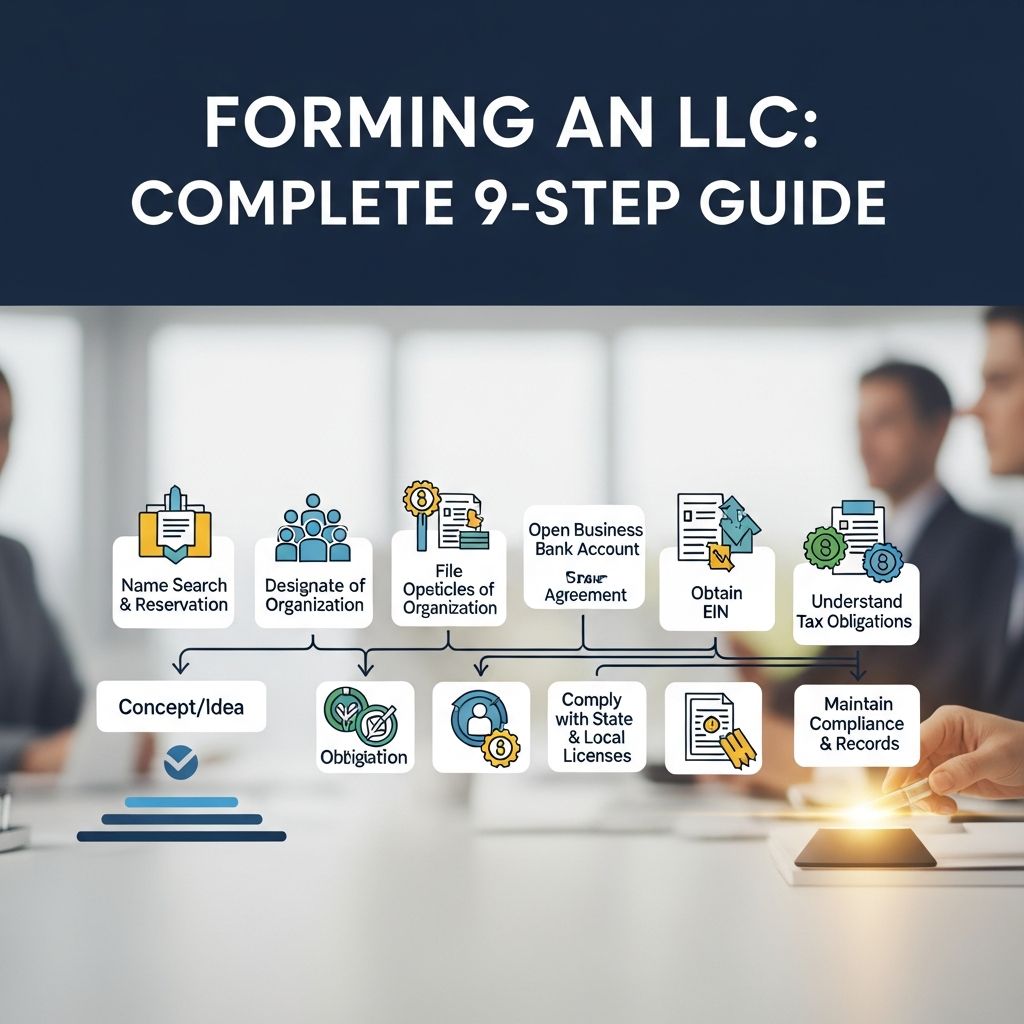
A Limited Liability Company (LLC) offers entrepreneurs a flexible structure that combines personal asset protection with simplified taxation and management. Unlike corporations, LLCs provide liability shielding without the rigid formalities of board meetings or extensive record-keeping. This guide outlines nine critical steps to legally establish your LLC, drawing from established practices across U.S. states to help you navigate the process efficiently.
Understanding LLC Fundamentals
Before diving into formation, grasp what makes an LLC advantageous. It limits owners’ (members’) personal liability for business debts and lawsuits, protecting homes and savings. Taxation passes through to members’ personal returns, avoiding double taxation common in C-corporations. Flexibility in management—member-managed or manager-managed—suits solo ventures or partnerships alike. According to the U.S. Small Business Administration, millions of LLCs operate nationwide, underscoring their popularity for small businesses.
Step 1: Select a Distinctive Business Name
Choosing the right name is foundational. It must be unique within your state to prevent confusion with existing entities. Most states require including ‘LLC,’ ‘Limited Liability Company,’ or abbreviations like ‘L.L.C.’ Avoid restricted terms like ‘bank,’ ‘insurance,’ or ‘corporation’ unless properly licensed.
- Search your state’s business entity database (often via Secretary of State website) for availability.
- Check domain registrars for .com availability to align with online branding.
- Reserve the name if allowed, typically for 30-120 days, for a small fee.
State-specific rules vary; for instance, some prohibit certain symbols or require specific wording. Use tools like those recommended by Stripe for instant checks during planning.
Step 2: Choose Your Formation State Strategically
You can form an LLC in any U.S. state, but your home state is usually most practical due to familiarity with local laws and lower ongoing fees. Delaware or Wyoming attract out-of-state filers for business-friendly courts and privacy. Consider factors like annual fees, taxes, and publication requirements. The SBA provides state-by-state resources to compare.
| State | Filing Fee Range | Annual Report Fee | Key Advantage |
|---|---|---|---|
| Delaware | $90-$300 | $300 Franchise Tax | Investor-friendly courts |
| California | $70 | $800 min tax | Large market access |
| Wyoming | $100 | $60 | Privacy protections |
| Texas | $300 | No annual fee | No state income tax |
This table summarizes costs; always verify current fees on official state sites.
Step 3: Appoint a Reliable Registered Agent
A registered agent is mandatory—a person or service receiving legal documents, tax notices, and service of process on your LLC’s behalf. They must have a physical street address in the formation state (no P.O. boxes) and be available during business hours.
- Options: Yourself, a member, employee, attorney, or professional service.
- Professionals like Northwest or LegalZoom handle this for $100-300/year, ensuring compliance.
- Change agents via state amendment if needed later.
Failing to maintain a valid agent risks default judgments or dissolution.
Step 4: Prepare and File Articles of Organization
This core document officially creates your LLC. Known variably as Certificate of Formation or Organization, it includes LLC name, address, agent details, management structure, and member info (if required).
- Download the form from your state’s Secretary of State site.
- Complete and submit online, mail, or in-person with fees ($50-$800).
- Processing times: 1-4 weeks; expedited options available.
Upon approval, receive a stamped certificate proving existence. Stripe notes the SBA’s state links simplify this. Track status online post-submission.
Step 5: Draft a Comprehensive Operating Agreement
Though not always legally required, this internal blueprint is vital for multi-member LLCs. It details ownership percentages, profit/loss allocation, voting rights, management duties, dissolution procedures, and buy-sell terms.
- Single-member LLCs benefit too, clarifying operations for banks or courts.
- Use free templates but customize; include dispute resolution and succession plans.
- Sign and store securely; not filed with the state.
Without it, default state laws apply, potentially causing conflicts.
Step 6: Secure an Employer Identification Number (EIN)
An EIN, or Federal Tax ID, is essential for banking, hiring, and taxes—even for single-member LLCs without employees. Apply free via IRS website (irs.gov) instantly online, or by mail/fax with Form SS-4.
- Required for multi-member LLCs, partnerships electing corporate tax status.
- Protects your SSN; list on W-9s, contracts.
Alabama guides emphasize its post-formation necessity.
Step 7: Obtain Essential Licenses and Permits
LLC formation doesn’t grant operation rights. Check federal (e.g., FCC for broadcasting), state, and local requirements via SBA’s permit finder.
- General business license, zoning permits, professional licenses (e.g., for healthcare).
- Fees $50-$500; apply online where possible.
- Sales tax permit if selling goods.
Non-compliance invites fines; research industry-specific rules.
Step 8: Establish Business Banking and Accounting
Open a dedicated business bank account using your EIN, articles, and ID. This separates personal and business finances, reinforcing liability protection.
- Choose banks offering low fees, integrations (e.g., QuickBooks).
- Set up accounting software early for tax prep.
- Consider merchant services for payments.
Track expenses meticulously for deductions.
Step 9: Ensure Ongoing Compliance
Post-formation, file annual reports (or equivalents) with fees to stay active. Publish notices in some states (e.g., New York). Register for state taxes, labor departments if hiring. Renew licenses timely.
Monitor deadlines via state portals; services automate reminders.
Common Pitfalls and Pro Tips
Avoid delays by double-checking name availability first. Budget $200-1000 initially, plus annual costs. For complexity, consult attorneys or formation services. Foreign qualification needed if operating outside formation state.
- Pro Tip: Form in Delaware for startups seeking VC funding due to established precedents.
- Pitfall: Forgetting publication can dissolve your LLC.
Frequently Asked Questions
Can a single person form an LLC?
Yes, single-member LLCs are standard and offer full liability protection. Draft an operating agreement anyway for banking.
How much does starting an LLC cost?
Expect $50-800 filing, plus agent fees ($0-300), licenses ($50+), totaling $100-2000 depending on state and services.
Do I need a lawyer to form an LLC?
Not required; DIY via state sites works for simple cases. Hire for complex ownership or industries.
How long does LLC approval take?
Days to weeks; expedited filing shortens to 1-2 days in many states.
What’s the difference between LLC and corporation?
LLCs offer pass-through taxation and flexibility; corporations face double taxation but suit raising capital better.
This 9-step process equips you to launch resiliently. Tailor to your state and venture for optimal results.
References
- How to form an LLC: A step-by-step guide for businesses — Stripe. 2024. https://stripe.com/resources/more/how-to-form-an-llc
- Create an LLC Online | Complete 2025 LLC Formation Guide — Tailor Brands. 2025. https://www.tailorbrands.com/llc-formation
- How to Form an LLC in Alabama: Step-by-Step Guide — eForms (YouTube). 2023. https://www.youtube.com/watch?v=cK3vwrtqLkQ
- How to Start an LLC in Alabama Step by Step Guide — YouTube. 2024. https://www.youtube.com/watch?v=xiBciMCh8Ro
- How to Start an LLC: Complete Guide — Wolters Kluwer. 2024. https://www.wolterskluwer.com/en/expert-insights/how-to-form-an-llc-what-is-an-llc-advantages-disadvantages-and-more
Similar Articles








Read full bio of Sneha Tete


