
Guide to Form N-600: Securing Your U.S. Citizenship Certificate
Master the Form N-600 process: eligibility rules, document requirements, step-by-step filing, and tips for approval.
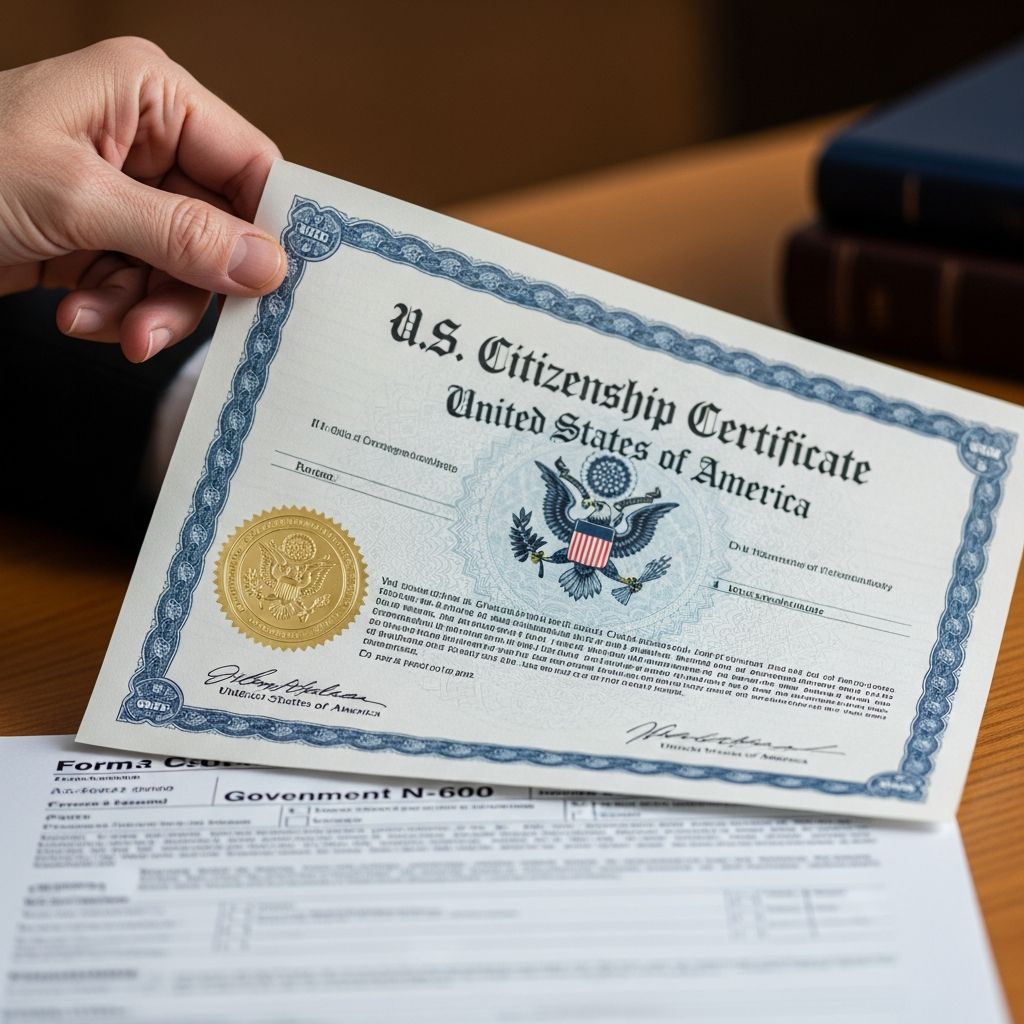
Obtaining official proof of U.S. citizenship is essential for many legal purposes, such as passport applications or employment verification. Form N-600, the Application for Certificate of Citizenship, serves this need for individuals who acquired or derived citizenship but lack a birth certificate issued in the U.S. This document provides formal evidence from U.S. Citizenship and Immigration Services (USCIS).
Understanding U.S. Citizenship Acquisition Pathways
U.S. citizenship can be acquired at birth or derived later through a parent’s naturalization. Those born outside the U.S. to at least one U.S. citizen parent may qualify under specific residency rules. For instance, a child born abroad to a U.S. citizen father must prove the father’s physical presence in the U.S. for at least five years, with two after age 14.
Derived citizenship applies when a child enters the U.S. as a lawful permanent resident (LPR) and resides in the legal and physical custody of a U.S. citizen parent before turning 18. Key requirements include: the parent being a U.S. citizen, biological relationship, LPR admission, and U.S. residence in custody.
Acquired vs. Derived Citizenship: Key Differences
| Aspect | Acquired at Birth | Derived After Birth |
|---|---|---|
| Timing | At birth abroad to citizen parent(s) | After LPR entry, before age 18 via parent’s naturalization |
| Residency Proof | Parent’s U.S. physical presence | Child’s residence with citizen parent |
| Custody | Not required | Legal and physical custody mandatory |
| Age Limit | No age limit for filing | Must occur before 18 |
This table highlights distinctions that dictate evidence needs.
Who Is Eligible to File Form N-600?
Eligibility hinges on citizenship transmission laws in effect at birth or naturalization. You can file if citizenship was gained at birth abroad or derived before 18. Special rules apply for children born out of wedlock: legitimation under residence laws, father’s written paternity oath, or court establishment is required, often by age 21 for certain eras.
- Born to two U.S. citizen parents with required U.S. residence.
- Born to one citizen parent meeting physical presence criteria.
- Adopted children under intercountry adoption rules, with fee exemptions.
- Derivatives via parent’s naturalization while under 18 and in custody.
Adoptees from abroad get fee waivers and need full adoption decrees plus two-year custody proof via school records.
Essential Documents for a Strong Application
Supporting evidence proves eligibility. Always submit originals where possible or certified copies. Common items include:
- Birth certificate: Showing parents’ names and proving relationship.
- Parent’s citizenship proof: Birth certificate, naturalization certificate, or passport.
- Marriage/divorce records: For custody chains if parents separated.
- Physical presence/residence evidence: School records, leases, tax returns sharing addresses.
- Adoption decree: Full and final for adoptees.
- Legitimation proof: For out-of-wedlock births.
For multi-generational claims, trace citizenship up the line with grandparents’ documents. Secondary evidence like baptismal certificates (showing birth details and parentage) suffices if primaries unavailable.
Document Checklist by Scenario
| Scenario | Required Documents |
|---|---|
| Born Abroad to Citizen Parent | Child’s birth cert, parent’s citizenship proof, parent’s U.S. residence evidence (e.g., pay stubs, mortgages) |
| Derived via Naturalization | LPR proof (green card), parent’s naturalization cert, joint residence docs (school/medical records) |
| Adopted Intercountry | Adoption decree, birth record, 2-year custody proof (transcripts), U.S. passport copy if held |
| Out-of-Wedlock | Legitimation docs, father’s affidavit, relationship evidence |
Prepare photos formerly, but USCIS now captures them at biometrics.
Step-by-Step Guide to Completing Form N-600
Form N-600 is available online via MyUSCIS or paper. Start with applicant details: name, birth info, addresses.
- Part 1: Applicant Info. Full name, A-number if applicable, birth date/place.
- Part 2: Citizenship Basis. Select acquired/derived, specify parents.
- Parent Sections: U.S. citizen parent’s details, citizenship proof; other parent’s info.
- Residence/Custody: List U.S. addresses, custody proof.
- Signature: Applicant or parent signs (under 14).
Online filing via MyUSCIS is fastest, allowing status tracking. Fee: $0 for adult intercountry adoptees since April 2024; otherwise, check USCIS site.
Filing Methods and Processing Timeline
Submit online or mail to USCIS lockbox. Post-filing: biometrics appointment (photo, signature; ~1 month). Processing varies; approvals lead to oath scheduling at a field office, where the certificate is issued.
- Track via MyUSCIS account.
- Expect 6-12 months total, faster online.
- Oath ceremony: Recite allegiance, receive certificate same day.
Common Mistakes and How to Avoid Them
Avoid denials by double-checking:
- Incomplete evidence chains, especially multi-gen.
- Missing custody proof for derivatives.
- Incorrect form sections (e.g., parent details).
- Not translating foreign docs.
- Forgetting secondary evidence notes if primaries lack.
If denied, appeal or refile with more evidence. Consult immigration experts for complex cases.
Special Considerations for Adoptees and Unique Cases
Intercountry adoptees: No fee, need adoption decree (foreign/U.S.), birth record, custody proof. Out-of-wedlock: Strict legitimation rules by birth era. Derivatives need unmarried status proof if required by law.
Frequently Asked Questions (FAQs)
Do I need Form N-600 if I have a U.S. passport?
No, a valid passport proves citizenship, but N-600 provides a dedicated certificate.
Is there a filing fee?
Fee-exempt for adult intercountry adoptees; others pay standard USCIS fee.
What if I’m over 18?
You can still file for acquired citizenship anytime; derivatives must precede 18.
Can a parent file for me?
Yes, if under 18.
How long does processing take?
Biometrics ~1 month, total 6-12 months; varies by case.
Why Pursue a Certificate of Citizenship?
Beyond passports, it’s vital for jobs, benefits, or transmitting citizenship to children. Ensures irrefutable proof amid complex family histories.
This guide equips you for success. Always verify latest USCIS instructions, as rules evolve.
References
- FAQ – N-600, Application for Certificate of Citizenship — Anwari Law. 2024. https://anwarilaw.com/immigration-services/united-states-citizenship/faq-n-600-application-certificate-citizenship/
- Applying for a Certificate of Citizenship (Form N-600) — Adoptees United. 2024-04-01. https://adopteesunited.org/citizenship/n-600-certificate-citizenship/
- Form N-600 Guide — CitizenPath. 2025. https://citizenpath.com/form-n-600-guide/
- Documents to File With an N-600 Application for U.S. Citizenship — AllLaw. 2025. https://www.alllaw.com/articles/nolo/us-immigration/documents-file-n-600-application-citizenship.html
- Instructions for Form N-600, Application for Certificate of Citizenship — USCIS (reginfo.gov). 2023. https://www.reginfo.gov/public/do/DownloadDocument?objectID=52280201
- Form N-600, Explained — Boundless. 2025. https://www.boundless.com/immigration-resources/form-n-600-explained
- N-600 ONLINE GUIDE — YouTube (video). 2024. https://www.youtube.com/watch?v=M_TPVbnH6cs
Similar Articles








Read full bio of medha deb


