
Florida Workplace Smoking & Vaping: Legal Requirements
Understanding Florida's comprehensive workplace smoking and vaping restrictions for employers and employees.
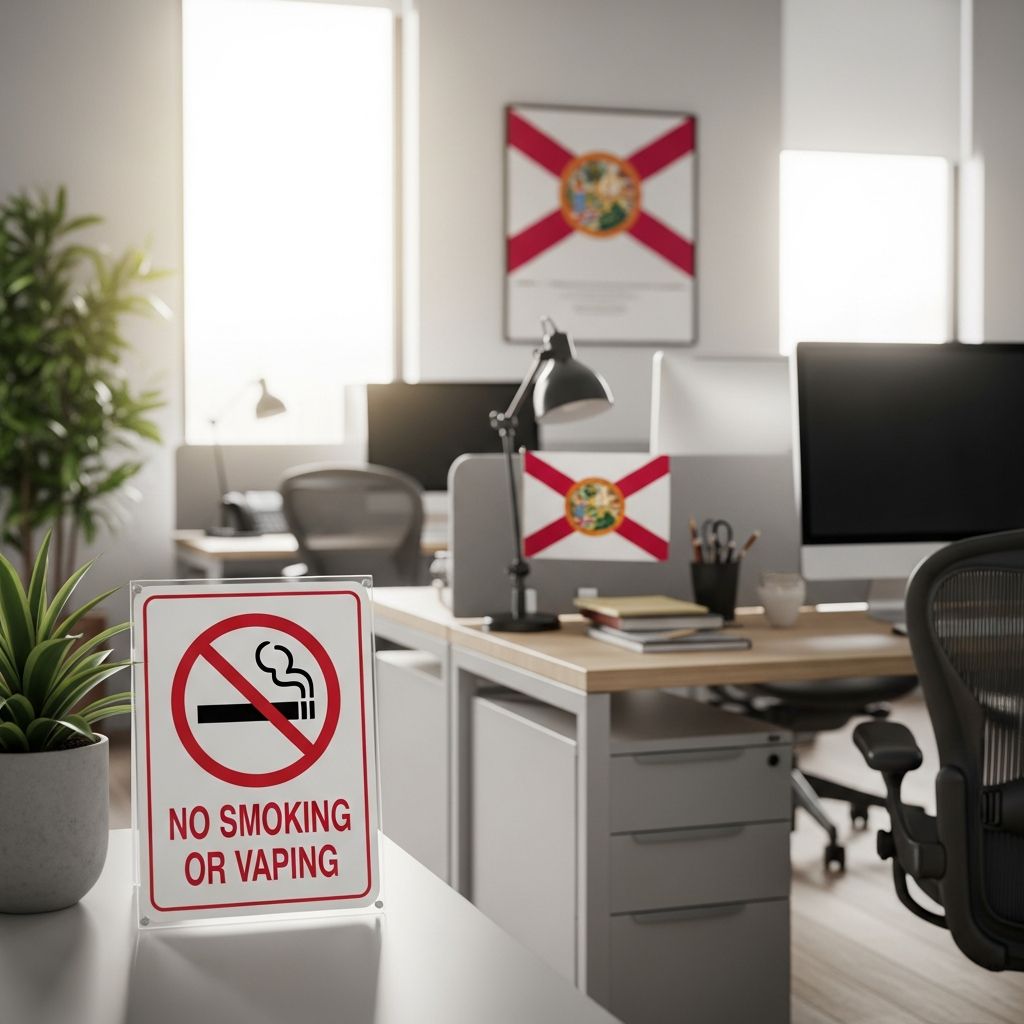
Understanding Florida’s Workplace Smoking and Vaping Regulations
Florida has established comprehensive legal protections against secondhand smoke and vapor in workplace environments. The state’s approach to regulating smoking and vaping in professional settings reflects a growing national trend toward protecting employee health and maintaining clean indoor air quality. Employers operating in Florida must understand these regulations to ensure compliance and avoid potential penalties.
The foundation of Florida’s smoking restrictions dates back to 1985, when the Florida Legislature enacted the Florida Clean Air Act to protect individuals from the health hazards associated with secondhand tobacco smoke. This legislation has been expanded and refined multiple times, most significantly in 2003 when Florida voters approved a constitutional amendment prohibiting smoking in enclosed indoor workplaces, which took effect on July 1, 2003.
The Scope of Florida’s Indoor Workplace Prohibition
Florida law prohibits both smoking and vaping in enclosed indoor workplaces. The term “enclosed indoor workplace” refers to any indoor space that is predominantly closed off by walls or other physical barriers, regardless of whether windows or other openings are present. This definition applies broadly to most commercial and professional environments where employees conduct business.
An enclosed indoor workplace encompasses:
- Office buildings and administrative spaces
- Retail establishments and shopping centers
- Restaurants and food service establishments
- Hospitals and healthcare facilities
- Transportation facilities and terminals
- Schools and educational institutions
- Government buildings and civic centers
- Common areas within apartment and lodging establishments
The prohibition applies to all tobacco products, including cigarettes, cigars, and pipe tobacco, as well as electronic vapor products such as e-cigarettes and vaping devices.
Critical Exemptions and Special Circumstances
Florida law does provide limited exemptions from the general smoking prohibition. Private residences used for work purposes are typically exempt from the ban, provided they are not operating as a commercial establishment. However, this exemption becomes narrower when a private residence functions as:
- A place where employees regularly conduct work
- A client-facing professional office
- A commercial service location
Additionally, certain specialized venues maintain specific exemptions from the comprehensive smoking ban. Standalone bars that do not serve food may permit smoking, and designated smoking rooms within specific establishments may be allowed under certain conditions. Retail tobacco shops continue to operate with exemptions for their primary business purposes.
Enforcement Mechanisms and Regulatory Authority
Two state agencies share responsibility for enforcing Florida’s smoking and vaping restrictions. The Florida Department of Health and the Department of Business and Professional Regulation (DBPR) work together to ensure compliance across different business sectors.
The DBPR specifically oversees enforcement in regulated industries including:
- Restaurants and dining establishments
- Bar and beverage venues
- Billiards facilities
- Bowling centers
- Bingo halls that serve food
- Civic and fraternal organizations
- Dog and horse racing tracks
When violations are identified, enforcement agencies may issue citations, fines, or other corrective actions. The severity of enforcement depends on the nature and frequency of violations, as well as whether the business owner demonstrates good faith efforts toward compliance.
Employer Policy Development and Implementation
Florida employers must establish clear, comprehensive workplace policies addressing smoking and vaping prohibitions. These policies serve as the primary mechanism through which employers communicate their legal obligations and workplace expectations to employees.
A compliant workplace smoking and vaping policy should include:
- A clear statement that smoking and vaping are prohibited in all enclosed indoor workspaces
- Specific reference to applicable Florida laws and regulations
- Definitions of what constitutes smoking and vaping for policy purposes
- Identification of all indoor areas where the prohibition applies
- Clarification regarding outdoor smoking areas, if the employer permits designated outdoor spaces
- Rules about possession of smoking or vaping devices within the workplace
- Procedures for addressing and documenting violations
- Disciplinary measures for employees who violate the policy
Signage and Workplace Communication Requirements
Effective workplace policies extend beyond written documentation. Employers must actively communicate smoking prohibitions through visible signage and employee notifications. Posted signs should clearly indicate that smoking and vaping are prohibited in the enclosed indoor workplace.
Best practices for workplace communication include:
- Installing prominent “No Smoking” and “No Vaping” signs at all building entrances and within common work areas
- Providing written notification to existing employees at least 60 to 90 days before implementing or modifying policies
- Including smoking and vaping prohibitions in employee handbooks and orientation materials
- Distributing copies of the updated policy to all staff members
- Scheduling informational meetings to discuss policy changes and answer employee questions
Handling Violations and Corrective Action Procedures
When employers or supervisors become aware of smoking or vaping violations, the response should be swift and consistent. Documented procedures for addressing violations help establish fairness and demonstrate good faith compliance efforts to regulatory agencies.
Recommended procedures for violation management:
- Assign a responsible party to receive and document violation complaints or observations
- Develop a system for recording the date, time, location, and nature of alleged violations
- Establish a process for interviewing the involved employee and obtaining their account
- Apply disciplinary responses consistently across all employees
- Maintain confidential records of violations and corrective actions taken
- Provide opportunities for employees to explain or contest allegations before discipline is applied
- Consider progressive discipline approaches when appropriate
Distinguishing Between Tobacco and Other Products
Florida’s current Clean Air Act regulations specifically address tobacco and nicotine products. It is important to note that marijuana smoke and vapor are subject to different legal frameworks. The Clean Air Act’s enforcement mechanism focuses exclusively on tobacco and nicotine vapor products, and does not regulate secondhand marijuana smoke or vapor in workplace settings.
Employers should be aware that state legislation regarding marijuana smoking in public places continues to evolve. Pending and recently proposed bills may expand restrictions on marijuana smoking and vaping, particularly in public and semi-public spaces. Employers should monitor legislative developments to ensure their policies remain current with any future changes to state law.
Updating Existing Clean Air Policies
Many established employers already maintain clean air policies adopted in response to earlier smoking restrictions. When Florida’s vaping prohibition took effect in 2019, employers needed to update these existing policies to account for electronic vapor products.
When reviewing and updating clean air policies, employers should:
- Expand definitions of “smoking” to explicitly include vaping and use of e-cigarettes
- Specify that electronic vapor products are covered by the same prohibitions as traditional tobacco products
- Clarify that the ban applies to all vapor-generating devices, not just nicotine products
- Remove any outdated language that may exclude e-cigarettes or vaping from restrictions
- Ensure policy language aligns with current statutory definitions and requirements
- Review enforcement procedures to ensure they adequately address vaping violations
Outdoor Smoking Areas and Designated Spaces
While Florida law prohibits smoking and vaping in enclosed indoor workplaces, the statute does not restrict outdoor smoking or vaping. Employers may choose to designate specific outdoor areas where employees may smoke or vape during breaks. When employers provide designated smoking areas, these spaces must be physically separated from indoor work environments and positioned to prevent smoke or vapor from entering enclosed spaces.
Employers considering outdoor smoking areas should address:
- The specific location and dimensions of any designated outdoor smoking area
- Distance requirements from building entrances and air intake systems
- Whether smoking is permitted at all times or only during designated break periods
- Maintenance and cleaning responsibilities for outdoor smoking areas
- Whether the employer will provide seating or shelter in outdoor smoking areas
- Rules regarding smoking while on the job at non-smoking outdoor locations
Special Considerations for Multi-Tenant Buildings
Employers leasing space in multi-tenant office buildings or shopping centers should clarify their rights and responsibilities regarding smoking regulations. In shared building environments, responsibility for enforcement may be distributed between the building management and individual tenants. Employers should:
- Consult their lease agreements regarding smoking policies and enforcement responsibilities
- Communicate with building management about their workplace smoking policies
- Understand whether building-wide policies exist that may exceed statutory minimums
- Coordinate with other tenants on consistent enforcement approaches in shared common areas
Industry-Specific Compliance Considerations
Certain industries face additional regulatory scrutiny or unique compliance challenges. Hospitality businesses, healthcare facilities, and government offices may encounter specific enforcement priorities or additional requirements beyond the general statutory framework.
| Industry Type | Key Considerations |
|---|---|
| Restaurants and Food Service | Subject to active DBPR enforcement; smoking prohibition includes server and kitchen areas |
| Healthcare Facilities | Stricter enforcement expectations; may have additional federal requirements under HIPAA or state health regulations |
| Government Buildings | May be subject to additional state or local restrictions beyond minimum statutory requirements |
| Transportation Facilities | May have federal aviation or transit regulations that supplement state law |
| Retail Establishments | Subject to DBPR enforcement; includes back-of-house areas and stockrooms |
Employee Rights and Protections
Florida employees have the right to work in environments free from secondhand tobacco smoke and vapor. These protections are grounded in both statutory law and the state constitutional amendment passed by voters. Employees who face violations of these protections may file complaints with enforcement agencies.
The right to a smoke-free workplace does not require employees to become enforcement officers themselves. However, employees who observe violations may report them to employer management or, if necessary, to relevant state enforcement agencies.
Frequently Asked Questions
Q: Does Florida law restrict vaping in outdoor workplace areas?
A: No. Florida’s vaping prohibition applies only to enclosed indoor workplaces. Outdoor areas are not regulated under the Clean Air Act, though employers may establish their own outdoor smoking and vaping policies.
Q: Can an employer prohibit smoking and vaping in areas where state law does not require it?
A: Yes. Florida law establishes minimum standards for smoking restrictions, but employers may adopt stricter policies. Many employers prohibit smoking and vaping entirely on their premises, including outdoor areas.
Q: What penalties can employers face for failing to enforce Florida’s smoking law?
A: Enforcement agencies may issue citations and fines to businesses that violate or fail to enforce smoking prohibitions. The specific penalties depend on the severity of the violation and the enforcement agency involved.
Q: Are private offices within an enclosed building exempt from the smoking ban?
A: No. Even private offices within enclosed indoor buildings are subject to the smoking and vaping prohibition. The ban applies to all enclosed indoor workplaces, regardless of whether they are shared or private spaces.
Q: How should employers communicate policy changes to existing employees?
A: Employers should provide written notice at least 60 to 90 days before implementing new smoking and vaping policies. This allows employees adequate time to understand the requirements and adjust their behavior.
Q: Can employers discipline employees who violate smoking policies?
A: Yes. Employers may establish disciplinary procedures for policy violations, ranging from warnings to termination. Discipline should be applied consistently and documented appropriately.
Q: Does the smoking ban apply to e-cigarettes with zero nicotine?
A: Florida law defines vaping broadly to include all electronic vapor products that generate an aerosol. The nicotine content is not relevant to whether the prohibition applies.
References
- Florida Clean Air Act — Florida Department of Health. 2024. https://www.floridahealth.gov/individual-family-health/injury-prevention-wellness/tobacco-free-florida/florida-clean-air-act/
- Senate Bill 986 (2026) – Smoking in Public Places — Florida Senate. 2026. https://www.flsenate.gov/Session/Bill/2026/986/BillText/Filed/HTML
- Florida Bans Workplace Vaping: What Businesses Need to Know — Group Management Solutions. 2024. https://www.groupmgmt.com/blog/florida-bans-vaping-in-the-workplace-what-it-means-for-business-owners/
- Florida Clean Air Act: Enforcement and Compliance — Tobacco Free Florida. 2024. https://tobaccofreeflorida.com/current-issues/clean-air-act/
- Florida Statutes Section 386.206 – Smoking Policies in Enclosed Indoor Workplaces — The 2025 Florida Statutes. https://www.leg.state.fl.us/statutes/index.cfm?App_mode=Display_Statute&Search_String=&URL=0300-0399%2F0386%2FSections%2F0386.206.html
Similar Articles








Read full bio of Sneha Tete




