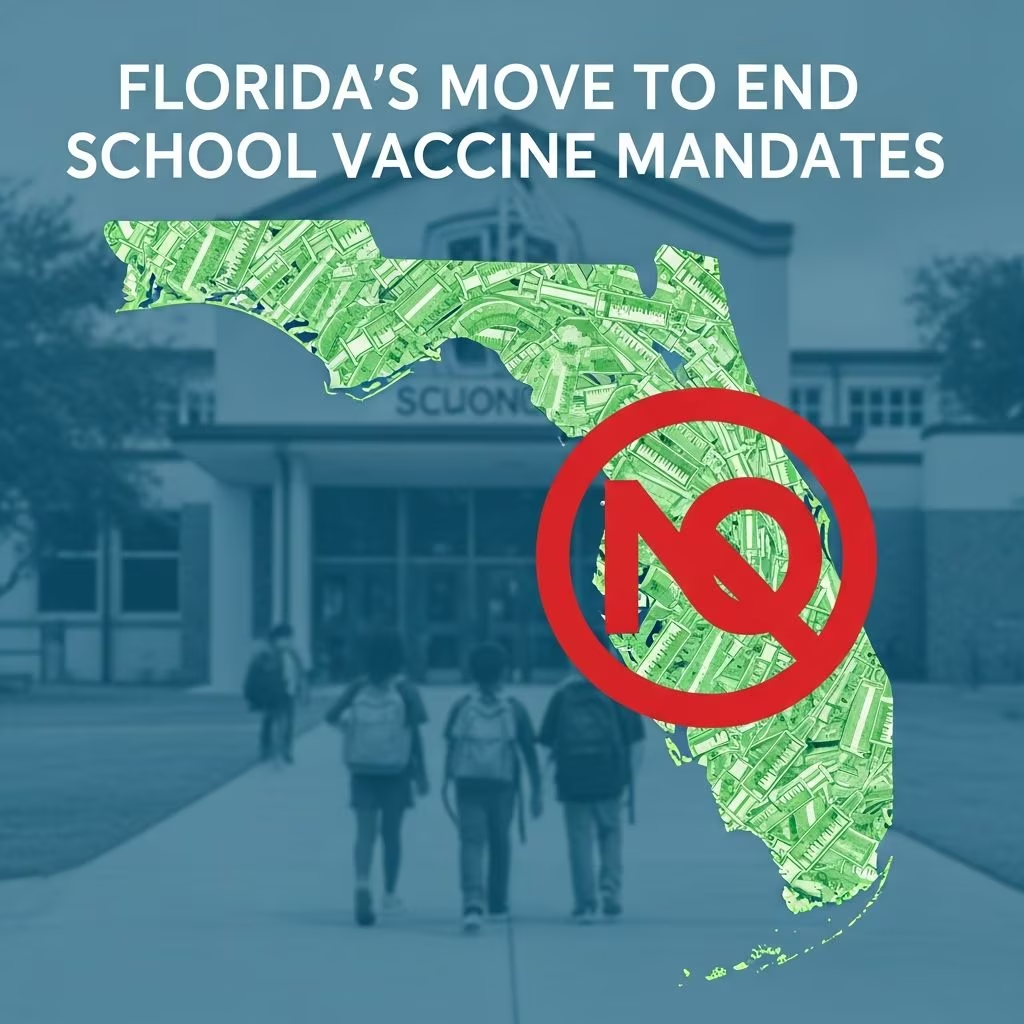
Florida officials have announced an aggressive plan to roll back, and potentially eliminate, state requirements that children receive certain vaccinations before attending school or child care. This development places Florida at the center of a national debate over how far states may, and should, go in scaling back long-standing public health protections that have sharply reduced once-devastating childhood diseases.
Background: How School Vaccine Mandates Work
For decades, all U.S. states have required children entering school to receive a core set of immunizations against highly contagious diseases such as measles, mumps, rubella, polio, and whooping cough. These laws are typically enforced at school entry and are tied to proof of immunization or acceptable exemptions.
In Florida, the legal framework for school-entry immunizations is grounded in state statutes and health regulations that authorize the Department of Health to specify which vaccines are required and how schools must verify compliance. Historically, these mandates have been a cornerstone of disease control, contributing to dramatic reductions in vaccine-preventable illnesses across the country.
What Is Changing in Florida?
Florida’s health officials have begun rolling back several required vaccines and announced an intent to remove all remaining school immunization mandates, a step that would make Florida the first state to fully abandon school vaccine requirements.
According to public reporting:
- The Florida Department of Health has moved to end requirements for certain vaccines, including those for hepatitis B, varicella (chickenpox), and vaccines targeting bacteria that cause meningitis and pneumonia.
- Eliminating mandates for long-standing core vaccines—such as measles, mumps, rubella, polio, diphtheria, pertussis, and tetanus—would require legislative action because they are tied to a 1977 law governing school-entry immunization.
If fully enacted, Florida’s plan would go beyond expanding exemptions and would instead remove the legal expectation that children be vaccinated for school attendance at all.
Florida’s Current Legal Framework on Immunizations
Florida’s existing laws outline both the state’s authority and the obligations of schools and families regarding immunizations.
| Legal Source | Key Function |
|---|---|
| Florida Statutes, Title XLVIII, Chapter 1003.22 | Authorizes school-entry health exams and immunization requirements for public K–12 students and sets out exemption rules. |
| Florida Statutes, Chapter 1002.23 & 1002.42 | Addresses student and parental rights in education, including immunization and record obligations for public and private schools. |
| Florida Administrative Code 64D-3.046 | Details immunization rules for public and nonpublic schools, preschool, K–12, and adult education programs. |
Any plan to remove all school vaccine mandates will require either substantial amendments to these statutes or a shift in how the Department of Health uses its regulatory authority under them.
Public Health Stakes: What Happens When Mandates Disappear?
Vaccine mandates are one of the most studied tools in public health. Research and experience show that requiring immunization for school attendance is associated with higher vaccination coverage and fewer outbreaks of preventable diseases.
Public health experts and organizations warn that removing mandates could lead to:
- Falling vaccination rates among children, especially in communities with existing mistrust of vaccines or barriers to health care access.
- Resurgence of vaccine-preventable diseases such as measles, whooping cough, and polio, which can cause severe illness, disability, or death.
- Greater risks for vulnerable groups, including infants too young to be fully immunized, cancer patients, and older adults with weakened immune systems.
The American Medical Association has taken the unusual step of publicly and strongly condemning Florida’s plan, warning that ending all vaccine mandates would undermine decades of progress and raise the likelihood of serious disease outbreaks.
Herd Immunity and Community Risk
Many vaccine-preventable diseases spread quickly once introduced into a community, particularly in school settings where children are in close contact. To limit outbreaks, public health officials rely on a concept known as herd immunity—a level of community-wide immunity high enough to interrupt sustained transmission.
For extremely contagious diseases like measles, experts generally estimate that around 95% of people in a community must be immune to prevent large outbreaks. When vaccination coverage drops below that threshold, the risk of widespread transmission rises sharply, especially if unimmunized individuals are clustered in certain schools or neighborhoods.
Parents’ Rights vs. Public Health Duties
Florida’s policy shift is framed by its proponents as a restoration of parental choice and individual liberty. Opponents emphasize the state’s traditional responsibility to protect children and communities from preventable harms. These competing values have long shaped U.S. vaccine law.
Historically:
- Courts, including the U.S. Supreme Court, have upheld states’ power to require vaccination, recognizing disease prevention as a legitimate public health goal.
- States have balanced this authority by allowing certain medical, religious, or personal-belief exemptions, although the scope of those exemptions varies widely from state to state.
What makes Florida’s new direction distinctive is not the expansion of exemptions, but the effort to eliminate the baseline mandate itself, effectively leaving vaccination decisions entirely to parents regardless of the collective implications.
Political Context and National Ripple Effects
Florida’s move comes after years of intense political conflict over COVID-19 vaccines and public health measures. Several states have already loosened school vaccine laws by broadening nonmedical exemptions or restricting the ability of schools to require certain vaccines, though none has yet fully removed school immunization mandates.
Policy analysts note:
- Florida is the first state to take sweeping executive action aimed at removing multiple school vaccine requirements.
- Other states, particularly those with similar political alignments, are watching to see whether Florida’s actions gain public support, face legal challenges, or trigger outbreaks that might change public opinion.
- Even if other states do not fully abolish mandates, Florida’s example may encourage further efforts to broaden exemptions or limit school authority to enforce health requirements.
Practical Consequences for Florida Families and Schools
Any large-scale change in vaccine mandates will be felt first and most directly by families, schools, and pediatric health providers.
For Parents and Guardians
Without mandates tied to school attendance, parents may face a more complex decision-making environment:
- Less automatic scheduling: Many families complete vaccines to meet school deadlines; those prompts may disappear, especially for low-income families juggling multiple demands.
- Greater information burden: Parents will have to rely more on their own research and conversations with health care providers to make immunization decisions.
- Possible cost or access barriers: While federal and state programs help cover vaccines for eligible children, policies that shift more costs or logistics to parents could result in fewer vaccinations.
For Schools and Child Care Providers
Institutions that educate and care for children will need to adjust their policies and planning:
- Reduced role in enforcing health rules, as schools may no longer be required to verify immunization status in the same way.
- Higher risk of outbreaks that could force classroom closures, quarantines, or temporary shifts to remote instruction.
- Liability and policy questions about what individual schools or private programs may do to protect students and staff if statewide mandates are withdrawn.
Could Private Entities Maintain Their Own Requirements?
Even if state-level mandates are lifted, some private or local entities may retain or adopt their own immunization requirements, subject to applicable state and federal law. For example, private schools or child care centers sometimes impose stricter health rules than the state minimums, though their ability to do so may depend on how new Florida laws are drafted.
Key considerations include:
- Whether any new statute explicitly prohibits schools or employers from setting vaccine requirements.
- How such restrictions would interact with existing civil rights and workplace safety laws.
- Whether parents and employees could challenge private requirements on religious or other grounds.
How Florida Compares to Other States
While Florida’s proposal is unique in its scope, it is part of a broader national pattern of legislative activity on vaccines. Since 2021, thousands of vaccine-related bills have been introduced across states, with nearly half focusing on vaccine requirements and exemptions.
| Policy Direction | Common Approaches in States | Florida’s Direction |
|---|---|---|
| Maintain or tighten mandates | Some states restrict nonmedical exemptions or add new vaccines to school lists. | Moving away from mandates entirely. |
| Expand exemptions | Many states broaden religious or personal-belief exemptions. | Goes further by seeking to end mandates rather than merely exempt more students. |
| Target COVID-19 alone | Several states bar schools from requiring COVID-19 vaccination. | Addresses long-standing childhood vaccines as well as newer ones. |
What Families Can Do Now
Because Florida’s legal framework is still evolving, parents and guardians should monitor official updates from state and local health authorities. Regardless of legal mandates, experts consistently advise families to make immunization decisions based on reliable medical guidance and established evidence.
Helpful steps include:
- Consulting a pediatrician or family physician to discuss the benefits and risks of each recommended vaccine, especially in light of local disease patterns.
- Reviewing official immunization schedules issued by national expert bodies, such as the Advisory Committee on Immunization Practices (ACIP) and the American Academy of Pediatrics, which are regularly updated as new data emerge.
- Checking school and child care policies to understand any institution-specific requirements that may remain in place even if state mandates change.
Frequently Asked Questions (FAQs)
Q1: If mandates end, will vaccines still be available in Florida?
Yes. Current proposals to end school vaccine mandates do not ban vaccines themselves. Health care providers will still be able to offer recommended childhood immunizations, and federal programs help ensure access for eligible children. However, without mandates, fewer families may complete vaccine schedules on time.
Q2: Does ending school mandates mean vaccines are unsafe?
No. Decisions to change legal requirements do not alter the scientific evidence behind vaccines. Large bodies of research and major medical organizations, including the American Medical Association, continue to affirm that recommended childhood vaccines are safe and effective in preventing serious disease.
Q3: Can my child’s school still ask for proof of immunization?
That depends on how Florida’s final laws and regulations are written. If the state removes its own mandates but does not bar schools from setting stricter policies, some institutions—particularly private schools and child care centers—may choose to maintain immunization requirements. Parents should review the specific policies of each school or program their child attends.
Q4: What diseases are most likely to return if vaccination rates fall?
Public health experts are particularly concerned about diseases that spread easily in schools and cause severe outcomes, such as measles, whooping cough, and meningitis. Measles is so contagious that even small declines in vaccination coverage can trigger significant outbreaks, especially in under-immunized communities.
Q5: Could Florida’s policy changes spread to other states?
Analysts suggest that other politically similar states are watching Florida closely. Some may be inspired to pursue similar rollbacks, while others may see the legal, political, or public health risks as too great. For now, Florida’s plan stands out as the most sweeping attempt to eliminate school vaccine requirements.
References
- DeSantis moves to end Florida’s childhood vaccination mandates, and doctors are alarmed — KFF Health News / ABC News. 2025-09-27. https://abcnews.go.com/Health/desantis-moves-end-floridas-childhood-vaccination-mandates-doctors/story
- Florida plans to stop school vaccine mandates. These states could be next. — Politico. 2025-09-19. https://www.politico.com/news/2025/09/19/rfk-vaccine-mandate-maha-florida-00572512
- A Look at Recent Changes to State Vaccine Requirements for School Children — KFF. 2025-10-02. https://www.kff.org/state-health-policy-data/a-look-at-recent-changes-to-state-vaccine-requirements-for-school-children/
- AMA statement on Florida ending all vaccine mandates — American Medical Association. 2025-09-20. https://www.ama-assn.org/press-center/ama-press-releases/ama-statement-florida-ending-all-vaccine-mandates
- Immunization Laws — Florida Department of Health. 2024-03-15. https://www.floridahealth.gov/programs-and-services/immunization/immunization-laws.html