
Fixed vs. Variable APR: How They Affect Your Borrowing
Understand how fixed and variable APRs change your borrowing costs, monthly payments, and long-term financial planning.
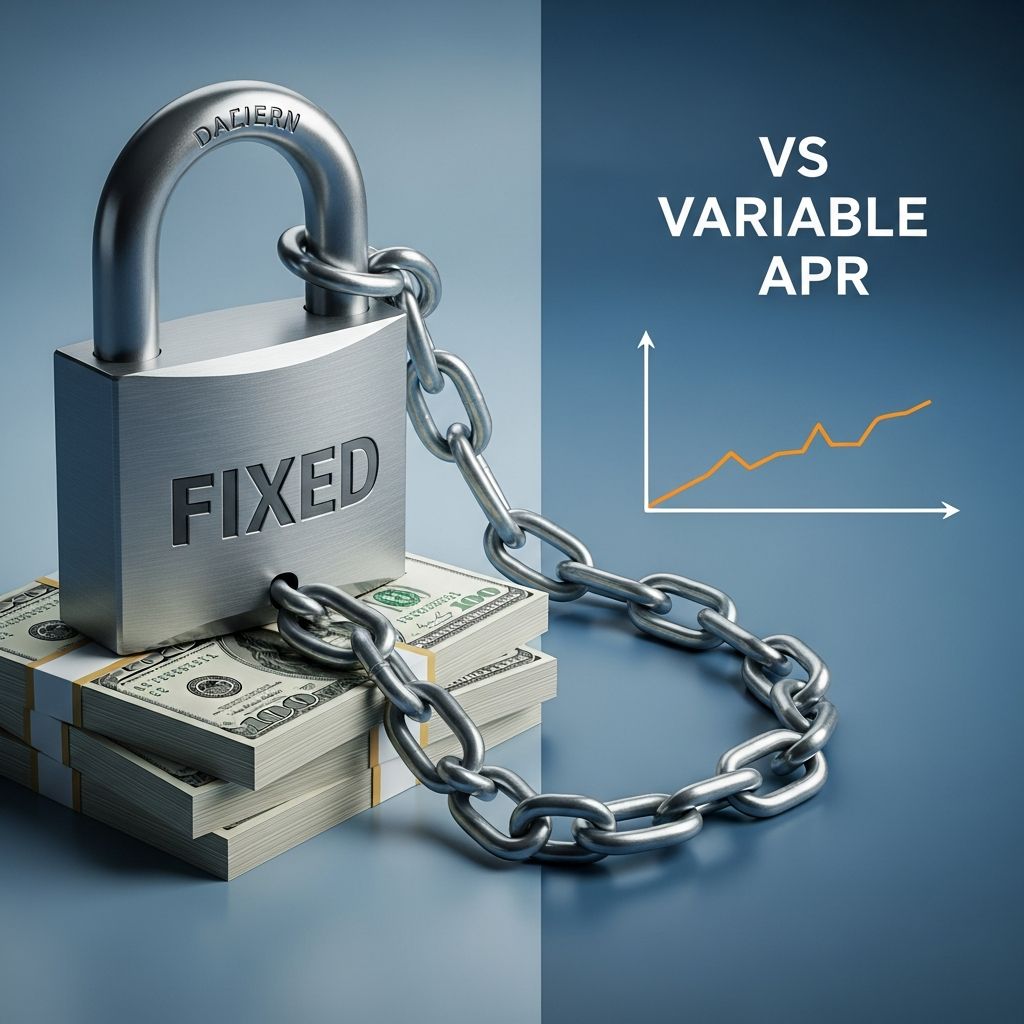
When you apply for a credit card, auto loan, student loan, or personal loan, you will see an APR, or annual percentage rate. That APR may be described as fixed or variable, and the type you have can change how much you pay over time and how predictable your payments are.
This guide explains what fixed and variable APRs mean, how they work in everyday borrowing, and what to think about when deciding which one best fits your budget and risk tolerance.
Understanding APR in Plain Language
APR (Annual Percentage Rate) is the yearly cost of borrowing, expressed as a percentage. It usually includes the interest rate and certain fees, giving you a more complete picture of what a loan or credit card really costs.
- Interest rate: The base cost of borrowing the lender charges on the amount you owe.
- Fees included in APR: Some products may include origination or certain finance charges in the APR, depending on disclosure rules and product type.
- Purpose of APR: To let you compare offers more easily, especially when fees and structures differ.
APR does not always capture every possible fee (for example, some late fees or penalty charges), so it should be used as a comparison tool, not a complete picture of all potential costs.
What Is a Fixed APR?
A fixed APR is designed to stay the same over time. Your interest rate does not normally move up and down with market benchmarks like the prime rate.
Fixed APRs are common on:
- Many auto loans
- Most traditional fixed-rate mortgages
- Many personal loans
- Some credit cards, although most cards use variable APRs
With a fixed APR loan, your payment schedule is typically predictable: the rate used to calculate your interest charges is expected to remain constant for the life of the loan, unless a change is allowed by your agreement and proper notice is given.
How a Fixed APR Works
When you sign a fixed-rate loan agreement, the lender sets your APR based on factors such as:
- Your credit history and score
- Your income and overall debts
- The loan amount and term
- Market conditions at the time of approval
Once your fixed APR is locked in, it is not expected to change because market interest rates move. For installment loans, this generally means your monthly principal-and-interest payment stays the same, helping you plan your budget more easily.
Can a Fixed APR Ever Change?
Fixed APR does not mean it can never change under any circumstance. In particular:
- Some credit card issuers may raise a fixed APR for reasons described in your agreement, such as repeated late payments, as long as they follow notice and timing requirements in law and in your contract.
- For many loans, a fixed rate can only be changed if you refinance, modify the loan, or otherwise agree to new terms.
The key idea: a fixed APR is not tied to a market index such as the prime rate. It does not fluctuate automatically just because general interest rates move.
What Is a Variable APR?
A variable APR can move up or down over time because it is linked to a published benchmark interest rate, often called an index.
Variable APRs are common on:
- Most credit cards
- Adjustable-rate mortgages (ARMs)
- Home equity lines of credit (HELOCs)
- Many private student loans and personal lines of credit
How a Variable APR Is Built
Variable APRs are usually described as:
- Index + Margin = Your APR
Key parts:
- Index: A reference rate, such as the prime rate, that moves with broader economic conditions.
- Margin: A fixed percentage the lender adds on top of the index. The margin is based largely on your credit profile and product type.
When the index changes, your variable APR can also change. If the index rises, your APR and your interest charges may go up; if it falls, your APR and costs may go down.
How Often a Variable APR Can Change
The timing and frequency of changes depend on your contract and the type of product:
- Credit card APRs tied to the prime rate may adjust shortly after the prime rate moves.
- Some mortgages and lines of credit adjust on a schedule, such as every 6 or 12 months, sometimes with limits on how much the rate can move at each adjustment and over the life of the loan.
The lender usually explains the index used, the margin, and how often adjustments can occur in your account-opening documents.
Key Differences at a Glance
| Feature | Fixed APR | Variable APR |
|---|---|---|
| Link to market rates | Not automatically tied to an index | Directly tied to an index like the prime rate |
| Payment predictability | More predictable payments and interest costs | Payments and interest can rise or fall over time |
| Initial rate level | Often higher than comparable variable rates | Often starts lower but can increase later |
| Risk to borrower | Less exposure to rising rates | More exposure if market rates increase |
| Common products | Fixed-rate mortgages, many auto loans, some personal loans | Credit cards, HELOCs, ARMs, many lines of credit |
Pros and Cons of Fixed APR
Advantages of Fixed APR
- Stable monthly payments: Because your rate is not expected to change, your principal-and-interest payment on installment loans tends to remain consistent.
- Easier budgeting: Predictable charges make it easier to plan long-term expenses and avoid surprises.
- Protection from rising rates: If general interest rates climb, your fixed APR stays the same, which may save money compared with a similar variable-rate product.
Disadvantages of Fixed APR
- Less benefit when rates fall: If market rates drop, you do not automatically receive a lower APR. You may need to refinance or apply for a new product to take advantage of lower rates.
- Possibly higher starting rate: Lenders often charge a bit more for rate stability, so your fixed APR may start higher than a comparable variable APR.
- Less flexible for short-term borrowing: If you only plan to borrow for a short time and expect rates to fall, a fixed APR could cost more than a variable alternative.
Pros and Cons of Variable APR
Advantages of Variable APR
- Potential for lower initial costs: Variable APRs often start below similar fixed rates, which may reduce interest costs in the short term.
- Can benefit when rates decline: If the index rate falls, your APR can go down too, potentially leading to lower monthly interest charges.
- Common on flexible products: Many revolving products like credit cards and HELOCs use variable APRs, allowing you to borrow and repay repeatedly within a limit.
Disadvantages of Variable APR
- Uncertainty: It can be harder to predict your future costs because your APR may move up or down multiple times during the year.
- Risk of higher payments: If market rates increase, your APR and monthly costs can rise, sometimes significantly, especially on long-term loans.
- Budgeting challenges: Fluctuating payments can make it harder to build a stable spending plan, particularly if your income is fixed.
Factors to Consider When Choosing Fixed or Variable APR
You will not always be able to choose your APR type—some products only come in one form. When you do have a choice, consider the following:
1. Your Risk Tolerance
- If you strongly prefer certainty and dislike the idea of payments increasing, a fixed APR tends to be more comfortable.
- If you can handle possible payment swings and want to try to save when rates are low or falling, a variable APR might be acceptable.
2. Loan or Borrowing Term
- For short-term borrowing, such as a small balance you plan to repay quickly, a variable APR with a lower introductory rate could be cost-effective.
- For long-term loans, rate increases over many years can add up. A fixed APR may provide more long-term stability, while a variable rate can be riskier the longer the term.
3. Your Budget and Income Stability
- If your income is steady but not easily increased, the predictability of a fixed APR can make it easier to stay current on payments.
- If you have flexibility in your budget and can absorb higher payments during periods of rate increases, you may be more comfortable with a variable APR.
4. Expectations About Interest Rate Trends
- If you expect rates to rise, locking in a fixed APR can limit the impact on your future payments.
- If you expect rates to fall or remain low, a variable APR may let you benefit from lower overall costs, especially early in the borrowing period.
How Fixed and Variable APRs Show Up on Different Products
Credit Cards
Most general-purpose credit cards use a variable APR tied to an index such as the prime rate. The issuer usually adds a margin based on your credit score, and your final APR can change when the index moves.
- Purchase APR: The rate that applies to new purchases when you carry a balance.
- Balance transfer APR: The rate for balances moved from another card. Some offers are promotional and may be lower or 0% for a limited time.
- Cash advance APR: Often higher than the purchase APR and may start accruing interest immediately.
A smaller number of credit cards may advertise fixed APRs, but even those can sometimes change under conditions stated in your agreement, such as repeated late payments.
Installment Loans
Many installment loans, like fixed-rate auto loans or personal loans, use a fixed APR. Your payment amount is set at the start and remains stable, assuming you pay as agreed.
Other installment products, including some student loans and adjustable-rate mortgages, use variable APRs. In those cases, your payment may change at each scheduled adjustment period based on movements in the reference index.
Lines of Credit and HELOCs
Lines of credit and HELOCs often use variable APRs. Because these products are revolving—letting you borrow, repay, and borrow again—an adjustable rate allows lenders to reflect overall interest rate conditions over time.
Practical Tips for Managing Either Type of APR
- Read disclosures carefully: Look for whether your APR is fixed or variable, the index used (if variable), and any conditions under which your rate can change.
- Monitor your statements: For variable APRs, compare your current rate to previous months so you notice increases early.
- Pay more than the minimum: Regardless of APR type, paying down your balance faster reduces total interest paid.
- Revisit your options when rates move: If general rates fall, it may be worth exploring refinancing a fixed-rate loan or looking for lower-rate offers.
- Avoid penalty triggers: Late payments or over-limit activity can lead to higher rates on some products, even when your APR is described as fixed.
Frequently Asked Questions (FAQs)
Is a fixed APR always better than a variable APR?
No. A fixed APR offers stability, but it may start higher than a variable APR and will not automatically go down when market rates fall. A variable APR can save money when rates are low or declining, but it carries the risk of higher costs if rates rise.
Why do most credit cards use a variable APR?
Credit cards are revolving products that may remain open for many years. Linking APRs to an index like the prime rate allows issuers to adjust pricing in line with overall interest rate conditions over time.
How can I tell if my APR is fixed or variable?
Check your account-opening disclosures and your periodic statements. The rate section usually states whether the APR is variable and, if so, which index it is tied to. If an index such as the prime rate is mentioned, your APR is variable.
What happens to my payment when a variable APR increases?
When your APR goes up, more of each payment goes toward interest. For credit cards, your minimum payment may rise; for installment loans with scheduled adjustments, your required monthly payment can change at the next reset date.
Can I switch from a variable APR to a fixed APR?
Sometimes. You may be able to refinance a variable-rate loan into a fixed-rate loan, or move a credit card balance to a fixed-rate personal loan. Availability and costs depend on lenders’ products and your credit profile.
References
- Fixed APR vs. Variable APR — Experian. 2024-03-18. https://www.experian.com/blogs/ask-experian/fixed-apr-vs-variable-apr/
- What are fixed and variable APR credit cards? — JPMorgan Chase Bank, N.A. 2023-08-10. https://www.chase.com/personal/credit-cards/education/build-credit/difference-between-fixed-variable-apr-credit-cards
- Fixed vs Variable Credit Card Interest Rates: Key Differences — SoFi Bank, N.A. 2023-09-14. https://www.sofi.com/learn/content/fixed-vs-variable-interest-rate-credit-cards/
- Fixed vs. variable interest rates: What’s the difference? — Capital One. 2023-10-05. https://www.capitalone.com/learn-grow/money-management/fixed-vs-variable-apr/
- Fixed vs. variable interest rates: What’s the difference? — Oportun. 2023-06-22. https://oportun.com/financial-education/fixed-vs-variable-interest-rates-whats-the-difference/
- Fixed vs Variable-Rate Loans – Understanding Rate Types — Jenius Bank. 2023-11-01. https://www.jeniusbank.com/blog/articles/fixed-vs-variable-rate
Similar Articles








Read full bio of medha deb


