
First Amendment Rights and Internet Censorship in 2024
Exploring the collision between digital freedom and modern state censorship.
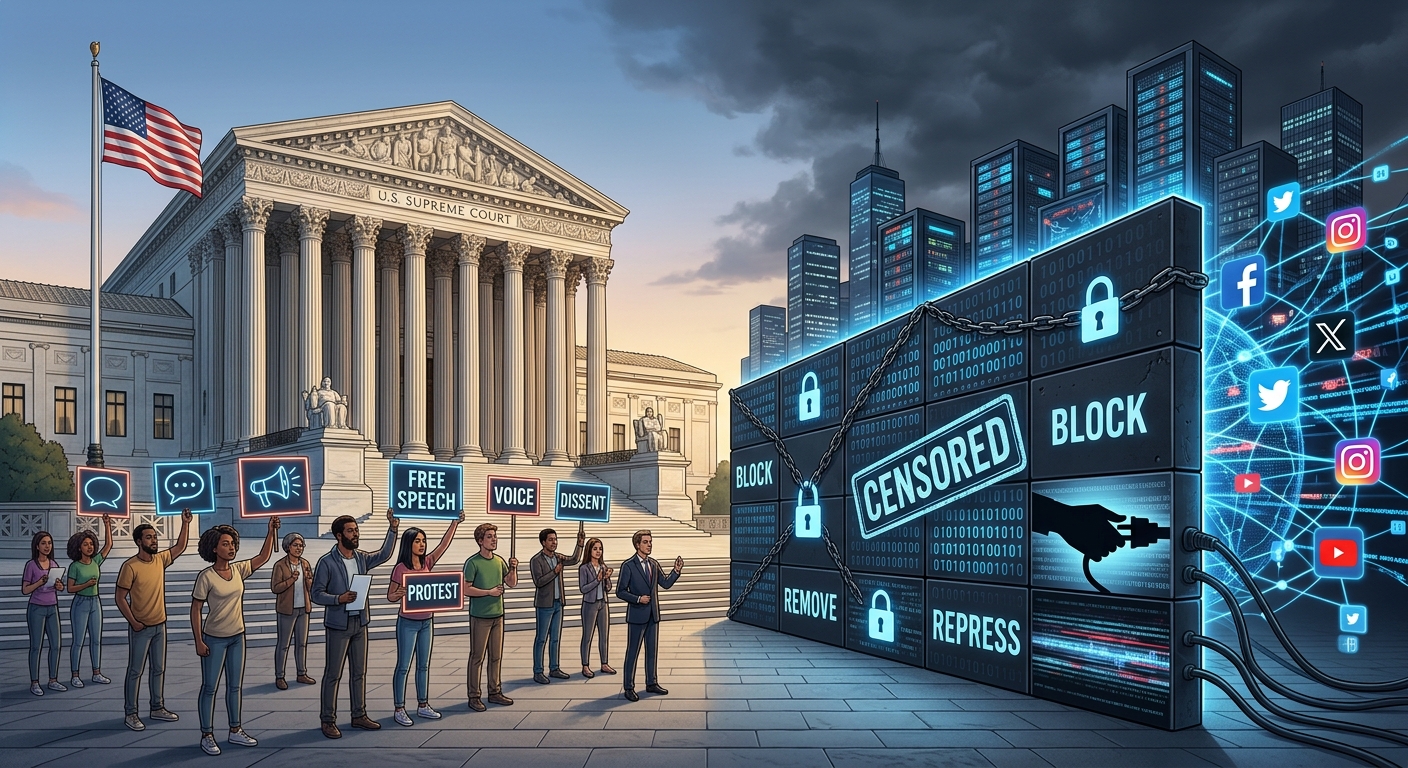
The Evolving Landscape of Digital Free Expression
The intersection of the First Amendment and the digital realm has never been more contested than in recent times. As the internet has evolved into the primary public square for modern discourse, lawmakers at both the state and federal levels have introduced a flurry of regulations aimed at controlling what can be said, seen, and shared online. Over the past year, the landscape of digital free expression has faced unprecedented challenges, culminating in landmark Supreme Court rulings, sweeping state-level censorship bills, and federal ultimatums against massive social media platforms.
This year will be remembered as a defining moment for internet free speech. From legislative efforts to mandate age verification and parental consent to heated debates over whether government officials can quietly pressure tech companies to moderate content, the fundamental right to freedom of expression has been under an intense and multi-front siege. The tension between protecting vulnerable populations online and preserving an open, uncensored internet has sparked fierce legal battles that will unequivocally shape the future of digital communication for generations to come. Understanding these shifts is essential for any citizen who relies on the internet for news, community building, and political engagement.
The Bedrock of Digital Free Speech and Historical Context
Before delving into the specific legal battles of the past year, it is absolutely essential to understand the historical context of First Amendment protections online. In the late 1990s, the courts established a vital precedent, declaring that speech on the internet receives the highest possible level of First Amendment protection—equivalent to that of traditional print media, rather than the more heavily regulated broadcast television or radio formats. This foundational legal principle ensured that the fledgling digital ecosystem could flourish as an unprecedented marketplace of ideas, free from heavy-handed government intervention and preemptive censorship.
However, as social media platforms have grown into technological behemoths with immense, centralized influence over public opinion, politicians across the political spectrum have increasingly sought ways to bypass these historical protections. The prevailing narrative among many lawmakers has dramatically shifted from viewing the internet as a bastion of free expression to portraying it as a dangerous, unregulated environment requiring strict government oversight. This paradigm shift has fueled a relentless wave of modern censorship efforts, fundamentally testing the resilience of our constitutional safeguards in the digital age and forcing the courts to re-evaluate how centuries-old legal doctrines apply to algorithms and digital feeds.
The Content Moderation Battleground: States vs. Platforms
One of the most significant and closely watched legal showdowns of the year centered on the constitutional right of social media companies to curate the content hosted on their platforms. At the very heart of this conflict were two state laws—one originating from Florida and another from Texas—that explicitly sought to strip platforms of their editorial discretion. Proponents of these legislative efforts argued that tech giants were unfairly silencing certain political viewpoints and should therefore be treated legally as “common carriers,” much like telephone lines, forced to host all speech equally regardless of their own corporate guidelines.
In the highly anticipated consolidated cases of Moody v. NetChoice and NetChoice v. Paxton, the Supreme Court of the United States reviewed the constitutionality of these unprecedented state mandates. The Court’s subsequent ruling reaffirmed a crucial First Amendment principle: the algorithmic curation, selection, and moderation of third-party content by private companies is inherently expressive activity, and is therefore protected by the Constitution. Just as a traditional newspaper editor has the absolute right to decide which op-eds to publish, private social media platforms maintain the right to enforce their own community guidelines and determine what speech they wish to amplify, demote, or completely remove.
While the Supreme Court ultimately decided to send the cases back down to the lower courts for further factual analysis regarding the full, overarching scope of the laws, the underlying message delivered from the bench was clear and undeniable. The government simply cannot compel private platforms to host speech they fundamentally disagree with, nor can it impose its own politically motivated vision of what online discourse should look like. This decision served as a vital, if temporary, bulwark against state-mandated internet censorship.
The Government Coercion Dilemma: Jawboning and Free Speech
While the legal right of platforms to moderate content remains protected, a more insidious and difficult-to-track threat to digital free speech arises when the government itself attempts to covertly influence those private moderation decisions. This controversial practice, frequently referred to in legal circles as “jawboning,” involves government officials utilizing informal pressure, implied threats of regulatory retaliation, or coordinated public campaigns to heavily coerce tech companies into suppressing specific viewpoints, topics, or individual users.
The past year saw this complex issue reach the highest court in the land in the case of Murthy v. Missouri. The lawsuit stemmed from serious allegations that various federal officials and agencies had systematically pressured social media platforms to swiftly remove or demote content related to the COVID-19 pandemic, vaccine efficacy, and election integrity. The plaintiffs forcefully argued that this behind-the-scenes coercion effectively transformed the private moderation decisions of tech companies into unconstitutional state action, thereby violating the First Amendment rights of the targeted online users whose posts were restricted.
Ultimately, the Supreme Court dismissed the case, ruling that the plaintiffs severely lacked the legal standing required to sue because they could not definitively prove a direct, undeniable chain of causation between the government’s pressure and the platforms’ subsequent decisions to censor their specific content. However, this dismissal on strict procedural grounds left the deeply concerning substantive constitutional question largely unresolved. The profound dangers of government jawboning remain a highly pressing concern, as the invisible line between permissible government persuasion and unconstitutional state coercion continues to dangerously blur in the rapidly evolving digital sphere.
“Think of the Children”: The Threat of Age Verification Laws
Perhaps the most widespread and practically alarming trend in internet censorship over the past legislative sessions has been the rapid proliferation of state-level age verification and mandatory parental consent laws. Drafted entirely under the appealing guise of protecting minors from online harms and addictive algorithms, these bills strictly require platforms to verify the exact age of their users—often by forcing the collection of highly sensitive government-issued identification—and mandate explicit parental approval for teenagers to access certain websites or standard platform features.
A prime example of this trend is Arkansas’s Social Media Safety Act (SB 396), which aggressively sought to impose stringent, technologically complex age-verification requirements on a wide range of digital platforms operating within the state. While the stated legislative goal of shielding children from inappropriate or dangerous content is universally commendable, the heavy-handed mechanisms mandated by these laws fundamentally undermine the First Amendment rights of all internet users, both adults and minors alike, creating a severe chilling effect on digital interaction.
The negative impacts of these laws are severe and multifaceted:
- Loss of Anonymity: By forcing users to surrender their anonymity to access digital platforms, age verification laws create an immediate chilling effect on free expression. Individuals seeking information on highly sensitive topics—such as reproductive health, substance abuse recovery, or domestic violence resources—may be entirely deterred from accessing critical support if they are forced to permanently link their real-world, verified identity to their private browsing history.
- Cybersecurity Vulnerabilities: Forcing social media platforms to collect and retain millions of copies of driver’s licenses and state IDs turns these companies into massive honeypots for malicious hackers. The inevitable data breaches would expose users to devastating identity theft, compounding the First Amendment harms with tangible financial and personal security risks.
- Barriers for Adults: These laws impose wildly disproportionate barriers for law-abiding adults who either lack current government IDs, are hesitant to share sensitive documents with massive tech conglomerates, or simply wish to exercise their constitutional right to consume digital media without being subjected to invasive corporate data collection.
The Ultimatum: Banning Platforms and the First Amendment
The year also witnessed an unprecedented escalation in federal internet censorship efforts: the aggressive legislative push to outright ban entire digital platforms based entirely on their corporate ownership structure. The swift enactment of the Protecting Americans from Foreign Adversary Controlled Applications Act (PAFACAA) specifically and uniquely targeted TikTok, a dynamic video-sharing application actively used by over 170 million Americans to express themselves, conduct independent business, and consume independent news.
The federal law gave the platform’s parent company a stark, uncompromising ultimatum: completely divest its United States operations within a highly abbreviated timeframe or face a total, nationwide ban on domestic app stores and vital internet hosting services. Proponents of the sweeping legislation cited urgent national security concerns, strongly arguing that the app’s corporate ties to foreign adversaries posed an unacceptable, systemic risk to private user data and the integrity of American public discourse.
However, from a strict First Amendment perspective, effectively banning a major, ubiquitous medium of communication represents a drastic and deeply concerning escalation of government intervention. Restricting access to an entire platform simultaneously silences millions of individual users and independent content creators, abruptly cutting off a vital, modern avenue for political speech, artistic expression, and grassroots community organizing. Legal experts have forcefully argued that the government must definitively demonstrate a compelling state interest and utilize the absolute least restrictive means possible before implementing such a sweeping prior restraint on mass speech. The highly contentious ongoing legal battles surrounding the impending TikTok ban will inevitably serve as a critical, generation-defining test of whether national security claims can be legally leveraged to justify mass internet censorship.
The Road Ahead: Protecting the Digital Public Square
As we reflect on the tumultuous legal events of the past year, it is glaringly evident that the ongoing fight for First Amendment rights on the internet is far from over. Lawmakers at every level of government continue to persistently propose novel, highly restrictive ways to regulate digital speech, often strategically framing their censorship initiatives as strictly necessary measures for public safety, consumer protection, or urgent national security.
To successfully preserve the promise of an open internet, it is absolutely crucial for citizens and digital rights advocates to remain highly vigilant against both direct legislative censorship and indirect government coercion. This ongoing struggle requires actively advocating for robust, comprehensive digital privacy protections, aggressively challenging unconstitutional state mandates in federal court, and demanding total transparency from both government agencies and the tech monopolies that govern our online lives. The digital public square must fiercely remain a protected place where diverse, dissenting voices can freely debate, organize, and connect without the looming fear of unwarranted government intrusion.
The federal courts will undoubtedly continue to play a uniquely pivotal role in defining the precise legal boundaries of online free speech in the coming years. But the ultimate responsibility inevitably lies with an informed, engaged public, ready to robustly defend the core principles of the First Amendment against the rapidly evolving, technologically sophisticated threats of the digital age.
Summary of Key First Amendment Battles Online
The past year has been defined by several critical legal conflicts that test the limits of constitutional law in digital spaces. The table below outlines the primary battles, the key legislation or court cases associated with them, and their current legal status.
| Issue Category | Notable Case / Legislation | Core First Amendment Question | Status / Outcome |
|---|---|---|---|
| Content Moderation | Moody v. NetChoice | Can state governments legally compel private platforms to host user speech they disagree with? | Remanded to lower courts; Algorithmic curation firmly recognized as protected expressive activity. |
| Jawboning / Coercion | Murthy v. Missouri | Can federal government officials use informal pressure to force platforms to remove disfavored speech? | Dismissed by the Supreme Court based on standing; the core constitutional issue remains largely unresolved. |
| Age Verification | Arkansas SB 396 | Does mandatory government ID verification unconstitutionally chill the right to anonymous speech? | Currently enjoined and actively being challenged in federal appellate courts. |
| Platform Bans | PAFACAA (TikTok Ban) | Can the United States Congress outright ban an entire digital communication platform? | Enacted into law; Currently facing massive, ongoing constitutional challenges in federal courts. |
Frequently Asked Questions (FAQs)
Q: Does the First Amendment directly apply to the moderation practices of private social media companies?
A: No. The First Amendment strictly limits government action, preventing the state from censoring speech. Private corporate entities, including social media platforms, possess their own First Amendment right to actively moderate content, establish subjective community guidelines, and decide exactly what speech they wish to host on their privately owned servers.
Q: Why are modern age verification laws considered by legal experts to be a massive threat to free speech?
A: Age verification laws fundamentally force all internet users—adults and minors alike—to provide highly sensitive identification to access everyday online platforms. This completely eliminates the ability to speak, read, and access digital information anonymously, which historically chills free expression. This is particularly dangerous for marginalized groups, whistleblowers, or individuals researching highly sensitive medical, political, or social topics who fear real-world retaliation.
Q: What exactly is “jawboning” in the specific context of internet censorship?
A: Jawboning refers to the informal pressure exerted by government officials onto private companies to influence their corporate behavior without passing actual laws. In the digital realm, it involves government agencies or politicians coercing tech platforms to censor, demote, or outright ban specific users or viewpoints under the veiled threat of devastating regulatory retaliation or antitrust investigations.
Q: Can the federal government legally ban a massively popular communication app like TikTok?
A: Banning an established communication platform used by hundreds of millions of citizens raises severe, unprecedented First Amendment concerns. While the government claims urgent national security interests justify the action, established constitutional law strictly requires that any prior restraint or restriction on speech be exceedingly narrowly tailored and represent the absolute least restrictive means of achieving that security goal. The federal courts are currently evaluating whether the TikTok ban meets this incredibly high standard of strict scrutiny.
References
- Moody v. NetChoice, LLC, 603 U.S. ___ (2024) — Supreme Court of the United States. 2024-07-01. https://www.supremecourt.gov/opinions/23pdf/22-277_d18f.pdf
- Murthy v. Missouri, 603 U.S. ___ (2024) — Supreme Court of the United States. 2024-06-26. https://www.supremecourt.gov/opinions/23pdf/23-411_3dq3.pdf
- TikTok v. Garland: Constitutional Challenges to the Protecting Americans from Foreign Adversary Controlled Applications Act — Congressional Research Service. 2024-12-19. https://crsreports.congress.gov/product/pdf/LSB/LSB11130
- Senate Bill 396 – Social Media Safety Act — Arkansas State Legislature. 2023-04-04. https://www.arkleg.state.ar.us/Bills/Detail?id=SB396&ddBienniumSession=2023%2F2023R
Similar Articles








Read full bio of medha deb


