
First Amendment Rights When Filming Federal Border Agents
Know your constitutional rights when recording law enforcement at ports of entry.
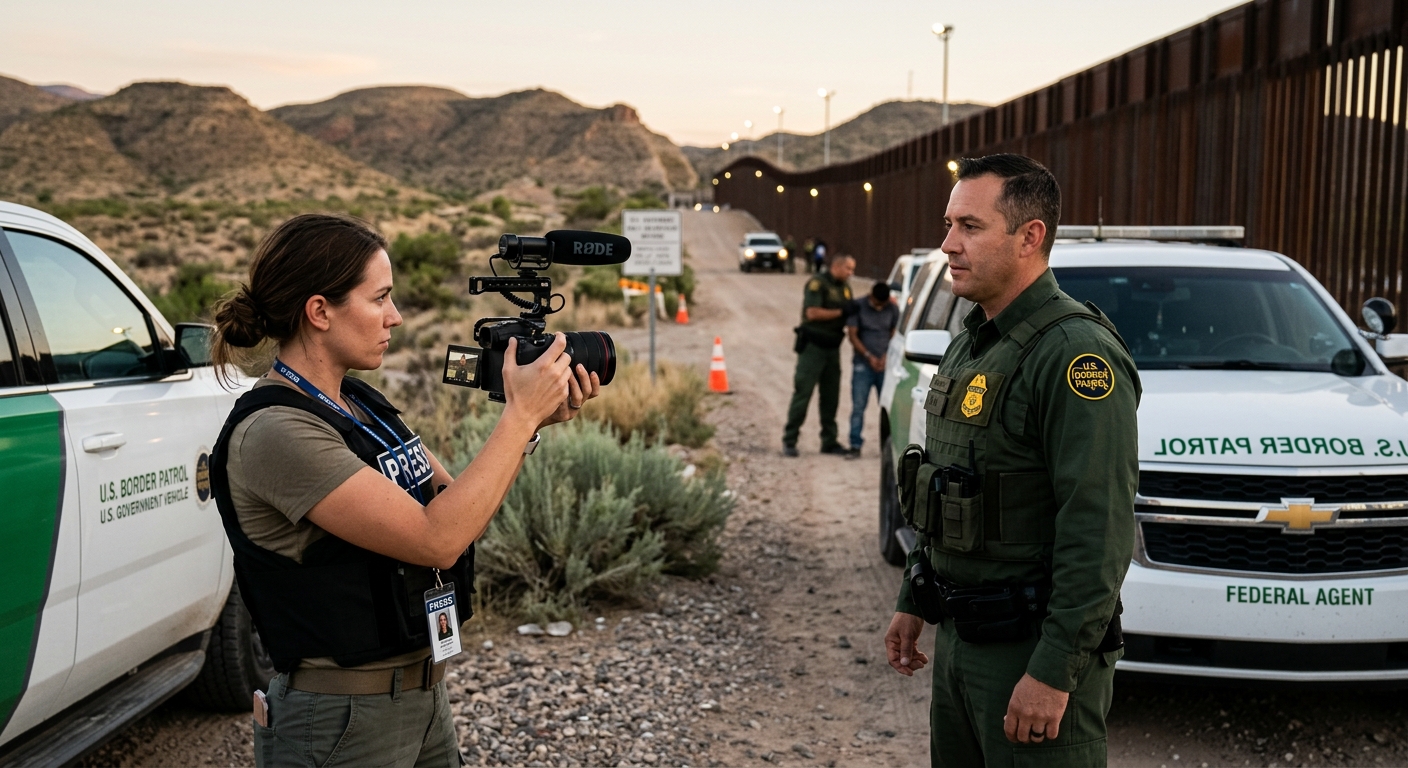
Visual accountability—the act of recording law enforcement officers as they perform their official duties—serves as a crucial check on government authority in a democratic society. Over the last decade, the public has grown increasingly aware of their right to film local and state police on public streets. However, significant confusion remains when these interactions involve federal agents. Specifically, encounters with United States Customs and Border Protection (CBP) and Immigration and Customs Enforcement (ICE) at borders, international airports, and ports of entry often exist in a frustratingly opaque legal gray area.
The right to film these federal agents extends the foundational democratic principle of freedom of speech and a free press. However, federal authorities in border zones frequently operate under sweeping jurisdictional mandates, leading to frequent clashes between internal agency protocols and the constitutional liberties of citizens and travelers. Understanding the complex legal landscape, the physical boundaries of these rights, and the practical steps one must take to remain safe while recording is essential for anyone traversing international borders, advocating for immigrant rights, or simply standing as an objective witness. This article delves deeply into the nuances of the First Amendment right to record federal law enforcement, dismantling common misconceptions and providing a comprehensive guide for travelers, activists, and everyday citizens.
The Constitutional Foundation of Citizen Recording
At the very heart of the right to record law enforcement lies the First Amendment of the United States Constitution. While the explicit text of the First Amendment protects the freedom of speech and the press, the Supreme Court and subsequent federal courts have long interpreted these protections broadly to encompass the actual gathering of information. Legally speaking, you cannot freely discuss, debate, or publish information about the government if you are systematically prevented from collecting that information in the first place.
A Consensus Across Appellate Courts
Over the past two decades, a robust consensus has emerged among the U.S. Circuit Courts of Appeals confirming that the First Amendment categorically protects the right of individuals to film police officers performing their duties in public. Landmark rulings have repeatedly affirmed this stance, establishing critical precedents for civil rights. For instance, in Glik v. Cunniffe (2011), the First Circuit Court of Appeals emphatically stated that the right to film public officials in public spaces is a basic, clearly established principle. Similarly, the Third Circuit in Fields v. City of Philadelphia (2017) reinforced that the public has a commensurate right to record—whether via photograph, film, or audio—police officers conducting official police activity in public areas.
When evaluating these cases, courts often emphasize that the public has a compelling interest in monitoring the conduct of its police forces. The First Circuit noted that gathering information about government officials in a form that can readily be disseminated to others serves a cardinal First Amendment interest in protecting and promoting the free discussion of governmental affairs. This means that a citizen capturing video is acting as a proxy for the general public, ensuring transparency in situations where state power is exercised against the individual. Importantly, the courts have not limited this right solely to credentialed journalists. The everyday citizen holding a smartphone is afforded the same constitutional protections to observe, document, and disseminate footage. This foundational right does not magically vanish simply because the uniform changes from a local police badge to the insignia of a federal immigration agent.
The “Border Exception” Myth and Federal Agencies
Despite the clear constitutional mandates surrounding the right to record, a pervasive myth exists that the United States border functions as a Constitution-free zone. It is entirely true that the government possesses enhanced authorities at international borders and ports of entry. Under the recognized “border search exception” to the Fourth Amendment, federal agents can legally conduct routine searches of luggage, vehicles, and persons without requiring a warrant or individualized suspicion of criminal activity. However, the dilution of Fourth Amendment privacy protections in these zones does not equate to a wholesale suspension of First Amendment rights.
Agency Directives vs. Constitutional Mandates
Travelers entering the United States through land border crossings or walking through international airport terminals are frequently greeted by intimidating signage prohibiting photography, video recording, and cell phone use. These signs are generally rooted in CBP internal policies and operational directives explicitly designed to maintain security, protect sensitive inspection techniques, and preserve the personal privacy of other travelers waiting in line.
While these agency directives serve a logical bureaucratic purpose, they do not automatically supersede the United States Constitution. Federal agents may routinely cite their internal policies to demand that a traveler stop recording an enforcement action, an aggressive interrogation, or a controversial search. They may even attempt to use the naturally intimidating environment of a port of entry to force absolute compliance. However, internal agency guidelines are not actual laws, and they cannot legally extinguish a citizen’s First Amendment right to gather information about the conduct of government officials in plain view. The friction invariably occurs when agents, accustomed to the broad deference traditionally granted to them in border environments, overstep their authority and attempt to enforce an agency policy as if it were a rigid constitutional limit.
Navigating Ports of Entry: What Travelers Should Know
Ports of entry are highly controlled and heavily monitored environments. Because these areas act as the literal gateways into the country, they are heavily policed by CBP officers who are tasked with a multitude of responsibilities, including customs enforcement, immigration control, and agricultural protection. It is within these high-stress, high-volume bottlenecks that the potential for civil rights violations often increases exponentially, making the need for citizen documentation critically important.
If you witness an agent using seemingly excessive force, conducting what appears to be a racially motivated stop, or verbally abusing an exhausted traveler, your first instinct may be to pull out your phone and document the encounter. Legally, if you are located in a space where you have a legitimate right to be present—such as a public waiting area, a pedestrian crossing line, or a main arrivals terminal—you generally have the corresponding right to record what you observe.
The Boundary Between Observation and Interference
The most critical caveat to the First Amendment right to record is that the right is not absolute. Courts have universally held that the right to record is subject to reasonable “time, place, and manner” restrictions. The paramount restriction governing these interactions is that a civilian’s recording activities cannot interfere with law enforcement operations.
Interference generally means you cannot physically obstruct an agent, block their path of travel, or create a hazardous environment for those present. Standing a few feet away and silently recording is legally protected observation. Conversely, shoving a camera directly into an agent’s face or purposefully crossing into non-public processing areas constitutes unlawful interference. Courts recognize that law enforcement officers operate in unpredictable and potentially dangerous environments, meaning they require adequate physical space to secure a scene, conduct searches, or subdue non-compliant individuals. If a recording individual encroaches on this necessary space, they transform from an observer to an active participant, compromising the safety of everyone involved. Therefore, maintaining active situational awareness is just as important as knowing your constitutional rights. If an individual becomes volatile or an area is suddenly cordoned off, the definition of what constitutes a ‘safe distance’ may change rapidly, requiring the civilian observer to adjust their position accordingly.
Practical Guidelines for Safely Documenting Interactions
Understanding your rights in abstract theory is very different from successfully exercising them in the unpredictable, often tense environment of an international border crossing. When choosing to record federal agents, prioritizing your physical safety and minimizing your legal exposure is paramount. Below are essential, practical guidelines to follow when deciding to document law enforcement:
- Maintain a Safe Distance: Ensure you stand far enough away to avoid credible accusations of physical interference. Remaining at least six to ten feet away from the active scene is generally considered a safe observational distance.
- Remain Calm and Objective: Act strictly as an objective observer. Avoid yelling, aggressive posturing, or arguing with officers, which could quickly be construed as incitement or distraction.
- Record Openly: It is generally safer and far more legally sound to keep your recording device in plain view rather than attempting to hide it.
- State Your Intentions Clearly: If an officer approaches you and asks what you are doing, calmly and respectfully state that you are exercising your First Amendment right to record a public interaction.
- Secure Your Device Beforehand: Before arriving at a port of entry, secure your phone with a strong alphanumeric passcode rather than using biometric unlocks (like fingerprint or facial recognition). Courts have historically provided stronger Fifth Amendment protections against forced passcode disclosure than against forced biometric device unlocks.
- Do Not Resist Physically: If an agent illegally confiscates your phone, do not physically resist or fight back. State clearly that you do not consent to the seizure of your property, but let them take the device. Physical resistance will almost certainly lead to secondary criminal charges like resisting arrest or assaulting a federal officer.
To summarize the expected behavior during these tense encounters, refer to the table below detailing common actionable guidance:
| Do’s for Recording Federal Agents | Don’ts for Recording Federal Agents |
|---|---|
| Maintain a safe observational distance (6-10 feet). | Physically block an agent’s path or workspace. |
| State your intentions calmly if explicitly asked. | Argue, yell, or escalate the tension verbally. |
| Keep your recording device in plain view. | Hide your camera or act suspiciously. |
| Comply with lawful spatial orders to step back. | Resist physically if an agent attempts to touch you. |
The Impact of Civilian Footage on Institutional Reform
The act of recording is not merely a personal defense mechanism; it is a proven catalyst for broader systemic change. Throughout modern history, civilian footage has been the pivotal element that successfully contradicts official agency narratives and exposes deeply entrenched abuses of power. Without bystander video, countless instances of excessive force, unlawful detention, and severe constitutional violations by federal agents would remain quietly buried in redacted, internally reviewed agency reports.
When footage of CBP or ICE agents overstepping their legal bounds goes viral, it immediately circumvents the slow, traditional bureaucratic channels of citizen complaints and thrusts the issue directly into the court of public opinion. This sudden visibility forces rapid legislative oversight, prompts immediate internal investigations, and provides indisputable, objective evidence for subsequent civil rights lawsuits. By choosing to bear witness and document the actions of the state, everyday citizens effectively transform fleeting moments of injustice into permanent digital records that demand strict accountability. The continuous accumulation of these digital records builds a highly compelling case for overarching policy reform, actively challenging the culture of impunity that can sometimes fester in highly secured, heavily militarized environments like border zones.
Frequently Asked Questions (FAQ)
Do I need permission to record federal agents?
No. In public-facing areas where you have a legal right to be present, and where the agents are actively performing their official duties in plain sight, you do not need their consent to record video or audio of them. The First Amendment protects your inherent right to gather information independently of the subjects’ personal or professional wishes.
Can an agent legally confiscate my phone or camera?
An agent cannot confiscate your device solely because you are recording them. To legally seize your personal property, they generally need a judge-issued warrant or a legitimate, legally justifiable exception to the warrant requirement (such as strict exigent circumstances where they reasonably believe vital evidence of a crime is about to be imminently destroyed). If they take your phone without a warrant or a valid exception, they are likely violating your Fourth Amendment rights against unreasonable seizure.
What should I do if an agent orders me to delete my footage?
Never delete your footage. It is explicitly illegal for a law enforcement officer to destroy evidence or intentionally force a citizen to delete photographs or videos under the threat of arrest. If ordered to do so, politely but firmly refuse, stating clearly that you are retaining the footage as is your constitutional right. If they take the phone and delete the files themselves, this constitutes a severe, actionable civil rights violation.
Does this right apply to international airports and land borders equally?
Yes, the foundational First Amendment right applies across all jurisdictions operating within the United States. However, international airports and land borders possess very specific restricted zones (such as the secure processing areas located strictly past the initial customs booths or secondary inspection rooms) where public access is strictly denied for security reasons. You can freely record in the public-facing areas, but you cannot bypass security barriers to record in restricted or classified zones.
The Future of Transparency at the Border
The complex intersection of national security, immigration enforcement, and fundamental civil liberties remains one of the most heavily contested legal battlegrounds in the United States today. As federal agencies increasingly deploy advanced, sometimes invasive surveillance technologies—ranging from facial recognition checkpoints to sweeping biometric tracking systems—the asymmetrical balance of power tips further away from the individual citizen. In this rapidly evolving technological landscape, the citizen’s camera remains the most potent, accessible counter-measure against unchecked government authority.
The fight for genuine transparency at the border is an ongoing struggle. While appellate courts have established a strong legal framework protecting the right to record, the daily reality on the ground often involves aggressive intimidation, unlawful device seizures, and bureaucratic retaliation. It requires immense courage and presence of mind to hold the line and document authority in these high-stakes environments. By thoroughly understanding legal boundaries and employing practical safety measures, advocates and travelers can help ensure federal law enforcement actions are continuously brought to light. The First Amendment was designed precisely for this vital purpose: to actively empower the governed to monitor the governors, ensuring that even at the very geographic edges of the nation, the Constitution remains the supreme law of the land.
References
- Glik v. Cunniffe, 655 F.3d 78 (1st Cir. 2011) — United States Court of Appeals for the First Circuit. 2011-08-26. https://openjurist.org/655/f3d/78/glik-v-cunniffe
- Fields v. City of Philadelphia, 862 F.3d 353 (3d Cir. 2017) — United States Court of Appeals for the Third Circuit. 2017-07-07. https://www.supremecourt.gov/DocketPDF/17/17-733/20127/20171116155909890_Fields%20v.%20City%20of%20Philadelphia%20Petition%20for%20Writ%20of%20Certiorari.pdf
- Photo, Video & Audio Use Guidelines — U.S. Customs and Border Protection. 2025-12-23. https://www.cbp.gov/newsroom/media-resources/photo-video-audio-use-guidelines
- Warrantless Border Searches of Electronic Devices — Yale Law School. 2021-03-08. https://law.yale.edu/warrantless-border-searches-electronic-devices-constitutional
- Facial Recognition Technology: CBP Traveler Identity Verification — U.S. Government Accountability Office. 2022-07-27. https://www.gao.gov/products/gao-22-106154
Similar Articles








Read full bio of medha deb


