
First Amendment Protection: Gesturing at Police
Understanding your constitutional rights when expressing frustration toward law enforcement officers.
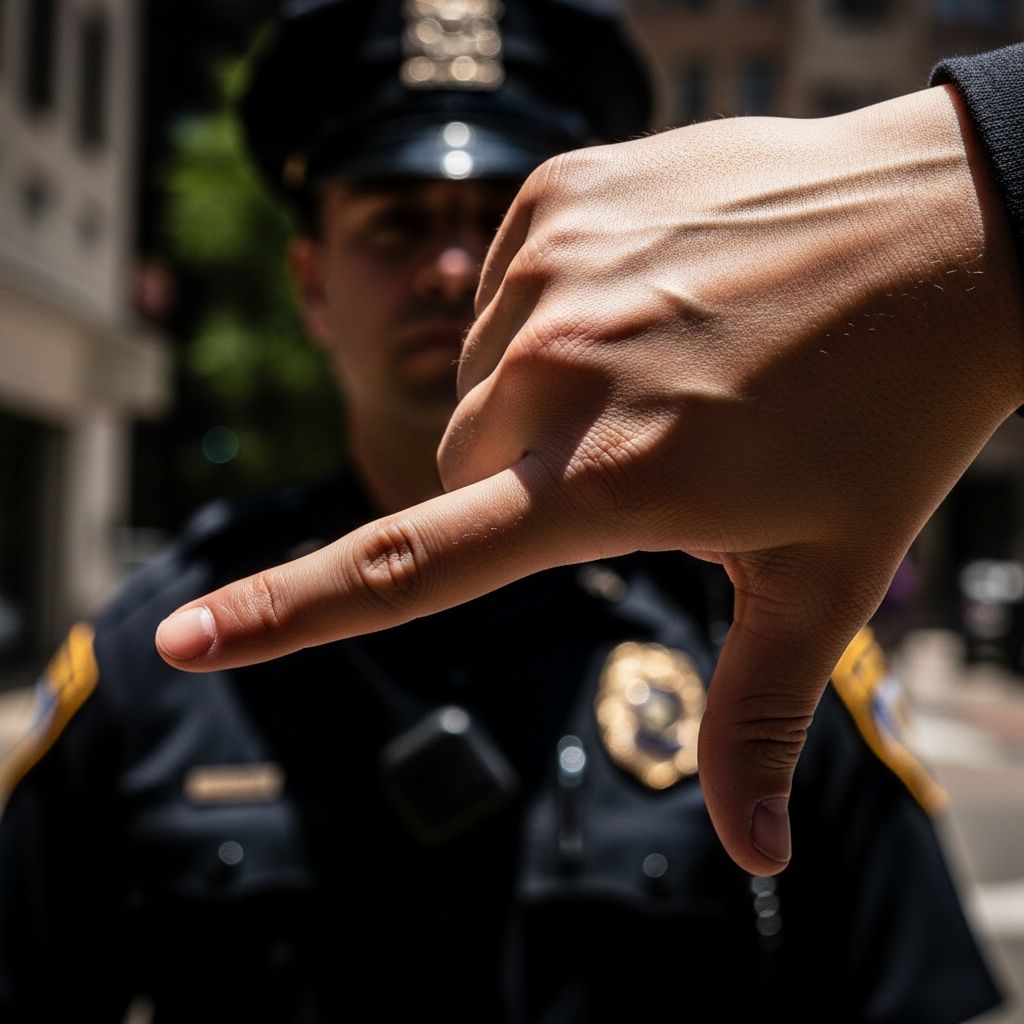
Understanding Expressive Conduct and Constitutional Protections
The question of whether citizens can face legal consequences for displaying vulgar gestures toward law enforcement officers has generated significant litigation and established important constitutional precedents. While such conduct may be considered rude or disrespectful, the legal landscape surrounding these actions reveals a strong tradition of First Amendment protections for expressive conduct, even when directed at government officials. Understanding the distinction between protected speech and unprotected conduct requires examining how courts have interpreted the Constitution and the specific circumstances that might transform a gesture into criminally actionable behavior.
The Constitutional Framework Protecting Nonverbal Expression
The First Amendment protects not only spoken words but also what legal scholars term “expressive conduct”—nonverbal communication that conveys a message or idea. Federal courts have consistently recognized that gestures, including those considered crude or offensive, fall within this protective umbrella when they communicate a coherent message. The Supreme Court and appellate courts have established that the government cannot criminalize expression simply because it offends or angers public officials, including law enforcement officers.
This protection extends to situations where citizens express frustration or disapproval through hand gestures during police encounters. The reasoning underlying these protections acknowledges that the ability to criticize government officials—even disrespectfully—represents a cornerstone of democratic society. Courts have emphasized that protecting unpopular or offensive speech is precisely what the First Amendment demands, as more palatable expressions require less legal protection.
How Courts Have Evaluated Gesture-Based Arrests
Multiple federal circuits have addressed scenarios where police officers arrested individuals for displaying offensive gestures. These judicial decisions have created a consistent body of law establishing that such arrests violate constitutional protections when the gesture alone forms the basis for the arrest.
Landmark Cases Establishing Legal Precedent
In a significant 2013 decision from the United States Court of Appeals for the Second Circuit, a New York man who was arrested for flipping off a police officer had his conviction reversed. The court determined that “this ancient gesture of insult is not the basis for a reasonable suspicion of a traffic violation or impending criminal activity.” This ruling emphasized that officers cannot lawfully stop or arrest citizens based solely on offensive gestures.
Similarly, the United States Court of Appeals for the Sixth Circuit addressed a Michigan case involving a driver who made an obscene gesture at a police officer after receiving a traffic citation. The officer responded by stopping the vehicle again and issuing a more severe ticket. The court ruled that the driver’s gesture, while “crude,” did not provide lawful justification for the second stop. The opinion stressed that “a lack of gratitude or fits of rudeness might break the Golden Rule, but that does not make it illegal.”
A 2021 decision from the United States Court of Appeals for the Eighth Circuit further reinforced these protections when it ruled in favor of a Minnesota man arrested after flipping off a police officer. These consistent rulings across multiple federal circuits demonstrate a unified judicial perspective on gesture-based expression.
High-Profile Settlement Cases
Beyond appellate decisions, settlement agreements have highlighted the vulnerability of jurisdictions that prosecute individuals for gesture-based conduct. In one notable Vermont case, a man arrested for disorderly conduct after flipping off a state trooper received a $175,000 settlement from the state. The Vermont Attorney General declined to defend the arrest in court, effectively acknowledging the constitutional weakness of prosecuting expressive conduct.
The state’s decision to settle reflected what legal experts anticipated: that no court would uphold convictions based solely on offensive gestures. Peter Teachout, a professor at Vermont Law School, noted that “the state settled in all likelihood because it was highly likely that a court would rule that Mr. Bombard’s First Amendment rights were violated.” Such settlements provide powerful evidence of how seriously courts take these constitutional violations.
The Distinction Between Protected and Unprotected Conduct
While courts have consistently protected gesture-based expression, the legal protection is not absolute. Context and accompanying conduct substantially influence whether expressive activity remains constitutionally protected or crosses into criminal territory.
When Gestures Remain Protected
- Silent, nonviolent gestures expressing disapproval or frustration
- Crude hand signals made during traffic stops or police encounters
- Expressive conduct that communicates a message without accompanying threats
- Disrespectful gestures that do not incite violence or create imminent danger
- Nonverbal communication expressing disagreement with police actions
Circumstances That May Remove Constitutional Protection
- Gestures accompanied by explicit verbal threats of violence
- Conduct that physically interferes with police operations or legitimate activities
- Expressive conduct that incites immediate violence or lawless action
- Threatening gestures combined with aggressive physical movements
- Behavior that constitutes true harassment or stalking
Courts recognize that the legality of expressive conduct depends significantly on context. A gesture that stands alone as pure expression may become illegal when combined with conduct that threatens public safety or disrupts legitimate government operations. Officers retain authority to address conduct that genuinely interferes with their duties, but they cannot exploit this authority to suppress unpopular or offensive expression.
The Fourth Amendment Dimension: Reasonable Suspicion
When police officers attempt to justify stops based on offensive gestures, they must overcome Fourth Amendment scrutiny. The Fourth Amendment protects citizens against unreasonable seizures, and a traffic stop constitutes a seizure requiring reasonable articulable suspicion of lawbreaking.
Courts have consistently held that displaying an offensive gesture does not provide the reasonable suspicion necessary to justify a stop. An officer cannot manufacture suspicion of a traffic violation simply because a citizen’s gesture angered them. The gesture itself is not “a legitimate reason for a stop.” To lawfully initiate a stop, officers must identify actual violations of traffic laws or provide evidence of criminal activity unrelated to the expressive conduct.
This Fourth Amendment analysis has proven crucial in numerous cases where officers attempted to justify subsequent stops as responses to offensive gestures. Courts recognize that allowing gesture-based justifications would effectively nullify First Amendment protections by allowing police to arrest individuals for any speech or gesture they find objectionable, merely by claiming they stopped the person for an unrelated violation.
Practical Consequences Despite Legal Protection
Understanding that courts protect gesture-based expression does not mean that exercising this right comes without consequences. Even when individuals ultimately prevail in defending against charges, they may face substantial practical burdens.
Immediate Enforcement Actions
When citizens gesture at police officers, those officers frequently respond by conducting additional investigations or issuing citations for separate violations. An officer who feels disrespected may cite traffic laws they initially overlooked, escalate charges from minor to serious offenses, or conduct vehicle searches based on claimed probable cause for drug or alcohol violations. What begins as protected expression can snowball into serious legal consequences when officers exploit their authority to investigate other potential violations.
Long-Term Litigation Burdens
Citizens arrested for gesture-based expression face years of litigation to vindicate their constitutional rights. While courts may ultimately dismiss charges or rule in their favor, the process involves significant financial costs, attorney fees, and personal disruption. The practical reality of defending oneself in court—even with a strong legal position—represents a substantial burden that may deter citizens from exercising protected rights.
Strategic Considerations
Legal experts universally acknowledge that while individuals possess the right to display offensive gestures toward police, exercising this right frequently creates complications. Expressing frustration through gestures may provoke officers to discover or manufacture additional bases for charges, leading to outcomes worse than the original encounter. Rebecca Tushnet, a professor at Harvard Law School, observed that “police officers can’t (in theory) arrest you for annoying them or even angering them,” highlighting the theoretical nature of these protections when officers retain discretion over investigations and charging decisions.
Variations Across Jurisdictions
While federal courts have established consistent constitutional protections, the enforcement practices and local interpretations of these protections vary significantly across jurisdictions. Some states and municipalities train officers extensively on constitutional limitations regarding expressive conduct, while others maintain inadequate training or institutional resistance to these protections.
Citizens in Louisiana, Texas, Mississippi, Arkansas, and throughout the United States technically possess identical constitutional protections, yet the likelihood of facing arrest and prosecution varies based on local enforcement cultures and judicial philosophies. Jurisdictions with strong oversight mechanisms and well-trained officers demonstrate lower rates of arrest for protected expression, while areas with less rigorous accountability may continue prosecuting constitutionally questionable cases.
The Role of Professional Standards and Training
Law enforcement agencies bear responsibility for training officers about constitutional limitations on their authority. Officers who lack proper training may genuinely misunderstand whether gesture-based expression provides grounds for arrest, leading to violations of constitutional rights through ignorance rather than intentional suppression.
Quality training programs educate officers about the distinction between protected speech and disorderly conduct that truly threatens public order. These programs emphasize that officers’ personal feelings regarding disrespect do not provide lawful justification for arrest or stops. Departments implementing comprehensive constitutional training demonstrate measurably lower rates of unlawful arrests based on expressive conduct.
Frequently Asked Questions
Q: Can I be arrested simply for giving a police officer the middle finger?
A: No. Federal courts have consistently ruled that displaying an offensive gesture alone does not provide lawful grounds for arrest. Your First Amendment right to expressive conduct protects such gestures even when directed at law enforcement officers, provided they do not accompany threatening behavior or violence.
Q: What if the officer claims my gesture made them fear for their safety?
A: Courts scrutinize such claims carefully. A silent, nonviolent gesture does not reasonably create fear of imminent harm. However, if your gesture was accompanied by explicit threats, aggressive movements, or other conduct suggesting imminent violence, the constitutional protection might not apply.
Q: Can an officer use my gesture as an excuse to search my vehicle?
A: An officer cannot lawfully use a protected gesture as probable cause for a vehicle search. However, officers retain authority to investigate other suspected violations. If an officer claims they smelled marijuana or observed other signs of impaired driving, they may conduct searches based on those independent observations rather than your gesture.
Q: If I’m arrested for displaying a gesture, what should I do?
A: Remain silent regarding the circumstances and request an attorney immediately. Do not attempt to argue your constitutional rights at the scene. Allow your attorney to raise these defenses in court where the legal arguments will receive proper judicial consideration.
Q: Are gestures protected the same way in all states?
A: Federal constitutional protections apply nationwide, but enforcement practices vary by jurisdiction. Consult with a local criminal defense attorney regarding specific conditions in your area, as local enforcement culture and court decisions may influence how these protections operate in practice.
Q: What if my gesture was combined with loud yelling or cursing?
A: Combining gestures with verbal expression strengthens your First Amendment claim, as courts recognize both verbal and nonverbal communication as protected speech. However, if the verbalization crosses into explicit threats or incitement to violence, constitutional protection may be lost.
References
- Man Who Was Arrested for Flipping Off Cop Settles for $175,000 — Reason. 2024-07-18. https://reason.com/2024/07/18/man-who-was-arrested-for-flipping-off-cop-settles-for-175000/
- What Happens If I Flip Off a Cop? — AER Law Group. https://www.aerlawgroup.com/blog/what-happens-if-i-flip-off-a-cop/
- If I Flip Off a Cop, Can I Get Arrested? — CDH Law PLLC. https://lawcdh.com/if-i-flip-off-a-cop-can-i-get-arrested/
- Is It Illegal to Flip Off a Cop? Examining the Legal and Social Implications — Performance Protocol. https://www.performance-protocol.com/post/is-it-illegal-to-flip-off-a-cop-examining-the-legal-and-social-implications
- Flipping the Bird to Cops Not a Basis for a Stop — North Star Criminal Defense. https://www.northstarcriminaldefense.com/flipping-the-bird-to-cops-stop/
- Is It Legal To Flip Off The Police In Louisiana? — 710 KEEL. https://710keel.com/is-it-legal-to-flip-off-the-police-in-louisiana/
- Can you be arrested for giving the finger to police? — TalksOnLaw. https://www.talksonlaw.com/briefs/can-you-be-arrested-for-giving-the-finger-to-police
Similar Articles








Read full bio of medha deb


