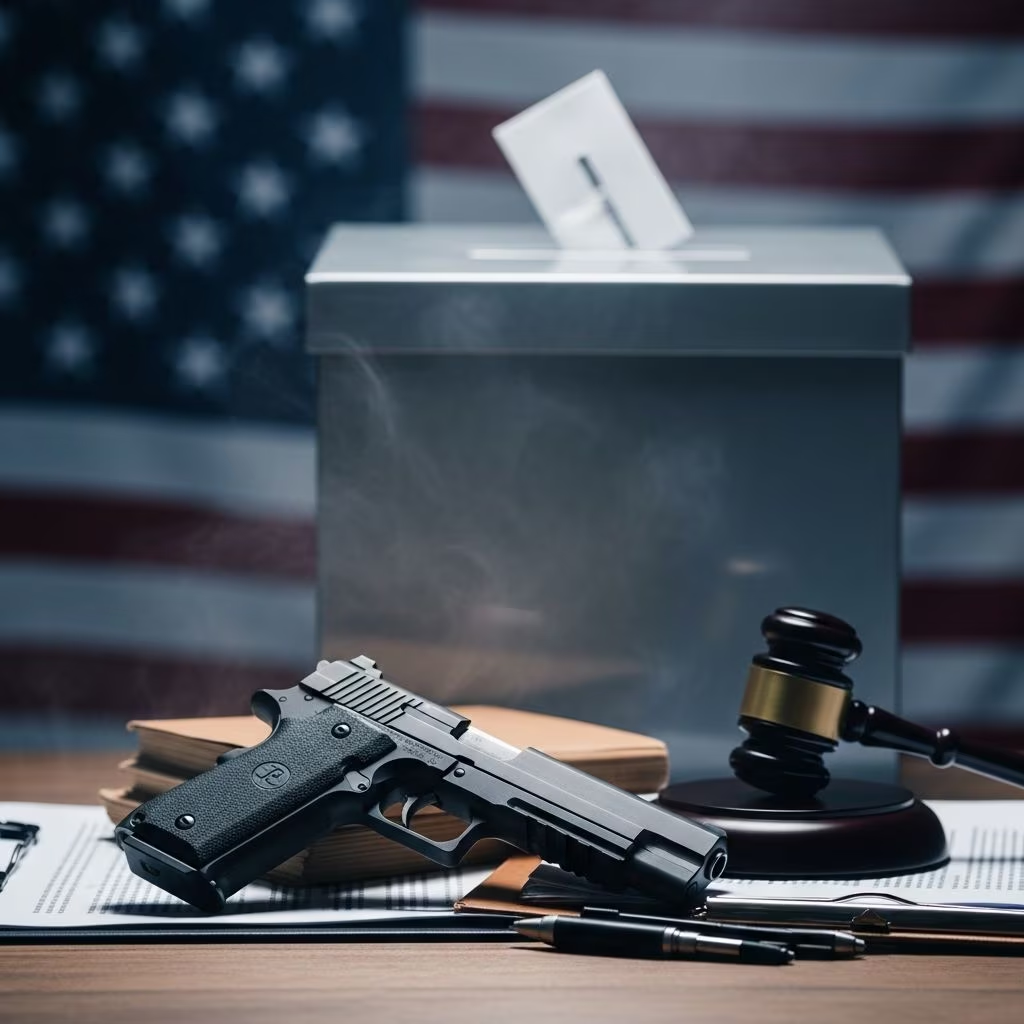
Across the United States, regulations on bringing firearms to polling places differ significantly by state, reflecting a balance between Second Amendment rights and the need to protect voters from intimidation. While no federal law explicitly bans guns at these locations, 22 states and Washington, D.C., have implemented restrictions ranging from total prohibitions to limits on open or concealed carry.
Why Restrictions Matter for Election Integrity
Election security has become a pressing issue, with reports of increased threats against poll workers and voters. Surveys indicate widespread public support for limiting guns near voting sites to prevent escalation of tensions into violence. For instance, a 2022 poll found 63% of voting-age adults, including over half of Republicans, favored such bans due to fears of intimidation or shootings. Incidents like a Texas poll worker assault highlight how minor disputes can turn dangerous if firearms are present.
Authorities are responding with enhanced measures. The FBI plans a national command center to monitor Election Day threats, while states bolster physical security at polls, including panic buttons in Georgia and snipers in Arizona. Experts emphasize that firearm restrictions serve as a key deterrent against hostile interactions.
Overview of State-by-State Regulations
State laws vary in scope, prohibiting firearms at polling places, drop boxes, or vote-counting sites. Some ban both open and concealed carry, others target only one, and many apply to nearby government buildings used as polls.
| State | Prohibition Type | Details |
|---|---|---|
| California | Total Ban | No firearms at polling places (CA Election Code § 18544(a)). Voters can sue for intimidation violations. |
| Colorado | Total Ban | Extended to concealed carry in 2024 (Colo. Rev. Stat. § 1-13-724). |
| Florida | Total Ban | Prohibits guns at polls (Fla. Stat. § 790.06(12)(a)6). |
| Georgia | Total Ban | No firearms at polling sites (Ga. Code Ann. § 16-11-127(b)(7)). |
| Massachusetts | Total Ban | Bars possession within 150 feet of polls (new 2024 law). |
| New Mexico | Total Ban (with exceptions) | Prohibits within 100 feet; exemptions for concealed carriers, peace officers (NM SB 5, 2024). |
| New York | Total Ban | Full prohibition (N.Y. Penal Law § 265.01-e(2)(q)). |
| Texas | Total Ban | No guns at polls (Texas Penal Code § 46.03(a)(2)). |
| Ohio | Partial Ban | Applies to poll observers only (ORC § 3505.21(B)). |
| Missouri | Partial Ban | Limited restrictions (MRS § 571.107.1(2)). |
This table summarizes select states; full lists show 15 states and D.C. with total bans, seven with partial ones. States like Arkansas, Idaho, and Utah have no clear prohibitions.
Recent Legislative Developments
In the past two years, ten states enacted new restrictions amid rising election violence concerns: Connecticut, Delaware, Hawaii, Maryland, New Jersey, New Mexico, New York, Washington, Colorado, and Massachusetts. Colorado expanded its open-carry ban to concealed weapons, while Massachusetts set a 150-foot perimeter.
- New Mexico’s SB 5, signed in 2024, bans guns within 100 feet but exempts concealed carry license holders and those in vehicles.
- California empowered voters to pursue civil action against intimidators.
- Failed bills in Connecticut, Illinois, Indiana, Michigan, Pennsylvania, and Vermont highlight partisan divides.
Virginia’s attempt to widen its ban from 40 to 100 feet was vetoed by Governor Glenn Youngkin over Second Amendment worries. Republican opposition is common, though some, like New Mexico’s caucus chair, supported amended versions.
No Federal Mandate: Reliance on States and the Voting Rights Act
Federal law lacks specific prohibitions on firearms at polls, leaving regulation to states. The Voting Rights Act (1965) bars intimidation, threats, or coercion interfering with voting, but does not deem mere gun presence as such. Advocacy groups push for federal reforms, yet states lead with tailored measures.
Open carry laws further complicate matters, varying by state and firearm type, often allowing display unless explicitly restricted.
Security Enhancements Beyond Firearm Bans
Even without bans, states invest in protections. A Brennan Center survey found 40% of officials upgraded polling site security since 2020.
- Panic buttons and shatterproof windows in multiple states.
- Armed guards and drones for surveillance.
- Law enforcement presence, including rooftop snipers.
These steps address broader threats, ensuring safe voting environments.
Public Opinion and Political Debates
Support for restrictions crosses party lines, with polls showing strong backing to curb potential intimidation. Proponents argue guns escalate risks, while opponents cite constitutional rights, especially in permitless carry states.
In politically charged atmospheres, neutral enforcement is crucial. Poll workers must know local rules to avoid confrontations.
Frequently Asked Questions (FAQs)
What states completely ban guns at polling places?
At least 15 states and D.C. prohibit both open and concealed carry, including California, Colorado, Florida, Georgia, and New York.
Are there exceptions in states with bans?
Yes, common exemptions include peace officers, concealed carry holders (e.g., New Mexico), and individuals in vehicles.
Can guns be near drop boxes or counting sites?
Many bans extend to these areas; check state-specific rules via the Brennan Center chart.
What happens if someone violates a polling place gun ban?
Violations are typically misdemeanors, with potential civil suits in places like California.
Is there a federal gun ban at polls?
No, but the Voting Rights Act prohibits intimidation.
Practical Advice for Voters and Officials
Voters should research local laws before heading to polls—apps and state election sites provide updates. Leave firearms at home if prohibited to avoid issues. Officials train on de-escalation and reporting threats promptly.
As elections evolve, ongoing dialogue between lawmakers, advocates, and communities will refine these protections, prioritizing safe democratic participation.
References
- States Prep for Election With Polling-Place Gun Restrictions — The Trace. 2024-10. https://www.thetrace.org/2024/10/state-gun-bans-polling-places-violence/
- Chart: State Prohibitions on Guns at Election Locations — Brennan Center for Justice. 2024. https://www.brennancenter.org/our-work/research-reports/chart-state-prohibitions-guns-election-locations
- Bill banning firearms from polling places on way to governor’s desk — Office of the Governor, New Mexico. 2024-02-14. https://www.governor.state.nm.us/2024/02/14/bill-banning-firearms-from-polling-places-on-way-to-governors-desk/
- Bans on Guns in Polling Places — Movement Advancement Project. 2024. https://www.lgbtmap.org/img/maps/citations-guns-in-polling-places.pdf
- Protecting Democracy — Giffords Law Center. 2024. https://giffords.org/lawcenter/gun-laws/policy-areas/guns-in-public/protecting-democracy/