
Firearms And Cannabis: 24-State Conflict Explained For 2025
Navigating the clash between state-legal cannabis use and federal gun ownership prohibitions in America.
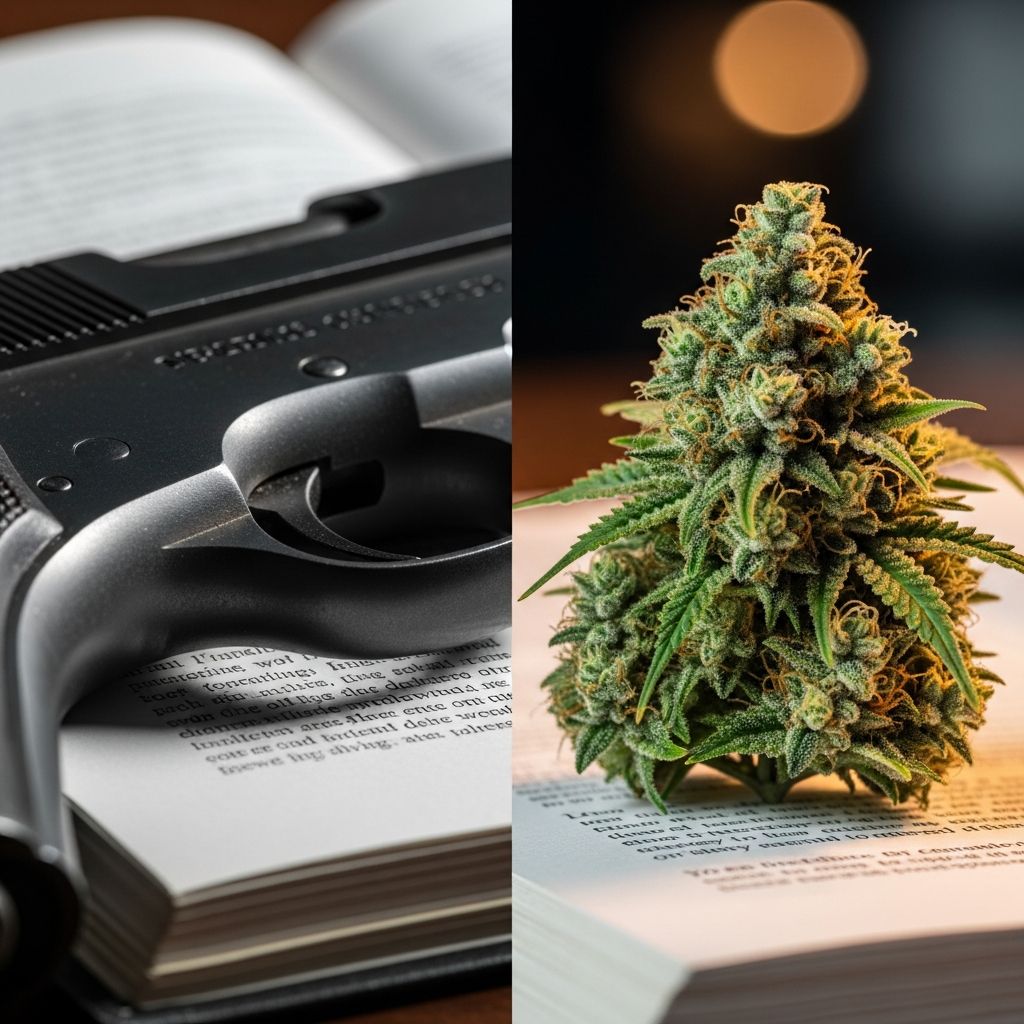
Federal law strictly prohibits individuals who use controlled substances, including marijuana, from possessing firearms, creating a significant conflict in states where cannabis is legal. This prohibition stems from longstanding statutes that classify marijuana users as unlawful, overriding state permissions and affecting millions of Americans.
The Federal Prohibition on Guns for Drug Users
At the core of this issue is 18 U.S.C. § 922(g)(3), which bars the sale, transfer, or possession of firearms by anyone who is an ‘unlawful user of or addicted to any controlled substance.’ Marijuana remains a Schedule I drug under the Controlled Substances Act, making even state-legal users federally prohibited from owning guns.
When purchasing a firearm from a licensed dealer, buyers complete ATF Form 4473, which explicitly asks if they are an unlawful user of marijuana or other controlled substances. Answering ‘yes’ disqualifies the buyer; answering ‘no’ while using cannabis exposes them to felony charges for lying on the form.
This rule applies not only to purchases but also to possession. Longtime gun owners who begin using legal marijuana in their state become instant violators, facing potential federal prosecution.
State Legalization vs. Federal Supremacy
Over 20 states have legalized recreational marijuana, and nearly all allow medical use, yet federal law does not recognize these changes. This discrepancy leaves cannabis consumers in a precarious position, unable to exercise Second Amendment rights without risking severe penalties.
In Nevada, for instance, dispensaries scan IDs for every purchase, creating records that could be subpoenaed by federal authorities investigating gun violations. Even private possession of previously owned firearms becomes illegal upon marijuana use.
- Recreational legalization in 24 states as of 2025.
- Medical programs in 38 states.
- Federal classification unchanged since 1970.
Advocates argue this creates an unfair burden, punishing law-abiding citizens who follow state laws.
Key Supreme Court Challenges
The U.S. Supreme Court is poised to address this tension in cases like U.S. v. Hemani (also referenced in related appeals). A Texas man faced charges for gun possession after admitting regular marijuana use, despite no evidence of intoxication during possession.
The Fifth Circuit Court of Appeals ruled the blanket ban unconstitutional under the Second Amendment framework established in New York State Rifle & Pistol Association v. Bruen (2022), which requires gun restrictions to align with historical traditions. The court held that prohibiting all marijuana users—many of whom use responsibly—lacks historical precedent, though it allowed restrictions for those actively impaired.
The Justice Department appealed, arguing habitual drug users pose unique dangers greater than alcohol consumers, justifying the broad prohibition. Nineteen states, including Nevada under Attorney General Aaron Ford, supported upholding the ban, claiming even sober cannabis users cannot be trusted with firearms.
Arguments are scheduled for the 2026 term, with a potential ruling reshaping gun rights for 20% of Americans who have used marijuana.
Landmark Lower Court Decisions
| Case | Court | Ruling | Impact |
|---|---|---|---|
| Wilson v. Lynch | Ninth Circuit | Uphheld federal ban | Denied gun purchase to medical marijuana patient in Nevada |
| U.S. v. Daniels (related) | Fifth Circuit | Struck down ban | Overturned conviction; limited to intoxication |
| Unnamed Texas Case | Fifth Circuit / SCOTUS | Pending review | Challenges blanket prohibition post-Bruen |
These cases highlight circuit splits: some uphold the full ban, others narrow it to active intoxication, necessitating Supreme Court clarification.
Legislative Efforts for Reform
The GRAM Act (Gun Rights And Marijuana Act, H.R. 2772, 118th Congress) seeks to exempt adults whose marijuana use is legal under state or tribal law from federal firearms restrictions. Introduced in April 2023, it directly addresses the conflict but has not advanced significantly.
Similar proposals have surfaced in states like Colorado, where a 2019 bill to protect medical marijuana patients’ gun rights failed amid federal concerns. Bipartisan support exists, including from Sen. Lisa Murkowski, urging ATF to align policies with state laws.
Practical Risks and ATF Guidance
The Bureau of Alcohol, Tobacco, Firearms and Explosives (ATF) enforces the ban rigorously. Dealers must refuse sales to known marijuana users, and open admission—like medical cards—triggers denial.
Even without a card, social media posts or dispensary records could flag users. Prosecution remains rare but possible, with felonies carrying up to 10 years imprisonment.
- Avoid admitting use on ATF forms.
- Pre-existing guns become illegal upon use.
- State-legal status offers no federal defense.
Broader Implications for Rights
This clash pits Second Amendment protections against drug policy. Critics call the ban outdated, given marijuana’s rescheduling discussions and lower public health risks compared to alcohol, which faces no such firearm bar.
If the Supreme Court narrows the prohibition, it could protect millions; upholding it reinforces federal supremacy over state reforms. Either way, it underscores the need for federal cannabis rescheduling or legalization.
Frequently Asked Questions (FAQs)
Can I legally own a gun if I have a medical marijuana card?
No, under federal law, medical marijuana users are considered unlawful users of a controlled substance, prohibiting firearm possession regardless of state approval.
Does the federal ban only apply to buying guns, not owning them?
No, it prohibits possession entirely, meaning prior owners violate the law upon starting cannabis use.
What happens if I lie on ATF Form 4473 about marijuana use?
It’s a federal felony punishable by up to 10 years in prison and fines.
Will the Supreme Court change this?
Pending cases like U.S. v. Hemani may narrow or uphold the ban; a decision is expected in 2026.
Are there exceptions for occasional users?
No current exceptions; the law targets ‘unlawful users,’ interpreted broadly by most courts.
State-by-State Overview
| State | Cannabis Status | Gun Ban Enforcement Notes |
|---|---|---|
| Nevada | Recreational + Medical | AG supports federal ban; ID scans create records |
| Colorado | Recreational + Medical | Advocates push reform; failed state bill |
| Texas | Limited Medical | Site of key SCOTUS case |
This table summarizes variations, but federal law dominates.
References
- H.R.2772 – 118th Congress (2023-2024): GRAM Act — Congress.gov. 2023-04-20. https://www.congress.gov/bill/118th-congress/house-bill/2772
- Supreme Court to hear case on marijuana use and gun ownership legality — NEWS3LV. Accessed 2025. https://news3lv.com/features/breaking-down-the-law/supreme-court-to-hear-case-on-marijuana-use-and-gun-ownership-legality
- Supreme Court to Rule on Gun Ownership by Drug Users — Connecticut Criminal Lawyer. Accessed 2025. https://www.connecticutcriminallawyer.com/blog/supreme-court-to-rule-on-gun-ownership-by-drug-users
- Marijuana Policy Reforms and the Second Amendment — Marijuana Policy Project. Accessed 2025. https://www.mpp.org/policy/federal/secondamendment/
- SCOTUS to consider if marijuana users can legally own guns — YouTube (Denver 7 Transcript). 2025. https://www.youtube.com/watch?v=LDo8WCVe31g
- OPINION: Attorney General Ford argues that legal cannabis users have no gun rights — The Nevada Independent. 2025-03. https://thenevadaindependent.com/article/opinion-attorney-general-ford-argues-that-legal-cannabis-users-have-no-gun-rights
Similar Articles








Read full bio of medha deb


