
Fingerprint Forensics: Science, Courts, and Challenges
Unravel the pivotal role of fingerprint evidence in modern criminal justice, from collection to courtroom scrutiny.
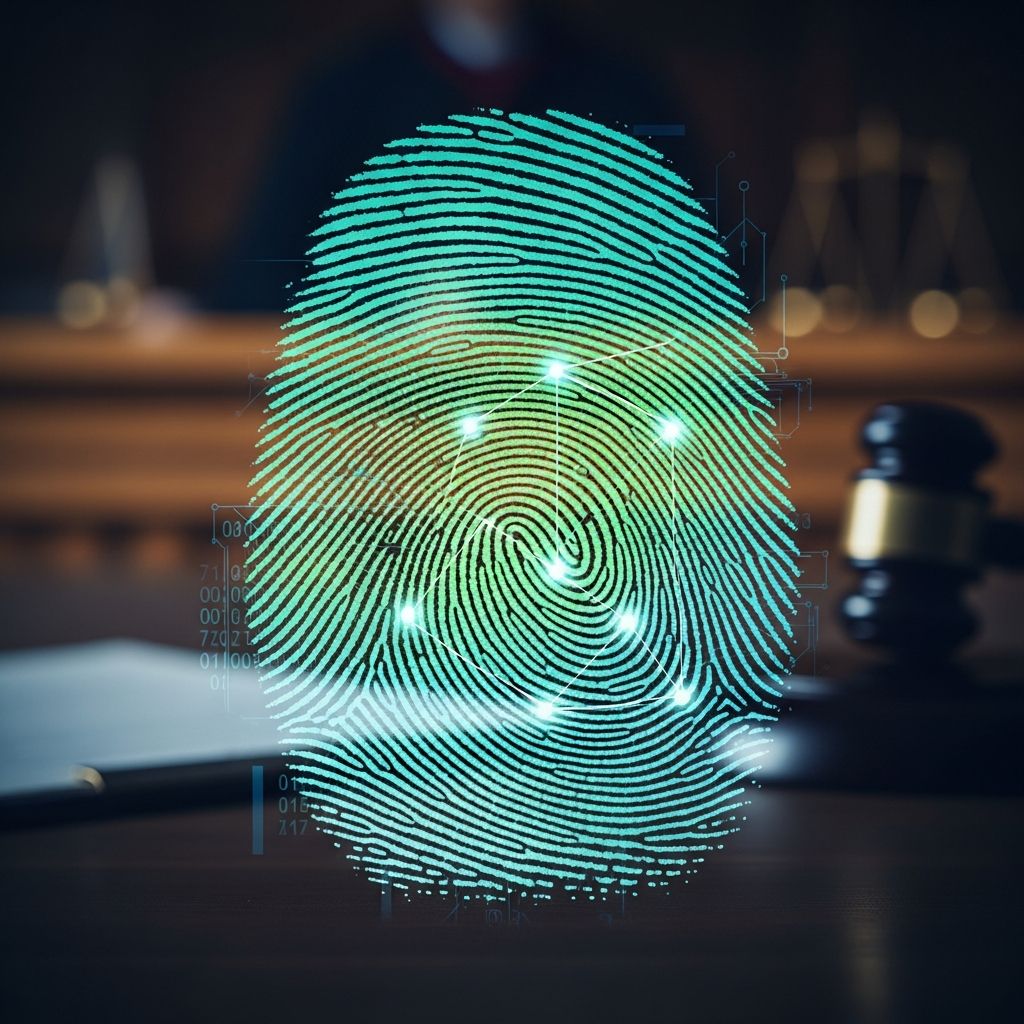
Fingerprint evidence stands as one of the most enduring pillars of forensic science, linking suspects to crime scenes with remarkable precision. Formed uniquely during fetal development, these ridge patterns on fingers remain unchanged throughout life, making them invaluable for identification in criminal cases.
The Biological Uniqueness of Fingerprints
Human fingerprints consist of friction ridges that develop in the womb and persist lifelong, unaffected by injury unless scarring alters them permanently. These patterns—loops, whorls, and arches—form the basis for individual identification, as no two people share identical configurations.
Forensic experts classify prints into three main categories:
- Loops: Ridges entering from one side, curving, and exiting the same side (about 60-65% of prints).
- Whorls: Circular or spiral patterns (30-35%).
- Arches: Ridges flowing from one side to the other without recurving (5%).
Within these, minutiae—ridge endings, bifurcations, and islands—provide the fine details for matching. This uniqueness underpins fingerprinting’s reliability, used globally by agencies like INTERPOL to confirm identities in investigations.
Types of Fingerprints in Crime Scene Investigation
Investigators encounter three primary fingerprint types at scenes:
- Patent prints: Visible impressions left in substances like blood, ink, or dirt.
- Plastic prints: Three-dimensional impressions in soft materials like wax or putty.
- Latent prints: Invisible deposits of sweat, oils, or residues requiring chemical or physical enhancement.
Latent prints, the most common and challenging, demand specialized recovery techniques. Experts dust surfaces with powders, apply cyanoacrylate fuming, or use ninhydrin for paper evidence to visualize them.
Step-by-Step Collection at Crime Scenes
Effective fingerprint recovery begins at the scene. Technicians photograph prints in place before lifting to preserve context. They use alternate light sources, lasers, or chemical sprays to reveal hidden latents on varied surfaces.
Key collection methods include:
| Method | Surface Type | Description |
|---|---|---|
| Powder dusting | Smooth, non-porous | Black or magnetic powder adheres to oils; lifted with tape. |
| Cyanoacrylate fuming | Plastic, metal | Superglue vapor polymerizes on moisture, hardening prints. |
| Chemical developers (e.g., ninhydrin) | Porous (paper) | Reacts with amino acids in sweat for color change. |
| Vacuum metal deposition | Non-porous, difficult | Thin metal layers enhance faint prints. |
Once lifted, prints are digitized and entered into databases like AFIS (Automated Fingerprint Identification System) for preliminary candidate matching.
The ACE-V Protocol: Core of Expert Analysis
Forensic fingerprint examiners follow the rigorous ACE-V methodology—Analysis, Comparison, Evaluation, and Verification—to ensure objectivity. This standardized process, endorsed by bodies like the FBI, minimizes subjective bias.
Phase 1: Analysis
Examiners assess latent print quality using a loupe or magnifier, noting minutiae count, clarity, and physical features like scars or creases. Insufficient detail leads to ‘no value’ determinations, halting analysis.
Phase 2: Comparison
Suitable latents are overlaid with known exemplars (ink prints from suspects or AFIS hits). Examiners align core points and trace ridge paths, counting agreeing minutiae sequences.
Phase 3: Evaluation
Decisions emerge: individualization (source identification), exclusion (different sources), or inconclusive. True positives confirm mated pairs; errors include false positives (non-mated individualizations) or false negatives.
Phase 4: Verification
A second qualified examiner independently reviews the conclusion, documenting agreement or discord. This blind verification bolsters reliability.
Studies show ACE-V yields high accuracy: in one large-scale trial with 744 print pairs, false positive rates were low (near 0%), though variability exists among examiners.
Technology Enhancing Fingerprint Matching
Modern forensics integrates AFIS, which scans millions of records using algorithms to rank candidates by similarity scores. Live scan devices capture exemplars digitally, replacing ink cards.
Emerging tools like AI-assisted analysis flag potential matches faster, but human experts make final calls to uphold scientific standards.
Presenting Fingerprint Evidence in Court
Admissible under standards like Daubert or Frye, fingerprint testimony requires examiners to qualify as experts, detailing ACE-V application without overstating certainty (e.g., avoiding ‘100% match’).
Prosecutors use enlarged charts highlighting minutiae correspondences—typically 12-16 points for individualization. Defense may challenge via cross-examination on error rates or contextual bias.
Judges evaluate:
- Peer-reviewed validation of methods.
- Known error rates from proficiency tests.
- General acceptance in the forensic community.
Potential Errors and Reliability Concerns
Despite strengths, fingerprint analysis faces scrutiny. The 2004 Madrid bombing misidentification prompted FBI reviews, revealing human factors like fatigue or pressure.
Research indicates:
- False positives: Rare (0.18% in controlled studies) but impactful in high-stakes cases.
- False negatives: Higher in poor-quality latents.
- Examiner variability: Conclusion rates differ (15-96% on non-mated pairs).
Mitigations include blinding verifiers to case details and standardized training. Latent quality strongly predicts suitability; video-enhanced ‘of value’ prints yield better outcomes.
Historical Milestones in Fingerprint Use
Fingerprints entered forensics in the late 19th century: Sir Francis Galton proved uniqueness (1892), while Scotland Yard adopted them post-1901 Porcelain Bowl case. By 1912, U.S. courts upheld their validity.
Today, they outpace DNA at scenes due to ubiquity—left on nearly every touched surface.
Future Directions and Innovations
Advancements like hyperspectral imaging detect prints on challenging substrates, while 3D scanning captures plastic impressions accurately. AI promises faster triage, but ethical concerns demand validation studies.
International standards from INTERPOL harmonize practices, enhancing cross-border cases.
Frequently Asked Questions (FAQs)
What is the ACE-V method in fingerprint analysis?
ACE-V stands for Analysis (assess suitability), Comparison (side-by-side review), Evaluation (source decision), and Verification (blind second opinion). It’s the gold standard for latent print exams.
Can fingerprints be faked or altered?
Genuine alterations via surgery are detectable by scarring; temporary spoofs like glue fail under minutiae scrutiny.
How many matching points prove identity?
No universal number; U.S. experts use 12+ with sequence agreement, prioritizing quality over quantity.
Are fingerprints more reliable than DNA?
Both are robust, but fingerprints are faster/cheaper at scenes; DNA suits trace evidence.
What if a print is inconclusive?
It means insufficient detail for decision; investigators pursue other leads.
References
- Fingerprint Analysis in Forensic Science – An Overview — LIFS. 2023. https://lifs.co.in/blog/fingerprints-analysis-in-forensic-science.html
- Fingerprint Analysis: How It’s Done — Forensic Science Simplified. Accessed 2026. https://www.forensicsciencesimplified.org/prints/how.html
- Accuracy and reliability of forensic latent fingerprint decisions — National Center for Biotechnology Information (PMC). 2011-05-24. https://pmc.ncbi.nlm.nih.gov/articles/PMC3093498/
- Fingerprint — Wikipedia. Accessed 2026. https://en.wikipedia.org/wiki/Fingerprint
- Fingerprints — INTERPOL. Accessed 2026. https://www.interpol.int/en/How-we-work/Forensics/Fingerprints
- Fingerprint Analysis: Fact v. Fiction — George Washington University Columbian College. Accessed 2026. https://columbian.gwu.edu/fingerprint-analysis-fact-v-fiction
Similar Articles








Read full bio of Sneha Tete


