
School-To-Prison Pipeline: A Comprehensive Guide To Reform Now
Reclaiming student rights from the school-to-prison pipeline.
The Crisis In Our Classrooms: Understanding the School-to-Prison Pipeline
Public schools in the United States were fundamentally designed to be sanctuaries of learning, growth, and opportunity. They are envisioned as the great equalizer, a space where every child, regardless of their background, is afforded the tools to build a successful and meaningful life. However, for a significant and growing number of marginalized students, the reality of public education is starkly different. Instead of a pathway to higher education or career readiness, their educational experience is dominated by surveillance, hyper-punitive discipline, and systemic exclusion. This disturbing phenomenon is widely known as the school-to-prison pipeline.
The school-to-prison pipeline is not a singular policy but a complex, overlapping web of local, state, and federal practices that systematically push children out of the classroom and into the juvenile and adult criminal justice systems. It represents a profound failure of the educational system, prioritizing incarceration and punishment over pedagogical support and intervention. By criminalizing normal adolescent behavior and relying heavily on law enforcement to handle routine school discipline, the pipeline irreparably harms young lives and undermines the constitutional right to a public education.
To dismantle this pipeline, we must first understand its architecture. We must interrogate the zero-tolerance policies that feed it, the disproportionate impact it has on students of color and students with disabilities, and the expanding presence of law enforcement officers within school corridors. Only through comprehensive reform and a dedication to restorative justice can we reclaim our schools as environments of learning rather than sites of criminalization.
The Architecture of Exclusion: Zero-Tolerance Policies
The roots of the modern school-to-prison pipeline can be traced back to the proliferation of zero-tolerance policies in the 1990s. Initially conceived as a strict response to severe infractions such as the possession of firearms or illegal drugs on campus, these policies rapidly expanded. Over time, the broad umbrella of zero-tolerance began to encompass minor, subjective behavioral issues—ranging from dress code violations and insubordination to simply talking back to a teacher.
Under a zero-tolerance framework, school administrators are often stripped of their discretion. Predetermined, harsh punishments—most notably out-of-school suspensions and expulsions—are mandated regardless of the context, the student’s history, or the underlying causes of the behavior. This reliance on exclusionary discipline is inherently counterproductive to the educational mission. When a student is suspended, they are removed from the learning environment, which directly correlates with a higher likelihood of academic failure, chronic absenteeism, and dropping out of school entirely.
Furthermore, exclusionary discipline fails to address the root causes of a student’s misbehavior, which often stem from trauma, unaddressed learning disabilities, or socioeconomic stressors. Instead of offering counseling or specialized educational support, schools isolate the student. Left unsupervised and disconnected from their educational community, suspended students face a significantly higher risk of encountering the juvenile justice system. The pipeline is thus sustained by a disciplinary philosophy that chooses immediate removal over meaningful, long-term intervention.
Disproportionate Impacts on Marginalized Communities
Perhaps the most alarming aspect of the school-to-prison pipeline is its stark inequity. The punitive measures that define the pipeline are not applied evenly across the student population. Extensive research and federal data consistently demonstrate that students of color, boys, and students with disabilities bear the overwhelming brunt of exclusionary discipline and school-based arrests.
The disparities are not indicative of higher rates of misbehavior among these groups; rather, they reflect systemic biases and the subjective application of disciplinary rules. For example, infractions labeled as “defiance” or “disruption” are highly subjective and leave ample room for implicit bias to influence an educator’s or administrator’s response. Consequently, a white student might receive a gentle reprimand for talking out of turn, while a Black student committing the exact same infraction may face out-of-school suspension or even referral to law enforcement.
Examining the Disciplinary Data
Federal data highlights the severity of these disparities. The U.S. Government Accountability Office (GAO) and the Department of Education’s Civil Rights Data Collection (CRDC) have repeatedly published findings that underscore the racial and disability-related gaps in school discipline.
| Student Demographic | Percentage of Total Enrollment | Percentage of Total Suspensions |
|---|---|---|
| Black Students | ~15.5% | ~39.0% |
| Students with Disabilities | ~12.0% | ~25.0% |
| White Students | ~50.0% | ~32.0% |
Note: Data approximations based on the GAO 2018 report and CRDC snapshots. These figures illustrate the severe overrepresentation of specific groups in disciplinary actions.
The intersectionality of these identities compounds the risk. Black students with disabilities are subjected to exclusionary discipline at exponentially higher rates than their white peers without disabilities. The U.S. Commission on Civil Rights noted that these overlapping vulnerabilities push students into the justice system with devastating efficiency. When a school system fails to accommodate a student’s disability and instead criminalizes the behavioral manifestations of that disability, it commits a profound civil rights violation under statutes like the Americans with Disabilities Act (ADA) and Section 504 of the Rehabilitation Act.
The Criminalization of Adolescence: School Resource Officers (SROs)
A critical engine driving the school-to-prison pipeline is the widespread integration of law enforcement within educational facilities. Often designated as School Resource Officers (SROs), these individuals are fully sworn police officers deployed to patrol school hallways. While the stated objective of SRO programs is to enhance school safety and protect students from external threats, their presence frequently yields unintended and harmful consequences.
The deployment of SROs fundamentally alters the school climate, shifting the paradigm from education to enforcement. In many districts, the boundary between standard school discipline and criminal law enforcement has become dangerously blurred. Routine behavioral issues—such as a minor scuffle in the cafeteria, a verbal altercation, or a teenager acting out—are increasingly escalated from the principal’s office to the police precinct. What would have historically resulted in detention or a call to parents is now classified as “assault,” “disorderly conduct,” or “disturbing the peace,” resulting in physical arrests and criminal records.
Research indicates that schools with a dedicated police presence report significantly higher rates of arrests for low-level, non-violent offenses compared to schools without SROs. The “Resource” in School Resource Officer is frequently a misnomer; these officers are typically trained to operate as an arm of local law enforcement, not as youth counselors or social workers. They are trained to identify suspects and mitigate threats using force and the law, a skill set that is fundamentally misaligned with the developmental and emotional needs of children. This criminalization of typical adolescent development is a direct pipeline to the juvenile justice system, causing severe psychological trauma and irreparably damaging a student’s future prospects.
Legal Frameworks and Civil Rights Violations
The operation of the school-to-prison pipeline raises profound civil rights concerns. When disciplinary policies systematically disadvantage specific racial groups, they implicate Title VI of the Civil Rights Act of 1964, which prohibits discrimination on the basis of race, color, or national origin in any program receiving federal financial assistance. Even if a school’s disciplinary policy appears neutral on paper, a starkly disproportionate impact on students of color can serve as evidence of unlawful discrimination.
Similarly, the aggressive disciplining of students with disabilities frequently violates federal law. The Individuals with Disabilities Education Act (IDEA) mandates that schools provide specialized support and evaluate whether a student’s misbehavior is a manifestation of their disability before applying severe disciplinary measures. In practice, however, under-resourced schools often bypass these legal safeguards, opting for rapid exclusion rather than necessary intervention and accommodation.
Advocacy groups and civil rights lawyers across the country are actively challenging these practices in court, arguing that the excessive use of exclusionary discipline and the over-reliance on school-based arrests deprive students of their fundamental right to a safe and equitable education. These legal battles are essential in forcing systemic accountability and highlighting the constitutional breaches occurring daily in American classrooms.
Reimagining School Safety: The Path to Restorative Justice
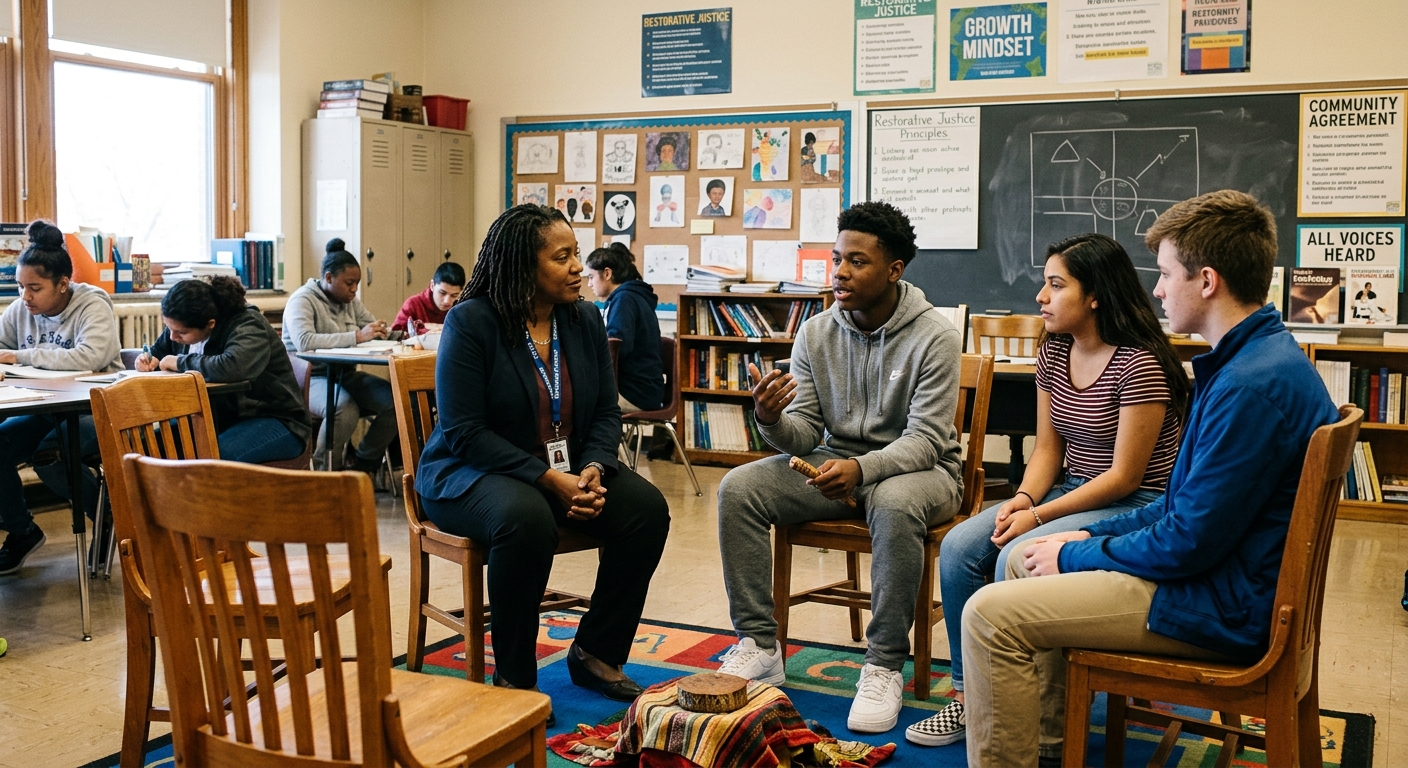
Dismantling the school-to-prison pipeline requires a radical reimagining of school safety and student discipline. We must transition away from a culture of punishment and embrace a culture of support. This begins with the widespread adoption of restorative justice practices. Unlike exclusionary discipline, which isolates the offender, restorative justice focuses on accountability, healing, and community reintegration. It brings together the affected parties to discuss the harm caused and to collaboratively determine a path forward, thereby teaching vital conflict resolution skills.
Furthermore, schools must prioritize the implementation of Positive Behavioral Interventions and Supports (PBIS) and trauma-informed care. Educators and administrators need comprehensive training to recognize the signs of trauma and to understand how adverse childhood experiences manifest in the classroom. By responding to misbehavior with empathy and support rather than handcuffs and suspensions, schools can interrupt the cycle of alienation.
A crucial step in this transformation is the reallocation of resources. Rather than funding police presence in schools, school districts and municipalities must invest in student support personnel. The hiring of school counselors, social workers, psychologists, and specialized behavioral interventionists provides students with the mental health and emotional resources they desperately need. Creating genuinely safe schools means ensuring that students feel physically, emotionally, and psychologically secure—an environment that surveillance and policing cannot manufacture.
Frequently Asked Questions
What exactly is the school-to-prison pipeline?
The school-to-prison pipeline refers to a disturbing national trend wherein children are funneled out of public schools and into the juvenile and criminal justice systems. This pipeline is largely driven by zero-tolerance disciplinary policies, the increased presence of police in schools, and the harsh punishment of minor infractions.
How do zero-tolerance policies harm students?
Zero-tolerance policies mandate harsh, predetermined punishments (like suspension or expulsion) for rule violations, regardless of the context. These policies harm students by removing them from the educational environment, increasing their chances of falling behind academically, dropping out, and interacting with the justice system.
Why are marginalized students disproportionately affected?
Systemic biases and the subjective nature of many school rules (such as punishing “defiance”) lead to unequal enforcement. Data shows that Black students, Indigenous students, and students with disabilities receive harsher punishments for the same behaviors compared to their white, non-disabled peers.
What are alternatives to police in schools?
Alternatives include investing in mental health resources by hiring more school counselors, social workers, and psychologists. Schools can also adopt restorative justice programs, which focus on repairing harm and teaching conflict resolution rather than relying on punitive enforcement and arrests.
Conclusion
The fight against the school-to-prison pipeline is one of the most critical civil rights battles of our time. Every child deserves an education that builds them up rather than tears them down. By challenging discriminatory zero-tolerance policies, reconsidering the role of law enforcement in schools, and investing heavily in restorative, trauma-informed practices, we can begin to dismantle this oppressive system. Ensuring that our public schools function as engines of opportunity rather than vestibules to the carceral state is not just an educational necessity; it is a profound moral imperative.
References
- Beyond Suspensions: Examining School Discipline Policies and Connections to the School-to-Prison Pipeline for Students of Color with Disabilities — U.S. Commission on Civil Rights. 2019-07-23. https://www.usccr.gov/files/pubs/2019/07-23-Beyond-Suspensions.pdf
- K-12 Education: Discipline Disparities for Black Students, Boys, and Students with Disabilities — U.S. Government Accountability Office (GAO). 2018-03-22. https://www.gao.gov/products/gao-18-258
- Civil Rights Data Collection – Data Snapshot: School Discipline — U.S. Department of Education, Office for Civil Rights. 2014-03-21. https://ocrdata.ed.gov/assets/downloads/CRDC-School-Discipline-Snapshot.pdf
- A better path forward for criminal justice: Reconsidering police in schools — Brookings Institution. 2021-04-09. https://www.brookings.edu/articles/a-better-path-forward-for-criminal-justice-reconsidering-police-in-schools/
Similar Articles








Read full bio of Sneha Tete




