Introduction: The Catalyst for Change
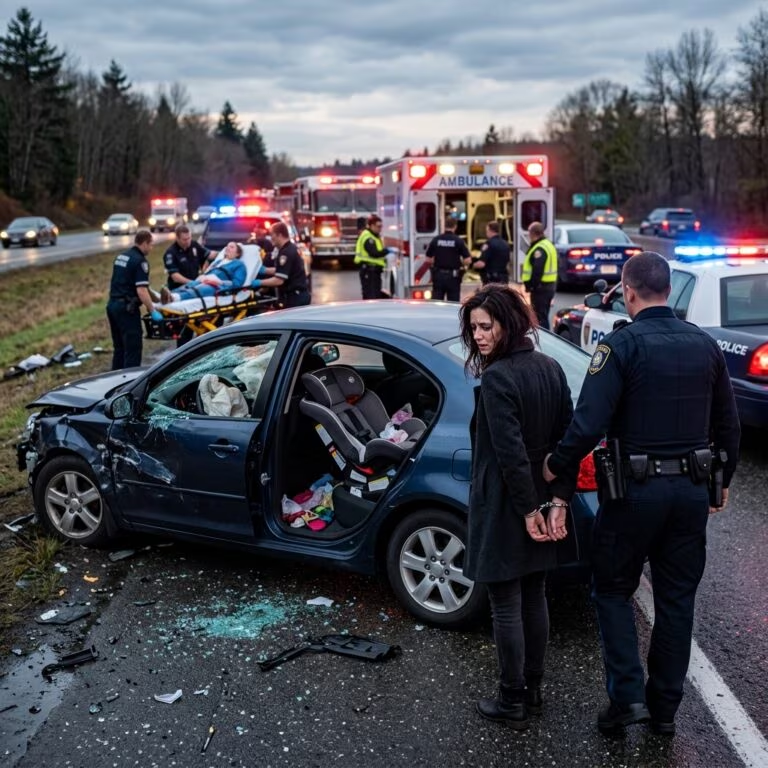
The year 2020 served as a profound watershed moment in the history of American civil rights. Following the tragic, highly publicized deaths of unarmed citizens, unprecedented public demonstrations erupted across the nation. Civilians demanded a fundamental reevaluation of how law enforcement operates, particularly within marginalized communities of color where historical tensions have long simmered. Trust between police departments and the civilians they are sworn to protect had fractured to critical, unsustainable lows. In the immediate aftermath, there was a flurry of proposed state and municipal reforms, yet a cohesive, unified national standard remained elusive due to entrenched congressional gridlock.
Recognizing the absolute urgency of the moment and the stalling of legislative avenues, the executive branch assumed the mantle of leadership. In May 2022, a sweeping and historic Executive Order was issued, designed to radically alter the rules of engagement for federal law enforcement agencies while concurrently creating a strategic blueprint for local jurisdictions to emulate. This maneuver marked a significant paradigm shift in federal policing policy. However, as civil rights advocates, legal scholars, and policy analysts have rightly pointed out, executive action can only serve as the foundational bedrock. True, enduring reform—the kind that survives the shifting winds of political administrations—demands a comprehensive legislative overhaul capable of permanently bridging the vast chasm between federal mandates and local police operations.
Historical Context: The Long Road to Data and Accountability
To fully grasp the magnitude and necessity of recent executive actions, one must look back at the historical struggles to quantify and correct police misconduct. For decades, the United States operated without a centralized, mandatory repository for tracking law enforcement use of force or officer misconduct. The Violent Crime Control and Law Enforcement Act of 1994 first directed the Attorney General to collect data on excessive force. However, measuring this accurately across a decentralized web of over 18,000 independent police departments proved monumentally difficult.
The sheer scale of policing in America makes oversight a daunting logistical challenge. In 2022 alone, approximately 49.2 million U.S. residents aged 16 or older had contact with police, illustrating the immense volume of daily interactions that require standardized oversight. While the vast majority of these interactions are resolved safely, the lack of standardized accountability meant that \”wandering officers\”—those fired for egregious misconduct in one jurisdiction who quietly find employment in another—remained a persistent threat to public safety. The fractured, localized nature of American policing made it nearly impossible to maintain a unified front on civil rights protections, creating an urgent need for federal intervention and centralized data tracking.
Decoding Executive Order 14074: A Blueprint for Federal Agents
The issuance of Executive Order 14074, formally titled \”Advancing Effective, Accountable Policing and Criminal Justice Practices to Enhance Public Trust and Public Safety,\” represented one of the most ambitious federal directives on policing in modern history. The order laid down strict, unequivocal rules for the approximately 100,000 federal law enforcement officers operating under the Department of Justice, the Department of Homeland Security, and other federal entities.
- Restricting Use of Force: The order mandated updated use-of-force policies that prioritize de-escalation tactics and the preservation of human life. Most notably, it strictly prohibited the use of chokeholds and carotid restraints unless deadly force is explicitly authorized, eliminating dangerous techniques that have frequently resulted in unnecessary fatalities.
- Limiting No-Knock Entries: The directive severely curtailed the controversial use of \”no-knock\” warrants. By requiring federal agents to announce their presence and purpose before entering a premise, the order aimed to prevent the chaotic, heavily armed, and often tragic misunderstandings that occur during surprise dynamic entries.
- Demilitarization of Agencies: The order rolled back the highly criticized transfer of military-grade equipment, such as bayonets, tracked armored vehicles, and grenade launchers, to state and local law enforcement agencies. This step was crucial in shifting the visual and tactical paradigm of policing away from a militarized occupying force back to a community-oriented protective service.
The National Law Enforcement Accountability Database (NLEAD)
One of the most consequential deliverables of the 2022 executive order was the creation of the National Law Enforcement Accountability Database (NLEAD). Officially launched to track verified records of misconduct, this centralized repository directly addresses the long-standing loophole that allowed disgraced officers to jump seamlessly between agencies.
The comprehensive database documents a wide variety of severe infractions. This includes criminal convictions, administrative suspensions linked to misconduct, outright terminations, and resignations while an officer is under active investigation for serious offenses. Between 2018 and 2023, the system tracked hundreds of critical records annually, providing hiring personnel within federal agencies the vital information needed to vet job candidates thoroughly and prevent the recycling of problematic officers. While the system is currently limited strictly to federal officers, the successful establishment of NLEAD serves as a robust, functional proof-of-concept for what a national, all-encompassing registry could look like, setting an entirely new gold standard for transparency in law enforcement hiring.
Bridging the Gap: Incentivizing State and Local Jurisdictions
The fundamental constitutional limitation of any presidential executive order is its jurisdictional reach. The U.S. Constitution, through the Tenth Amendment, leaves the general police power to the states. Therefore, the federal mandates regarding chokeholds, no-knock warrants, and mandatory database reporting do not automatically apply to a sheriff’s deputy in Texas, a state trooper in Florida, or a municipal police officer in Ohio.
To navigate this formidable hurdle, the federal government is heavily utilizing its most effective non-legislative lever: the power of the purse. The executive branch has strategically tied compliance with these new, elevated standards to federal grant funding. The Department of Justice now actively works to award highly sought-after discretionary grants in a manner that overwhelmingly favors state, tribal, local, and territorial (STLT) agencies that voluntarily adopt the policies outlined in the executive order. Furthermore, the DOJ has established rigorous new accreditation standards to help local departments align their internal protocols with these federal best practices.
While this incentive-based approach is highly pragmatic, it is inherently limited by its voluntary nature. Well-funded suburban departments might simply opt to forgo federal grants entirely to avoid the strings attached, while severely underfunded rural departments might lack the administrative capacity to achieve the required accreditation. Consequently, the incentive structure creates a fragmented patchwork of accountability rather than an impenetrable, unified safety net.
The Inherent Limits of Executive Action
Executive orders are undeniably powerful tools for immediate policy correction, but they are intrinsically fragile in the long term. Because they completely bypass the traditional legislative process, they can be unilaterally revoked, heavily modified, or intentionally ignored by a subsequent presidential administration with a differing political ideology or law enforcement philosophy. This inherent vulnerability underscores exactly why civil rights advocates and legal scholars view Executive Order 14074 merely as a temporary foundation rather than a permanent, unshakeable edifice.
Furthermore, an executive order fundamentally cannot alter foundational federal statutes or established judicial doctrines that shield individual officers from legal accountability. The most prominent example is \”qualified immunity,\” a powerful judicial doctrine that protects government officials from personal financial liability for constitutional violations unless they violate clearly established statutory rights. Overturning, modifying, or eliminating qualified immunity requires a definitive act of Congress, making direct legislative intervention absolutely indispensable for holistic, lasting reform.
The Legislative Imperative: The George Floyd Justice in Policing Act
To legally secure the fragile gains made by executive action and mandate their expansion across all 50 states, comprehensive, binding legislation is required. The George Floyd Justice in Policing Act represents the most sweeping, ambitious effort to reform law enforcement and enhance accountability in U.S. legislative history. Though it has seen successful passage in the House of Representatives during previous sessions, it has repeatedly stalled in the Senate due to partisan divisions over key provisions.
The Act aims to convert the temporary policies of the executive order into permanent statutory law, while significantly expanding their scope and enforcement mechanisms. The most fiercely debated provision of the Act seeks to alter the legal landscape of qualified immunity, significantly lowering the barrier for citizens to sue police officers in civil court for brutal civil rights violations, thereby fostering a direct culture of personal financial and professional accountability.
Additionally, the legislation addresses the criminal intent standard. Currently, federal law requires prosecutors to prove beyond a reasonable doubt that an officer acted \”willfully\” to deprive a citizen of their rights—an exceptionally high, almost insurmountable legal bar. The Act proposes modifying this stringent standard from \”willfulness\” to \”recklessness,\” making it far more feasible for the Justice Department to prosecute persistently abusive officers. Furthermore, unlike the executive order’s polite incentive-based approach, the Act would tie all federal law enforcement funding strictly to local mandatory adoption of bans on chokeholds and no-knock warrants in drug cases.
Rebuilding Public Trust Through Community-Oriented Solutions
While legislation and executive orders deal primarily with the rigid administrative mechanisms of policing, the ultimate, overarching goal is deeply sociological: repairing the fractured, damaged trust between law enforcement agencies and the diverse communities they serve. Trust is the absolute currency of effective public safety. When citizens do not trust the police, they avoid reporting crimes, they do not step forward as crucial witnesses, and overall community safety rapidly deteriorates.
True, organic reform requires heavily investing in alternative community response models. A significant portion of incidents that currently escalate into police use of force originate as severe mental health crises, complex substance abuse episodes, or tragic instances of homelessness. Diverting substantial public funding toward specialized, unarmed civilian crisis responders, clinical social workers, and mental health professionals can dramatically reduce the daily burden on armed officers. By actively narrowing the scope of what traditional police are expected to handle, agencies can intensely focus on their primary, intended mission of solving and preventing violent crime, thereby reducing the sheer volume of potentially volatile civilian encounters.
Conclusion: A Stepping Stone to Enduring Justice
The federal shift toward uncompromising police accountability is actively in motion, powerfully propelled by the urgent, unyielding demands of a public weary of systemic failures. The 2022 executive directives laid a critical, stabilizing foundation, proving that swift, decisive administrative action can effectively reform massive federal agencies and set a powerful, undeniable example for the rest of the nation. Through the establishment of the accountability database and the implementation of stringent, life-preserving use-of-force guidelines, the federal government has firmly drawn a line in the sand.
However, foundations are purposefully meant to be built upon, not lived in. Without the eventual passage of robust, permanent, and binding legislation like the George Floyd Justice in Policing Act, the vital progress made remains highly vulnerable to political headwinds and frustrating jurisdictional limitations. The arduous journey toward a truly just, equitable, and accountable American criminal justice system is long and complex. Yet, by strategically leveraging both immediate executive leadership and sustained legislative fortitude, a safer, more transparent future for all communities remains entirely within reach.
Frequently Asked Questions (FAQs)
- What is the National Law Enforcement Accountability Database (NLEAD)?
The NLEAD is a centralized federal repository created to meticulously document instances of serious misconduct among federal law enforcement officers. It successfully tracks official records such as criminal convictions, administrative suspensions, and terminations related to misconduct, ensuring that federal agencies have immediate access to a candidate’s full disciplinary history during the hiring process. - How does a federal executive order legally affect local police departments?
Federal executive orders primarily direct the actions of federal agencies (such as the FBI, DEA, and Border Patrol). However, they can strongly influence local and state police departments by conditionally tying lucrative federal grant money and prestigious accreditation opportunities to the voluntary adoption of the order’s high standards, such as aggressively banning chokeholds or updating use-of-force policies. - Why is qualified immunity a major focus in modern police reform debates?
Qualified immunity is a powerful legal doctrine that heavily shields government officials, including armed police officers, from being held personally liable in civil lawsuits unless they directly violated a \”clearly established\” statutory or constitutional right. Critics and civil rights advocates argue it creates an almost insurmountable, unfair barrier for innocent victims actively seeking legal justice and financial accountability for horrific civil rights violations. - What is the George Floyd Justice in Policing Act?
It is a comprehensive, historically significant piece of proposed federal legislation aimed at forcefully combating police misconduct, excessive force, and systemic racial bias in modern policing. Key, sweeping provisions include banning chokeholds and no-knock warrants on a strictly national level, modifying qualified immunity for law enforcement, and actively establishing a national registry of police misconduct that legally encompasses all local, state, and federal jurisdictions.
References
- Advancing Effective, Accountable Policing and Criminal Justice Practices To Enhance Public Trust and Public Safety — Federal Register. 2022-05-31. https://www.federalregister.gov/documents/2022/05/31/2022-11810/advancing-effective-accountable-policing-and-criminal-justice-practices-to-enhance-public-trust-and
- Padilla, Booker Introduce Sweeping Law Enforcement Reforms Through George Floyd Justice in Policing Act — Office of U.S. Senator Alex Padilla. 2024-08-06. https://www.padilla.senate.gov/newsroom/press-releases/padilla-booker-introduce-sweeping-law-enforcement-reforms-through-george-floyd-justice-in-policing-act/
- National Law Enforcement Accountability Database, 2018–2023 — Bureau of Justice Statistics. 2024-12-01. https://bjs.ojp.gov/library/publications/national-law-enforcement-accountability-database-2018-2023
- Contacts Between Police and the Public, 2022 — Bureau of Justice Statistics. 2024-10-04. https://bjs.ojp.gov/library/publications/contacts-between-police-and-public-2022