
The Federal Death Penalty and America’s Evolving Values
Examining political promises versus federal death penalty realities.
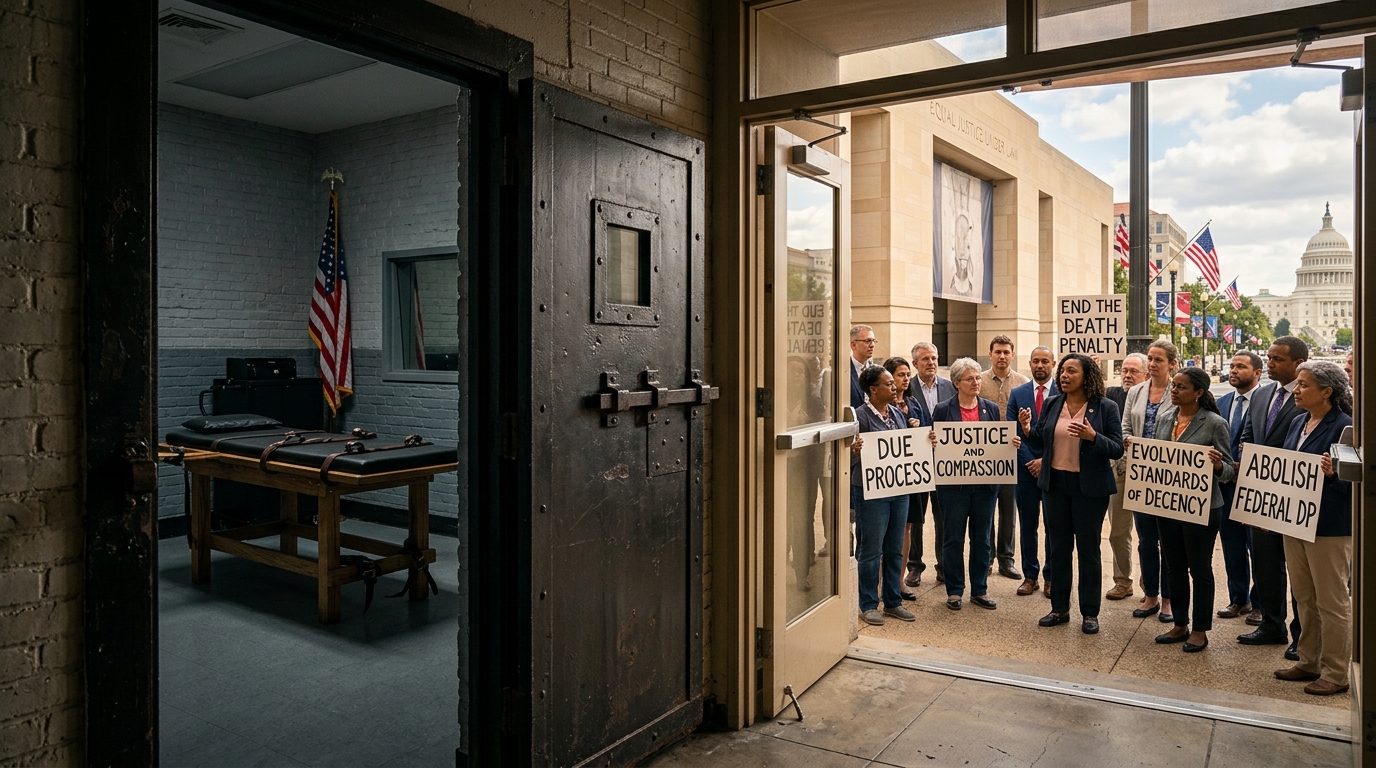
A Nation at a Crossroads on Capital Punishment
Capital punishment has long been one of the most profoundly debated and ethically fraught issues within the American criminal justice system. For centuries, the ultimate punishment was viewed by many as a necessary deterrent and an instrument for absolute retribution. However, as the nation evolves, so too do its collective moral compass and its understanding of justice. Today, the United States finds itself at a unique crossroads regarding the federal death penalty. The practice is increasingly scrutinized not just by human rights advocates, but by mainstream political figures, legal scholars, and the general public.
At the heart of this contemporary debate is the noticeable gap between the rhetoric used during political campaigns and the subsequent actions taken by governing administrations. As societal values shift toward a more reformative approach to criminal justice, the federal government’s continued entanglement with capital punishment raises pressing questions about whether the death penalty truly reflects modern American ideals, or if it is merely an antiquated relic of a more punitive era.
Political Promises vs. Institutional Inertia
During the 2020 presidential campaign, candidate Joe Biden made a highly publicized pledge: he promised to work toward abolishing the federal death penalty and to incentivize individual states to follow the federal government’s example . This commitment was heralded by civil rights organizations as a monumental step forward, signaling a potential end to a practice that has drawn consistent international condemnation. However, the reality of the administration’s legal maneuvering has proven to be far more complex and contradictory than the campaign trail rhetoric originally suggested.
Under the direction of Attorney General Merrick Garland, the Department of Justice (DOJ) announced a formal moratorium on federal executions in 2021, effectively pausing the scheduling of new execution dates pending a comprehensive review of the department’s internal policies and protocols . While this moratorium temporarily halted the use of the lethal injection chamber at the federal penitentiary in Terre Haute, Indiana, it did not completely dismantle the federal death penalty apparatus. In practice, the DOJ has continued to defend existing capital sentences on appeal and has even authorized federal prosecutors to actively pursue the death penalty in certain new, high-profile cases .
This duality—maintaining a pause on physical executions while actively fighting to secure or uphold death sentences in the courtroom—illustrates the powerful force of institutional inertia within the justice system. Legal scholars and policy critics argue that this bifurcated approach creates a dangerous state of limbo. An executive moratorium is inherently fragile; it relies entirely on the political disposition of the sitting president. Without permanent legislative abolition enacted by Congress, the federal death penalty remains readily available in the statutory code for any future administration to rapidly resurrect. This vulnerability was starkly demonstrated when the Trump administration abruptly ended a 17-year informal hiatus, aggressively carrying out 13 federal executions in its final six months in office .
A Statistical Shift: Why Americans Are Turning Away from the Death Penalty
The political hesitation to fully abolish capital punishment stands in direct contrast to a clear and measurable shift in public opinion. For several decades, maintaining a stringent “tough on crime” stance that included staunch support for the death penalty was considered a political necessity for elected officials. However, recent scientific polling indicates a profound transformation in the American electorate’s viewpoint on the morality and efficacy of state-sanctioned executions.
According to comprehensive polling data released by Gallup spanning into 2024 and 2025, overall public support for the death penalty has plummeted to a five-decade low . Only about 52% to 53% of Americans now state they are in favor of the death penalty for a person convicted of murder. This represents a dramatic and sustained decline from the peak support level of 80% recorded in 1994 . Conversely, moral and practical opposition to the practice has climbed to its highest level since the mid-1960s.
This decline in public endorsement is largely driven by a massive generational divide. Gallup’s detailed demographic analysis reveals that a solid majority of Millennials and Generation Z adults now outright oppose capital punishment . Younger Americans, having grown up in an era heavily characterized by widespread discussions of systemic racism, criminal justice reform, and the well-documented flaws of mass incarceration, tend to view the death penalty through a highly critical and skeptical lens.
The erosion of support is not strictly limited to age demographics; it also crosses established political lines. Support among political Independents and Democrats has steadily decreased over the past two decades. As the general public becomes increasingly informed about the harsh realities of how capital punishment is practically administered—including its exorbitant financial costs compared to life imprisonment without parole—the societal appetite for state-sanctioned executions continues to wane.
Gallup Polling: Death Penalty Support Over Time
| Year | In Favor (%) | Opposed (%) |
|---|---|---|
| 1994 | 80% | 16% |
| 2004 | 64% | 31% |
| 2014 | 63% | 33% |
| 2024 / 2025 | 52% | 44% |
The Unforgiving Reality of Wrongful Convictions
One of the most compelling ethical and practical arguments driving the shift in public opinion is the undeniable fallibility of the legal system. The death penalty is an absolute, irreversible punishment administered by a fundamentally imperfect human institution. Over the past several decades, the advent of advanced post-conviction DNA testing and the tireless investigative work of innocence projects nationwide have laid bare a terrifying reality: the United States criminal justice system has frequently sentenced entirely innocent people to die.
Data meticulously maintained by the Death Penalty Information Center (DPIC) provides a sobering statistical picture of this crisis. Since 1973, at least 200 individuals have been completely exonerated and released from death row after definitive evidence of their innocence was brought to light . To put this staggering figure into perspective, for every eight people executed in the modern era of the death penalty, one person on death row has been proven innocent and exonerated .
These wrongful convictions are rarely the result of honest, unavoidable mistakes. The DPIC research indicates that the leading systemic causes of wrongful capital convictions include pervasive official misconduct by law enforcement or prosecutors, perjury or deliberate false accusations by incentivized informants, mistaken eyewitness identifications, and the heavy reliance on flawed, unvalidated, or fraudulent forensic science. The chilling revelation that the state has repeatedly come perilously close to executing innocent citizens fundamentally undermines the moral authority of the death penalty. It poses a direct and irreconcilable challenge to the core American value that the justice system must prioritize fairness, accuracy, and the absolute protection of the innocent above all else.
Geographic Arbitrariness and Systemic Inequities
Beyond the catastrophic risk of executing an innocent person, the federal and state death penalty systems are plagued by profound and deeply ingrained systemic inequities. Capital punishment in the United States is characterized by a shocking degree of geographic arbitrariness. Whether a criminal defendant receives a death sentence often depends significantly less on the actual severity or brutality of their crime, and vastly more on the specific county in which the crime was committed, the political ambitions and discretionary power of the local prosecuting attorney, and the quality and funding of the court-appointed defense counsel provided to the accused.
Furthermore, the modern application of the death penalty cannot be meaningfully divorced from the legacy of racial bias that permeates the broader American criminal justice system. Rigorous statistical analyses and academic studies have consistently demonstrated that race plays a grossly disproportionate role in capital sentencing outcomes. Defendants of color, particularly Black men, are sentenced to death at wildly disproportionate rates compared to their white counterparts who commit similar offenses. Moreover, the race of the victim heavily dictates the legal outcome; crimes involving white victims are statistically much more likely to result in a capital prosecution and a subsequent death sentence than crimes involving Black or Hispanic victims .
When the ultimate legal punishment is distributed unevenly based on geographic location and racial demographics, it blatantly violates the fundamental constitutional guarantee of equal protection under the law. This arbitrary, capricious, and racially biased application is a stark contradiction of the cherished national ideals of fairness, equality, and blind justice, fueling the powerful argument that the death penalty is fundamentally incompatible with the principles of a modern, equitable democracy.
Reassessing Justice on the World Stage
To fully understand and evaluate the American stance on the death penalty, one must also look outward at the broader international community. In the realm of capital punishment, the United States remains a glaring anomaly among Western, industrialized democracies. While allied nations across Europe, the Americas, and vast parts of the Asia-Pacific have overwhelmingly abolished capital punishment in law and practice—viewing it as a fundamental violation of human rights—the U.S. continues to align itself with authoritarian regimes in its retention of the practice.
This stark exceptionalism continuously complicates the United States’ role and credibility as a global champion of human rights and civil liberties. International organizations, human rights tribunals, and allied nations frequently criticize the U.S. for its continued use of executions, repeatedly pointing to the inherent physical cruelties of lethal injection, the extended psychological torture of decades spent on death row, and the deeply entrenched systemic flaws in capital trials. If the nation truly aims to lead by moral example in promoting human dignity, the stubborn retention of the federal death penalty serves as a contradictory blemish on its international human rights record.
The Path Forward: Abolition or the Status Quo?
The United States is currently caught in an uncomfortable holding pattern regarding the ultimate punishment. While an executive moratorium on federal executions is currently in place, it is a fragile, impermanent measure that merely masks the underlying machinery of death. It does not erase the death sentences currently pending on appeal, nor does it completely prevent the Department of Justice from adding new individuals to federal death row. The noticeable gap between recognizing the deep, systemic flaws of the death penalty and taking decisive, permanent action to dismantle it remains remarkably wide.
To ensure that federal laws accurately reflect the evolving, more compassionate, and equity-focused values of the modern American public, legal advocates and civil rights leaders argue that formal legislative action is an absolute necessity. Congress possesses the clear constitutional authority to permanently remove capital punishment from the federal criminal code, effectively transforming a temporary executive pause into a lasting legacy of criminal justice reform. Until such definitive legislation is drafted and passed, the federal death penalty will remain a lingering, dormant threat. It stands as a powerful symbol of a retributive justice system that the nation is slowly and painfully outgrowing, yet struggling to fully leave behind.
Frequently Asked Questions (FAQs)
What is the current status of the federal death penalty?
Under the current administration, the Department of Justice has imposed a temporary moratorium on carrying out federal executions to review internal protocols. However, this does not equate to complete abolition. Federal prosecutors are still permitted to defend existing death sentences in appellate courts and, in specific instances, seek the death penalty in new trials. The federal death penalty remains legal under U.S. statutory law until Congress passes binding legislation to abolish it entirely.
How has public opinion regarding capital punishment shifted?
Public support has steadily declined over the past three decades. Polling data from organizations like Gallup indicates that support for the death penalty is currently at a 50-year low, hovering around 52%. The drop is particularly pronounced among Millennials and Generation Z, who largely oppose the practice due to concerns about racial bias, wrongful convictions, and broader human rights violations.
How common are wrongful convictions in death penalty cases?
Wrongful convictions are alarmingly common in capital cases. Since 1973, at least 200 individuals have been fully exonerated and released from death row in the United States. These cases often involve severe systemic failures, including police or prosecutorial misconduct, coerced false confessions, and the use of unreliable or fraudulent forensic evidence.
Why is the death penalty criticized for being racially biased?
Extensive statistical research demonstrates that the death penalty is applied in a racially disproportionate manner. Black defendants are far more likely to receive a death sentence than white defendants for similar crimes. Additionally, cases involving white victims are significantly more likely to be prosecuted as capital crimes compared to cases where the victims are people of color, highlighting systemic inequities in the valuation of human life within the justice system.
References
- EXPLAINER: Biden inaction, mixed signals on death penalty — Associated Press. 2023-01-18. https://apnews.com/article/biden-death-penalty-promises-justice-department-2f5a05b38d3567a216f49d21c56b7c52
- Attorney General Merrick B. Garland Imposes a Moratorium on Federal Executions — Department of Justice. 2021-07-01. https://www.justice.gov/opa/pr/attorney-general-merrick-b-garland-imposes-moratorium-federal-executions
- Death Penalty | Gallup Historical Trends — Gallup. 2024-11-14. https://news.gallup.com/poll/1606/death-penalty.aspx
- Innocence Database — Death Penalty Information Center. 2024-01-01. https://deathpenaltyinfo.org/policy-issues/innocence
Similar Articles








Read full bio of Sneha Tete




