
First Amendment Wins: Courts Overturn College Alcohol Ad Bans
Federal courts shield student press from unconstitutional alcohol ad bans.
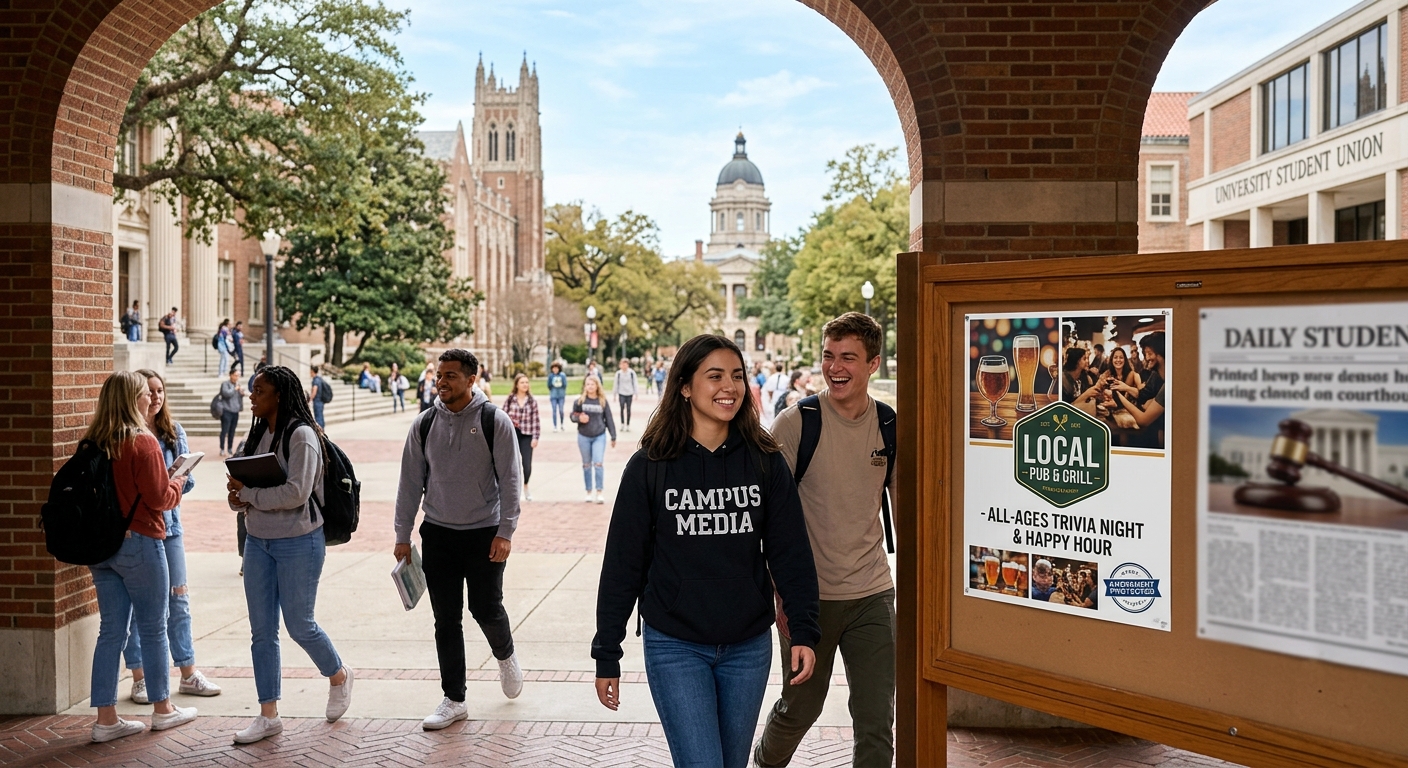
The Battle for Student Press Freedom: Federal Courts and Alcohol Advertising
Free speech on college campuses is a perennial battleground, but not all conflicts involve controversial speakers, political protests, or academic freedom. A quieter, yet equally significant, legal war has raged over the right of college newspapers to publish advertisements for alcoholic beverages. State governments, driven by the noble but complicated desire to curb underage drinking, have repeatedly attempted to ban these advertisements. However, federal courts have often intervened, striking down these bans as unconstitutional infringements on the First Amendment.
This article explores the legal history, the landmark court cases, and the broader implications for commercial speech and student journalism when the government attempts to regulate what can and cannot be printed in collegiate media.
The Intersection of Paternalism and Press Freedom
States possess a legitimate, compelling interest in preventing underage consumption of alcohol. Binge drinking on college campuses poses well-documented risks to student health, safety, and academic success. In an effort to mitigate these risks, several state legislatures and alcohol beverage control boards have targeted the environmental factors they believe contribute to the problem, including advertising.
But targeting the student press is a blunt instrument. A significant portion of a university’s population—including faculty, staff, graduate students, and upperclassmen—is legally of drinking age. By prohibiting alcohol advertisements in publications “associated with” educational institutions, lawmakers restrict truthful information about a legal product directed at adults of legal drinking age.
Furthermore, these bans often suffer from glaring inconsistencies. A college student walking down the street or browsing the internet is bombarded with alcohol marketing. Yet, the moment they open their campus newspaper, the state demands a sanitized environment. This selective enforcement raises serious constitutional questions regarding the efficacy and fairness of the law.
The Legal Framework: Commercial Speech and the Central Hudson Test
To understand why these advertising bans frequently fail constitutional scrutiny, one must examine the Supreme Court’s jurisprudence on “commercial speech.” Historically, commercial speech—speech that proposes a commercial transaction—received no First Amendment protection. However, the legal paradigm shifted dramatically in the late 20th century, culminating in the landmark 1980 decision, Central Hudson Gas & Electric Corp. v. Public Service Commission of New York.
In Central Hudson, the Supreme Court established a four-part test to determine whether government regulations on commercial speech are constitutional:
- First Prong: Does the speech concern lawful activity and is it not misleading? (Since alcohol is legal for adults over 21 and the ads in question are standard promotions, this prong is easily satisfied).
- Second Prong: Is the asserted government interest substantial? (Courts universally agree that preventing underage drinking is a substantial interest).
- Third Prong: Does the regulation directly advance the governmental interest asserted? (This is where many state laws falter; the government must prove the ban actually works).
- Fourth Prong: Is the regulation not more extensive than is necessary to serve that interest? (The law must be narrowly tailored, rather than a broad, sweeping prohibition).
When state laws banning college newspaper alcohol ads face judicial review, the battleground is almost always the third and fourth prongs of the Central Hudson test. The state must provide concrete evidence that censorship materially reduces underage drinking, rather than simply relying on assumptions.
A Watershed Moment: Pitt News v. Pappert
One of the most consequential decisions in this legal arena emerged from Pennsylvania. In the late 1990s, the state actively enforced Act 199, which strictly forbade advertisers from paying for alcohol-related advertisements in any media affiliated with colleges and universities.
The financial toll on student media was immediate and severe. The Pitt News, the independent student newspaper at the University of Pittsburgh, lost an estimated $17,000 in advertising revenue in a single year. Because the paper relied entirely on advertising to fund its printing and operations, this loss forced the student journalists to reduce the length of their publication and limit their coverage of campus events.
The Pitt News, supported by civil liberties organizations, filed a lawsuit arguing the ban violated their First Amendment rights. The case eventually reached the United States Court of Appeals for the Third Circuit in 2004. In a unanimous, powerful ruling authored by then-Circuit Judge Samuel Alito (who would later be elevated to the U.S. Supreme Court), the court struck down the Pennsylvania law.
Alito’s opinion served as a masterclass in First Amendment commercial speech analysis. The Third Circuit found that the state unequivocally failed the third prong of the Central Hudson test. The government provided no empirical evidence that censoring the college newspaper would actually reduce underage drinking. Judge Alito pointed out the absurdity of the ban, noting that students were continuously exposed to alcohol advertisements on television, radio, billboards, and other mainstream publications that were freely available on campus.
Crucially, the court emphasized that the law imposed a disproportionate financial burden on a narrow, specific segment of the media. By targeting the financial lifeline of the student press, the state was engaging in an unconstitutional form of indirect censorship.
Virginia Tech and the Complexities of Judicial Review
The issue of student press advertising bans did not end with the Pennsylvania decision. A similar legal battle unfolded in Virginia, highlighting the complexities and occasional contradictions within the federal judiciary. The Virginia Department of Alcoholic Beverage Control (ABC) enforced regulations that heavily restricted alcohol ads in college publications, limiting them to generic terms without pricing or promotional language.
The Collegiate Times at Virginia Tech and The Cavalier Daily at the University of Virginia challenged the regulations in the case of Educational Media Company at Virginia Tech v. Swecker. The student publications argued that the ban hindered their ability to generate necessary revenue and violated their commercial speech rights.
A federal district court initially struck down the ban, mirroring the logic of the Pitt News decision. The lower court found that the state failed to prove that the advertising restrictions materially advanced the goal of reducing underage consumption. However, in a stark divergence from the Third Circuit, a divided panel of the Fourth Circuit Court of Appeals later upheld the ban.
The Fourth Circuit majority relied heavily on a “common sense” argument, concluding that there was an inherent link between alcohol advertising and consumption demand, even absent specific empirical evidence tying the newspaper ads to underage drinking rates. This circuit split underscored the highly contentious nature of applying the Central Hudson test and demonstrated that the constitutional protections for student media can sometimes vary depending on geographic jurisdiction.
The Existential Threat to Independent Student Journalism
Beyond the abstract constitutional and legal arguments lies a harsh economic reality. College newspapers are rarely fully funded by their host universities. In fact, maintaining editorial independence often requires strict financial separation from the school’s administration, ensuring that university officials cannot use funding as leverage to control editorial content or suppress unfavorable stories.
For independent student newspapers, advertising revenue is the ultimate lifeblood. Local bars, restaurants, and entertainment venues are natural advertisers for a campus demographic. When states abruptly criminalize or ban this revenue stream, they threaten the very existence of the student press.
If newspapers are forced to drastically reduce page counts, cut printing days, or move entirely online due to a lack of funds, the campus community loses a vital source of information. Student journalists report on administrative transparency, campus crime, local elections, and student government—topics that mainstream metropolitan newspapers often ignore. A state law that starves these publications of their primary funding source effectively silences a crucial watchdog.
The Danger of Viewpoint Discrimination and Indirect Censorship
The legal battles over booze ad bans also raise the specter of indirect censorship and potential viewpoint discrimination. The First Amendment strictly prohibits the government from targeting specific speakers or targeting specific messages because it dislikes them.
If the government is permitted to choke off a specific revenue stream for a particular type of publication, it establishes a dangerous precedent. What stops the state from banning advertisements for other controversial but entirely legal products or services? Could a state ban ads for reproductive health clinics in college papers? Could it ban ads for political organizations or advocacy groups?
By striking down these bans, courts like the Third Circuit in Pitt News v. Pappert reinforced the principle that the government cannot bypass the First Amendment by merely attacking the financial infrastructure of the press. Freedom of the press includes the freedom to gather the financial resources necessary to publish.
Summary of Key First Amendment Cases on Alcohol Advertising
| Case Name | Year | Court | Key Ruling / Outcome |
|---|---|---|---|
| Central Hudson Gas & Electric Corp. v. Public Service Commission | 1980 | U.S. Supreme Court | Established the definitive four-part constitutional test for evaluating government restrictions on commercial speech. |
| Pitt News v. Pappert | 2004 | Third Circuit Court of Appeals | Struck down a Pennsylvania ban on alcohol ads in college newspapers, citing a failure to prove the ban reduced underage drinking and noting the unfair financial burden on student media. |
| Educational Media Company at Virginia Tech v. Swecker | 2010 | Fourth Circuit Court of Appeals | Upheld a Virginia restriction on alcohol advertising in collegiate publications, finding a “common sense” link between advertising and alcohol demand, highlighting a circuit split. |
Frequently Asked Questions (FAQs)
What is commercial speech?
Commercial speech is a legal term primarily describing speech that proposes a commercial transaction, such as advertising a product or service. While it receives First Amendment protection, the government is allowed more leeway to regulate it compared to political or individual speech, provided the regulation passes the Central Hudson test.
Why do states try to ban alcohol ads in college newspapers?
States typically enact these bans with the intention of combating underage drinking and binge drinking on college campuses. Lawmakers argue that reducing students’ exposure to alcohol promotions will lead to a decrease in underage consumption.
How does the Central Hudson test protect student newspapers?
The Central Hudson test requires the government to prove that restricting commercial speech directly and materially advances a substantial government interest, and is not more extensive than necessary. Many state alcohol ad bans fail this test because states cannot provide solid evidence that banning ads in a student paper actually prevents underage drinking, especially when students are exposed to countless other forms of alcohol marketing.
Can a university ban alcohol ads in its own newspaper?
If the university is a public institution, it is bound by the First Amendment and generally cannot dictate the content of an independent student newspaper, including lawful advertising. However, if the newspaper is a private entity or the university is a private institution, the legal dynamics change significantly, as private schools are not bound by the First Amendment in the same way government entities are.
Why is advertising revenue so critical for college media?
Most independent college newspapers do not receive direct funding from the university in order to maintain editorial independence. Advertising revenue pays for printing costs, website hosting, and equipment. Stripping away lucrative ad categories, such as local restaurants and venues, can financially devastate the publication.
Conclusion
The legal tug-of-war over alcohol advertising in college newspapers highlights a critical intersection of public policy, commercial speech, and freedom of the press. While the government’s goal of protecting minors from the harms of underage drinking is undeniably important, the First Amendment demands that state action be carefully tailored and supported by concrete evidence.
Landmark rulings like Pitt News v. Pappert demonstrate the judiciary’s vital role in preventing the state from effectively bankrupting independent student journalism under the guise of public health. As these legal debates continue to evolve across different judicial circuits, the core principle remains: protecting the financial viability of the student press is synonymous with protecting a free and robust campus dialogue.
References
- Central Hudson Gas & Electric Corp. v. Public Service Commission of New York — Supreme Court of the United States. 1980-06-20. https://supreme.justia.com/cases/federal/us/447/557/
- PITT NEWS v. PAPPERT — United States Court of Appeals, Third Circuit. 2004-07-29. https://caselaw.findlaw.com/court/us-3rd-circuit/1126743.html
- Educational Media Company at Virginia Tech, Inc. v. Swecker — United States Court of Appeals, Fourth Circuit. 2010-04-09. https://caselaw.findlaw.com/court/us-4th-circuit/1519500.html
Similar Articles








Read full bio of Sneha Tete


