
Maximizing Democratic Participation: The Role of Federal Agencies in Voter Registration
How the executive branch and federal agencies can structurally improve voter access and civic participation.
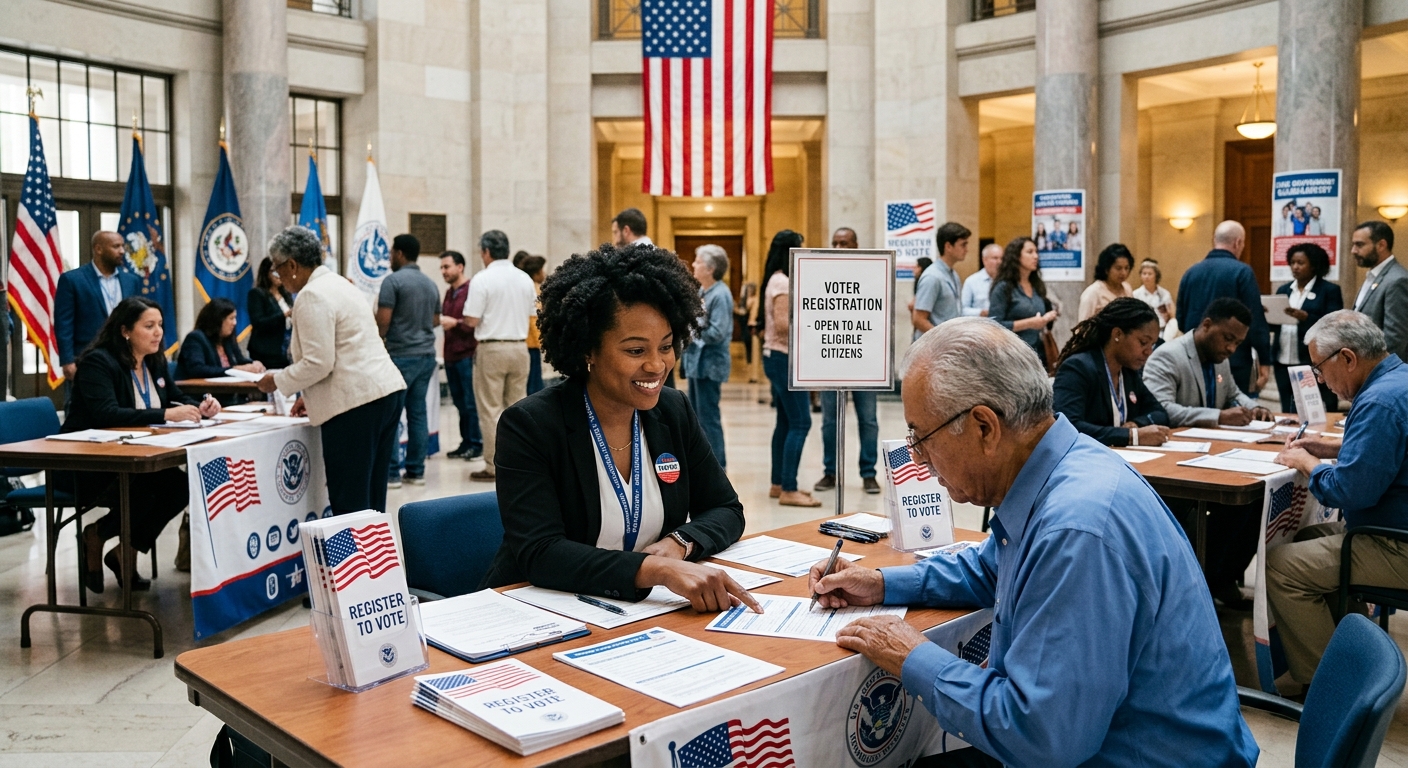
Introduction: The Unmet Potential of Federal Agencies in Elections
Democratic participation is the cornerstone of a functional representative government, yet the gap between the number of eligible voters and those who actually cast a ballot remains a persistent challenge in American politics. While election administration is primarily managed at the state and local levels, the federal government possesses an extraordinary, often underutilized capacity to facilitate voter registration. Every day, millions of Americans interact with federal agencies—from veterans seeking medical care to new citizens taking their oaths of allegiance. These touchpoints represent critical opportunities to integrate civic engagement into routine government services.
For decades, advocates and policymakers have debated the extent to which the executive branch should actively promote voter registration. The conversation frequently centers on whether federal agencies should serve as designated voter registration hubs, providing nonpartisan assistance to citizens navigating complex state electoral systems. By examining the existing legal frameworks, historical administrative actions, and current demographic data, we can better understand the structural possibilities and limitations of federal involvement in expanding voter access.
The Legal Foundation: Understanding the National Voter Registration Act (NVRA)
Any discussion regarding the federal government’s role in voter registration must begin with the National Voter Registration Act of 1993 (NVRA), colloquially known as the “Motor Voter Act.” Enacted by Congress to enhance voting opportunities for every American, the NVRA established nationwide standards for making voter registration more accessible while maintaining the integrity of the electoral process .
The NVRA introduced several mandates that revolutionized how Americans register to vote, primarily through two key provisions:
- Section 5 (Motor Voter): This section requires states to provide individuals with the opportunity to register to vote simultaneously when they apply for or renew a driver’s license. The state motor vehicle authority must automatically forward the completed application to the appropriate election official .
- Section 7 (Agency-Based Registration): This provision mandates that states offer voter registration opportunities at all offices that provide public assistance (such as SNAP or Medicaid) and all state-funded programs primarily engaged in providing services to persons with disabilities. Crucially, applicants must be provided with a voter registration form, assistance in completing it, and the transmittal of the form to election authorities .
While the NVRA successfully expanded access by embedding registration into state-level government interactions, it also contains language allowing states to designate federal offices as voter registration agencies, provided the federal agency agrees . This statutory opening provides the legal foundation for the executive branch to transform its own agencies into proactive facilitators of democratic engagement.
Federal Agencies as Untapped Voter Registration Hubs
To fully realize the potential of the NVRA, the executive branch could theoretically partner with states to designate a wide array of federal agencies as official voter registration sites. Because the federal government interacts with demographics that are historically underrepresented in the electorate—including low-income citizens, rural populations, and minorities—these agencies are uniquely positioned to close the registration gap.
The Intersection of Public Health and Civic Duty
Healthcare facilities managed by the federal government are prime locations for integrating voter registration. The Department of Veterans Affairs (VA) and the Indian Health Service (IHS) serve millions of Americans annually. By offering voter registration forms alongside patient intake paperwork, these agencies could ensure that veterans and Native Americans—groups that often face unique geographic and administrative barriers to voting—are seamlessly added to the voter rolls. Ensuring that health clinics provide nonpartisan assistance in filling out these forms would fulfill the spirit of Section 7 of the NVRA.
Integrating Registration into Immigration and Naturalization
The United States Citizenship and Immigration Services (USCIS) oversees the naturalization of hundreds of thousands of new citizens each year. Currently, the degree to which voter registration is integrated into naturalization ceremonies varies heavily by jurisdiction. A standardized federal approach could ensure that every new citizen is immediately presented with a voter registration application upon taking their oath. Transitioning from a fragmented system to a uniform, federally mandated registration opportunity at all USCIS ceremonies would capture a highly motivated demographic at the exact moment they become eligible to vote.
Criminal Justice and Voting Rights Restoration
The criminal justice system represents another critical juncture. The Bureau of Prisons (BOP) and the U.S. Marshals Service interact daily with individuals who either retain their right to vote while incarcerated (typically those held on misdemeanor charges or awaiting trial) or those who are re-entering society and may be eligible to have their voting rights restored. Navigating the complex, state-by-state patchwork of felony disenfranchisement laws is notoriously difficult. Federal agencies could demystify this process by providing standardized, state-specific guidance and registration forms to individuals as part of their pre-release programming, empowering formerly incarcerated citizens to reintegrate into the democratic process.
Analyzing the Data: Voter Registration and Turnout Trends
To understand why maximizing federal touchpoints is so critical, it is necessary to examine recent electoral data. The U.S. Census Bureau closely tracks voting and registration patterns through its Current Population Survey (CPS) Voting and Registration Supplement.
According to the Census Bureau, the voter registration rate for the 2022 congressional midterm elections reached 69.1%, representing the highest registration rate for a midterm election in 30 years . However, despite this milestone in registration, the actual voter turnout rate was only 52.2%, a decrease from the 53.4% turnout witnessed during the 2018 midterms .
| Election Year | Voter Registration Rate (%) | Voter Turnout Rate (%) |
|---|---|---|
| 2018 (Midterm) | 66.9% | 53.4% |
| 2022 (Midterm) | 69.1% | 52.2% |
This data highlights a critical administrative reality: while more Americans are making it onto the voter rolls, the conversion from registered voter to active voter remains incomplete. Federal agencies could address this by not only offering registration but by providing timely, accurate information regarding early voting, mail-in ballot deadlines, and polling locations. Furthermore, the Census data underscores that non-voters tend to skew younger, have lower incomes, and move more frequently—demographics that frequently interact with federal housing, education, and labor programs.
The Debate Over Federal Involvement in Election Administration
The extent to which the federal government should drive voter registration is a subject of intense political and legal debate. Proponents argue that the executive branch has a constitutional and moral obligation to eliminate administrative barriers to the ballot box, using every tool at its disposal to guarantee a republican form of government. Opponents, however, often cite federalism concerns, arguing that the Constitution explicitly delegates the “Times, Places and Manner of holding Elections” to the state legislatures, and that federal overreach risks politicizing neutral government agencies.
This ideological tug-of-war has been highly visible in recent executive actions. In March 2021, the Biden administration issued Executive Order 14019, “Promoting Access to Voting,” which directed federal agencies to expand their voter registration efforts and evaluate how their operations could better support voter participation. However, indicating the highly polarized nature of election administration, this directive was swiftly revoked. On January 20, 2025, President Donald Trump issued Executive Order 14148, rolling back several of his predecessor’s initiatives, including the mandate that turned federal agencies into proactive voter registration centers .
Such policy reversals highlight the instability of relying solely on executive orders to expand voting access. Without permanent statutory mandates or voluntary partnerships solidified with state governments, federal voter registration initiatives remain vulnerable to the changing tides of presidential administrations. For enduring impact, federal agencies must ground their actions firmly within the bipartisan, established framework of the NVRA, working cooperatively with state election officials.
Strategic Recommendations for Agency Action
Regardless of the political climate, there are foundational steps the federal government can take to enhance the security, accessibility, and accuracy of the voter registration process without overstepping jurisdictional boundaries.
- Modernizing Digital Infrastructure: Federal websites, particularly Vote.gov, should be continuously upgraded to serve as the premier, nonpartisan clearinghouse for voting information. This includes providing high-quality translations in multiple languages and ensuring the platform is fully accessible to individuals with disabilities.
- Facilitating State Partnerships: Instead of top-down mandates, federal agencies should actively invite states to designate specific federal facilities (like VA hospitals or military recruitment centers) as NVRA Section 7 agencies. This cooperative approach respects state sovereignty while utilizing federal resources.
- Standardizing List Maintenance: Under Section 8 of the NVRA, states are required to maintain accurate voter rolls . Federal agencies, particularly the Social Security Administration and the U.S. Postal Service (through the National Change of Address database), can securely share data with state election officials to help identify voters who have moved or passed away, ensuring that registration lists remain secure and up-to-date.
- Enhancing Federal Workforce Participation: The federal government is the nation’s largest employer. Expanding policies that grant federal employees paid administrative leave to serve as nonpartisan poll workers can help alleviate the chronic shortage of election workers that plagues state and local jurisdictions.
Frequently Asked Questions (FAQs)
What is the National Voter Registration Act (NVRA)?
Enacted in 1993, the NVRA, or “Motor Voter Law,” is a federal statute designed to make it easier for Americans to register to vote. It requires states to offer voter registration opportunities at motor vehicle agencies, public assistance offices, and disability service centers.
Can the federal government automatically register citizens to vote?
No. Under current law, the federal government cannot mandate nationwide automatic voter registration. Election administration is handled at the state level. While several individual states have implemented automatic voter registration (AVR) systems, federal agencies can only facilitate registration by providing forms or directing individuals to state portals, unless specifically designated as a registration agency by the state.
How does the executive branch influence election administration?
The executive branch primarily influences elections through the enforcement of federal civil rights laws by the Department of Justice, the dissemination of best practices by the Election Assistance Commission (EAC), and by dictating the internal policies of federal agencies regarding how they interact with the public regarding voter education.
Why is voter turnout lower than voter registration?
Registration is only the first step in the democratic process. Voters may fail to turn out due to administrative hurdles (such as restrictive ID laws or changing polling locations), a lack of competitive races, insufficient information about down-ballot candidates, or inability to take time off work. Data consistently shows a gap between those registered and those who actually cast a ballot.
Conclusion: Strengthening the Foundations of Democracy
The vitality of a democracy is measured by the participation of its citizens. While the U.S. Constitution decentralizes election administration, the federal government maintains an undeniable footprint across the lives of millions of Americans. By strategically leveraging this footprint within the bounds of the National Voter Registration Act, federal agencies have the capacity to dismantle administrative barriers and foster a more inclusive electorate. Whether through modernizing digital resources, partnering with state election officials, or integrating civic engagement into healthcare and immigration services, the executive branch holds significant, untapped potential to ensure that every eligible American has the opportunity to make their voice heard.
References
- About The National Voter Registration Act — Department of Justice. 2023-04-05. https://www.justice.gov/crt/about-national-voter-registration-act
- Census Bureau Releases 2022 Congressional Election Voting Report — U.S. Census Bureau. 2024-04-23. https://www.census.gov/newsroom/press-releases/2024/2022-congressional-election-voting-report.html
- Initial Rescissions Of Harmful Executive Orders And Actions — The White House. 2025-01-20. https://www.whitehouse.gov/presidential-actions/2025/01/initial-rescissions-of-harmful-executive-orders-and-actions/
- The National Voter Registration Act Of 1993 (NVRA) — Department of Justice. 2024-11-01. https://www.justice.gov/crt/national-voter-registration-act-1993-nvra
Similar Articles








Read full bio of Sneha Tete


