
The Evolution of Voting Rights and Grassroots Activism
Examining the historical and ongoing fight for equal ballot access.
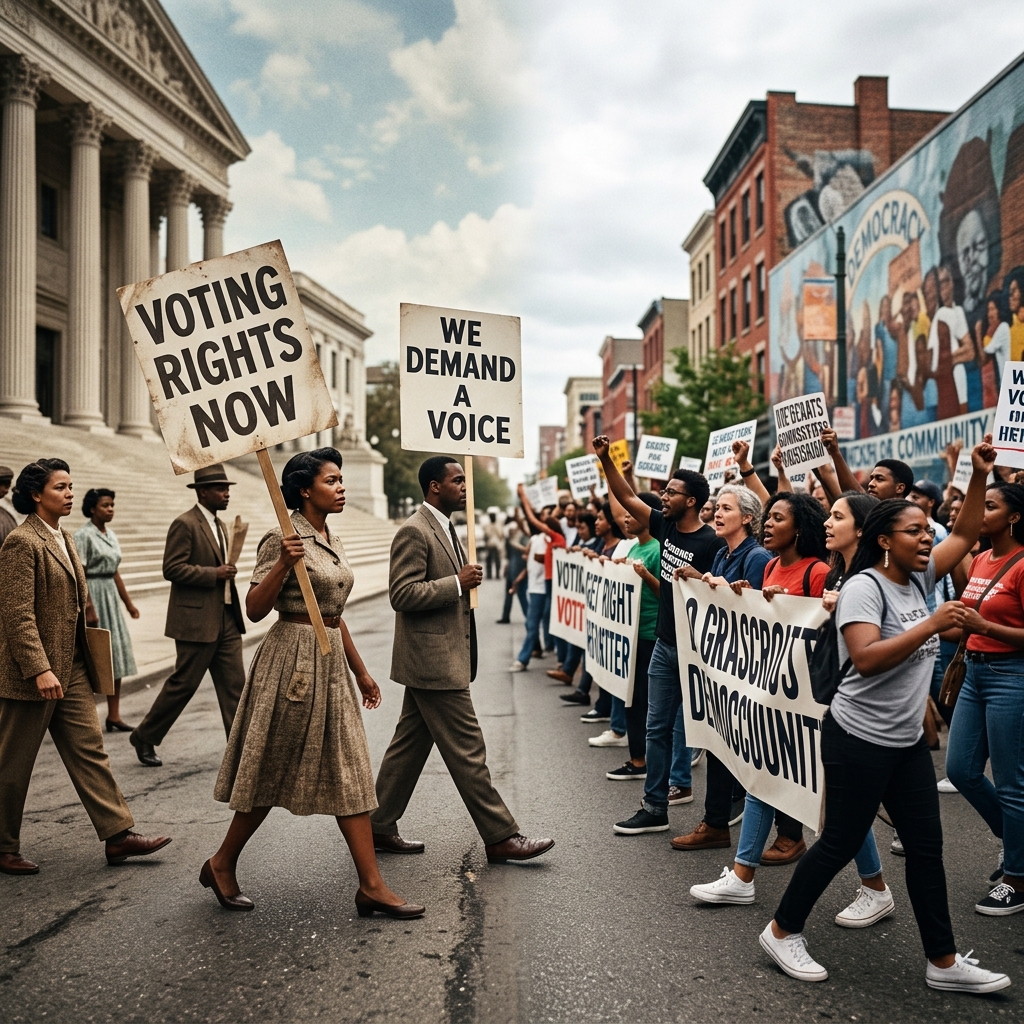
The right to vote is universally recognized as the bedrock of American democracy, yet the journey to secure, expand, and maintain this fundamental right has been anything but a linear path of progress. Often, historical narratives frame the struggle for civil rights as a closed chapter—a victorious battle culminating in the 1960s with landmark legislation that permanently cured the nation’s democratic ailments. However, the fight for equitable access to the ballot box remains a highly dynamic, fiercely contested marathon that requires constant vigilance.
In thoroughly examining the trajectory of the franchise, it becomes clear that while the specific tactics of disenfranchisement have evolved over the decades, so too have the strategies of resistance. Today’s voting rights landscape is profoundly shaped by the immense sacrifices of mid-century activists, the transformative legal frameworks they helped establish, the subsequent judicial rollbacks of those protections, and the powerful emergence of a new generation of grassroots organizers determined to protect the democratic process for marginalized communities.
Historical Foundations: The Sacrifices of the 1960s
To fully understand the contemporary battle over voting rights, one must first critically examine the historical context that necessitated aggressive federal intervention. Despite the ratification of the Fifteenth Amendment in 1870, which explicitly prohibited states from denying a citizen the right to vote based on race, discriminatory practices severely curtailed African American political participation for nearly a century. Across the Jim Crow South, systemic and structural barriers such as exorbitant poll taxes, impossible literacy tests, exclusionary grandfather clauses, and campaigns of violent physical intimidation effectively disenfranchised millions of Black citizens.
The Civil Rights Movement of the 1950s and 1960s brought these egregious injustices to the forefront of the national conscience. Before landmark federal action occurred, the groundwork was painstakingly laid by organizations like the Student Nonviolent Coordinating Committee (SNCC). Young activists—often college students—traveled into the deep South for highly dangerous campaigns like the 1964 Freedom Summer. They faced unwarranted arrests, severe beatings, and even murder to register Black voters and establish community “Freedom Schools.” This foundational era highlights that the movement was heavily built on the backs of ordinary young people who risked their livelihoods for the franchise, a dynamic that directly mirrors the youth-led social movements of the modern era.
The tipping point occurred on March 7, 1965, during a peaceful march from Selma to Montgomery, Alabama. Protestors advocating for ballot access were violently attacked by heavily armed state troopers on the Edmund Pettus Bridge in a horrific event that became known as “Bloody Sunday.” The televised brutality shocked the conscience of the nation and finally catalyzed the federal government to take decisive legislative action to protect minority voters from state-sanctioned oppression.
The Transformative Power of the Voting Rights Act of 1965
In direct response to the undeniable public outcry and the tireless, bleeding advocacy of civil rights leaders, President Lyndon B. Johnson signed the Voting Rights Act (VRA) into law on August 6, 1965. This legislation is widely considered by legal scholars and historians to be the most effective civil rights law in the history of the United States.
The VRA aggressively dismantled the primary, first-generation mechanisms of disenfranchisement. It explicitly banned literacy tests nationwide and authorized the appointment of federal examiners to unilaterally register qualified citizens in jurisdictions with a known history of racial discrimination. Perhaps its most powerful and historically significant enforcement tool was Section 5, which established the “preclearance” requirement. Under Section 5, specific states and localities with a documented, pervasive history of discriminatory voting practices (determined mathematically by a coverage formula located in Section 4) were strictly prohibited from altering their election laws without first receiving explicit approval from the U.S. Department of Justice or a federal court in Washington, D.C.
This proactive, preventative measure was incredibly successful. Within just a few years of its passage, voter registration among Black citizens in the Southern states skyrocketed, fundamentally shifting the political landscape and directly leading to the historic election of thousands of minority officials. For nearly five decades, the Voting Rights Act served as a robust, impenetrable shield against new, increasingly subtle forms of voter suppression.
The Turning Point: Shelby County v. Holder
The legal landscape of voting rights underwent a seismic, detrimental shift in 2013 with the Supreme Court’s landmark decision in Shelby County v. Holder. The highly controversial case centered on a direct constitutional challenge by Shelby County, Alabama, to the legality of Section 4(b) and Section 5 of the Voting Rights Act.
In a deeply divided 5-4 decision, the Supreme Court struck down the coverage formula in Section 4(b) as unconstitutional. The majority argued that the formula was based on decades-old historical data and no longer reflected the current political and social realities of the South. By completely invalidating the coverage formula, the Court effectively rendered the Section 5 preclearance requirement unenforceable and hollow. While the concept of preclearance technically remained intact within the law, there were no longer any jurisdictions subjected to it unless Congress could successfully draft and pass a new, updated formula—a monumental legislative hurdle that remains uncleared today.
When analyzing this pivotal moment, it is critical to note the fierce opposition from the Court’s minority. Justice Ruth Bader Ginsburg penned a now-famous dissenting opinion, joined by three other justices. She passionately argued that throwing out preclearance because it had successfully curbed discrimination was “like throwing away your umbrella in a rainstorm because you are not getting wet.” She pointed out that while blatant, first-generation barriers like poll taxes were gone, “second-generation barriers” such as racial gerrymandering and at-large voting systems were still being actively and routinely blocked by Section 5. Her dissent proved prophetic, as a massive wave of restrictive voting laws flooded the country almost immediately after the ruling was handed down.
The Modern Landscape of Voter Disenfranchisement
In the direct aftermath of the Shelby County decision, the United States witnessed a rapid, systemic resurgence of restrictive voting laws. Without the preventative shield of federal preclearance, the legal burden violently shifted. Civil rights organizations and the Department of Justice were now forced to challenge discriminatory laws only after they had already been enacted, and tragically, often after entire election cycles had already taken place under those tainted rules.
Since 2013, dozens of state legislatures have enacted highly partisan legislation that intrinsically makes it more difficult for ordinary citizens to cast their ballots. These modern, sophisticated barriers include:
- Strict Voter ID Laws: Stringent requirements that voters present specific, often costly forms of government-issued photo identification, which minority, low-income, and elderly voters are statistically significantly less likely to possess.
- Polling Place Closures: The systematic, calculated reduction of polling locations, particularly in densely populated urban areas and predominantly minority neighborhoods, leading to excessively long wait times that act as a deterrent to working-class voters.
- Aggressive Roll Purges: Flawed, often error-prone purges of state voter registration lists, which frequently and illegally remove eligible voters who have simply not voted in recent election cycles, rather than solely removing those who have moved or passed away.
- Restrictions on Mail-In and Early Voting: Deliberately curtailing early voting periods (such as attempting to eliminate “Souls to the Polls” Sunday voting efforts led by Black churches) and placing unnecessarily strict bureaucratic limitations on absentee ballot drop boxes.
These restrictive measures, while almost universally justified by their authors under the guise of preventing election fraud and ensuring integrity, have a verifiable, disproportionate impact on marginalized communities. They effectively echo the structural, racist barriers of the pre-1965 era, repackaged in more subtle, bureaucratic forms.
Intergenerational Activism and Passing the Torch
The aggressive rollback of federal voting protections has fortunately sparked a powerful resurgence in grassroots organizing, highlighting the critical, undeniable importance of intergenerational activism. The seasoned civil rights veterans of the 1960s laid a profound structural and moral foundation, but they have consistently emphasized in their teachings that freedom is never a static state but an act—a continuous, exhaustive process of defense and expansion.
Today’s movement for voting rights is primarily characterized by a highly decentralized, incredibly diverse coalition of activists. Young organizers are masterfully leveraging digital tools, social media networks, and advanced data analytics to conduct massive, targeted voter registration drives. They work tirelessly to educate the public about rapidly changing local election laws and mobilize historically disenfranchised groups to the polls. This new generation openly draws inspiration from the unparalleled courage of their predecessors while actively adapting their strategies to combat the sophisticated, heavily funded nature of modern disenfranchisement.
Organizations led by youth and minority organizers focus intensely not only on high-profile federal elections but also on vital local races. They recognize that state legislatures, county commissioners, and local election boards wield immense, unchecked power over the daily administrative functions of democracy.
Key Actionable Steps to Protect Democratic Participation
Safeguarding the sacred right to vote requires active, sustained, and educated participation from the entire electorate. Meaningful advocacy extends far beyond Election Day and involves several critical, actionable steps:
- Check Registration Status Regularly: Because of the high frequency of aggressive and sometimes unannounced voter roll purges, all voters should routinely verify their registration status well before local registration deadlines close.
- Understand State-Specific Laws: Citizens must familiarize themselves with their specific local identification requirements, mail-in ballot request deadlines, and early voting schedules, as these administrative rules vary drastically by state and even by county.
- Support Non-Partisan Voter Protection: Individuals can volunteer as local poll workers or provide financial and logistical support to non-profit organizations that provide legal assistance and ride-shares to polling locations for vulnerable, elderly, and disabled populations.
- Advocate for Comprehensive Federal Legislation: Voters must actively engage with their elected representatives to support new federal voting rights legislation. Proposals like the John Lewis Voting Rights Advancement Act aim to directly address the Shelby County ruling by creating a modernized preclearance formula to restore vital federal oversight.
Comparing Eras of Civil Rights Advocacy
To understand the evolution of the fight for the franchise, it is helpful to compare the distinctive characteristics of the mid-20th century civil rights movement with modern advocacy efforts.
| Aspect | 1960s Civil Rights Movement | Modern Voting Rights Advocacy |
|---|---|---|
| Primary Barriers Faced | Literacy tests, poll taxes, white primaries, and organized violent intimidation. | Strict voter ID laws, polling place closures, aggressive roll purges, and partisan gerrymandering. |
| Key Legislative Goals | Passage of the Civil Rights Act of 1964 and the Voting Rights Act of 1965. | Passage of the Voting Rights Advancement Act and the Freedom to Vote Act to restore federal oversight. |
| Organizational Structure | Highly centralized leadership driven by charismatic figures and large national organizations. | Decentralized, grassroots, network-based local coalitions focusing on community-specific issues. |
| Primary Communication Tools | National television broadcasts, print newspaper campaigns, and physical church networks. | Social media platforms, digital organizing tools, relational text-banking, and viral awareness campaigns. |
Frequently Asked Questions (FAQs)
What was the core purpose of the Voting Rights Act of 1965?
The Voting Rights Act of 1965 was intentionally designed to enforce the 15th Amendment of the U.S. Constitution by explicitly outlawing discriminatory voting practices, such as subjective literacy tests. Crucially, it also established federal oversight—known as preclearance—for any election law changes in specific states with a documented history of severe voter suppression.
How did the Supreme Court decision in Shelby County v. Holder impact voters?
The 2013 Supreme Court decision fundamentally invalidated the specific mathematical coverage formula used to determine which states needed federal approval before changing their election laws. This immediate lack of oversight allowed states to quietly implement highly restrictive voting measures—like strict ID laws and massive polling place closures—without prior federal review, directly leading to an alarming increase in voter disenfranchisement.
Why is modern grassroots organizing so essential for voting rights today?
Since the strict federal guardrails originally provided by the Voting Rights Act have been severely weakened by the courts, protecting ballot access now relies incredibly heavily on local, grassroots efforts. Community organizers work directly on the ground to help citizens navigate complex new voting laws, rapidly register marginalized voters, and provide the essential logistical support needed to overcome intentional bureaucratic hurdles.
What exactly are voter roll purges, and why are they considered controversial?
Voter roll purges are the administrative process by which local election officials remove names from registration lists to keep them updated. While standard, careful maintenance is necessary (such as removing deceased voters or those who have moved out of state), aggressive purges often rely on highly flawed data matching or target individuals simply for choosing not to vote in recent, low-turnout elections. This practice disproportionately and unfairly disenfranchises minority, younger, and low-income voters who may vote less frequently but remain legally eligible.
Conclusion: The Ongoing Marathon for Equality
The ongoing struggle for equitable access to the ballot box is a defining, relentless characteristic of the American democratic experiment. From the horrifying, violent physical confrontations on the Edmund Pettus Bridge to the dense, highly technical legal battles currently playing out in federal courthouses, the underlying fight remains fiercely focused on a singular, fundamental principle: every eligible citizen deserves an unencumbered, equal voice in their government. As new, bureaucratic barriers constantly arise to suppress turnout, so too does a remarkably resilient, renewed spirit of intergenerational activism. By deeply understanding the historical context, properly recognizing the systemic, insidious nature of contemporary disenfranchisement, and firmly committing to active, year-round civic engagement, the next generation can bravely continue the vital work of ensuring that democracy truly functions for all of its people.
References
- Voting Rights Act (1965) — National Archives. 2022-02-08. https://www.archives.gov/milestone-documents/voting-rights-act
- Shelby County v. Holder — Oyez. 2013-06-25. https://www.oyez.org/cases/2012/12-96
- New Voting Restrictions in America — Brennan Center for Justice. 2019-11-19. https://www.brennancenter.org/our-work/research-reports/new-voting-restrictions-america
- States Have Added Nearly 100 Restrictive Laws Since SCOTUS Gutted the Voting Rights Act 10 Years Ago — Brennan Center for Justice. 2023-06-23. https://www.brennancenter.org/our-work/analysis-opinion/states-have-added-nearly-100-restrictive-laws-scotus-gutted-voting-rights
Similar Articles








Read full bio of Sneha Tete


