
Evolution of May Day: Labor to Immigrant Rights
How an 1886 labor fight transformed into a modern push for migrant justice.
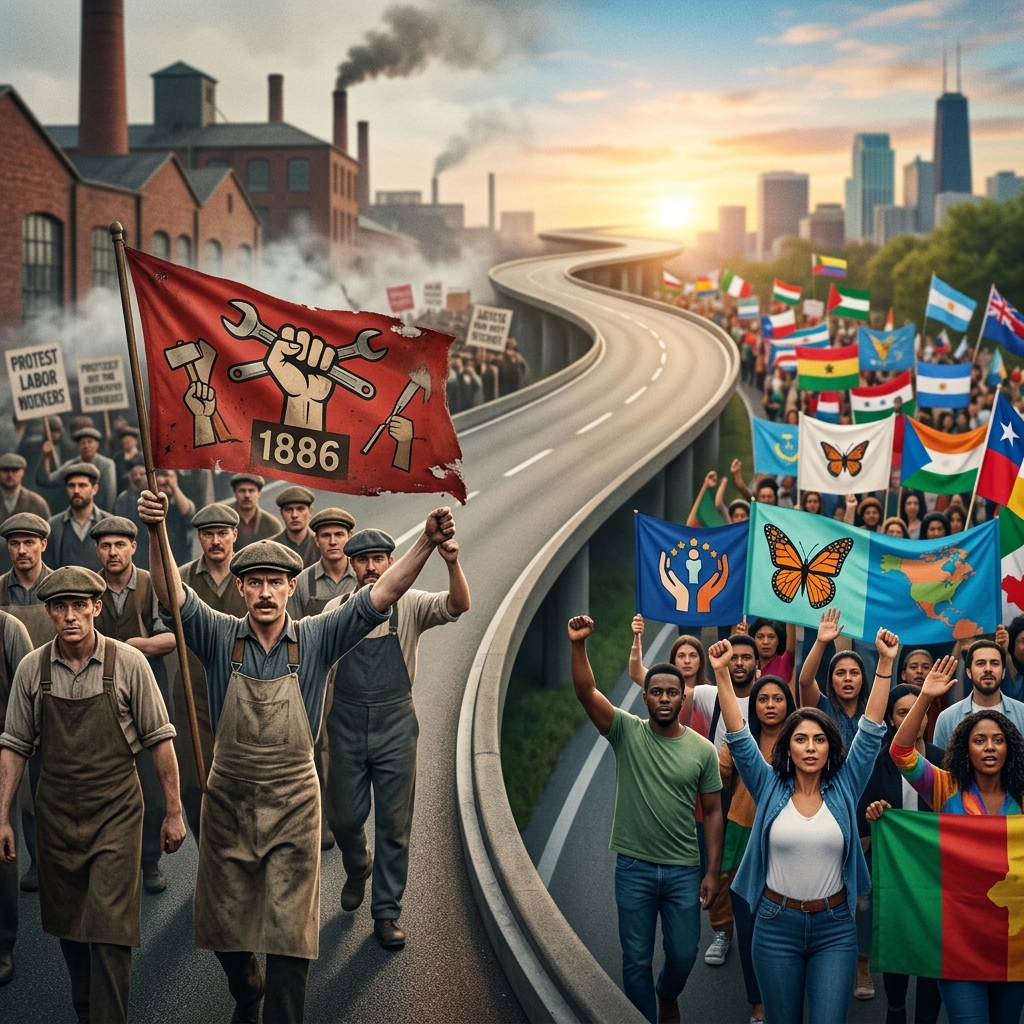
The Dawn of a Movement: The American Roots of Global Solidarity
On the first of May, cities across the globe explode in vibrant displays of labor solidarity. From Paris to Tokyo, millions of workers march to demand fair wages, safer conditions, and human dignity. Yet, despite its international flavor, the origins of this global observance are deeply and unmistakably American. The history of this date is a profound chronicle of class struggle, state violence, and the enduring fight for equity that began in the smoke-choked industrial hubs of the nineteenth-century United States.
To understand the modern incarnation of this holiday—and how it eventually intertwined with the fight for migrants’ rights—one must look back to the Gilded Age. During the 1880s, the American Industrial Revolution was roaring. Wealth was accumulating at the top of the socioeconomic ladder, while the working class endured punishing conditions. Men, women, and children routinely worked ten to sixteen hours a day, six days a week, in factories, foundries, and sweatshops for poverty wages.
Driven by exhaustion and exploitation, the nascent American labor movement drew a line in the sand. The Federation of Organized Trades and Labor Unions, which would later evolve into the American Federation of Labor, passed a resolution declaring that starting May 1, 1886, the eight-hour workday would become the legal standard. Their rallying cry was simple but revolutionary: “Eight hours for work, eight hours for rest, and eight hours for what we will.”
The Crucible of 1886: The Haymarket Tragedy
When the first day of May arrived in 1886, hundreds of thousands of workers across the United States laid down their tools in a massive, coordinated general strike. Chicago, a rapidly expanding industrial powerhouse with a heavily immigrant workforce, became the epicenter of the movement. For the first few days, the demonstrations were massive and largely peaceful, paralyzing the city’s rail lines and factories.
However, the peace was shattered on May 3rd, when police fired into a crowd of striking workers at the McCormick Harvesting Machine Company, killing several individuals. Outraged by the unprovoked violence, labor leaders and anarchist organizers called for a mass rally the following evening at Chicago’s Haymarket Square to protest police brutality.
As the May 4th rally was winding down under a steady rain, police marched in to disperse the remaining crowd. Suddenly, an unidentified person tossed a dynamite bomb into the police ranks. The explosion and the chaotic gunfire that followed left seven police officers and at least four civilians dead, with dozens more severely wounded.
The aftermath was a swift and brutal crackdown on labor organizing. Authorities rounded up prominent socialist and anarchist leaders, bringing eight men to trial. In a glaring miscarriage of justice driven by xenophobia and anti-radical hysteria, the “Haymarket Martyrs” were convicted despite a lack of evidence tying them to the bomb. Four were ultimately hanged. The international community watched in horror, and in 1889, the Second International—a global coalition of socialist and labor parties—declared the first of May as International Workers’ Day to honor the martyrs of Chicago.
The Great American Fracture: Distancing from a Radical Legacy
As the rest of the world embraced the first of May as a tribute to the working class, the United States government actively sought to suppress the holiday, terrified by its radical and socialist associations. Politicians and corporate titans viewed the date as a dangerous catalyst for anarchy.
In 1894, following the bloody Pullman Strike, President Grover Cleveland sought to placate an angry labor force without endorsing the revolutionary undertones of the Chicago martyrs. He signed legislation establishing a federal Labor Day on the first Monday of September—a date previously proposed by more conservative labor factions. This strategic move successfully decoupled the American celebration of labor from the radicalism of the Haymarket affair.
The distancing continued into the twentieth century. During the ideological battles of the Cold War, the U.S. government took further steps to obscure the holiday’s true origins. President Dwight D. Eisenhower officially designated the date as “Law and Order Day” and “Loyalty Day,” urging Americans to reaffirm their allegiance to the state rather than international worker solidarity. Thus, an incredible irony was cemented: the nation that birthed International Workers’ Day effectively scrubbed it from its own mainstream cultural calendar.
A Shifting Workforce: The Intersection of Labor and Migration
As the twentieth century progressed into the twenty-first, the demographic makeup of the American working class underwent a profound transformation. The grueling, low-wage jobs in agriculture, construction, meatpacking, and the service sector were increasingly filled by immigrant labor, both documented and undocumented.
These new workers faced vulnerabilities strikingly similar to those of the industrial laborers of the 1880s. They endured rampant wage theft, hazardous working conditions, lack of benefits, and the constant, looming threat of deportation. For decades, mainstream labor unions often ignored or actively marginalized these migrant workers, viewing them as a threat to domestic wage standards.
However, a realization eventually dawned on progressive labor organizers: the survival of the American labor movement depended entirely on organizing and protecting its most exploited members. The struggles of the nineteenth-century factory worker and the twenty-first-century undocumented farmhand were fundamentally identical. Both demographics were fighting against systemic exploitation for the right to human dignity, fair compensation, and a voice in their own destinies.
The Catalyst: The Sensenbrenner Bill of 2005
The simmering tensions surrounding immigrant labor reached a boiling point in December 2005. The U.S. House of Representatives passed the Border Protection, Antiterrorism, and Illegal Immigration Control Act (H.R. 4437), introduced by Representative Jim Sensenbrenner. The legislation was one of the most draconian anti-immigrant measures in modern American history.
If enacted, H.R. 4437 would have fundamentally altered the legal landscape of the United States. Its most controversial provisions included:
- Reclassifying undocumented presence in the United States from a civil violation to an aggravated felony.
- Authorizing the construction of a massive militarized fence along the U.S.-Mexico border.
- Criminalizing anyone who assisted, transported, or sheltered undocumented immigrants, meaning teachers, priests, nurses, and aid workers could face up to five years in federal prison for providing basic humanitarian aid.
The sheer cruelty of the bill shocked the immigrant community out of the political shadows. A population that had historically remained quiet to avoid drawing the attention of immigration enforcement realized that silence was no longer a viable survival strategy. The legislation inadvertently unified a massive coalition of laborers, students, religious leaders, and civil rights advocates.
The Great American Boycott: Reclaiming the First of May
The backlash to H.R. 4437 was swift and unprecedented. Throughout the spring of 2006, massive protests erupted in cities like Chicago, Los Angeles, and Dallas. Sensing the momentum, a vast network of grassroots organizers called for a coordinated, nationwide action to be held on May 1, 2006.
They dubbed the event “El Día Sin Inmigrante” (A Day Without an Immigrant) and the “Great American Boycott.” The objective was to paralyze the American economy for a single day to prove the indispensable nature of immigrant labor. The choice of the date was highly intentional; it explicitly reclaimed the holiday’s American origins, drawing a direct historical line from the Haymarket martyrs fighting for the eight-hour day to migrant workers fighting against criminalization.
The results were staggering. Millions of people poured into the streets in over a hundred cities across the country. The economic impact was immediate and visible:
- Major meatpacking plants across the Midwest were forced to halt production.
- Vast produce markets in Los Angeles sat empty and silent.
- Thousands of restaurants, construction sites, and retail businesses closed their doors or operated with skeletal crews.
- Tens of thousands of students staged walkouts, leaving classrooms empty to march with their families.
The message delivered to the political establishment was undeniable: immigrants were not criminals to be discarded; they were the economic engine of the nation and deeply woven into its social fabric.
Enduring Legacies: The Modern Synthesis of Justice
The 2006 mobilizations achieved their immediate goal—the Sensenbrenner bill died in the Senate. But their most profound impact was cultural. The “Day Without an Immigrant” awakened a sleeping political giant and permanently redefined the first of May in the United States.
Today, the holiday serves a dual purpose. Rallies across the country are vibrant, intersectional displays of advocacy. Demonstrators carry signs demanding a living wage, universal healthcare, and the right to unionize alongside banners calling for comprehensive immigration reform, an end to deportations, and a clear pathway to citizenship. The synergy between the labor movement and the immigrant rights movement is now unbreakable. Organizers recognize that the fight against corporate exploitation is inextricably linked to protecting the most vulnerable workers from state violence.
The evolution of this historic date is a powerful reminder that the fight for justice is continuous and interconnected. It honors the blood spilled by the martyrs in Chicago in 1886 and the millions who marched in 2006, united by the timeless truth that the demand for human dignity knows no borders.
Frequently Asked Questions (FAQs)
Why is Labor Day in the United States celebrated in September instead of the spring?
Following the Haymarket affair in 1886, the first of May became associated with radical labor movements, socialism, and anarchism. To distance the American labor movement from these radical elements, President Grover Cleveland signed a law in 1894 establishing Labor Day in September, a date previously championed by more conservative labor unions.
What exactly was the Haymarket Affair?
The Haymarket Affair was a violent confrontation that took place on May 4, 1886, in Chicago. During a peaceful labor rally advocating for an eight-hour workday and protesting police brutality, an unknown person threw a bomb at the police. The resulting explosion and gunfire killed multiple officers and civilians. It led to the controversial trial and execution of several labor activists, sparking global outrage and the creation of International Workers’ Day.
What was the Sensenbrenner Bill (H.R. 4437)?
Introduced in 2005, the Border Protection, Antiterrorism, and Illegal Immigration Control Act (H.R. 4437) was a strict legislative proposal that sought to make living in the U.S. without documentation an aggravated felony. It also aimed to criminalize anyone who provided assistance—such as food, shelter, or medical care—to undocumented immigrants. The bill’s severity triggered massive nationwide protests.
How did the 2006 protests change the meaning of the holiday?
Before 2006, the date was largely ignored in the mainstream U.S. or observed mostly by niche socialist and labor groups. The massive “Day Without an Immigrant” protests in 2006 reclaimed the date, intertwining the historical fight for workers’ rights with the modern struggle for immigrants’ rights, forever linking the two causes in American activism.
References
- Haymarket Affair: Topics in Chronicling America — Library of Congress. 2019-07-10. https://guides.loc.gov/chronicling-america-haymarket-affair
- History of Labor Day — U.S. Department of Labor. https://www.dol.gov/general/laborday/history
- H.R.4437 – Border Protection, Antiterrorism, and Illegal Immigration Control Act of 2005 — Congress.gov. https://www.congress.gov/bill/109th-congress/house-bill/4437
- The Immigrant Rights Marches (Las Marchas): Did the “Gigante” (Giant) Wake Up or Does It Still Sleep Tonight? — Nevada Law Journal. Spring 2007. https://scholars.law.unlv.edu/nlj/vol7/iss3/9/
Similar Articles








Read full bio of Sneha Tete




