
Evolution of Gender Equality Under the 14th Amendment
How strategic legal battles in the 1970s transformed constitutional law.
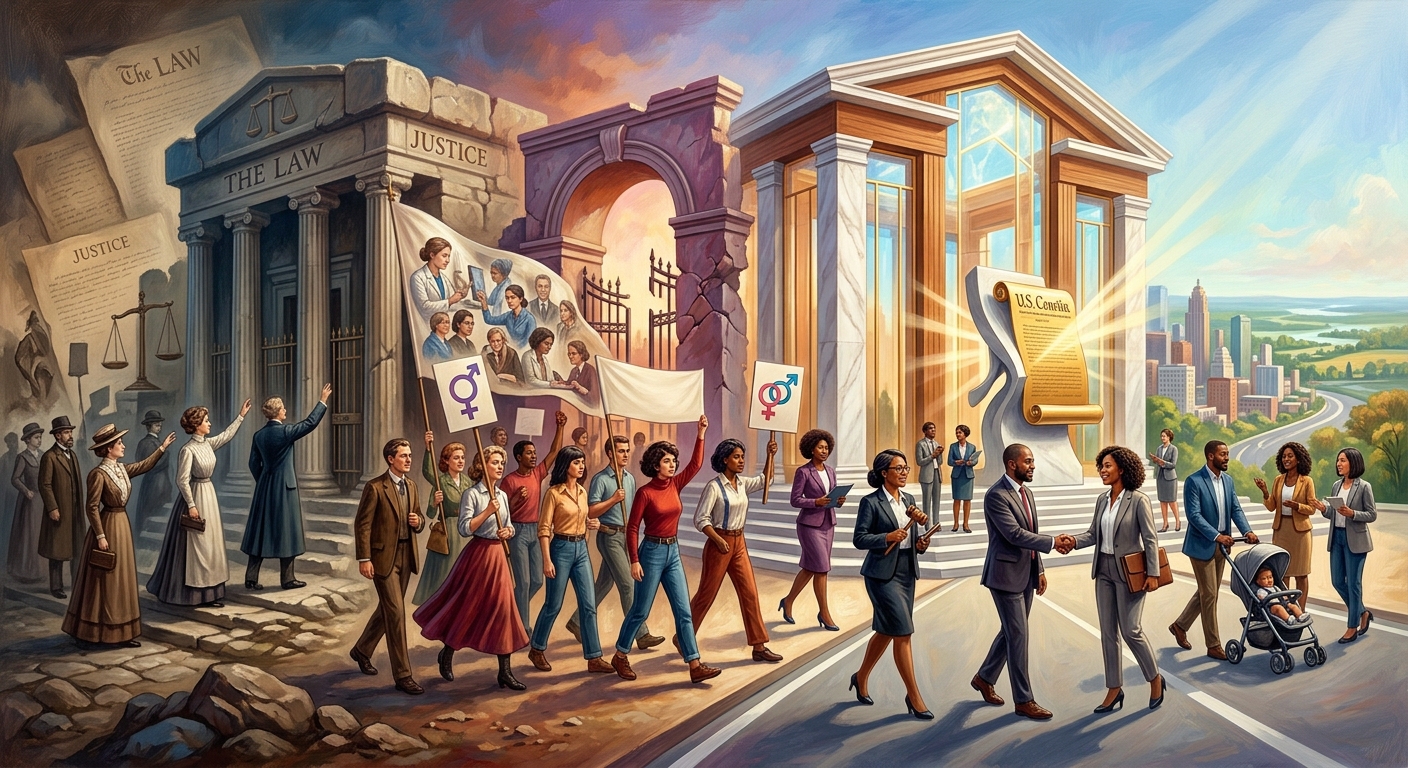
Introduction to the Constitutional Silence on Gender
For much of American history, the United States Constitution was remarkably silent on the issue of gender equality. When the Founding Fathers drafted the foundational document, the legal identity of a married woman was entirely subsumed by her husband under the common law doctrine of coverture. Women were systematically denied the right to vote, the right to own property independently in many jurisdictions, and the right to pursue most professions. The promise of equal justice under the law was, in practice, an exclusive privilege reserved almost entirely for men.
It was not until the latter half of the twentieth century that this paradigm experienced a seismic, irreversible shift. This transformation was not an accidental evolution of cultural norms, but rather the direct result of a highly deliberate, meticulously planned legal strategy executed by brilliant legal minds and civil liberties advocates. By challenging state and federal laws that legally mandated disparate treatment based on sex, these advocates forced the American judicial system to reevaluate the constitutional rights of women and the broader implications of gender stereotypes.
The Fourteenth Amendment: A Promise Deferred
At the heart of this legal revolution was the Fourteenth Amendment. Ratified on July 9, 1868, in the aftermath of the Civil War, its original and primary purpose was to guarantee citizenship and protect the civil rights of formerly enslaved African Americans. The amendment introduced the Equal Protection Clause, which unequivocally states that no state shall ‘deny to any person within its jurisdiction the equal protection of the laws.’ Despite the broad, universally inclusive language of the amendment, the Supreme Court of the United States historically interpreted this clause with an incredibly narrow lens, completely bypassing its application to gender discrimination.
In the late nineteenth and early twentieth centuries, the Supreme Court repeatedly rebuffed attempts by women to use the Fourteenth Amendment to secure equal civil rights. A notorious example occurred in the 1873 case of Bradwell v. Illinois, where the Court upheld a state law that prohibited women from practicing law. The prevailing judicial sentiment of the era was rooted in paternalism; judges frequently justified discriminatory laws by claiming they were necessary to protect a woman’s delicate nature and preserve her traditional roles as a mother and a homemaker.
This legal framework, often described as ‘romantic paternalism,’ effectively trapped women in a subordinate economic and social status. State legislatures passed numerous laws restricting the hours women could work, the physical weight they could lift on the job, and the types of occupations they could hold. While these statutes were ostensibly designed to shield women from the harsh, dangerous realities of the industrial workplace, they practically ensured that women were excluded from high-paying jobs, supervisory roles, and leadership positions, setting the stage for a massive legal confrontation decades later.
The Turning Point: Reed v. Reed (1971)
The modern era of constitutional gender equality officially began in 1971 with a seemingly obscure probate dispute originating in Idaho. The case, Reed v. Reed, involved Sally and Cecil Reed, a separated couple who were tragically brought to court over the estate of their deceased teenage son. Both parents filed applications to administer the boy’s modest estate. The local probate court, following the strict letter of the Idaho legal code, automatically appointed the father as the administrator. The state statute explicitly directed that when determining administrators of an estate, ‘males must be preferred to females’ if the applicants were otherwise equally closely related to the deceased.
The rationale behind the Idaho law was simple and utilitarian: administrative convenience. The state legislature had decided that automatically preferring men over women would heavily reduce the workload of probate courts by eliminating the need to hold evidentiary hearings to determine which parent was more qualified. Sally Reed challenged this law, arguing passionately that it violated the Equal Protection Clause of the Fourteenth Amendment.
When the case reached the Supreme Court, civil liberties organizations submitted a groundbreaking amicus curiae brief. The legal argument posited that classifying individuals based on sex for the sheer administrative convenience of the state was not only arbitrary but inherently unconstitutional. The brief famously drew direct legal parallels between gender discrimination and racial discrimination, arguing that sex, like race, is an immutable characteristic determined entirely at birth and bears absolutely no relation to an individual’s ability to contribute to society or administer an estate.
In a landmark, unanimous decision, the Supreme Court agreed with the challengers. Chief Justice Warren Burger wrote that giving a mandatory preference to members of either sex over members of the other for the mere purpose of eliminating administrative hearings was forbidden by the Equal Protection Clause. For the very first time in American legal history, the Supreme Court had struck down a state law specifically on the grounds that it unconstitutionally discriminated against women.
Strategic Litigation and Institutional Advocacy
The monumental victory in Reed v. Reed was the primary catalyst for a much broader, institutionalized movement. Recognizing that isolated, ad-hoc legal victories were insufficient to dismantle a deeply entrenched national system of gender bias, legal advocates realized they needed to establish dedicated legal projects. By the early 1970s, organizations formed specialized projects specifically to serve as the national legal arm for the women’s equality movement through the courts.
The legal advocates utilized several core strategies to systematically dismantle discriminatory laws across the country:
- Targeting ‘Appendix E’: Lawyers identified and meticulously documented hundreds of federal statutes that explicitly differentiated between men and women. This comprehensive list became a strategic playbook for identifying the most vulnerable laws to challenge in court.
- Representing Male Plaintiffs: By strategically taking on cases where men were overtly disadvantaged by gender-based laws, advocates proved that gender stereotypes constrained and damaged society as a whole. This tactic was brilliantly designed to appeal to an all-male Supreme Court by demonstrating that sexism was not just a ‘women’s issue.’
- Incremental Precedent Building: Rather than aiming for a single, sweeping legal ruling that the conservative bench might reject, advocates built a fortress of legal precedent case by case. They patiently moved from less controversial areas like estate law to highly contentious areas like military benefits and tax codes.
Pushing the Boundaries: Frontiero v. Richardson (1973)
The next major constitutional leap forward occurred in 1973 with the case of Frontiero v. Richardson. Sharron Frontiero, a lieutenant serving in the United States Air Force, applied for dependent housing and medical benefits for her civilian husband. Under federal military statutes, male service members automatically received these benefits for their wives without any further inquiry. However, female service members were uniquely required to undergo a burdensome administrative process to prove that their husbands were dependent on them for more than one-half of their total financial support.
The federal government argued that the law was simply a matter of administrative efficiency and cost-saving, relying on the sociological assumption that most wives were dependent on their husbands, while most husbands were independently employed and not dependent on their wives. The legal team representing Lieutenant Frontiero forcefully urged the Supreme Court to elevate gender to a ‘suspect classification,’ a highly protected legal category previously reserved only for race, religion, and national origin.
In an 8-1 decision, the Supreme Court ruled in favor of Frontiero, decisively striking down the discriminatory military statute. Notably, four justices signed a plurality opinion agreeing that sex should be treated as a suspect classification subject to ‘strict scrutiny’—the highest and most rigorous level of judicial review. Although this opinion fell one vote short of establishing strict scrutiny as the binding majority standard for the entire nation, the decision severely crippled the government’s ability to ever again use mere ‘administrative convenience’ to justify treating men and women differently under the law.
The Compromise of Intermediate Scrutiny: Craig v. Boren (1976)
With the concept of strict scrutiny for gender narrowly defeated in previous terms, the legal community desperately needed a clear, binding standard by which lower courts could consistently evaluate gender discrimination claims. That standard was finally forged in the 1976 Supreme Court case Craig v. Boren. The legal battle centered around a rather peculiar Oklahoma statute concerning the sale of ‘nonintoxicating’ 3.2% beer. The state law allowed women to purchase the low-alcohol beer at age 18 but required men to wait until they were 21.
The state of Oklahoma attempted to justify the unequal law by presenting traffic arrest statistics showing that young men between the ages of 18 and 20 were statistically more likely than young women of the same age to be arrested for drunk driving. A young male plaintiff, operating alongside a licensed female beer vendor, challenged the constitutionality of the statute. The Supreme Court thoroughly examined the state’s statistical evidence and found it to be entirely flimsy and woefully insufficient to justify a blanket gender-based restriction that arbitrarily penalized all young men.
In deciding Craig v. Boren, the Supreme Court established a brand new standard of constitutional review: ‘intermediate scrutiny.’ Under this new framework, in order for any gender-based classification to withstand a constitutional challenge, it must serve ‘important governmental objectives’ and must be ‘substantially related’ to the achievement of those specific objectives. This new tier of judicial review struck a pragmatic balance, providing a formidable barrier against arbitrary and stereotypical gender discrimination while stopping just short of the nearly insurmountable strict scrutiny applied to race.
Understanding the Tiers of Judicial Scrutiny
To fully grasp the magnitude of these 1970s legal victories, it is essential to understand how the American judicial system evaluates potential violations of the Equal Protection Clause. The courts do not treat every legislative classification equally; instead, they apply varying levels of ‘scrutiny’ based on the groups being affected by the law.
Before the 1970s, gender discrimination cases were evaluated under Rational Basis Review. This is the lowest level of scrutiny, where a law is presumed constitutional as long as it is rationally related to a legitimate government interest. Because this test is incredibly easy for the government to pass, nearly all gender-based laws survived. By fighting to elevate gender to a higher standard of review, legal advocates fundamentally shifted the burden of proof. By securing Intermediate Scrutiny, they forced the government to provide robust, non-stereotypical justifications for any law that separated citizens by sex. This doctrinal shift was the legal mechanism that ultimately dismantled institutionalized gender inequality.
Summary of Landmark Supreme Court Gender Cases
| Case Name | Year | Core Legal Issue | Constitutional Standard Applied / Result |
|---|---|---|---|
| Reed v. Reed | 1971 | Idaho probate law automatically preferring male administrators over females. | First time the Court struck down a law for gender bias under the 14th Amendment. |
| Frontiero v. Richardson | 1973 | Unequal requirements for male and female military members to claim spousal benefits. | Law struck down; four justices pushed for Strict Scrutiny for gender classifications. |
| Craig v. Boren | 1976 | Oklahoma law setting different legal drinking ages for men (21) and women (18). | Established Intermediate Scrutiny for all future gender discrimination cases. |
The Enduring Legacy of the 1970s Legal Strategy
The legacy of this strategic litigation campaign is permanently woven into the fabric of modern American civil rights. By moving methodically from the obscure estate laws of Idaho to the sprawling military bases of the Armed Forces, and eventually to the convenience stores of Oklahoma, these early legal pioneers systematically dismantled the architecture of legal inequality. The establishment of intermediate scrutiny ensured that subsequent generations of women and men would be evaluated by the state on their individual merits, rather than archaic generalizations about their respective societal roles.
Today, the Equal Protection Clause stands as a robust and enduring shield against gender-based discrimination in employment, education, housing, and government benefits. The history of this remarkable legal evolution serves as a powerful reminder that constitutional text is not self-executing. The grand promises of liberty and equality embedded in the Fourteenth Amendment required the relentless, strategic advocacy of dedicated individuals to force the law to fulfill its highest potential for all citizens.
Frequently Asked Questions
What is the Equal Protection Clause?
The Equal Protection Clause is a crucial component of the Fourteenth Amendment to the United States Constitution, ratified in 1868. It mandates that no state shall deny any person within its jurisdiction the equal protection of the laws. Originally intended to secure the civil rights of formerly enslaved African Americans after the Civil War, its application was significantly expanded in the twentieth century to prohibit arbitrary discrimination based on sex, alienage, and other classifications.
What are the levels of judicial scrutiny in constitutional law?
Judicial scrutiny refers to how rigorously courts analyze laws that classify and treat groups of people differently. There are three main tiers:
1. Rational Basis Review: The lowest level. The government must merely show that the law is rationally related to a legitimate state interest.
2. Intermediate Scrutiny: The middle tier, applied to gender. The law must serve an important government objective and be substantially related to achieving that objective.
3. Strict Scrutiny: The highest tier, applied to suspect classifications like race. The law must serve a compelling state interest and be narrowly tailored to achieve that goal.
Why did civil rights lawyers represent male plaintiffs in gender discrimination cases?
During the 1970s, the Supreme Court was composed entirely of male justices who were accustomed to a patriarchal legal system. By representing men who were unfairly penalized by laws rooted in gender stereotypes—such as widowers denied the same financial benefits as widows—legal advocates effectively demonstrated that sexism harms society as a whole. It highlighted the sheer arbitrariness of these legal classifications, making the need for constitutional reform more relatable and legally evident to the bench.
References
- 14th Amendment to the U.S. Constitution: Civil Rights (1868) — National Archives. 2024-03-06. https://www.archives.gov/milestone-documents/14th-amendment
- Reed v. Reed, 404 U.S. 71 (1971) — Justia U.S. Supreme Court Center. 1971-11-22. https://supreme.justia.com/cases/federal/us/404/71/
- Frontiero v. Richardson, 411 U.S. 677 (1973) — Justia U.S. Supreme Court Center. 1973-05-14. https://supreme.justia.com/cases/federal/us/411/677/
- Craig v. Boren, 429 U.S. 190 (1976) — Justia U.S. Supreme Court Center. 1976-12-20. https://supreme.justia.com/cases/federal/us/429/190/
- Tribute: The Legacy of Ruth Bader Ginsburg and WRP Staff — American Civil Liberties Union. 2006-03-07. https://www.aclu.org/other/tribute-legacy-ruth-bader-ginsburg-and-wrp-staff
Similar Articles








Read full bio of medha deb


