
Evictions and Restraining Orders in Rental Housing
Understand how evictions work, when restraining orders affect tenancies, and what legal protections landlords and tenants each have.
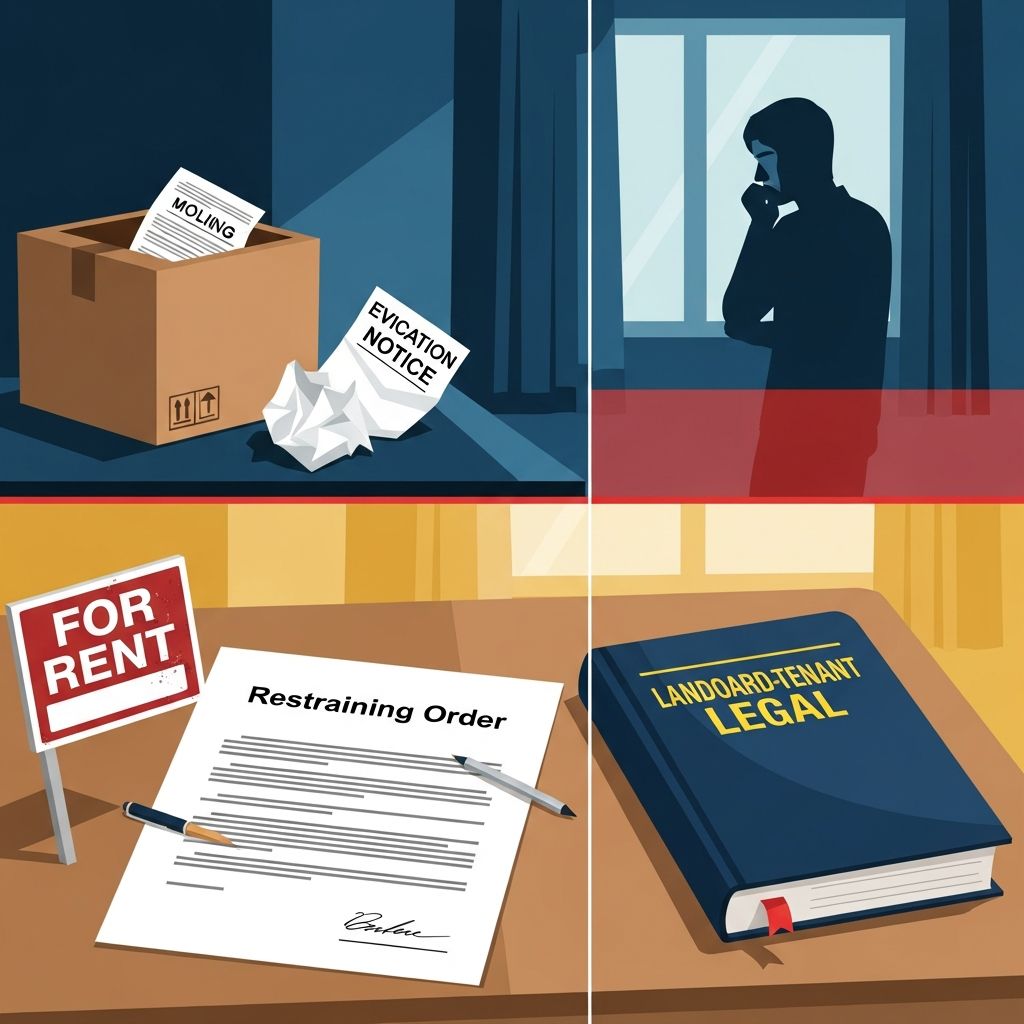
Conflicts in rental housing sometimes escalate beyond typical lease disputes. When harassment, threats, or violence arise, courts may issue restraining orders (also called protective or protection orders). These orders can significantly change how both landlords and tenants navigate an eviction case and day-to-day living arrangements.
This guide explains how the eviction process works, what restraining orders do, and how the two can overlap when safety and housing stability are both at stake.
Core Concepts: Evictions and Restraining Orders
Before exploring how these legal tools interact, it helps to separate what each one is designed to do.
What an Eviction Is (and Is Not)
An eviction is a formal legal process in which a landlord asks a court to order a tenant to move out of a rental property. The specifics vary by state and country, but common features include:
- The landlord must give written notice before going to court, except in rare emergencies.
- The landlord must file a lawsuit; they cannot legally remove a tenant without a court order.
- Only a law enforcement officer (such as a sheriff or bailiff) can physically remove a tenant after a court issues a judgment.
Eviction cases are usually based on reasons such as unpaid rent, serious lease violations, property damage, or illegal activity on the premises.
What a Restraining Order Does
A restraining order is a court order intended to prevent one person from harming or contacting another. Different jurisdictions and statutes use terms like protective order, order of protection, or no-contact order, but the core idea is similar:
- It can bar someone from contacting the protected person in person, by phone, electronically, or through third parties.
- It may prohibit the restrained person from going to the protected person’s home, workplace, or school.
- Violating the order can be a separate criminal offense and may also carry civil penalties.
Restraining orders are often used in cases involving domestic violence, stalking, harassment, or serious threats.
Typical Eviction Timeline and Steps
Understanding the normal eviction sequence makes it easier to see how a restraining order might affect specific stages.
| Eviction Stage | What Usually Happens | Key Legal Points |
|---|---|---|
| 1. Notice | Landlord serves a written notice to quit or cure (for example, pay rent or move out). | Must meet local timing, content, and service rules; often 3–30 days depending on the reason. |
| 2. Court Filing | If the tenant does not comply by the deadline, the landlord files an eviction lawsuit. | Tenant receives a summons and complaint and has an opportunity to respond and appear. |
| 3. Hearing or Trial | Both sides present evidence, witnesses, and legal arguments to a judge. | Judge decides whether the landlord has legal grounds to regain possession. |
| 4. Judgment | The court issues an order either granting or denying possession. | Some jurisdictions allow appeals or a short grace period before enforcement. |
| 5. Enforcement | If the landlord wins and the tenant still does not leave, a sheriff or bailiff conducts the physical move-out. | Self-help evictions (changing locks, cutting utilities) are typically illegal. |
When a Tenant Seeks a Restraining Order
Sometimes the person seeking protection is the tenant, and the restrained party may be the landlord, a neighbor, another tenant, or a household member. This can complicate both ongoing tenancies and pending eviction cases.
Restraining Order Against a Landlord
If a landlord threatens, harasses, or assaults a tenant, the tenant may request a protective order. Consequences can include:
- No in-person contact: The landlord may be barred from approaching the tenant, entering the tenant’s unit except under specific conditions, or lingering near the tenant’s door.
- Limits on communication: Only written or third-party communication (for example, through a property manager or attorney) might be allowed to handle repairs or notices.
- Impact on access to the property: In serious cases, the order might prohibit the landlord from coming onto the premises at all without law enforcement escort.
The protective order does not automatically cancel the lease or block an otherwise lawful eviction. However, it changes how the landlord must exercise their rights.
Practical Adjustments for a Landlord Under an Order
- Use licensed property managers, attorneys, or maintenance staff to handle all in-person interactions with the tenant.
- Serve legal notices by legally permitted methods that do not violate no-contact restrictions (such as certified mail or a process server, where allowed).
- Request clarification from the court if the order’s terms conflict with the landlord’s statutory duties (for example, emergency access for repairs).
Restraining Order Against a Neighbor or Co-Tenant
Tenants sometimes seek protection from another tenant in the building or from a roommate on the same lease. In these situations:
- The restrained person may be ordered not to enter the shared rental unit or common areas where the protected person lives.
- The court might effectively remove the restrained person from the home by prohibiting them from living there, even if their name is on the lease.
- The landlord might need to adjust access devices (such as keys, codes, or fobs) to comply with the order.
A landlord who knowingly helps a restrained person violate an order—for example, by letting them back into the unit contrary to the order’s terms—could be drawn into legal problems, including potential contempt issues in some jurisdictions.
When a Landlord Seeks a Restraining Order
On the other side, a landlord may request a restraining order against a tenant or someone associated with the tenant if there are threats, stalking, or violence. This can happen whether or not an eviction is pending.
Common Reasons Landlords Seek Protection
- Repeated verbal threats or acts of violence toward the landlord or staff.
- Harassment or stalking at the landlord’s home or office.
- Serious property damage combined with threatening behavior.
A restraining order may bar the tenant from contacting the landlord directly, requiring all communication to go through legal counsel or a designated agent.
How a Restraining Order Affects Ongoing Tenancy
Even if a landlord obtains a protective order, the tenant might still have legal rights to remain in the unit until a court formally ends the tenancy. In that period:
- The landlord can usually continue an eviction already in progress, provided they work through attorneys, agents, or virtual hearings where possible.
- Written notices and court documents are still served as required by law; the order primarily changes the method and tone of interactions.
- The tenant must respect both the lease and the protective order; violating either can have legal consequences.
Intersection: Evictions Involving Domestic Violence or Abuse
Many legal systems give special consideration to tenants facing domestic violence, stalking, or similar abuse. These protections can alter the usual eviction analysis when a restraining order is in place.
Protections for Victims in Rental Housing
In some U.S. federal programs and many state laws, a landlord cannot evict a tenant solely because they are a victim of domestic violence or because police were called to respond to violence perpetrated by someone else. While details vary, typical protections include:
- Limits on using police calls or disturbance reports as the main reason for eviction.
- The possibility of bifurcating a lease—removing the abuser from the lease while allowing the survivor to stay, where allowed by law.
- Options for survivors to request emergency lock changes or early lease termination with appropriate documentation.
Restraining orders can serve as key evidence that domestic violence or stalking has occurred and may trigger these special statutory protections.
Evicting the Abuser but Not the Survivor
Where law allows, a landlord may:
- Seek to remove only the violent household member through court procedures, often relying on the existence of a protective order.
- Allow the protected tenant and any children to continue the tenancy and assume sole responsibility for rent and lease obligations.
- Coordinate with law enforcement when enforcing both the eviction judgment and the protective order to minimize risk.
In practice, landlords should consult local statutes or legal counsel before taking steps that differentiate between household members. Missteps can risk discrimination claims or conflicts with housing protections.
Service of Notices and Court Documents Under a Restraining Order
One of the most practical challenges in combining evictions and restraining orders is service—how notices and legal papers are delivered without violating the order.
Permitted Methods of Service
Most landlord-tenant laws specify acceptable ways to give notice, such as:
- Personal delivery by a process server, constable, or sheriff.
- Posting the notice on the door plus mailing a copy, in jurisdictions that permit this.
- Certified or first-class mail, sometimes with proof of mailing.
If a restraining order bars a landlord from any face-to-face contact, the landlord can still comply with service rules by relying on third-party professionals or mail, as allowed.
Coordinating with the Court
When a restraining order exists between the parties in an eviction case, courts often make procedural adjustments, such as:
- Scheduling the parties to appear in different rooms or at staggered times for hearings.
- Allowing remote participation by video or phone for one or both sides.
- Ensuring security staff are available at the courthouse.
Any party concerned about safety should inform the court clerk or their attorney in advance so reasonable arrangements can be made.
Illegal Evictions and Harassment
Because emotions can run high when restraining orders and safety concerns are involved, it is important to distinguish legal enforcement from unlawful self-help tactics.
Examples of Illegal Self-Help Evictions
In many jurisdictions, it is unlawful for a landlord to do the following without a court order and proper enforcement:
- Change the locks to keep the tenant out.
- Cut off essential services such as water, heat, or electricity to force the tenant to leave.
- Remove the tenant’s belongings or place them on the curb without a sheriff or bailiff present.
- Threaten or harass the tenant into moving out.
These actions may lead to civil liability, financial penalties, or even criminal charges, depending on local law.
Harassment and Retaliation
Some housing laws specifically prohibit a landlord from retaliating against a tenant for exercising legal rights—for example, calling the police, requesting a restraining order, or reporting housing code violations.
Retaliation can include:
- Serving an eviction notice shortly after the tenant files a complaint, without a valid independent reason.
- Increasing rent or reducing services in response to the tenant’s legal actions.
- Engaging in a pattern of threats or harassment.
If timing suggests possible retaliation, some courts allow tenants to raise this as a defense in an eviction case or as a separate claim.
Safety Planning Around Evictions
Whether you are a landlord, a tenant, or a property manager, safety should be a central concern when violence or threats overlap with housing disputes.
For Tenants
- Document incidents of threats, abuse, or stalking with dates, times, and witnesses where possible.
- Seek free legal help from legal aid or tenant advocacy groups when facing both eviction and abuse claims.
- Ask the court for specific safety measures (separate waiting rooms, remote hearings, or escorted entry) if a protective order is involved.
- Explore housing assistance or emergency shelter options if remaining in the unit is unsafe.
For Landlords and Property Managers
- Train staff to recognize and appropriately respond to reports of domestic violence or harassment.
- Coordinate with law enforcement, especially when enforcing a judgment of possession involving a restrained party.
- Avoid any actions that could be seen as punishing tenants for seeking help from police or the courts.
- Consult legal counsel about balancing safety concerns with fair housing and anti-discrimination laws.
Frequently Asked Questions (FAQs)
Does a restraining order automatically evict someone from a rental unit?
No. A restraining order is focused on protecting a person, not on resolving landlord-tenant rights. It may prohibit someone from living in or visiting a particular address, but an eviction or lease termination usually still requires separate legal steps through the landlord-tenant court.
Can a landlord evict a tenant just because the tenant got a restraining order?
In many jurisdictions, a landlord cannot lawfully retaliate against a tenant for requesting a restraining order or contacting law enforcement. Eviction must be based on valid legal grounds such as non-payment of rent, serious lease violations, or other lawful reasons, not merely on the tenant’s use of legal protections.
What if the restraining order says the landlord cannot come near the tenant?
The landlord can typically use third-party agents such as property managers, process servers, or attorneys to handle necessary interactions, repairs, and notices. If the order’s terms make normal property management impossible, the landlord can ask the issuing court for clarification or modification while still following all existing terms until the court rules.
How are court hearings handled when both parties have a no-contact order?
Civil courts regularly manage cases where restraining orders exist between the parties. Judges may arrange for separate waiting areas, remote appearances, or strict seating plans to maintain compliance with the order while allowing each side to present their case.
Can a tenant stay in subsidized or public housing after reporting domestic violence?
In many publicly assisted housing programs and under certain federal laws, tenants cannot be evicted solely because they are victims of domestic violence, dating violence, sexual assault, or stalking. Specific rights and obligations depend on the program and local law, and tenants should review their housing documents and seek legal advice or advocacy assistance.
References
- Evictions 101: The Eviction Process: How It Works and What to Know — National Low Income Housing Coalition. 2021-03-01. https://nlihc.org/resource/evictions-101-eviction-process-how-it-works-and-what-know
- Tenants’ Guide to Eviction — Massachusetts Trial Court / Mass.gov. 2023-08-10. https://www.mass.gov/info-details/tenants-guide-to-eviction
- Private Renting: Evictions — UK Government, GOV.UK. 2024-01-15. https://www.gov.uk/private-renting-evictions
- Tenant Guide to Eviction Cases for Non-Payment of Rent — Legal Aid DC. 2024-06-01. https://www.legalaiddc.org/sites/default/files/2024-06/eviction-nonpayment_of_rent_packet.pdf
- Eviction Notices from Private Landlords — Shelter England. 2023-11-20. https://england.shelter.org.uk/housing_advice/eviction/eviction_notices_from_private_landlords
- Eviction Notices — WashingtonLawHelp.org, Northwest Justice Project. 2023-04-05. https://www.washingtonlawhelp.org/eviction-notices
- Renting Out Your Property: Giving Notice to Evict Tenants — UK Government, GOV.UK. 2024-02-01. https://www.gov.uk/guidance/renting-out-your-property-guidance-for-landlords-and-letting-agents/giving-notice-to-evict-tenants
Similar Articles








Read full bio of medha deb


