
Freedom of the Press: Core Rights for Americans
Discover the foundational principles of press freedom in the U.S., from constitutional safeguards to modern challenges and limitations.
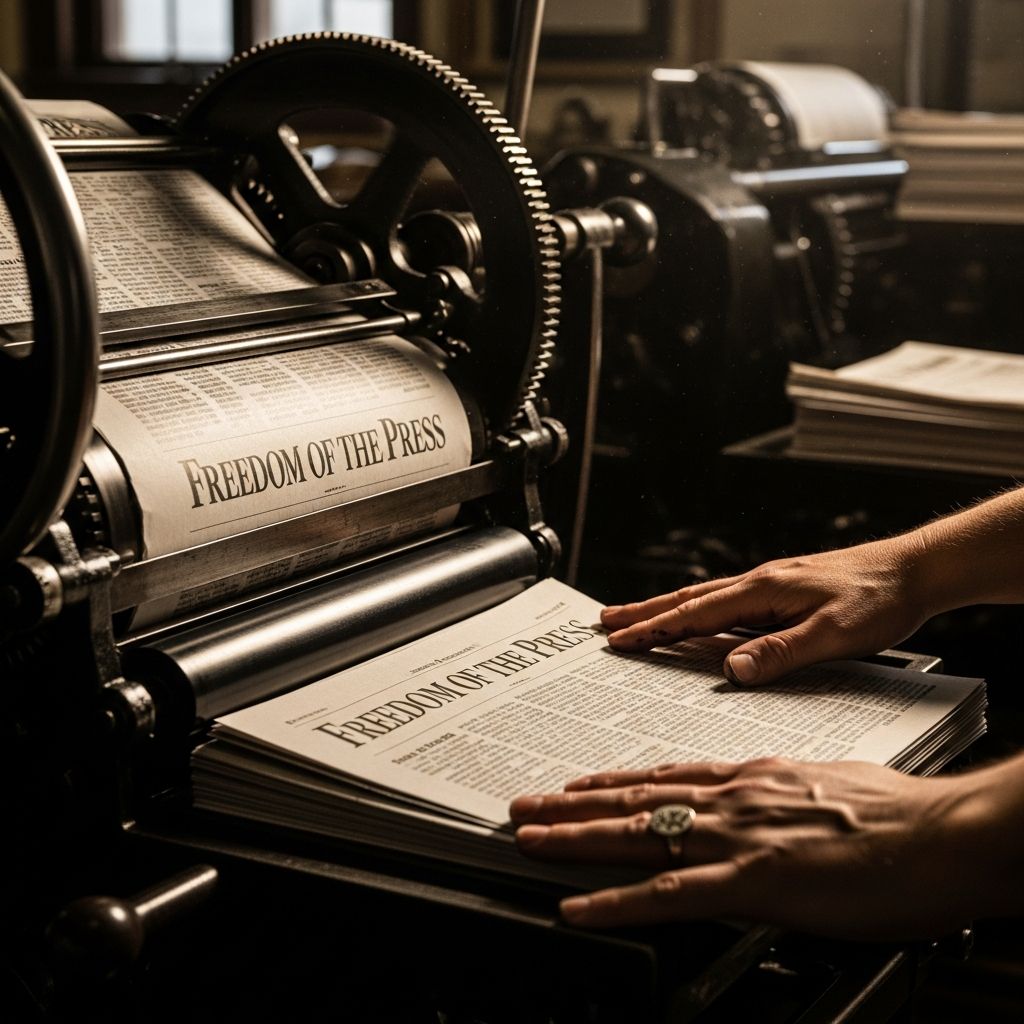
The First Amendment to the U.S. Constitution stands as a cornerstone of American democracy, explicitly safeguarding freedom of the press alongside speech, religion, assembly, and petition rights. Ratified in 1791 as part of the Bill of Rights, it declares: “Congress shall make no law… abridging… the freedom of… the press.” This protection ensures that media outlets, journalists, bloggers, and citizens can disseminate information without undue government interference, fostering an informed public essential for self-governance.
Historical Foundations and Constitutional Anchoring
Freedom of the press emerged from colonial experiences with British censorship, where publications critical of the crown faced severe repercussions. The framers, drawing from Enlightenment ideals, embedded this liberty in the First Amendment to prevent similar abuses. The amendment’s text separates “freedom of speech” from “freedom of the press,” signaling the press’s unique societal role in investigating power and holding officials accountable.
Through the Fourteenth Amendment, these protections extend to state and local governments, binding all public entities. Justice Potter Stewart emphasized this distinction, noting the Constitution’s recognition of the press’s “critical role” in democracy, demanding governmental sensitivity to its operations.
Landmark Judicial Decisions Shaping Press Liberties
Supreme Court rulings have defined the scope of press freedom, establishing precedents that prohibit prior restraints—government orders halting publication before it occurs. In Near v. Minnesota (1931), the Court struck down a state law allowing abatement of “malicious” newspapers, ruling such measures violate the First Amendment. This decision extended free speech principles to the press, rejecting preemptive censorship.
Other cases affirm broad protections. The Court has ruled that bloggers receive the same First Amendment safeguards as traditional journalists, provided they do not act negligently in defamation claims. This equalizes digital and legacy media, promoting diverse information sources.
- Near v. Minnesota (1931): Prohibits prior restraints on publication.
- Associated Press v. United States (1945): First Amendment does not exempt press from antitrust laws, as news is interstate commerce.
- Obsidian Finance Group v. Cox (2014): Bloggers entitled to journalist-level protections.
Government Restrictions: What Crosses the Line?
While robust, press freedom is not absolute. Governments cannot impose content-based restrictions—laws targeting specific messages or viewpoints—deemed presumptively unconstitutional. For instance, bans on war criticism or unpopular ideas distort public discourse.
However, incidental regulations, like generally applicable laws enforced against media, are permissible if they do not target journalism. The Court has clarified that the press lacks a right to compel government information access beyond public availability, treating media akin to citizens in many respects.
| Type of Restriction | Constitutional? | Example |
|---|---|---|
| Prior Restraint | No | Pre-publication bans |
| Content-Based | Generally No | Laws silencing specific views |
| Incidental Effects | Yes | Antitrust application to news |
| Time, Place, Manner | Possibly | Neutral public safety rules |
Modern Applications: From Broadcasts to Digital Platforms
Interpretations have evolved with technology. The First Amendment covers broadcasting, internet publications, and symbolic acts like flag burning. Online expression, including social media and blogs, falls under press protections, ensuring the “widest possible dissemination of information from diverse sources.”
Public institutions must refrain from viewpoint discrimination. Criticism of government, even if unpopular, remains shielded, promoting “more speech, not enforced silence,” as Justice Brandeis advocated.
The Right to Receive Information: A Two-Way Street
Press freedom encompasses the public’s right to receive ideas. The Supreme Court has held this as fundamental, linking it to meaningful exercise of speech and political freedoms. In Lamont v. Postmaster General (1965), restrictions on receiving foreign mailings were invalidated.
School library book removals have been scrutinized; while not absolute, such actions cannot suppress ideas without justification, underscoring access to diverse viewpoints.
Boundaries and Exceptions: Libel, Obscenity, and More
Press outlets face limits for defamation, where false statements harm reputations, though public figures must prove “actual malice.” Obscenity, incitement to imminent lawless action, and true threats fall outside protections. Commercial speech receives lesser safeguards.
Corporations, including media entities, enjoy First Amendment rights, as affirmed in First National Bank of Boston v. Bellotti, prioritizing public access to debate over speaker identity.
Press Freedom’s Role in Democratic Accountability
An independent press acts as a watchdog, exposing corruption and informing voters. Without it, self-governance falters. The Framers viewed a free press as vital to countering power abuses, a principle enduring amid digital shifts and polarization challenges.
In contemporary contexts, protections guard against censorship in schools, libraries, and online spaces, ensuring intellectual freedom.
Frequently Asked Questions (FAQs)
Does freedom of the press apply only to traditional newspapers?
No, it extends to bloggers, broadcasters, and online publishers, as long as they disseminate information.
Can the government censor a story before publication?
Generally no; prior restraints are heavily disfavored under Near v. Minnesota.
Is the press entitled to special access to government information?
No, but they benefit from public records laws and cannot be compelled for exclusive access.
What about defamation? Can anyone sue the press?
Yes, but public figures face a high bar of proving actual malice.
Does press freedom protect obscene or harmful content?
No, exceptions exist for obscenity, incitement, and true threats.
Challenges Ahead: Preserving Press Liberties
Emerging issues like digital misinformation, platform moderation, and national security claims test boundaries. Yet, core principles—opposition to censorship, support for diverse voices—remain. Every American benefits from an unfettered press, empowering informed citizenship.
References
- Freedom of the press in the United States — Wikipedia. Accessed 2026. https://en.wikipedia.org/wiki/Freedom_of_the_press_in_the_United_States
- First Amendment and Censorship — American Library Association. Accessed 2026. https://www.ala.org/advocacy/intfreedom/censorship
- Amdt1.9.1 Overview of Freedom of the Press — Constitution Annotated, Congress.gov. Accessed 2026. https://constitution.congress.gov/browse/essay/amdt1-9-1/ALDE_00000395/
- Interpretation: Freedom of Speech and the Press — National Constitution Center. Accessed 2026. https://constitutioncenter.org/the-constitution/amendments/amendment-i/interpretations/266
- Freedom of Press Overview — Legal Information Institute, Cornell Law School. Accessed 2026. https://www.law.cornell.edu/constitution-conan/amendment-1/freedom-of-press-overview
- U.S. Constitution – First Amendment — Library of Congress. Accessed 2026. https://constitution.congress.gov/constitution/amendment-1/
- The Bill of Rights: A Transcription — National Archives. 1791. https://www.archives.gov/founding-docs/bill-of-rights-transcript
Similar Articles








Read full bio of Sneha Tete


