
New Hire Paperwork: Essential Checklist For Employers 2025
Master the critical documents and steps for seamless new employee onboarding from day one to ensure compliance and smooth integration.
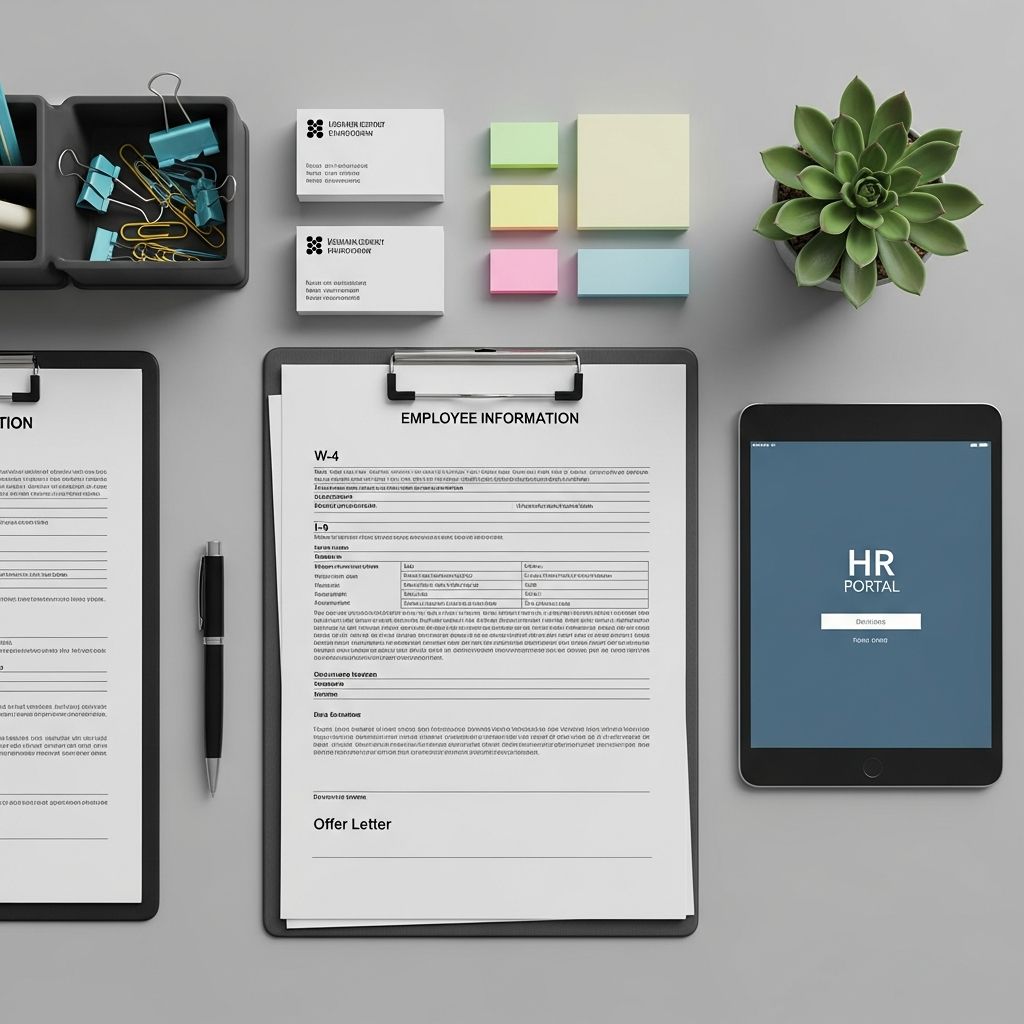
New employees bring fresh energy to any organization, but their first day hinges on handling paperwork correctly. This guide details the key documents required for legal compliance, tax withholding, and smooth integration, drawing from federal and state mandates to help employers avoid penalties and foster retention.
Why First-Day Documentation Matters
Completing paperwork on or before the first day ensures immediate payroll processing, verifies work eligibility, and sets clear employment expectations. Federal law requires Form I-9 verification within three business days, while tax forms like W-4 prevent withholding errors that could lead to IRS issues. Proper handling also signals professionalism, reducing new hire anxiety and boosting long-term engagement. Employers who streamline this process see up to 50% higher retention rates in the first year, according to HR best practices.
Mandatory Federal Forms for Every New Hire
All U.S. employers must collect specific federal documents to comply with immigration and tax laws. Here’s a breakdown:
- Form I-9 (Employment Eligibility Verification): Confirms the employee’s identity and authorization to work in the U.S. Employees choose from List A (e.g., U.S. passport) or one from List B (e.g., driver’s license) plus List C (e.g., Social Security card). Employers must complete by day three; non-compliance fines start at $272 per form.
- Form W-4 (Employee’s Withholding Certificate): Determines federal income tax withholding based on filing status, dependents, and other income. Updated in 2020 to align with the Tax Cuts and Jobs Act, it no longer uses allowances. Employees submit before first payroll.
- Direct Deposit Authorization: Optional but standard; routes pay to bank accounts via ACH for efficiency and security.
These forms are available free from the USCIS and IRS websites. Use electronic systems for e-signatures to speed up processing.
State and Local Tax Withholding Requirements
Beyond federal forms, most states mandate additional paperwork. For example:
| State Example | Required Forms | Key Notes |
|---|---|---|
| California | DE 4 (State Withholding), DLSE Notice to Employee | High minimum wage; paid sick leave notice required. |
| New York | IT-2104 (State Withholding), Wage Theft Prevention Act Notice | Details pay rate, overtime, and at-will status. |
| Texas | No state income tax form | Focus on federal; local ordinances may apply. |
| Florida | No state income tax | Reemployment Assistance tax notice. |
Check your state’s labor department site for exact forms. Some localities like New York City require additional withholding certificates. Always provide wage notices under state wage theft laws, specifying pay frequency, rate, and overtime eligibility.
Offer Letters and Employment Agreements
While not always federally required, offer letters are crucial for clarity. Include job title, start date, compensation, benefits overview, reporting structure, and at-will language where applicable. For exempt roles, specify salary to comply with FLSA. Employment agreements may detail non-compete clauses, IP assignment, or probation periods, but keep them concise to avoid unenforceability risks.
- Essential elements: Compensation details, work schedule, remote/hybrid terms, benefits enrollment deadlines.
- Best practice: Send digitally pre-start for review; collect signed copy on day one.
Benefits Enrollment and Acknowledgments
New hires typically have 30 days to elect benefits. Provide summaries of health insurance, 401(k), PTO, and other perks. Require signed acknowledgments for:
- Employee handbook receipt (covering policies on harassment, safety, DEI).
- Receipt of benefits packets.
- Emergency contact information.
Discuss open enrollment windows and point to HR portals for self-service. For remote workers, mail physical swag or packets.
Onboarding Checklist: From Pre-Start to First 90 Days
A structured checklist prevents oversights. Divide into phases:
Preboarding (Before Day 1)
- Send signed offer letter and welcome email with agenda, dress code, parking info.
- Initiate background checks if needed.
- Provision equipment: Laptop, phone, badge.
- Announce hire to team.
- Share digital forms for pre-completion (I-9, W-4).
Day 1 Orientation
- Welcome and facility tour (highlight restrooms, break areas, security).
- Collect/review paperwork.
- IT setup: Email, logins, software access.
- Manager 1:1 on goals and culture.
- Team introductions and peer buddy assignment.
First 30 Days
- Weekly check-ins for feedback.
- Compliance training: Safety, data privacy, anti-harassment.
- Job shadowing and initial tasks.
60-90 Days
- Performance review and goal setting.
- Advanced training.
- Social integration events.
This phased approach ensures compliance while promoting belonging.
Special Considerations for Remote and Hourly Workers
Remote hires need virtual tours, shipped kits, and Zoom orientations. Ensure I-9 remote verification complies with DHS rules (effective 2024 for some). Hourly/non-exempt employees require precise timekeeping setup and overtime notices. Gig or seasonal workers may need abbreviated forms but still full I-9/W-4.
Common Pitfalls and How to Avoid Them
- Delaying I-9: Fines escalate quickly; use reminders.
- Incomplete W-4: Causes payroll errors; provide calculators.
- Missing State Notices: Audit annually per DOL guidelines.
- No Acknowledgment Trails: Digitize everything for audits.
Leverage HR software for automation, e-signatures, and tracking.
Frequently Asked Questions
What happens if I-9 isn’t completed on time?
Employers face civil fines from $272 to $27,018 per violation, plus potential criminal charges for patterns. Complete within three days.
Can new hires start without W-4?
No; payroll can’t process without it. Default to single/zero withholding if unsigned, but encourage prompt submission.
Is an employee handbook legally required?
Not federally, but acknowledgments protect against disputes. Include EEO, ADA, FMLA policies.
How long to keep new hire forms?
I-9: 3 years after hire or 1 year post-termination. W-4: 4 years. Digitize for easy access.
What about contractors vs. employees?
Contractors need 1099 prep but no I-9/W-4. Misclassification risks back taxes; use IRS SS-8 for clarity.
Tools and Technology for Streamlined Onboarding
Modern HRIS platforms automate 80% of paperwork. Features include e-forms, workflows, mobile apps, and integrations with payroll like ADP or Paychex. Track completion rates and send nudges. For small businesses, free tools from DOL suffice initially.
Investing in tech reduces admin time by 40%, per industry benchmarks, allowing focus on culture-building.
References
- Employee Onboarding Checklist for Compliance — HR Consulting Group. 2023. https://www.hr-consulting-group.com/hr-news/employee-onboarding-checklist-for-compliance
- New Hire Onboarding Checklist — Paylocity. 2024-01-15. https://www.paylocity.com/resources/learn/articles/employee-onboarding-checklist/
- New Hire Onboarding Checklist — Indeed for Employers. 2024. https://www.indeed.com/hire/c/info/new-hire-onboarding-checklist
- I-9 Employment Eligibility Verification — U.S. Citizenship and Immigration Services (USCIS). 2025-01-10. https://www.uscis.gov/i-9
- Form W-4 Employee’s Withholding Certificate — Internal Revenue Service (IRS). 2024-12-01. https://www.irs.gov/forms-pubs/about-form-w-4
- New Hire Reporting — U.S. Department of Labor. 2024. https://www.dol.gov/general/topic/hiring/newhire
Similar Articles








Read full bio of medha deb


