
Essential Money Words for Young Learners
A clear, student-friendly guide to core financial terms that builds confidence with money decisions from school years to adulthood.
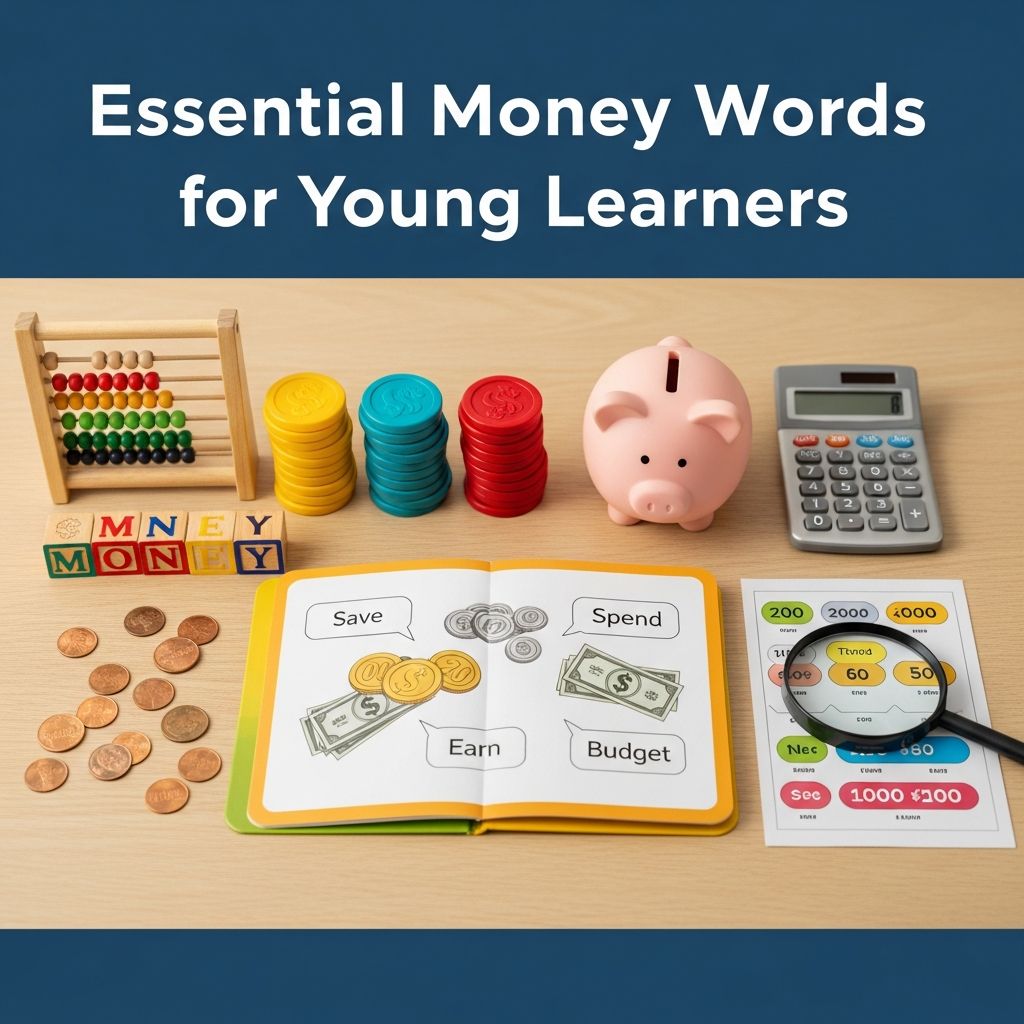
Understanding basic financial vocabulary helps young people make smarter choices about earning, saving, borrowing, and paying for education. This guide explains key money words in simple language, with youth and families in mind.
1. Building Blocks of Everyday Money Decisions
Some financial ideas show up in almost every money choice, whether you are buying a snack, opening an account, or planning for college. Learning these concepts first makes advanced terms much easier to understand.
Income, Spending, and Saving
Every money plan starts with what comes in, what goes out, and what you keep for later.
- Income: Money you receive, such as pay from a job, tips, gifts, or government benefits.
- Expenses: All the things you spend money on, from bills to entertainment and school supplies.
- Budget: A written or digital plan that shows how you expect to use your income for saving, spending, and giving.
- Savings goal: A specific amount you aim to set aside to reach a future objective, such as buying a device or paying for a class.
When students practice tracking income and expenses, they learn how to decide between wants and needs and how long it may take to reach a savings goal.
Banks, Credit Unions, and Accounts
Most people use financial institutions to keep money safe and to move it when they make payments.
- Financial institution: An organization like a bank or credit union that offers accounts, loans, and payment services.
- Checking account: An account designed for frequent transactions such as paying bills or using a debit card; it usually pays little or no interest.
- Savings account: An account meant for storing money and usually earning interest over time.
- Mobile banking: Using a phone or tablet app to check balances, move money, or deposit checks without visiting a branch.
| Feature | Checking Account | Savings Account |
|---|---|---|
| Typical purpose | Day-to-day spending and bill payments | Short- or longer-term saving |
| Number of transactions | Frequent | Usually fewer transfers or withdrawals |
| Interest earnings | Often very low or none | Usually pays interest to grow savings |
| Common tools | Debit card, checks, online bill pay | Transfers to and from checking |
2. Credit, Debt, and the Cost of Borrowing
Youth often first encounter credit through student loans, store cards, or car loans. Knowing how borrowing works can prevent long-lasting financial problems.
Credit, Loans, and Minimum Payments
- Credit: The ability to borrow money now and promise to repay it later, usually with interest.
- Loan: A formal agreement where you receive money and must pay it back over time, following set terms.
- Principal: The original amount of money borrowed on a loan, not including interest.
- Minimum payment: The smallest amount you are required to pay each month on a credit card or loan to keep the account in good standing.
Paying only the minimum can keep you from falling behind, but it often means you pay much more interest over the life of the debt.
Interest, Rates, and Premiums
- Interest: The cost of using someone else’s money when you borrow, or the reward the bank pays you for keeping money on deposit.
- Interest rate: The percentage used to calculate how much interest you will pay or earn over a period of time.
- Annual Percentage Rate (APR): The yearly cost of borrowing, including interest and certain fees, expressed as a percentage to help compare loans.
- Premium: The amount you pay, often monthly, for an insurance policy that protects against certain risks, such as car damage or health expenses.
For long-term goals such as college or buying a car, even small differences in interest rates can lead to large changes in total cost.
3. Planning for Education After High School
Many of the most confusing money words for teens relate to education after high school. These terms are central to understanding how much school will cost and how to pay for it.
Types of Education and Credentials
- Post-secondary education: Any education after high school, including trade schools, community colleges, and four-year colleges or universities.
- Degree: An academic qualification such as an associate’s or bachelor’s degree, usually requiring two to four years of study.
- Post-secondary school certificate (non-degree): A formal recognition that a student has completed a focused program, often lasting a few weeks to two years; it does not count as a degree.
Certificates can help students gain in-demand skills quickly, while degrees often open doors to a wider range of careers and higher earnings on average.
What School Really Costs
- Tuition and fees: Charges from a school for instruction and required services.
- Cost of attendance (COA): The full estimated yearly cost to attend a school, including tuition and fees, housing and food, books and supplies, transportation, and typical personal expenses.
- Room and board: Housing and food costs if you live on-campus or buy meal plans.
Federal rules require colleges that participate in federal aid programs to publish clear cost of attendance figures so students can compare schools more easily.
Student Aid, Scholarships, and Work Options
- Financial aid: Money to help pay for education expenses, which can come as grants, scholarships, work-study jobs, or loans.
- Grants: Need-based education funds that usually do not have to be repaid, such as federal Pell Grants.
- Scholarships: Funding students receive based on academics, talent, service, or other criteria; typically does not need to be repaid.
- Federal Work-Study: A program that offers part-time jobs for eligible students to earn money to help cover education costs.
- Student loans: Borrowed funds that must be paid back with interest; can be federal or private.
Students often receive a mix of aid types. Comparing packages from different schools can show which offers the lowest debt for the same credential.
Planning Tools and Indexes
- Student Aid Index (SAI): A number used to decide how much federal student aid a student may receive; it replaces the former Expected Family Contribution in U.S. aid formulas.
- College savings plan: An investment or savings program designed to help families set aside money for future education costs, often with tax advantages.
4. Saving and Investing for the Future
Once basic bills are covered, saving and investing help young people prepare for emergencies and long-term goals like education, housing, or retirement.
Goals, Funds, and Emergency Protection
- Emergency fund: Money set aside to cover unexpected costs such as car repairs, a broken phone, or a sudden loss of income.
- Short-term goal: A target you plan to reach within about a year, such as saving for a trip or course fee.
- Long-term goal: A target that may take several years or more, like paying for advanced education or a home.
Experts commonly suggest building an emergency fund that can cover at least three months of essential expenses once someone has stable income.
Basic Investing Terms
- Investment: Putting money into something with the expectation that it will grow in value or pay income over time.
- Stock: A type of investment that represents partial ownership in a company; the value can rise or fall with the business and the wider market.
- Bond: A loan you make to a company or government that promises to repay with interest on a schedule.
- Mutual fund: A pooled investment where many investors’ money is combined and professionally managed to buy stocks, bonds, or other assets.
Investment products used inside college savings plans or retirement accounts are typically regulated and must provide disclosure documents that explain fees and risks.
Education-Focused Savings Plans
- 529 savings plan: A tax-advantaged account sponsored by states that lets families invest for education costs; money can be used for college and, in many states, for K-12 tuition as well.
- Education savings plan: Another term often used for 529 plans where contributions are invested in mutual funds or similar options. The value can rise or fall with the market.
U.S. federal tax law treats qualified withdrawals from 529 plans for approved education expenses as free from federal income tax on earnings.
5. Protecting Yourself: Scams, Subscriptions, and Rights
Knowing how to spot unfair offers and read agreements is just as important as learning how to save or invest.
Recognizing Scams and Fraud
- Scam: A dishonest scheme designed to trick someone out of money or personal information; it can appear through texts, social media, email, phone calls, or in person.
- Identity theft: When someone uses your personal information without permission to open accounts, make purchases, or commit other fraud.
- Phishing: Messages that pretend to be from real organizations to get you to share passwords, card numbers, or other sensitive data.
Government consumer-protection agencies advise never sharing financial details through links you did not expect and verifying contact information through official websites before responding.
Subscriptions, Contracts, and Fine Print
- Subscription: An ongoing agreement to receive a product or service—such as streaming, gaming, or apps—often billed automatically at regular intervals.
- Free trial: A short-term offer to use a service at no cost that may automatically convert into a paid subscription unless canceled in time.
- Contract: A legally binding agreement that describes the rights and duties of each party in a transaction, such as a phone plan or rental lease.
Reading cancellation terms and saving confirmation emails helps students avoid paying for subscriptions they no longer use.
6. Money, Markets, and the Bigger Picture
Behind everyday prices and wages are basic economic forces that also show up in personal finance terms.
Supply, Demand, and Prices
- Supply: The total amount of a good or service that sellers are willing to offer at different prices.
- Demand: How much consumers want to buy at different prices.
- Market: Any arrangement—online or offline—where buyers and sellers exchange goods, services, or assets.
When demand rises and supply stays the same, prices usually increase; when supply grows faster than demand, prices often fall.
Wages, Taxes, and Take-Home Pay
- Minimum wage: The lowest hourly pay rate that employers are allowed to pay most workers under law, though some jobs are exempt.
- Gross income: Total earnings before taxes and other deductions are taken out.
- Net pay: The amount of money you actually receive in your paycheck after taxes and deductions.
- Taxes: Required payments individuals and businesses make to federal, state, and local governments; they fund services such as schools, roads, and safety programs.
7. Quick-Reference FAQ for Students and Families
Q: Is all financial aid free money?
A: No. Scholarships and most grants do not need to be repaid, but student loans must be paid back with interest. Work-study is money you earn from a job, not free money.
Q: Why does the cost of attendance matter if I know the tuition price?
A: Tuition covers instruction, but the cost of attendance also includes housing, food, books, supplies, transportation, and typical personal expenses. It gives a more realistic picture of what school will cost for a full year.
Q: How is a 529 savings plan different from a regular savings account?
A: A 529 plan is designed specifically for education and usually invests in mutual funds or similar assets, so the value can go up or down. Qualified education withdrawals often get favorable tax treatment, unlike regular savings interest that is usually taxable.
Q: What is the risk of paying only the minimum on my credit card?
A: Paying only the minimum payment keeps your account current but slows down progress and increases the total interest you pay. Larger payments reduce your balance faster and cut interest costs.
Q: How can I help a teen avoid online scams?
A: Teach them to be cautious with unexpected messages, to avoid clicking unfamiliar links, and to confirm requests for money or personal information through trusted contact methods. Encourage them to ask an adult if something feels rushed, secretive, or too good to be true.
References
- Financial Terms Glossary — Consumer Financial Protection Bureau. 2024-01-18. https://www.consumerfinance.gov/consumer-tools/educator-tools/youth-financial-education/glossary/
- Financial Terms Glossary for Teens & Students — Money Fit. 2023-06-01. https://www.moneyfit.org/financial-terms-glossary-teens/
- Financial Literacy Glossary — Ohio University. 2022-08-15. https://www.ohio.edu/financial-aid/financial-literacy-glossary
- 20 Terms to Know for Financial Literacy — First National Bank. 2022-04-20. https://www.fnb247.com/education-center/news/articles/20-terms-to-know-for-financial-literacy/
- 12th Grade Financial Glossary (PDF) — Vermont Student Assistance Corporation / MENTOR Vermont. 2021-09-01. https://mentorvt.org/wp-content/uploads/12th-Grade-Financial-Glossary.pdf
- 10 Financial Terms Every Young Adult Should Know — Central Bank. 2023-03-10. https://www.centralbank.net/learning-center/10-financial-terms-every-young-adult-should-know/
- Financial Literacy: Glossaries of Financial Terms — Benedictine University Library. 2022-02-01. https://researchguides.ben.edu/c.php?g=1144985&p=8589739
Similar Articles








Read full bio of Sneha Tete


