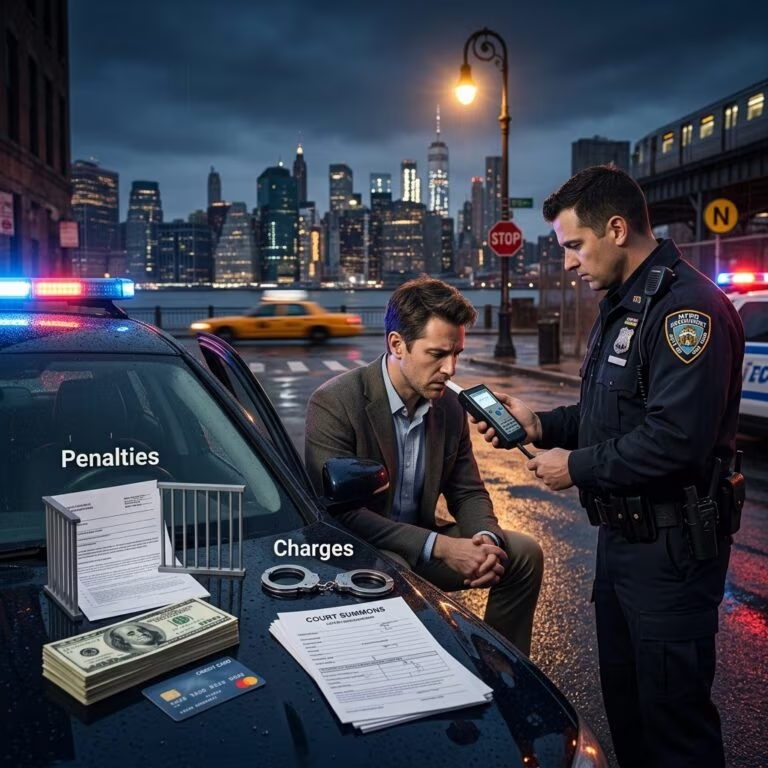
Navigating the legal landscape of driving under the influence requires familiarity with specialized terminology. These terms appear in police reports, court documents, and statutes across the U.S., influencing arrests, charges, and penalties. Understanding them empowers drivers to make informed decisions during traffic stops and legal proceedings.
Core Differences: DUI, DWI, and Related Charges
Driving-related intoxication offenses vary by jurisdiction, with acronyms reflecting local laws. **DUI** stands for Driving Under the Influence, the most common term nationwide, covering operation of a vehicle while impaired by alcohol or drugs. In contrast, **DWI** means Driving While Intoxicated or Driving While Impaired, often used in states like Texas and New York. DUI typically applies to higher impairment levels, such as a blood alcohol concentration (BAC) of 0.08% or more, while DWI may cover slightly lower thresholds like 0.07-0.08% or visible impairment without a precise BAC reading.
Some regions employ **OVI** (Operating a Vehicle Impaired), common in Ohio, or **OWI** (Operating While Intoxicated) in states like Wisconsin and Michigan. These distinctions matter because penalties differ: a first DUI might incur up to one year in jail and $1,000 fines, whereas a DWI could limit jail to 60 days and $500 fines initially. Repeat offenses escalate dramatically, with DUI carrying up to two years imprisonment on subsequent charges.
| Term | Meaning | Common States | Typical BAC Threshold |
|---|---|---|---|
| DUI | Driving Under the Influence | California, Florida, Georgia | 0.08%+ |
| DWI | Driving While Intoxicated/Impaired | Texas, New York, Maryland | 0.07-0.08% or impairment |
| OVI | Operating a Vehicle Impaired | Ohio | 0.08%+ |
| OWI | Operating While Intoxicated | Wisconsin, Michigan | 0.08%+ |
Blood Alcohol Concentration (BAC): The Legal Measure
**BAC** refers to the percentage of alcohol in a person’s bloodstream, the primary metric for intoxication charges. Legally, 0.08% is the per se limit for drivers 21 and older in all states, meaning no further proof of impairment is needed for conviction if exceeded. For commercial drivers, the limit drops to 0.04%, and those under 21 face zero-tolerance at 0.02% or even any detectable alcohol.
**Extreme DUI** or high-BAC enhancements apply at 0.15-0.19%, triggering harsher penalties like extended license suspensions and mandatory alcohol education. Above 0.20%, some states classify it as an aggravated offense with felony potential. Testing methods include breathalyzers, blood draws, or urine samples, each with specific evidentiary rules.
- Breath tests: Portable roadside devices (PBT) are preliminary; evidentiary ones occur at stations.
- Blood tests: Used post-accident or refusal, accurate but invasive.
- Urine tests: Less common, for drug detection.
Implied Consent Laws and Test Refusals
**Implied consent** means that by holding a driver’s license, you agree to chemical testing if arrested for DUI. California’s Vehicle Code §23612 exemplifies this: refusal leads to automatic license suspension (one year for first offense) and can be used as evidence in court. All states have similar laws, with penalties independent of criminal conviction.
Refusing a **preliminary breath test (PBT)** roadside is often legal without automatic penalties, but post-arrest refusal of evidentiary tests invokes **DUI refusal penalties**: enhanced jail time, fines, and ignition interlock requirements. Officers must inform drivers of consequences beforehand for admissibility.
Classifications: Misdemeanor, Felony, and Wobblers
Most first-time DUIs are **misdemeanors**, punishable by fines, probation, DUI school, and short jail stints (e.g., 24-48 hours minimum in Georgia). **Felony DUI** arises with priors (3+ within 10 years in California), injuries, or fatalities, potentially leading to prison terms under Penal Code §191.5 for vehicular manslaughter.
**Wobbler** offenses, like DUI causing injury (Vehicle Code §23153), can be charged as misdemeanor or felony based on factors like priors or injury severity. Aggravating circumstances—minors in vehicle (VC §23572), high BAC, or refusal—add enhancements, increasing minimum sentences.
Field Sobriety Tests and Standardized Procedures
**FST** (Field Sobriety Tests) assess impairment roadside. The **SFST** (Standardized Field Sobriety Tests) include three validated tasks: Horizontal Gaze Nystagmus (eye jerkiness), Walk-and-Turn, and One-Leg Stand. Failure provides probable cause for arrest. Non-standard tests like alphabet recitation are subjective and challengeable.
Officers observe for **DIV** (Driving in Violation) cues like swerving or speeding before stopping. **Reasonable suspicion** justifies the stop; **probable cause** (odor, slurred speech, FST failure) allows arrest.
Sentencing Enhancements and Repeat Offender Rules
**Prior DUI** convictions trigger lookback periods (5-10 years), mandating longer suspensions, interlocks, and programs. Two DUIs within five years often require ignition interlock devices (IID), breath-alcohol ignitions preventing starts above set limits.
Injury-related charges like **DUI with injury** elevate to wobblers, with 2-year prison for serious harm and $3,000 fines. Fatalities invoke manslaughter charges, up to 5 years prison and $5,000 fines. Points systems (e.g., 12 points revoke Maryland licenses for 6 months) compound with insurance hikes.
California-Specific Statutes and Jury Instructions
In California, **VC 23152** covers standard misdemeanor DUIs (alcohol/drugs or 0.08% BAC), while **VC 23153** handles injury cases. **CALCRIM 2100 series** guide juries: No. 2110 requires proof of driving while under alcohol influence; No. 2111 focuses on BAC; Nos. 2112-2113 cover drugs/combined.
Penal Code sections like 1203 (probation) and 1463.14 (fines) apply, with enhancements for refusals or high BAC imposing extra jail.
Post-Arrest Processes: DMV vs. Criminal Court
DUI cases split into **DMV hearing** (administrative license suspension) and **criminal court** (fines, jail). Request DMV hearings within 10 days to challenge suspensions. Criminal stages include arraignment, plea, trial, and sentencing, with possible civil suits for accident damages.
Defensive Strategies and Professional Advice
Challenging **chain of custody** in tests, officer training, or rising BAC defenses (alcohol absorption post-driving) can reduce charges. Consult DUI attorneys early, as priors and enhancements complicate cases. Programs like **DUI school** (mandatory 3-9 months) and **IID** (6-12 months) are common mitigators.
Frequently Asked Questions (FAQs)
Q: What is the difference between DUI and DWI?
A: DUI often denotes higher impairment (BAC 0.08%+), while DWI covers impairment at lower levels or without BAC confirmation, varying by state.
Q: Can I refuse a breath test without consequences?
A: Preliminary roadside tests can often be refused, but post-arrest chemical tests trigger implied consent penalties like license suspension.
Q: How long do DUI convictions stay on my record?
A: Criminal records are permanent, but DMV points may drop after 10 years; insurance impacts last 3-10 years depending on state.
Q: What happens in a first-time DUI with no accident?
A: Expect fines up to $1,000, 4-6 month suspension, DUI classes, and possible short jail; repeats worsen significantly.
Q: Does a commercial driver’s DUI differ?
A: Yes, lower BAC limit (0.04%) and CDL disqualification for one year minimum federally.
References
- Los Angeles DUI Terminology — Kraut Law Group. 2023. https://www.losangelescriminallawyer.pro/los-angeles-dui-terminology.html
- 20 Facts to Understand a DUI Arrest — Saller Law Firm. 2024. https://www.sallerlaw.com/20-facts-to-understand-a-dui-arrest/
- Terminology in Criminal Defense as it Pertains to DUI — Castellanos Law Group. 2023. https://www.castellanoslawgroup.com/blog/terminology-in-criminal-defense-as-it-pertains-to-dui/
- DWI vs DUI: Deciphering the Legal Jargon — Willis Law Firm. 2024-03-25. https://www.willislawga.com/2024/03/25/dwi-vs-dui-deciphering-the-legal-jargon/
- California DUI Glossary — Tyler Law. 2024. https://www.tylerlaw.com/glossary-of-dui-terms/