
The Escalation of Law Enforcement: Rethinking Police Tactics
Examining the shift from community guardians to combat-ready policing.
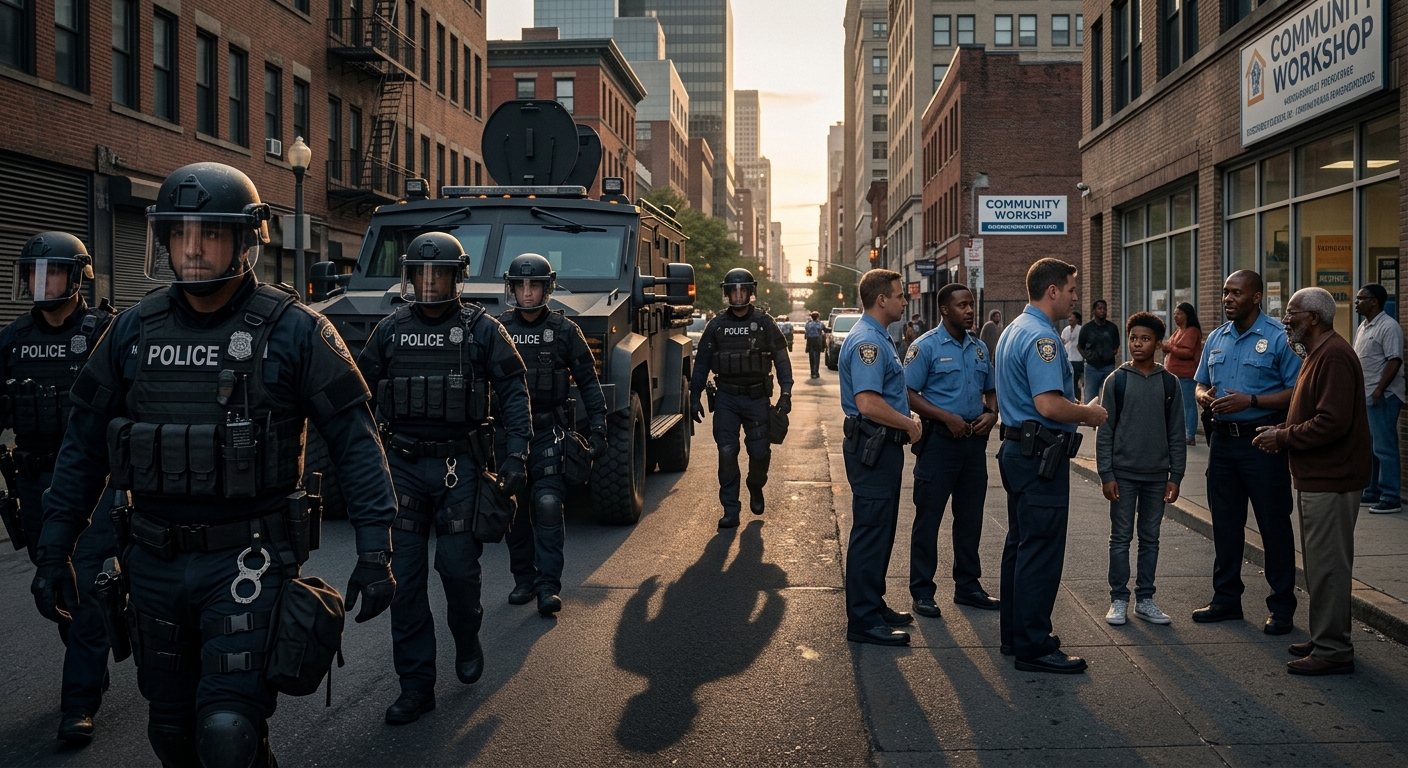
The Changing Face of Domestic Law Enforcement
Over the past few decades, the visual and operational landscape of domestic law enforcement in the United States has undergone a profound transformation. The traditional image of the neighborhood beat cop, equipped with a standard uniform and a service weapon, has increasingly been supplemented—and in some cases, replaced—by officers clad in heavy body armor, carrying assault rifles, and deploying from armored vehicles. This shift represents more than just a change in attire or equipment; it signifies a fundamental evolution in the philosophy and tactical approach of local policing. The integration of military-grade hardware and combat-oriented tactics into everyday law enforcement activities raises critical questions about public safety, civil liberties, and the essential relationship between police departments and the communities they are sworn to protect.
The escalation of police tactics is not an overnight phenomenon. It is the result of decades of policy decisions, federal funding initiatives, and a gradual blurring of the lines between military operations and domestic peacekeeping. As local agencies accumulate surplus equipment designed for overseas conflict, the threshold for deploying specialized tactical units has lowered. Understanding the roots, mechanisms, and consequences of this escalation is vital for policymakers, community leaders, and citizens striving to build a more equitable and effective criminal justice system.
The Historical Shift: From Crisis Response to Routine Patrol
The concept of specialized tactical units, most commonly known as Special Weapons and Tactics (SWAT) teams, originated in the late 1960s. The initial formation of these units was a direct response to highly specific and volatile crises—such as active shooter scenarios, hostage situations, and heavily armed barricaded suspects—where standard patrol officers lacked the necessary training and equipment to safely resolve the threat. In these early years, SWAT deployments were rare, utilized only as a last resort when conventional de-escalation and law enforcement methods were deemed insufficient or had already failed.
However, as the decades progressed, particularly with the advent of the War on Drugs in the 1980s, the operational mandate of these specialized units began to undergo significant scope creep. The legislative and cultural emphasis on eradicating illicit narcotics created an environment where aggressive, proactive policing was heavily incentivized. Consequently, tactical units were increasingly utilized not just for resolving life-threatening emergencies, but for executing routine search warrants, particularly in drug-related investigations. This transition marked a crucial turning point: highly militarized interventions shifted from being an emergency anomaly to a standard operational procedure in many jurisdictions across the country.
Federal Pipelines: How Military Hardware Reaches Local Streets
The physical transformation of local police departments could not have occurred without the establishment of federal transfer mechanisms that funnel surplus military equipment directly to state and local agencies. The most prominent of these mechanisms is the Department of Defense’s 1033 Program. Authorized by the National Defense Authorization Act in the 1990s, the program was designed to allow the military to offload excess gear—ranging from office supplies and clothing to high-caliber weapons and Mine-Resistant Ambush Protected (MRAP) vehicles—to local law enforcement agencies at virtually no cost.
While the stated goal of the program was to assist cash-strapped municipalities in equipping their officers for counter-drug and counter-terrorism activities, the sheer volume and nature of the equipment transferred have fundamentally altered the capabilities of local police. Billions of dollars worth of military hardware have been distributed nationwide. The influx of this equipment is not merely a logistical footnote; it dictates operational capacity. When a police department acquires an armored personnel carrier or a cache of assault rifles, there is an inherent bureaucratic and cultural pressure to utilize that equipment, justifying the acquisition and the associated maintenance costs.
The Financial and Bureaucratic Incentives
For many local government officials, the allure of the 1033 Program and similar federal grants (such as those from the Department of Homeland Security) is primarily financial. Acquiring a multi-million-dollar armored vehicle for the cost of shipping appears, on paper, to be an extraordinary benefit to local taxpayers. However, this cost-benefit analysis often ignores the hidden expenses of maintenance, specialized training, and the potential liability associated with deploying military hardware in civilian environments. Furthermore, federal grant structures sometimes require agencies to demonstrate a recurring need for the equipment to maintain eligibility for future funding, creating a perverse incentive to deploy tactical units more frequently than necessary.
The Routine Deployment of Specialized Tactics
The most tangible consequence of this influx of equipment and shifting philosophy is the normalization of dynamic entry tactics for standard police work. Today, a significant majority of tactical deployments are not for active shooters or hostage rescues, but for executing search warrants. These operations often involve “no-knock” or “quick-knock” warrants, where heavily armed officers breach a residence using battering rams, flashbang grenades, and overwhelming force to secure the premises before the occupants have an opportunity to react or dispose of evidence.
The reliance on the element of surprise and overwhelming speed is designed to maximize officer safety and prevent the destruction of contraband. However, the chaotic nature of dynamic entry introduces extreme risks to everyone involved. The use of flashbang grenades—devices designed to temporarily blind and deafen—can cause severe burns and ignite fires. The sudden, violent breach of a home can easily trigger a tragic misunderstanding, as startled residents may mistake law enforcement for criminal intruders and attempt to defend themselves, leading to fatal exchanges of gunfire. The collateral damage of these operations—both physical and psychological—is immense, particularly when children or elderly individuals are present in the home during a raid.
Demographic and Geographic Disparities
The deployment of highly militarized police units is not distributed evenly across populations or geographic areas. Research and extensive data analysis consistently indicate that dynamic entry raids and specialized tactical deployments are disproportionately concentrated in minority communities and lower-income neighborhoods. This disparity is inextricably linked to the historical targeting of these communities during the War on Drugs.
When military-style raids become a routine feature of law enforcement in specific neighborhoods, it fundamentally damages the relationship between the police and the residents. Instead of viewing officers as public servants tasked with maintaining community safety, residents often perceive them as an occupying force. This breakdown in trust has severe implications for public safety; when community members fear the police, they are less likely to report crimes, cooperate with investigations, or serve as witnesses, ultimately making the community less safe and hindering the core mission of law enforcement.
The Psychological Shift: Guardian vs. Warrior Mentality
Beyond the physical danger and community alienation, the militarization of police profoundly impacts the psychology of the officers themselves. Law enforcement experts and sociologists often describe this psychological shift as the transition from a “Guardian” mindset to a “Warrior” mindset. The equipment an officer wears and the tactical training they receive heavily influence their perception of the public and their approach to conflict resolution.
| Characteristic | The Guardian Mindset | The Warrior Mindset |
|---|---|---|
| Primary Goal | Protecting the community, preserving life, and maintaining civil order. | Neutralizing threats, conquering an objective, and surviving a hostile environment. |
| View of the Public | Citizens to be served and partnered with to solve local problems. | Potential combatants or threats to be managed and controlled. |
| Approach to Conflict | Prioritizes de-escalation, communication, and patience. | Prioritizes overwhelming force, quick resolution, and tactical dominance. |
| Training Emphasis | Community relations, crisis intervention, and constitutional law. | Combat tactics, weapons proficiency, and dynamic entry. |
When officers are outfitted in camouflage, heavy plating, and carry military-grade weaponry, the environment they patrol can subtly transform in their minds into a hostile zone. The “Warrior” mentality emphasizes survival and threat neutralization above all else, which can lead to a heightened state of hyper-vigilance where ambiguous situations are rapidly interpreted as lethal threats. Conversely, the “Guardian” mentality emphasizes de-escalation, mutual respect, and constitutional policing. Reorienting departmental culture back toward the Guardian model is a critical step in reducing unnecessary police violence and restoring community trust.
The Path Forward: Restoring Community Trust and Oversight
Addressing the escalation of domestic law enforcement requires comprehensive policy reforms at the local, state, and federal levels. First and foremost, there must be strict, standardized criteria governing the deployment of specialized tactical units. Legislation should mandate that SWAT and dynamic entry tactics be legally restricted to genuine, high-risk emergencies—such as hostage situations or active shooters—rather than routine warrant service. Raising the legal threshold for obtaining “no-knock” warrants is essential to preventing unnecessary violence in the home.
Secondly, there must be rigorous oversight and transparency regarding the acquisition of military equipment. Local city councils and civilian oversight boards should be required to publicly review and approve any requests for federal surplus gear or military-style hardware. The federal government must also impose stricter audits on the 1033 Program, restricting the transfer of certain offensive equipment, such as weaponized aircraft, bayonets, and large-caliber firearms, which have no legitimate application in domestic policing.
Finally, police training academies must fundamentally restructure their curricula to prioritize de-escalation, implicit bias training, and crisis intervention over combat-style maneuvers. By redefining the culture of policing to emphasize community partnership rather than tactical dominance, law enforcement agencies can effectively protect the public without treating neighborhoods like active combat zones.
Frequently Asked Questions (FAQ)
- What is the DoD 1033 Program?
The 1033 Program is a federal initiative managed by the Defense Logistics Agency that transfers surplus military equipment—ranging from office furniture to armored vehicles and firearms—to local and state law enforcement agencies across the United States. - Does military equipment help lower crime rates?
Academic research indicates that the acquisition of military equipment does not significantly reduce crime rates or enhance officer safety. In fact, studies suggest that heavily militarized police forces may actually diminish public trust and negatively impact the reputation of law enforcement in the community. - What is the difference between a “Guardian” and “Warrior” mentality?
The “Guardian” mentality focuses on protecting the community, prioritizing de-escalation, and treating citizens as partners. The “Warrior” mentality, often fostered by military-style training and gear, views the community as a potentially hostile environment where the primary goal is threat neutralization and survival. - Are SWAT teams still necessary?
Yes, specialized tactical units are crucial for responding to genuine emergencies, such as active shooters or hostage situations, where specialized training and equipment are necessary to save lives. The reform focus is on limiting their use strictly to these high-risk scenarios rather than routine policing.
References
- 1033 Program FAQs — Defense Logistics Agency (DLA), U.S. Department of Defense. 2024-01-15. https://www.dla.mil/DispositionServices/Offers/Reutilization/LawEnforcement/ProgramFAQs.aspx
- Militarization fails to enhance police safety or reduce crime but may harm police reputation — Mummolo, Jonathan. Proceedings of the National Academy of Sciences (PNAS). 2018-08-20. https://www.pnas.org/doi/10.1073/pnas.1805161115
- Final Report of the President’s Task Force on 21st Century Policing — U.S. Department of Justice, Office of Community Oriented Policing Services. 2015-05-01. https://cops.usdoj.gov/pdf/taskforce/taskforce_finalreport.pdf
- Militarization and police violence: The case of the 1033 program — Delehanty, Casey, et al. Research & Politics. 2017-06-14. https://journals.sagepub.com/doi/10.1177/2053168017712885
Similar Articles








Read full bio of medha deb




