
The Enduring Writ: Habeas Corpus and American Liberty
How habeas corpus safeguards citizens against unlawful detention.
Introduction: The Bedrock of Individual Liberty
At the very heart of the American legal system lies a profound and unyielding constitutional principle: the government cannot strip an individual of their physical liberty without demonstrating a valid, lawful basis before a neutral judicial official. This foundational legal doctrine is embodied in the writ of habeas corpus, a Latin phrase translating directly to “you shall have the body.” Often referred to by legal scholars and historians as the “Great Writ,” it serves as the ultimate procedural safeguard against arbitrary state action, executive overreach, and unlawful imprisonment. Throughout history, whenever nations face severe security crises, the immediate reflex of those in positions of power is often to bypass judicial scrutiny in the name of collective safety and national security. Yet, the resilience of habeas corpus represents the true, enduring strength of a constitutional democracy. The ongoing struggle to maintain this fundamental right is not merely a technical battle fought in sterile courtrooms and partisan legislative chambers; it is a public fight that occasionally spills out into the grandest natural landscapes of the country, reflecting the bedrock nature of the civil liberties themselves. In exploring the deep history, the post-9/11 controversies, and the grassroots advocacy that has sustained this right, we can better understand why the Great Writ remains the most critical tool for preserving individual freedom in the face of immense state power.
The Historical Foundations of Due Process
To fully grasp the magnitude of the Great Writ, one must look back beyond the founding of the United States to the origins of Western common law. The doctrine is not a modern invention but a deeply entrenched mechanism of justice that has evolved over centuries of legal and political conflict.
From Magna Carta to the United States Constitution
The conceptual origins of habeas corpus are inextricably linked to the Magna Carta, signed in 1215, which established the groundbreaking premise that the sovereign is not above the law. While the Magna Carta itself did not explicitly define the writ as we know it today, it laid the philosophical groundwork for due process. By the seventeenth century, the English Habeas Corpus Act of 1679 codified the procedures, ensuring that no subject could be detained indefinitely without trial. When the architects of the American republic gathered to draft the United States Constitution, their historical memory of British monarchical abuses heavily influenced their debates. They understood that a government armed with the power to arrest and detain without explanation is inherently tyrannical. Consequently, they embedded the Great Writ into the very fabric of the nation’s founding document, well before the addition of the Bill of Rights.
Understanding the Suspension Clause
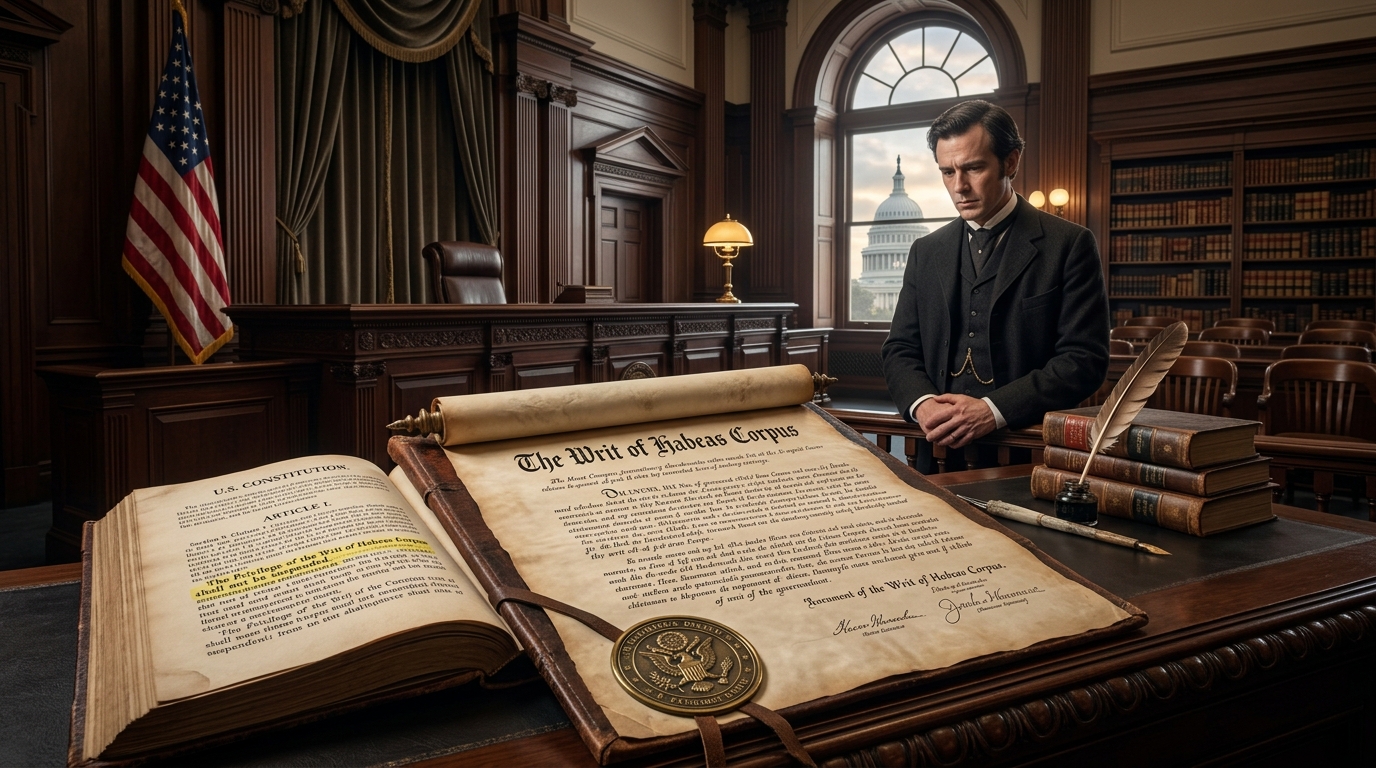
The specific protection for this legal mechanism is found in Article I, Section 9, Clause 2 of the United States Constitution, famously known as the Suspension Clause. The text is brief but carries immense constitutional weight: “The Privilege of the Writ of Habeas Corpus shall not be suspended, unless when in Cases of Rebellion or Invasion the public Safety may require it.” This phrasing accomplishes two critical things. First, it acknowledges the pre-existing, natural right to challenge one’s detention. The Founders did not feel the need to grant the right; they merely prohibited its suspension. Second, it sets an extraordinarily high bar for when the executive or legislative branches can bypass this judicial check. Ordinary crime, civil unrest, or generalized threats do not meet the threshold. Only an existential threat to the republic—a literal rebellion or physical invasion—can justify suspending the Great Writ, ensuring that liberty remains the default state of the American populace.
National Security and the Post-9/11 Legal Landscape
Throughout American history, the societal commitment to civil liberties has been most severely tested during times of intense national crisis. From the Civil War to the internment of Japanese Americans during World War II, the tension between civil rights and national security has often resulted in the temporary erosion of fundamental protections. However, the legal landscape shifted dramatically in the twenty-first century.
The Establishment of Offshore Detention
Following the catastrophic terrorist attacks of September 11, 2001, the United States government initiated a global campaign against terrorism that fundamentally challenged the boundaries of constitutional law. In a calculated effort to interrogate and detain suspected enemy combatants outside the jurisdiction of federal courts, the executive branch established a military prison at the Guantanamo Bay Naval Base in Cuba. The underlying legal theory posited that because Guantanamo was geographically located outside the sovereign territory of the United States, foreign nationals detained there possessed no constitutional rights, including the right to file a petition for habeas corpus. This unprecedented strategy effectively created a legal black hole, where individuals could be held indefinitely, without charge, trial, or access to legal counsel. For years, human rights organizations and civil liberties advocates fought fiercely to bring the actions of the military and the executive branch under the purview of the federal judiciary.
The Supreme Court Intervenes: Boumediene v. Bush
The legislative branch initially attempted to codify this denial of rights by passing the Military Commissions Act of 2006, which explicitly sought to strip federal courts of the jurisdiction to hear habeas corpus petitions from non-citizen detainees held as enemy combatants. However, the constitutional crisis culminated in the landmark 2008 Supreme Court decision, Boumediene v. Bush. In a deeply divided ruling, the Court declared that the legislative attempt to strip the courts of jurisdiction was an unconstitutional suspension of the Great Writ. The Court emphatically ruled that the protections of habeas corpus are not rigidly bound by formal territorial borders, particularly when the United States exercises complete jurisdiction and control over a facility like Guantanamo Bay. This pivotal ruling reaffirmed the judiciary’s role as an independent check on executive power and underscored the principle that constitutional rights cannot be simply legislated away in the name of national security.
Advocacy in the Wild: Visualizing Abstract Legal Rights
While appellate briefs and Supreme Court oral arguments are the traditional battlegrounds for civil liberties, profound legal shifts also require public consensus and cultural advocacy. Legal concepts like due process and jurisdictional authority can often seem abstract, academic, and disconnected from the daily lives of ordinary citizens. To bridge this gap, advocacy organizations frequently turn to creative, highly visible grassroots campaigns.
The Grand Canyon as a Monumental Metaphor
During the height of the national debate over offshore detention and the Military Commissions Act, activists utilized a compelling strategy to make the abstract concept of habeas corpus tangible. Citizens across the nation began documenting “habeas sightings,” taking literal signs and letters defending the Great Writ to iconic American landmarks. The imagery of an individual holding a sign demanding due process against the backdrop of the Grand Canyon provided a striking, unforgettable visual metaphor. The Grand Canyon, carved relentlessly over millions of years by the Colorado River, represents an enduring, unmovable geological foundation. Its sheer scale and permanence stand in stark contrast to the fleeting, often reactionary political laws passed by frightened legislatures in times of panic.
By visually linking the writ of habeas corpus to the Grand Canyon, advocates communicated a powerful philosophical message: our fundamental constitutional rights are the bedrock of our republic. Just as the canyon cannot be easily moved or paved over, the foundational human right to be free from arbitrary detention cannot be easily erased by temporary executive decrees. The juxtaposition of a fragile piece of paper demanding justice against the timeless, layered rock of the canyon reminded the public that the struggle for human rights is ancient, layered, and requires constant preservation against the forces of erosion.
The Ongoing Struggle Against Unlawful Detentions Today
While the high-profile battles over offshore military detention facilities dominated headlines during the early 2000s, the writ of habeas corpus remains an essential, active tool in the modern legal system. Its application extends far beyond national security crises, serving as a vital remedy for systemic failures within domestic law enforcement.
Immigration and Border Enforcement
Today, the Great Writ is frequently invoked in the context of immigration enforcement and border security. As the federal government expands its network of civil detention centers, thousands of foreign nationals face prolonged confinement while awaiting immigration hearings or deportation proceedings. Unlike criminal defendants, individuals in civil immigration detention are not always guaranteed access to appointed legal counsel, making them particularly vulnerable to bureaucratic errors and unlawful confinement. Civil rights attorneys routinely file habeas corpus petitions on behalf of detained immigrants, arguing that indefinite detention without a bond hearing violates the fundamental guarantees of due process. These modern legal challenges highlight the ongoing tension between a nation’s sovereign right to control its borders and the universal human right to liberty.
Mass Incarceration and the Criminal Justice System
Beyond the realm of immigration, habeas corpus remains a crucial avenue for post-conviction relief within the domestic criminal justice system. For individuals serving lengthy prison sentences who have exhausted all their direct appeals, a habeas petition is often the last available mechanism to challenge a wrongful conviction. State and federal prisoners use the writ to argue that their constitutional rights were violated during their trials—whether due to ineffective assistance of counsel, the suppression of exculpatory evidence by prosecutors, or systemic racial bias in jury selection. Although legislative reforms have made it increasingly difficult to succeed on a habeas petition, the writ continues to function as a vital safety valve, ensuring that the judicial system retains the capacity to correct its most egregious errors and free the innocent.
Frequently Asked Questions (FAQs)
What exactly is a writ of habeas corpus?
A writ of habeas corpus is a formal judicial order that compels law enforcement officials, prison wardens, or government agencies to bring a detained individual before a court. The purpose of the hearing is for a neutral judge to determine whether the government has a valid, legal justification for holding the person. If the detention is deemed unlawful, the judge can order the individual’s immediate release.
Where is the right to habeas corpus found in the U.S. Constitution?
The right is enshrined in Article I, Section 9, Clause 2 of the United States Constitution, commonly referred to as the Suspension Clause. It explicitly states that the privilege of the writ shall not be suspended except in extreme circumstances, ensuring that Congress cannot easily revoke the right.
Can the President of the United States unilaterally suspend habeas corpus?
The Constitution states that the writ can only be suspended “when in Cases of Rebellion or Invasion the public Safety may require it.” Historically, the Supreme Court has indicated that only Congress possesses the legislative authority to suspend the writ, though President Abraham Lincoln notably suspended it unilaterally during the early days of the Civil War before Congress officially authorized the action.
How did the Supreme Court rule in Boumediene v. Bush?
In the 2008 case Boumediene v. Bush, the Supreme Court ruled that foreign nationals detained as enemy combatants at the Guantanamo Bay Naval Base possess the constitutional privilege of habeas corpus. The Court struck down a federal law that attempted to strip the federal courts of jurisdiction to hear their cases, reaffirming that the executive branch cannot operate outside the bounds of constitutional review.
Conclusion: The Eternal Vigilance of Liberty
The enduring legacy of habeas corpus is a testament to the foresight of those who crafted the American legal system. From its medieval origins in the Magna Carta to the modern courtrooms grappling with immigration detention and national security, the Great Writ has remained the most reliable bulwark against government tyranny. It serves as a constant reminder that liberty is not a passive state of being, but a delicate structure that requires active, relentless defense. Whether advocated for in the halls of the Supreme Court or visually celebrated at the rim of the Grand Canyon, the right to due process must be protected by each successive generation. As long as human societies concentrate power in the hands of the state, the writ of habeas corpus will be necessary to ensure that such power is never exercised without justification, transparency, and justice.
References
- Glossary of Legal Terms: Habeas Corpus — Administrative Office of the U.S. Courts. 2023-12-01. https://www.uscourts.gov/glossary
- Boumediene v. Bush, 553 U.S. 723 (2008) — Oyez, Chicago-Kent College of Law. 2008-06-12. https://www.oyez.org/cases/2007/06-1195
- The Constitution of the United States: A Transcription — National Archives. 2024-01-29. https://www.archives.gov/founding-docs/constitution-transcript
Similar Articles








Read full bio of Sneha Tete


