
Ending Warrantless Bus Searches: A Civil Rights Victory
How legal advocacy ended unwarranted bus passenger searches.
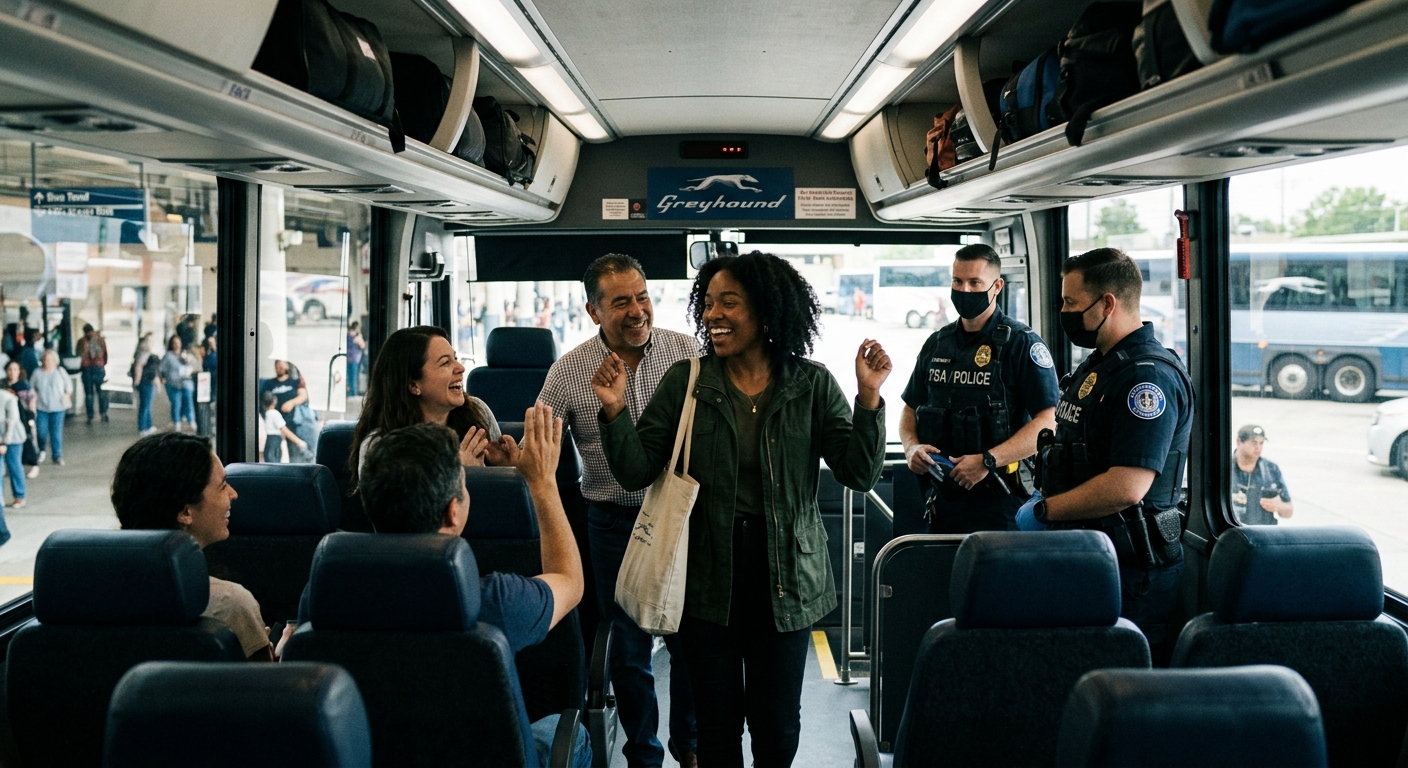
The Disruption of Domestic Travel
The landscape of domestic travel in the United States underwent a profound transformation when civil liberties defenders launched a coordinated effort to halt unwarranted law enforcement sweeps on commercial bus lines. For years, paying passengers on major transit carriers faced a disconcerting reality. Mid-journey, their vehicles would routinely be boarded by federal agents demanding identification and proof of citizenship. This practice, conducted without judicial warrants or individualized suspicion, turned ordinary commutes into high-stress interrogations.
Imagine boarding a vehicle late at night, expecting to sleep until your destination, only to be jolted awake by armed officers shining flashlights and demanding papers. For countless domestic travelers, this was not a dystopian fiction, but a routine reality. This disruption of safe travel disproportionately targeted vulnerable populations, turning the simple act of buying a bus ticket into an anxiety-inducing endeavor. This article delves into the systemic challenges, the constitutional battleground, and the eventual corporate policy shift that restored a vital measure of privacy to the American traveling public.
Understanding the Border Enforcement Zone
To comprehend how federal officers gained access to commercial buses operating deep within the American interior, one must examine the legal concept of the border enforcement zone. According to federal regulations established decades ago, authorities claim the jurisdiction to conduct certain immigration enforcement activities within a “reasonable distance” from any external boundary of the United States. This distance has long been defined administratively as a 100-air-mile radius from any land border or coastal boundary.
Consequently, this expansive geographic perimeter encompasses roughly two-thirds of the entire United States population. The 100-mile zone includes massive metropolitan areas, entire states such as Florida, New Jersey, and Massachusetts, and countless critical commercial transit hubs. Relying on this sweeping interpretation of border proximity, federal agencies began treating inland bus terminals as functional equivalents of international checkpoints. Agents established a routine of intercepting interstate travelers, asserting that their proximity to a coast or border justified spontaneous, suspicionless sweeps of passenger vehicles, regardless of whether the bus had actually crossed an international border.
The Human Cost of Transit Interrogations
The practical execution of these transit sweeps was heavily scrutinized for fundamentally compromising the dignity and rights of marginalized communities. Reports from passengers nationwide painted a distressing picture of how these boarding procedures unfolded. Typically, heavily armed officers would enter the narrow confines of a bus aisle, visually scanning the seated travelers. Rather than questioning everyone equally, officers frequently singled out individuals based on highly subjective criteria.
Advocates argued that such tactics amounted to blatant racial profiling. Singling out travelers based on perceived ethnicity, skin color, or linguistic traits violates the fundamental tenets of equal protection under the law. For riders of color, boarding a commercial vehicle became a gamble with their personal freedom. The psychological toll of being subjected to arbitrary detention and interrogation simply for traveling from one domestic city to another sparked outrage among community organizers, legal scholars, and human rights defenders across the nation.
The Constitutional Conflict on Commercial Transit
The core of this extensive legal dispute hinged on the rigorous application of the Fourth Amendment of the U.S. Constitution, which safeguards individuals and entities against unreasonable searches and seizures. While law enforcement personnel possess the undeniable right to enter spaces that are completely open to the general public, the interior of a commercial transit vehicle is legally classified differently. Boarding an intercity bus requires the purchase of a ticket, rendering the passenger cabin a non-public, restricted commercial space.
Because the passenger cabin is restricted, government agents cannot lawfully access it on a mere whim. To legally board and interrogate passengers in this non-public area, agents must possess a judicially authorized warrant, demonstrate exigent emergency circumstances, or obtain explicit, voluntary consent from the property owner—in this scenario, the transit corporation itself. This legal reality placed the responsibility for the constitutional privacy of the passengers squarely on the shoulders of the corporate executives managing these transit lines.
The Myth of Mandatory Corporate Compliance
For an extended period, the nation’s largest intercity bus carriers maintained a purely defensive public posture regarding these enforcement operations. Corporate spokespeople repeatedly asserted that federal law compelled them to cooperate with enforcement agencies, thereby excusing the regular and disruptive presence of federal officers in their aisles. The transit companies insisted their hands were legally tied, suggesting to the public and the media that denying access to federal agents would constitute obstruction of justice or violate complex regulatory statutes.
This narrative allowed transit operators to sidestep accountability for the environment of fear cultivated on their vehicles. By claiming helplessness in the face of federal authority, the carriers attempted to maintain a neutral image. However, legal experts recognized this stance as a fundamental misinterpretation of commercial property rights and constitutional law, setting the stage for a massive confrontation between corporate policy and civil liberties.
Grassroots Mobilization and Strategic Action
Legal scholars and civil rights coalitions aggressively dismantled this corporate defense. They maintained that commercial transit companies were voluntarily surrendering their Fourth Amendment rights at the direct expense of their customers’ safety and dignity. Activists demanded that these corporations immediately assert their constitutional right to refuse warrantless entries. To achieve this, an extensive, multi-state advocacy campaign was mobilized.
Organizations flooded corporate headquarters with legal briefings demanding policy overhauls, while volunteers organized massive public awareness drives at transit hubs across the country. Advocates distributed thousands of “Know Your Rights” pamphlets to commuters, educating the public on their right to remain silent and their right to refuse unlawful searches. Simultaneously, political pressure mounted as coalitions of federal lawmakers issued formal letters demanding that corporate leadership protect their consumers. Petitions garnering hundreds of thousands of signatures were physically delivered to corporate offices, transforming a localized legal dispute into a nationwide public relations crisis.
The Turning Point: Exposing the Legal Reality
The ultimate turning point in this protracted battle did not arrive via a landmark Supreme Court ruling, but through a pivotal bureaucratic revelation. In early 2020, journalists acquired a leaked internal memorandum originating from federal border authorities. This critical document unequivocally stated that enforcement agents did not possess the legal authority to board private commercial buses to conduct routine checks without the explicit consent of the transit company or a valid, judicially signed warrant.
This leaked directive completely shattered the long-standing corporate narrative of mandatory compliance. The revelation proved that transit carriers had always possessed the legal power to turn agents away at the door. The realization that the bus companies had been willingly permitting these intrusions—despite possessing the clear constitutional authority to stop them—exponentially intensified the public backlash and forced the carriers into an untenable position.
The Role of Consumer Protection Litigation
When constitutional arguments met stubborn corporate resistance, advocates found a secondary, highly effective legal angle: consumer protection litigation. State officials and attorneys general began arguing that by allowing arbitrary law enforcement boarding, transit companies were fundamentally failing to deliver the safe and reliable service they actively advertised to the public. Passengers purchased tickets with the reasonable expectation of secure, uninterrupted travel to their respective destinations.
Instead, customers were subjected to terrifying delays, invasive questioning, and potential detentions. Lawsuits successfully argued that facilitating these sweeps constituted an unfair and deceptive business practice under state laws. This combination of economic threat and legal liability proved pivotal. It forced the transit corporations to finally acknowledge their operational responsibility to the consumer, demonstrating that constitutional rights can be fiercely and effectively defended in the arena of commercial litigation.
A Historic Policy Reversal
Faced with undeniable proof of their legal rights, immense grassroots pressure, and mounting legal liabilities, the corporate dam finally broke. In February 2020, major transit carriers officially reversed their long-standing policies. They publicly announced that they would no longer consent to unwarranted law enforcement searches on their buses or in the private, ticketed areas of their transit terminals.
To ensure strict compliance with this new directive, companies implemented comprehensive retraining programs for their drivers, dispatchers, and station managers. Staff members were explicitly instructed to ask boarding agents for a judicially signed warrant and to formally deny boarding consent if a warrant could not be produced. Furthermore, transit carriers began affixing visible decals and signage to their vehicle fleets, clearly communicating to any approaching officers that the company did not, under any circumstances, consent to warrantless searches.
Frequently Asked Questions (FAQs)
What is the 100-mile border enforcement zone?
The 100-mile border enforcement zone is a geographic area defined by federal regulations where immigration authorities claim expanded search and seizure capabilities. It extends 100 air miles inland from any external boundary of the United States, including coastlines. Because of the country’s geography, this zone encompasses roughly two-thirds of the U.S. population and major cities like New York, Seattle, and Miami.
Can federal agents legally board a private commercial bus without a warrant?
No, not without the consent of the bus company or exigent circumstances. The interior of a commercial bus is considered a private, non-public space because passengers must purchase a ticket to enter. Therefore, the Fourth Amendment requires agents to have a judicially signed warrant or explicit permission from the transit company to board and conduct routine checks.
Did transit companies willingly allow these searches?
For years, major transit companies claimed they were legally required to allow federal agents on board. However, a leaked federal memo in 2020 confirmed that agents required the company’s consent to conduct warrantless sweeps. Once this was revealed, it became clear that the companies had the authority to refuse entry all along, leading to a massive shift in corporate policy.
What should a passenger do if an agent boards their bus?
Passengers have constitutional rights regardless of where they are traveling. Individuals have the right to remain silent and do not have to answer questions about their citizenship or immigration status. Passengers also have the right to refuse to consent to a search of their personal belongings, though they should never physically resist or interfere with an officer.
How did public advocacy change corporate policy?
Public advocacy changed corporate policy through a combination of grassroots mobilization, public awareness campaigns, and legal pressure. Organizations delivered hundreds of thousands of petition signatures, handed out informational pamphlets, and coordinated with state attorneys general to file consumer protection lawsuits, ultimately forcing transit carriers to assert their Fourth Amendment rights to protect their customers.
References
- Greyhound to stop allowing immigration checks on buses — Associated Press. 2020-02-21. https://apnews.com/article/wa-state-wire-us-news-ap-top-news-border-patrols-immigration-cb116bbfa97a3a830b8b2fcb263309a9
- Greyhound to stop allowing immigration checks without a warrant — PBS NewsHour. 2020-02-21. https://www.pbs.org/newshour/nation/greyhound-to-stop-allowing-immigration-checks-without-a-warrant
- Greyhound must stop allowing warrantless and suspicionless immigration sweeps, pay $2.2 million to end AG Ferguson’s lawsuit — Washington State Office of the Attorney General. 2021-09-27. https://www.atg.wa.gov/news/news-releases/greyhound-must-stop-allowing-warrantless-and-suspicionless-immigration-sweeps
- Greyhound Has a Choice on Warrantless Searches — American Civil Liberties Union. 2018-03-26. https://www.aclu.org/news/immigrants-rights/greyhound-has-choice-warrantless-searches
Similar Articles








Read full bio of Sneha Tete


