
The Movement to End Civil Immigration Detention in the US
Analyzing the systemic failures, human costs, and economic realities of mass civil immigration detention.
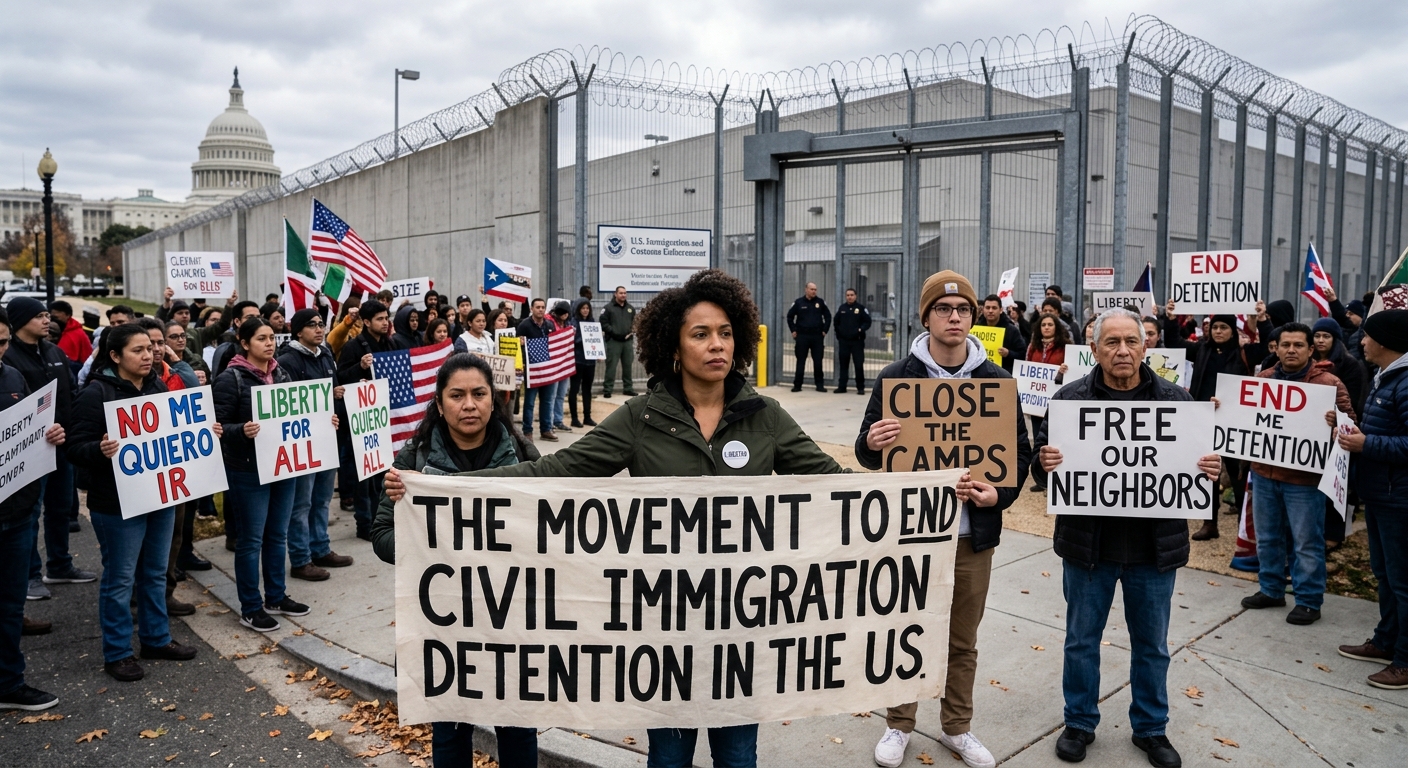
The Growing Consensus to End Civil Immigration Detention
The United States maintains the largest and most expansive immigration detention infrastructure in the world. Operated under the authority of U.S. Immigration and Customs Enforcement (ICE), this sprawling network of detention facilities holds tens of thousands of individuals on any given day. Ostensibly, the purpose of this system is purely administrative—to ensure that individuals attend their immigration court hearings and comply with final orders of removal. However, over the past few decades, what was meant to be a brief, civil holding process has morphed into a multi-billion-dollar carceral apparatus. Today, a robust coalition of human rights advocates, legal professionals, and community organizations are issuing a unified call: the current civil immigration detention system is fundamentally broken and must be shut down entirely.
The demand to abolish mass immigration detention is not a fringe political slogan; it is a carefully considered policy stance rooted in extensive documentation of human rights abuses, profound economic waste, and legal inequity. As reports from government watchdogs and independent health organizations continually expose the dire realities inside these walls, it has become increasingly evident that relying on institutional incarceration for civil immigration violations is an inherently flawed strategy.
The Fundamental Flaws of Mass Immigration Incarceration
The Civil vs. Criminal Distinction
One of the most persistent misconceptions about the U.S. immigration system is the conflation of civil immigration violations with criminal offenses. Under U.S. law, being undocumented or overstaying a visa is a civil infraction, not a crime. Consequently, immigration detention is legally classified as a non-punitive, administrative procedure. Yet, the physical and psychological realities of ICE detention centers are virtually indistinguishable from maximum-security federal prisons.
Individuals in immigration custody are frequently subjected to strip searches, forced to wear institutional jumpsuits, housed in cells with heavy steel doors, and surrounded by razor wire. Their movement is heavily restricted, and they are routinely subjected to arbitrary disciplinary measures, including the devastating use of solitary confinement. This profound disconnect between the legal purpose of detention (administrative processing) and its practical application (punitive incarceration) represents a profound violation of civil liberties.
Widespread Reports of Medical and Psychological Neglect
The conditions within these facilities have been the subject of relentless scrutiny. Numerous investigations by the Department of Homeland Security’s Office of Inspector General (DHS OIG) and the Government Accountability Office (GAO) have documented systemic failures in safeguarding the health and well-being of those detained . Medical neglect is a pervasive issue, characterized by severe understaffing, delayed responses to emergency medical requests, and a lack of access to specialized care.
Detainees frequently report being denied essential medications or facing prolonged waits for urgent dental and medical procedures. Furthermore, the psychological toll of indefinite detention—where individuals are held without a clear release date—is catastrophic. Health organizations have highlighted how the environment exacerbates trauma, particularly for asylum seekers who have fled violence and persecution in their home countries . The lack of informed consent for medical procedures and instances of dangerous sanitation issues, such as mold and contaminated water, further underscore the systemic inability of these facilities to provide a safe environment.
Profit Over People: The Role of Private Prison Corporations
The Financial Mechanics of For-Profit Detention
A driving force behind the massive expansion of the immigration detention system is its deep entanglement with the private prison industry. The majority of individuals in ICE custody are held in facilities owned or operated by for-profit corporations. This privatization fundamentally misaligns the goals of the immigration system with the profit motives of private shareholders.
Many contracts between ICE and private prison operators include “guaranteed minimums” or bed quotas. These clauses require the federal government to pay for a specific number of beds every single day, regardless of whether they are occupied . This financial structure essentially incentivizes the government to maintain high rates of arrest and detention to justify the expenditure, creating a self-perpetuating cycle of mass incarceration that prioritizes corporate revenue over sensible immigration policy.
Transparency and Accountability Deficits
Privatizing detention also creates severe deficits in transparency and accountability. Unlike federal agencies, private corporations are largely shielded from certain public records laws, making it exceptionally difficult for journalists, lawyers, and human rights organizations to investigate internal practices. When government watchdogs do uncover egregious violations—such as spoiled food, hazardous living conditions, or the misuse of segregation—private contractors frequently face minimal consequences.
Instead of losing contracts for failing to meet basic federal detention standards, these corporations often continue to receive billions in taxpayer funding. The extensive lobbying power of the private prison industry further entrenches this system, ensuring that federal budgets continue to allocate massive sums toward physical detention beds rather than exploring more humane and cost-effective alternatives.
Evaluating Community-Based Alternatives to Detention (ATD)
How Case Management Programs Function
The most compelling argument for shutting down ICE detention centers is the proven viability of Alternatives to Detention (ATD). These programs shift the focus from physical incarceration to community-based monitoring and case management. Traditional ATDs often involve electronic monitoring, such as GPS ankle bracelets or smartphone applications equipped with facial recognition and voice authentication .
However, advocates argue that the most effective and humane ATDs are comprehensive community support programs. These holistic models pair individuals with social workers and legal navigators who help them secure housing, access medical care, and understand their legal obligations. By addressing the root causes of why someone might miss a court date—such as lack of transportation, language barriers, or simply not understanding the complex legal mail—community-based programs ensure compliance without the trauma of imprisonment.
Cost-Effectiveness and Compliance Rates
The economic contrast between physical detention and ATDs is staggering, representing one of the most inefficient uses of taxpayer funds in the federal budget.
| Program Type | Average Daily Cost Per Person | Court Appearance Compliance Rate |
|---|---|---|
| Physical ICE Detention | $150 – $165+ | N/A (Forced compliance) |
| Electronic Monitoring (ATD) | $3.00 – $5.00 | Over 90% |
| Community-Based Case Management | $10.00 – $15.00 | Over 95% |
As the data illustrates, the government spends hundreds of dollars a day to keep a single individual in a cell, whereas comprehensive case management costs a mere fraction of that amount . More importantly, studies consistently show that when immigrants are provided with legal representation and community support, their appearance rates at final immigration hearings exceed 95%. This renders the massive expenditure on institutional detention entirely unjustifiable from a fiscal perspective.
The Collateral Damage on Families and Communities
The impact of civil immigration detention extends far beyond the individuals locked behind bars; it inflicts profound collateral damage on families and local communities. When a parent or primary breadwinner is suddenly detained, families are frequently plunged into immediate economic crisis. Children are left without caretakers, leading to severe psychological distress, poor academic performance, and an increased risk of entering the foster care system.
Furthermore, local economies suffer when active community members are removed from the workforce. The arbitrary nature of these detentions breeds a pervasive climate of fear in immigrant communities, discouraging individuals from reporting crimes to local police, seeking necessary medical care, or participating in public life. The social fabric of entire neighborhoods is torn apart by the constant threat of sudden, indefinite separation.
Legal Challenges and the Fight for Due Process
A foundational pillar of the American legal system is the right to due process, yet the immigration detention apparatus actively undermines this principle. Because immigration proceedings are civil, individuals are not provided with government-appointed public defenders. They must secure their own legal representation, a task that becomes nearly impossible when detained in remote, rural facilities located hundreds of miles away from legal aid organizations.
Navigating the labyrinthine complexities of U.S. immigration law from inside a jail cell, often with limited access to telephones, translation services, or legal libraries, severely disadvantages detainees. Statistics overwhelmingly show that immigrants with legal representation are exponentially more likely to win their cases and secure lawful status. By isolating individuals in remote detention centers, the system effectively strips them of their ability to mount a fair defense, resulting in countless unjust deportations of people who have valid legal claims to remain in the country.
The Path Forward: Policy Recommendations for Systemic Change
Transitioning away from a reliance on mass immigration incarceration requires a fundamental paradigm shift. Policymakers must recognize immigration not as a carceral issue requiring punishment, but as an administrative and humanitarian process requiring efficient management. The first crucial step is a deliberate phase-out of all contracts with private, for-profit prison corporations, removing the financial incentive to detain.
Simultaneously, the billions of dollars currently funneled into maintaining detention beds should be reinvested into the immigration court system to hire more judges and clerks, thereby reducing the massive backlog of cases. Furthermore, robust funding must be allocated to community-based case management programs that respect human dignity while ensuring legal compliance. By dismantling the detention infrastructure, the United States can rebuild an immigration system that honors its commitments to human rights, due process, and fiscal responsibility.
Frequently Asked Questions (FAQs)
What is the legal justification for holding immigrants in detention centers?
Immigration detention is legally justified as an administrative tool used by the government to ensure that individuals appear for their immigration court hearings and are available for deportation if a judge orders their removal. It is strictly classified as a civil procedure, not a punitive measure for a crime. However, critics argue that the actual conditions of these facilities violate the civil nature of the detention by subjecting individuals to prison-like environments.
Are individuals in ICE detention serving time for criminal offenses?
No. While some individuals in ICE custody may have past criminal records for which they have already served their sentences in the criminal justice system, their presence in an ICE detention center is solely related to their civil immigration status. Many detainees have no criminal record whatsoever and are simply seeking asylum or navigating administrative visa issues.
How do Alternatives to Detention (ATD) guarantee that individuals show up to court?
Alternatives to Detention rely on case management, community support, and sometimes electronic monitoring to ensure compliance. Data shows that the vast majority of immigrants want to resolve their legal status and will attend court if they understand the process. By providing legal orientation, access to counsel, and basic social support (like transportation assistance), community-based ATDs achieve court appearance rates exceeding 95%, proving that physical incarceration is unnecessary for ensuring legal compliance.
References
- Immigration Detention: ICE Can Improve Oversight and Management (GAO-23-106350) — U.S. Government Accountability Office. 2023-01-09. https://www.gao.gov/products/gao-23-106350
- Concerns About ICE Detainee Treatment and Care at Detention Facilities (OIG-18-32) — Department of Homeland Security Office of Inspector General. 2017-12-11. https://www.oig.dhs.gov/sites/default/files/assets/2017-12/OIG-18-32-Dec17.pdf
- Health Issues for Immigrants in Detention Centers — KFF. 2025-09-30. https://www.kff.org/racial-equity-and-health-policy/issue-brief/health-issues-for-immigrants-in-detention-centers/
- Archived: Alternatives to Detention — U.S. Immigration and Customs Enforcement (ICE). 2026-05-18. https://www.ice.gov/features/atd
Similar Articles








Read full bio of Sneha Tete




