
Ending the 1033 Program: A Case for Demilitarizing Police
Surplus military gear transforms local police into occupying forces. It is time to demilitarize.
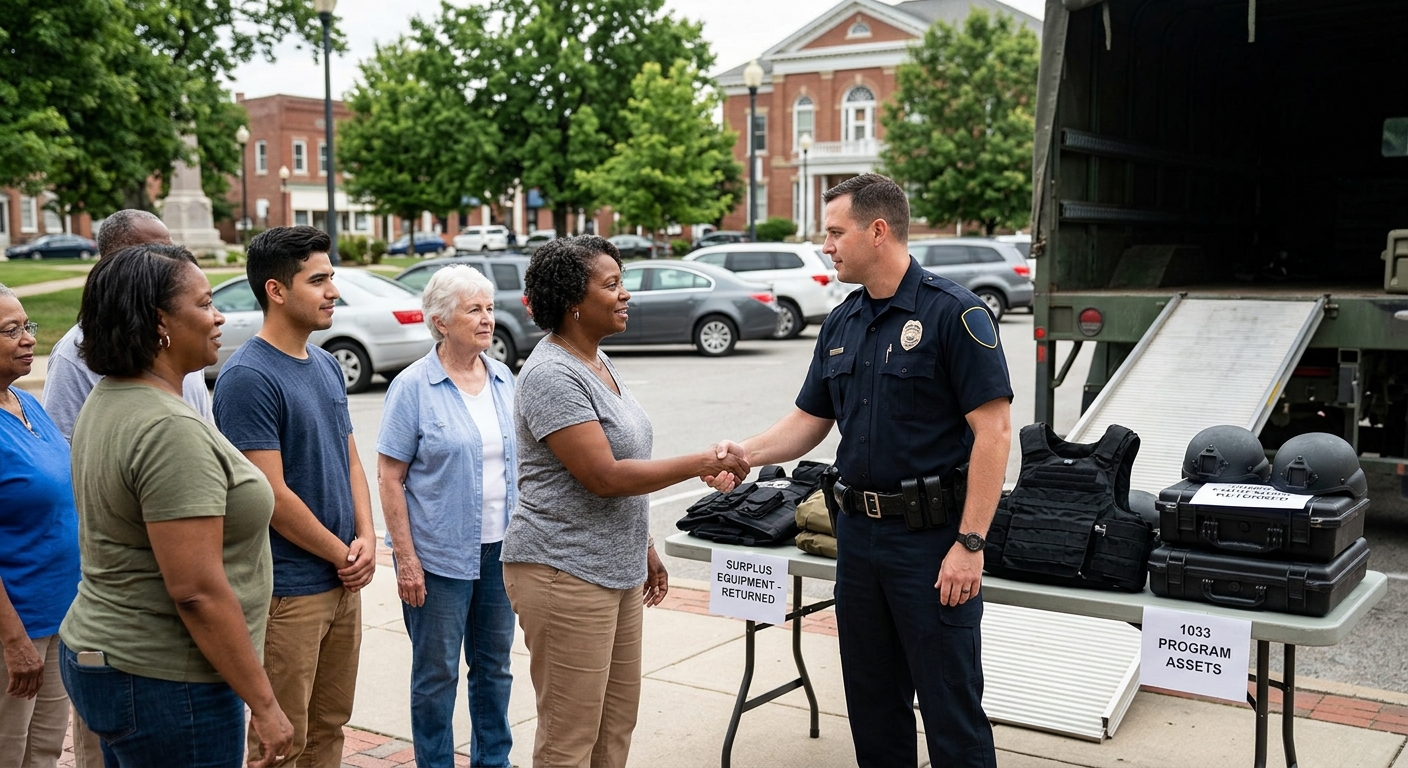
Over the last few decades, a quiet but profound transformation has occurred within American law enforcement. Local police departments, once visibly distinct from the armed forces, have increasingly adopted the uniforms, vehicles, and heavy weaponry of combat infantry. The catalyst for this dramatic visual and tactical shift is not a sudden rise in domestic insurgency, but rather a bureaucratic pipeline known as the 1033 Program. Administered by the Department of Defense (DOD), this initiative permits the transfer of surplus military equipment to civilian law enforcement agencies at virtually no cost.
The visual impact of this policy is both stark and unsettling. Armored vehicles originally designed to withstand roadside bombs in overseas war zones now rumble down suburban avenues in the United States. Officers responding to civilian protests or executing routine search warrants are frequently outfitted in military-grade camouflage and armed with high-caliber assault rifles. While proponents of this system argue that this gear is necessary for officer safety in an increasingly unpredictable world, a growing body of evidence suggests the exact opposite. The infusion of military hardware into local policing fundamentally alters the relationship between officers and the communities they serve, creating an environment of hostility rather than protection.
Ending the 1033 program is not merely a budgetary or administrative reform; it is a vital sociological step toward restoring the foundational principles of community-oriented policing. To understand the depth of this issue, we must examine its origins, its psychological toll on law enforcement, and the empirical data that refutes its core justifications.
Tracing the Roots: How Military Gear Reached Local Police
The origins of police militarization through federal pipelines can be traced back to the early 1990s. Initially authorized under the National Defense Authorization Act (NDAA) of 1990, the precursor to the modern 1033 Program was explicitly designed to assist state and local police in the “War on Drugs.” Lawmakers at the time believed that supplying local agencies with military surplus would provide a necessary tactical advantage against heavily armed cartels.
By 1997, the program was expanded, formalized, and officially designated as the 1033 Program, overseen by the Defense Logistics Agency’s Law Enforcement Support Office (LESO). The post-9/11 era further accelerated the demand for and distribution of this equipment, as the focus of federal and local law enforcement rapidly expanded to include domestic counterterrorism efforts. Today, over eight thousand law enforcement agencies participate in the program across the country, transforming the aesthetic and functional nature of domestic policing.
The inventory of transferred items ranges from mundane office supplies, file cabinets, and sleeping bags to highly lethal and intimidating combat hardware. While the government frequently notes that the majority of transferred items are non-lethal, the inclusion of Mine-Resistant Ambush Protected (MRAP) vehicles, bayonets, grenade launchers, and military-grade firearms has rightfully drawn intense public scrutiny. Providing civilian police forces with tools designed explicitly for battlefield combat blurs the crucial distinction between the military’s mission—to eliminate foreign enemies—and the police’s mission—to protect and serve the domestic public.
The “Warrior Cop” Mentality: A Psychological Shift
Equipping civilian police officers like frontline soldiers inevitably influences how they perceive their role in society. Sociologists, legal scholars, and criminologists have long warned of the “warrior cop” mentality, a dangerous psychological paradigm shift where officers begin to view the communities they patrol not as neighborhoods to be protected, but as hostile territories to be occupied.
When an agency acquires an armored personnel carrier or a cache of assault rifles, there is an inherent administrative and cultural pressure to deploy them. This phenomenon, often referred to in psychology as the “law of the instrument,” dictates that when you give an agency a hammer, every problem begins to look like a nail. Specialized Weapons and Tactics (SWAT) teams, which were originally created for extreme, high-stakes emergencies like hostage situations or active shooters, are now routinely deployed for low-level drug raids and the execution of basic, non-violent search warrants.
This militarized posture inherently escalates everyday encounters. The sudden, violent entry of heavily armed officers into a private home dramatically increases the risk of panic, unpredictable reactions, and tragic, fatal misunderstandings. Furthermore, the visual intimidation factor during public demonstrations often provokes the very unrest it is ostensibly deployed to manage, turning peaceful assemblies into volatile standoffs.
Scrutinizing the Data: Does Militarization Enhance Public Safety?
The primary justification for the continued existence of the 1033 Program is the assertion that military-grade equipment keeps officers and civilians safer in an unpredictable environment. However, empirical research consistently fails to support this claim. A comprehensive data analysis conducted by researchers at Emory University and other leading academic institutions revealed that acquiring military equipment through the 1033 Program does not lead to a reduction in violent crime rates or lower officer casualty rates.
In fact, the data points to a disturbing counter-narrative: some studies indicate that as police departments become increasingly militarized, the rate of lethal force used by officers tends to increase correspondingly. This suggests that the presence of military gear may actually lower the psychological threshold for violence rather than deterring criminal behavior. If the equipment does not demonstrably improve objective public safety metrics, its continued distribution represents an unnecessary and unacceptable risk to civilian lives.
| Claimed Benefit of the 1033 Program | Empirical Reality & Data Findings |
|---|---|
| Reduces violent crime in local communities | No statistically significant reduction in violent crime rates observed across militarized jurisdictions. |
| Enhances officer safety during daily patrols | No measurable or consistent decrease in officer injuries or fatalities correlated with military gear. |
| Improves crowd control during large public protests | Often escalates tensions, alienates communities, and provokes aggressive, defensive responses from civilians. |
A Systemic Failure of Oversight and Accountability
Beyond the profound sociological and psychological impacts, the 1033 Program has been plagued by severe administrative failures and a glaring lack of oversight. The Department of Defense has repeatedly demonstrated an inability to properly track, inventory, and secure the advanced weaponry it disperses across the country.
One of the most damning indictments of the program’s lax oversight came in 2017 when the Government Accountability Office (GAO) conducted a rigorous undercover sting operation. GAO investigators created a completely fictitious federal law enforcement agency, complete with a fake website and a physical address that led to nothing more than a vacant lot. Without conducting basic physical verifications or stringent background checks, the DOD approved the fake agency’s requests.
They transferred over $1.2 million worth of controlled military equipment to the nonexistent department, including night-vision goggles, simulated M-16A2 rifles, and pipe bomb materials. If a fabricated agency can easily acquire weapons of war via a simple email exchange, the safeguards preventing actual police departments from misusing, losing, or illegally selling this equipment are woefully inadequate. Reports of local agencies losing track of military-grade firearms have surfaced multiple times, highlighting a dangerous supply chain vulnerability that places high-powered weapons directly onto the black market.
The Disproportionate Burden on Marginalized Communities
The negative consequences and inherent risks of police militarization are not distributed equally across the American population. Decades of demographic data confirm that SWAT deployments, no-knock raids, and militarized police tactics are disproportionately utilized in Black, Indigenous, and Hispanic neighborhoods.
According to research exploring the complex intersection of race, policing, and community safety, minority communities bear the overwhelming brunt of heavily armed patrols and hyper-aggressive tactical responses. The deployment of MRAPs, flashbang grenades, and officers in full tactical gear during protests following the deaths of unarmed Black citizens starkly illuminated this racial divide. Instead of fostering community dialogue and protecting the First Amendment rights of peaceful demonstrators, the deployment of combat-style units treated citizens exercising their democratic rights as enemy combatants.
This inequitable application of military force exacerbates historical traumas and deepens the systemic divides between law enforcement and minority populations. True, effective community policing requires building authentic relationships, fostering mutual respect, and engaging in collaborative problem-solving. These vital community goals are fundamentally incompatible with a policing model that relies on the visual threat of overwhelming, military-style force.
The Path Forward: Policy Solutions for Demilitarization
Reforming the 1033 Program has been attempted through various executive orders and legislative amendments over the past decade. These efforts have often resulted in a frustrating pendulum swing of restrictions and reinstatements, entirely dependent on the political priorities of the administration in power. However, minor bureaucratic tweaks—such as temporarily banning bayonets but continuing to allow the transfer of heavily armored vehicles—fail to address the core ideological and systemic problem.
The most effective and necessary solution is the complete abolition of the 1033 Program and any similar federal initiatives that funnel combat gear to civilian law enforcement agencies. Police departments must be structurally reoriented toward public service, transparency, and de-escalation, rather than tactical warfare and domestic occupation. Funding and federal resources should be immediately redirected toward more productive avenues:
- Comprehensive De-escalation Training: Equipping officers with the verbal and psychological communication skills needed to defuse tense situations without ever resorting to lethal force.
- Mental Health Crisis Intervention: Partnering with specialized medical and psychiatric professionals to respond to non-violent behavioral crises, rather than dispatching armed units to handle mental health emergencies.
- Direct Community Investment: Addressing the root causes of crime—such as poverty, lack of education, and housing instability—through targeted socio-economic programs rather than purely punitive policing.
By completely severing the pipeline of military hardware to local police, policymakers can take a definitive, irreversible step toward dismantling the toxic “warrior cop” culture.
Frequently Asked Questions (FAQ)
What exactly is the DOD 1033 Program?
The 1033 Program is a federal initiative managed by the Defense Logistics Agency. It allows the Department of Defense to transfer excess military equipment to federal, state, and local law enforcement agencies at virtually no cost, aside from shipping and routine maintenance expenses.
Does the 1033 Program only provide weapons and armored vehicles?
No. A significant portion of the transferred items includes non-lethal, everyday equipment such as office furniture, first aid kits, sleeping bags, and computers. However, the program remains highly controversial specifically due to its inclusion of “controlled property,” which encompasses assault rifles, explosives, and Mine-Resistant Ambush Protected (MRAP) vehicles.
Can police departments sell the military gear they receive?
Generally, no. The controlled equipment remains the property of the Department of Defense, meaning local agencies are essentially borrowing it. They are strictly prohibited from selling the combat gear for profit and must return or properly dispose of it according to strict DOD regulations.
Has the government ever tried to stop or limit this program?
Yes. In 2015, an Executive Order restricted the transfer of certain highly militarized items like tracked armored vehicles, bayonets, and grenade launchers following widespread public outcry. However, these restrictions were later rolled back by subsequent administrations. Various ongoing legislative efforts continuously seek to permanently scale back or outright abolish the program.
Conclusion
The continued operation of the 1033 Program represents a fundamental misalignment of American law enforcement priorities. Providing local police with the surplus spoils of overseas wars does not make our streets safer; it transforms them into domestic battlegrounds. The empirical evidence is overwhelmingly clear: militarization does not reduce violent crime, the program inherently lacks basic accountability and oversight, and its aggressive tactics disproportionately harm marginalized communities. To rebuild the fractured trust between police departments and the public they swear to serve, we must first ensure that our police look and act like civilian protectors, not an occupying military force. Abolishing the 1033 Program is the necessary first step toward true justice reform.
References
- Militarizing police does not reduce crime, new Emory data analysis finds — Emory University. 2020-12-07. https://news.emory.edu/features/2020/12/militarization-of-police/index.html
- GAO-17-532, DOD EXCESS PROPERTY: Enhanced Controls Needed for Access to Excess Controlled Property — Government Accountability Office (GAO). 2017-07-18. https://www.gao.gov/products/gao-17-532
- More security may actually make us feel less secure — Proceedings of the National Academy of Sciences (PNAS). 2018-09-10. https://www.pnas.org/doi/10.1073/pnas.1811566115
Similar Articles








Read full bio of medha deb




