Introduction: The Disappearance of the Public Face
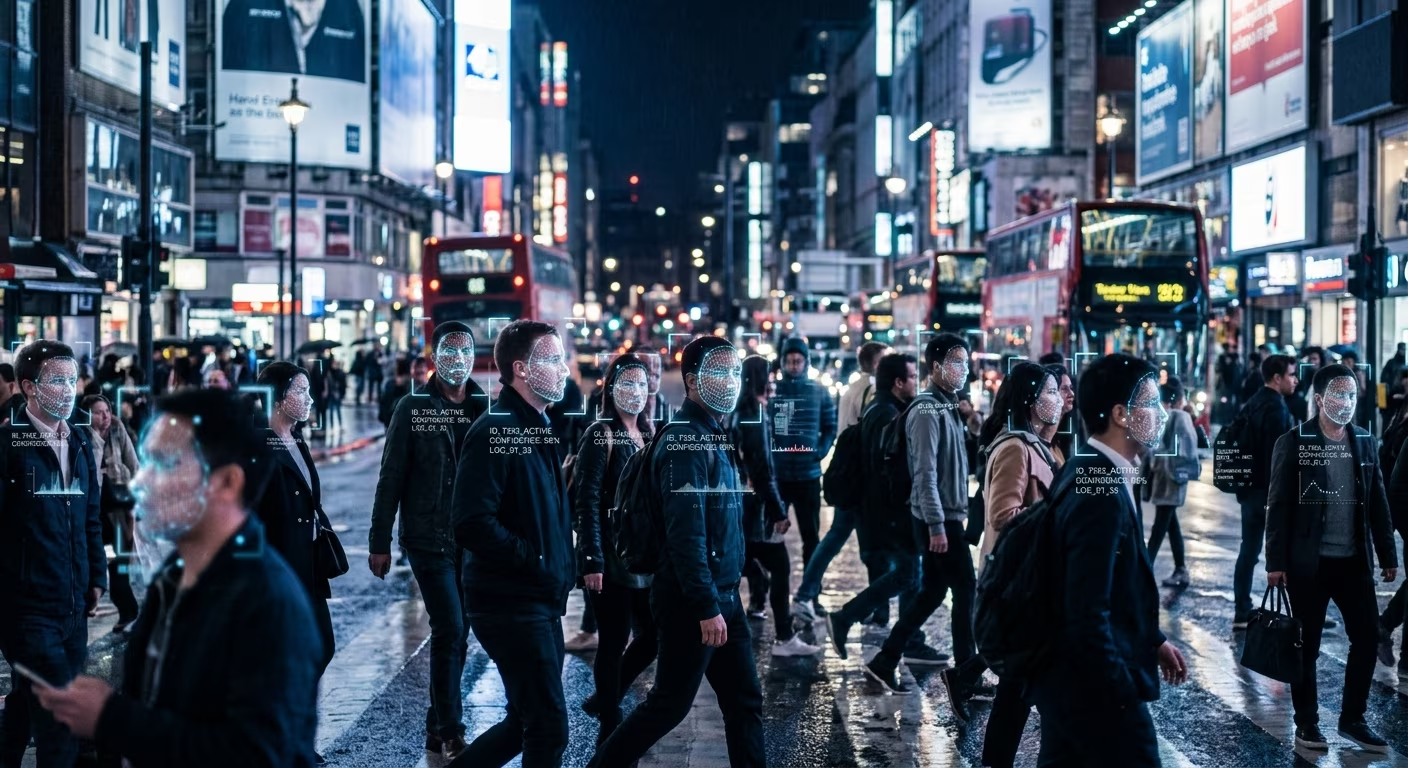
Imagine stepping out of your front door and instantly handing a detailed, permanent dossier of your identity, associations, and habits to every passing corporation and government agency. While this sounds like the premise of a dystopian novel, it is rapidly becoming the functional reality of our modern technological landscape. We are currently living through the unprecedented and largely unchecked expansion of biometric surveillance. At the very center of this societal transformation is facial recognition technology—software once relegated to the realm of highly classified national security operations, now readily available to private technology corporations, local police departments, and even private citizens.
The fundamental problem lies not simply in the existence of algorithms capable of recognizing a human face, but in the staggering, industrial scale at which these biometric systems now operate. They threaten to completely eradicate the concept of public anonymity. For the entirety of human history, blending into a crowd was a default state of existence. You could walk down a busy city street, buy a cup of coffee, or attend a political rally while remaining functionally invisible to the broader world. Today, when anyone can be instantly identified by a smartphone lens connected to a remote database, the foundational fabric of a free society begins to unravel. The unconsenting commodification of our physical identities is not just a digital privacy issue; it is a critical civil rights emergency.
The Mechanics of Mass Data Scraping: Building a Global Dragnet
To understand the severity of this threat, one must deeply examine how these modern biometric systems are constructed. Historically, facial recognition databases were highly regulated and derived from controlled, official sources, such as criminal mugshots, driver’s license repositories, and passport registries. Today’s commercial biometric systems operate on a vastly different, aggressively invasive, and highly controversial model. Technology companies are deploying automated software bots to continuously scour the open internet, scraping billions of publicly available images from social media profiles, professional networking sites, personal blogs, and image-hosting forums.
Crucially, they perform this mass data harvesting without the explicit consent, knowledge, or compensation of the individuals whose faces are being captured. If you have ever uploaded a photograph of yourself or your family to a public profile, there is a very high probability that it has been permanently ingested into one of these massive proprietary databases. This process fundamentally alters the power dynamics of the digital age. The software maps the unique geometry of your face—measuring the distance between your eyes, the shape of your cheekbones, and the contour of your jawline—to create a distinct, mathematical biometric template. This template can then be instantly cross-referenced against a grainy surveillance still or a stranger’s snapshot. Ultimately, mass data scraping turns the entire internet into a giant, non-consensual biometric lineup, stripping individuals of their ability to control their own digital and physical likeness.
The Erosion of Civil Liberties and the Chilling Effect on Free Expression
One of the most profound and immediate consequences of ubiquitous facial recognition technology is the death of obscurity. For generations, citizens of democratic nations have inherently enjoyed the right to be a “face in the crowd”—to navigate public spaces without being continuously tracked, cataloged, or monitored by unseen authorities. This expectation of privacy in public is not merely a convenience; it is a cornerstone of civil liberties, intimately connected to the constitutional freedoms of speech, association, and peaceful assembly.
When public anonymity is stripped away by unchecked algorithms, the chilling effects on civic participation are immediate and severe. Consider the impact on individuals attending a peaceful protest for a controversial social or political cause. If participants operate under the assumption that their faces will be scanned, cross-referenced with a global database, and permanently linked to their legal identity, employer, and home address, many will simply choose to stay home out of a justifiable fear of retribution. This same logic applies to citizens visiting sensitive locations, such as reproductive health clinics, mental health specialists, addiction support meetings, or places of worship. Unregulated biometric surveillance inherently deters active participation in public and democratic life. It cultivates a society driven by self-censorship, suspicion, and surveillance-induced paranoia, effectively weaponizing our own physical presence against us.
The Danger of Misuse: From Interpersonal Stalking to State Overreach
The rapid democratization of mass surveillance technology introduces profound security vulnerabilities that extend far beyond theoretical privacy concerns. If access to these omnipotent facial recognition platforms is not strictly controlled by law, the potential for devastating real-world misuse is virtually limitless. Bad actors, stalkers, and domestic abusers could easily weaponize these tools to track down victims who have gone into hiding, uncover their home addresses based on a single photograph taken on a street corner, or monitor their daily routines with chilling precision.
Beyond the terrifying prospect of interpersonal abuse, the deployment of this technology by government agencies poses severe risks of oppressive state surveillance. Without strict legislative oversight, law enforcement can utilize these vast, privately-owned databases to track political dissidents, whistleblowers, or marginalized communities without obtaining a warrant or establishing probable cause. This effectively bypasses constitutional protections against unreasonable searches and seizures.
These concerns are heavily documented. A comprehensive 2023 report by the U.S. Government Accountability Office (GAO) investigated the use of facial recognition technology by federal law enforcement agencies. The GAO found that several agencies utilized commercial facial recognition services—which rapidly search through billions of scraped photos—often without requiring their personnel to undergo specific training. Furthermore, some of these agencies completely lacked policies specifically designed to protect civil rights and civil liberties when deploying facial recognition tools. The absence of stringent internal controls and civil liberty safeguards within the very institutions tasked with upholding the law demonstrates the urgent danger of allowing this technology to proliferate in a regulatory vacuum.
Flaws in the Machine: Demographic Bias and Systemic Inaccuracy
Adding to the profound privacy implications is the fact that current facial recognition technology is fundamentally flawed. These systems are not the objective, infallible truth-tellers that corporate marketing departments claim them to be. Biometric algorithms are heavily influenced by the vast datasets they are trained on, and historically, these datasets have been overwhelmingly composed of white, male faces, leading to severe demographic biases.
The National Institute of Standards and Technology (NIST) has conducted extensive and ongoing evaluations of facial recognition technologies to mathematically assess these very issues. Their rigorous scientific testing consistently demonstrates that significant demographic disparities persist across the commercial industry. Specifically, algorithms frequently exhibit much higher false positive rates for women, people of color, and the elderly compared to white men.
A false positive occurs when the system incorrectly matches an innocent person’s face to a suspect’s image or a database entry. In a law enforcement context, this algorithmic bias is not merely a technical glitch; it is a direct pathway to wrongful arrests, traumatic police encounters, and the exacerbation of systemic racism within the criminal justice system. Relying on an empirically biased machine to make high-stakes determinations about a person’s identity and fundamental liberty is irresponsible and inherently unjust, transferring the hidden biases of software developers directly into the real world.
The Regulatory Vacuum and the Path to Legislative Protections
Despite the rapid deployment of biometric mass surveillance, the United States currently lacks a comprehensive federal framework to govern its use. We are operating in a dangerous regulatory vacuum, relying on a fragmented patchwork of localized state laws that are entirely inadequate to address a global, internet-scale privacy threat. Private technology companies are essentially operating by their own rules, prioritizing rapid expansion, massive data hoarding, and corporate profit over the fundamental rights of the public.
Conversely, international governing bodies are beginning to recognize the immense severity of this threat and are taking decisive legislative action. For instance, the European Union’s Artificial Intelligence Act (EU AI Act) strictly classifies certain AI applications as carrying an “unacceptable risk.” Notably, the Act explicitly bans the untargeted scraping of facial images from the internet or CCTV footage to create or expand facial recognition databases, recognizing this practice as a gross violation of fundamental human rights.
The U.S. and other nations desperately need a similarly robust statutory response. Civil rights advocates and digital privacy experts are calling for comprehensive data privacy laws, including:
- Strict, legally binding moratoriums on the government’s use of facial recognition technology.
- The establishment of clear legal boundaries that explicitly prohibit non-consensual biometric mass surveillance.
- Robust individual data rights, including the right to immediate deletion of biometric templates from corporate servers.
- Mandatory, independent algorithmic auditing to identify and eliminate demographic biases before software is deployed.
Until the law catches up with the rapidly advancing technology, our faces remain vulnerable to endless corporate and state exploitation.
Comparing Unregulated and Regulated Biometric Environments
To clearly illustrate the vast differences between our current technological trajectory and a future secured by robust legal frameworks, the following table outlines the impacts of an unregulated biometric landscape versus one governed by strict privacy legislation.
| Societal Aspect | Unregulated Biometric Environment | Regulated Biometric Environment (e.g., EU AI Act) |
|---|---|---|
| Data Collection | Mass, untargeted scraping of social media and public websites without user consent. | Strict prohibitions on scraping; explicit opt-in consent required for any biometric processing. |
| Public Anonymity | Constant risk of instant identification by private citizens, corporations, and authorities. | Preservation of obscurity in public spaces; comprehensive bans on real-time biometric tracking. |
| Law Enforcement Use | Unchecked access to commercial dragnet databases without warrants or civil liberty training. | Mandatory warrants, robust civil rights training requirements, and public transparency logs. |
| Algorithmic Bias | High rates of unmonitored false positives disproportionately affecting marginalized demographic groups. | Mandatory demographic equity testing, public reporting, and strict liability for algorithmic harms. |
Frequently Asked Questions (FAQs)
What exactly is biometric surveillance?
Biometric surveillance refers to the use of automated technology to monitor, identify, and track individuals based on their unique physical or behavioral characteristics. In the context of facial recognition, it involves mapping the distinct geometry of a person’s face to create a digital, mathematical template that can be instantly matched against vast databases of identified images.
How do companies get my photos for facial recognition databases?
Most commercial facial recognition companies acquire images through a highly invasive process called “mass data scraping.” They deploy automated software bots to continuously crawl public internet sites—including social media platforms, personal blogs, news sites, and professional networking pages—downloading billions of publicly available photos and associating them with whatever identifying text is available on the page, all completely without the subject’s consent.
Is facial recognition technology biased?
Yes. Extensive empirical research, including ongoing studies conducted by the National Institute of Standards and Technology (NIST), has definitively shown that many facial recognition algorithms suffer from severe demographic bias. Because they are often trained on skewed datasets, they perform significantly worse on images of women, people of color, and the elderly, resulting in much higher rates of false positives (dangerous misidentifications) for these specific demographic groups.
Are there federal laws protecting my facial data in the United States?
Currently, there is no comprehensive federal law in the United States that specifically regulates facial recognition technology or explicitly outlaws mass biometric data scraping. While a small handful of individual states and cities have passed localized biometric privacy laws (such as the Illinois Biometric Information Privacy Act), national protections remain virtually nonexistent, leaving a massive, dangerous regulatory gap.
Conclusion: Reclaiming the Right to Privacy
The unchecked proliferation of facial recognition technology represents a critical crossroads for modern digital society. We are currently being forced to decide whether we will passively accept a future where our faces are infinitely commodified, and our every movement is effortlessly trackable, or whether we will actively demand robust legal protections that preserve our fundamental right to exist without constant algorithmic observation. The technology is advancing far more rapidly than our existing legal frameworks, but it is not too late to impose the necessary boundaries. Protecting the public face from non-consensual exploitation is not simply about preserving an abstract, digital concept of privacy; it is fundamentally about defending the core civil liberties—freedom of speech, association, and autonomous movement—that enable a free, democratic society to function, evolve, and thrive.
References
- Facial Recognition Services: Federal Law Enforcement Agencies Should Take Actions to Implement Training, and Policies for Civil Liberties — U.S. Government Accountability Office (GAO). 2023-09-12. https://www.gao.gov/products/gao-23-105607
- Demographic Effects in Face Recognition — National Institute of Standards and Technology (NIST). 2025-03-05. https://www.nist.gov/programs-projects/face-recognition-technology-evaluation-frte/demographic-effects-face-recognition
- Article 5: Prohibited AI Practices — EU Artificial Intelligence Act. 2025-02-02. https://artificialintelligenceact.eu/article/5/