
On-Site Lunch Requirements: Employer Rights and Legal Boundaries
Understand what employers can legally require during employee lunch breaks.
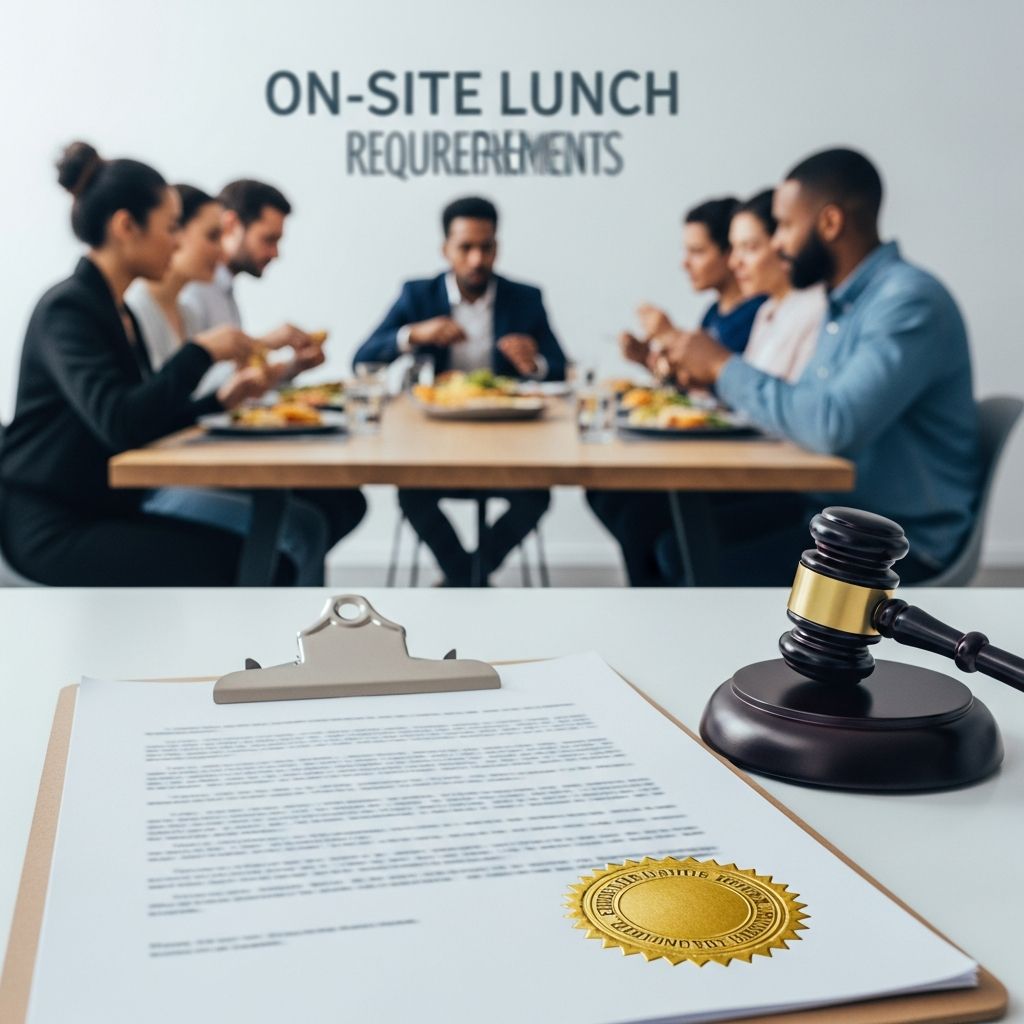
Understanding Employer Authority Over Meal Breaks
One of the most frequent questions business owners face involves the extent to which they can control employee activities during designated meal periods. Many employers wonder whether they can require staff to remain on company premises, eat in a designated cafeteria, or otherwise restrict how employees spend their break time. The answer is nuanced and depends on several factors, including state law, the nature of the work, and specific employment agreements.
Federal labor law provides a foundation for understanding break requirements, but individual states have enacted more stringent protections for workers. Federal law does not mandate that employers provide lunch or meal breaks at all. However, when employers choose to offer breaks lasting fewer than 20 minutes, federal law requires these to be paid time counted toward the workweek. Meal periods of 30 minutes or longer can be unpaid if the employee is completely relieved of work duties.
The Difference Between Paid and Unpaid Meal Periods
Understanding the distinction between paid breaks and unpaid meal periods is critical for both compliance and operational planning. This classification affects not only compensation but also employer flexibility in setting break conditions.
When a break lasts fewer than 20 minutes, the Department of Labor and most state regulations classify it as part of the compensable workday. Employees must be paid for this time regardless of whether they leave the workplace. In contrast, true meal periods of 30 minutes or longer qualify as unpaid time, provided employees are relieved of all duties and are free to use the time as they wish.
This distinction matters significantly when considering on-site requirements. If an employer insists that an employee remain in the building during a 10-minute rest break, that time must be paid. If an employer mandates staying on-site during a designated 30-minute lunch period, the meal break itself can remain unpaid, but the employer cannot require work-related activities during that interval.
State-Specific Meal Break Mandates and Location Restrictions
While federal law is permissive, state regulations create a patchwork of requirements that employers must navigate carefully. Some states impose detailed specifications about meal breaks, including timing, duration, and conditions.
California requires a 30-minute meal period after five hours of work unless the workday will be completed in six hours or less and both parties agree to waive it. Critically, California law does not explicitly mandate that employees remain off-premises or on-premises; the focus is on providing adequate time and relief from duties.
Connecticut mandates a 30-minute break after the first two hours and before the last two hours of any shift lasting 7.5 hours or longer. The law permits collective bargaining agreements to modify these requirements and provides exemptions for employers with fewer than five employees on duty.
Oregon requires a 30-minute relief period for each six- to eight-hour work period, with specific timing windows depending on shift length. Like many states, Oregon allows modifications through collective bargaining agreements.
Nevada and Nebraska each require 30-minute meal breaks for eight-hour shifts, though neither explicitly addresses location restrictions. Maine and Massachusetts both mandate 30-minute lunch periods after six consecutive work hours.
The critical insight across these state requirements is that laws focus on granting employees relief from duty rather than controlling where they spend break time. This distinction has substantial legal implications for employers considering on-site-only policies.
“Relief from Duty” as the Core Legal Standard
The foundational principle underlying most state meal break laws is the concept of relief from duty. This means employees must be completely freed from work obligations, cannot be required to monitor work situations, and cannot be held responsible for business operations during their break.
When employers mandate that employees remain on-site but provide true relief from duty—such as allowing them to eat in a break room, use a company patio, or remain in the building without working—many jurisdictions would likely permit such arrangements. The key is demonstrating that employees are genuinely relieved of all responsibilities.
However, if an employer requires employees to stay on-site and simultaneously requires them to monitor equipment, answer phones, assist customers, or perform any work-related task, the break ceases to qualify as a meal period. This converts it into compensable work time, which creates wage and hour compliance issues.
Some states acknowledge situational exceptions. Connecticut law, for example, allows exemptions when compliance would endanger public safety or when only one employee can perform critical duties. Nevada’s Labor Commissioner may grant case-by-case exemptions under specific circumstances. These narrow exceptions recognize that certain industries—such as utilities, emergency services, or healthcare—may not allow true relief from duty under any circumstances.
Collective Bargaining and Written Agreements
Many state meal break laws explicitly permit employers and employees to negotiate different arrangements through collective bargaining agreements or written contracts. Connecticut, Kentucky, Maine, Minnesota, and Oregon all allow modifications through such agreements.
This flexibility provides a legitimate pathway for employers seeking to establish on-site meal policies. If a union contract or individual employment agreement specifies that employees will take their meal break on-site, with clear terms about compensation and duties, courts are far more likely to uphold such arrangements.
The enforceability of these agreements depends on several factors: the agreement must be in writing, employees must understand the terms clearly, consideration must be exchanged, and the arrangement must not violate any non-waivable statutory protections. Some states permit waiving certain break requirements through agreement, while others protect meal break rights so strongly that waiver is impossible regardless of employee consent.
Business Necessity and Operational Considerations
Certain industries face genuine operational challenges in providing traditional meal break relief. A receptionist who must monitor incoming calls, a security guard at a sensitive facility, or a manufacturing line supervisor might not realistically leave their post.
When business necessity prevents relief from duty, employers have several legal options. First, they can seek statutory exemptions if their state provides them. Connecticut, for instance, allows exemptions for public safety concerns or single-employee operations. Nevada’s Labor Commissioner reviews case-specific requests.
Second, employers can offer paid meal periods instead. If an employee eats lunch while monitoring work operations, that time qualifies as compensable work time under federal law. By clearly classifying and paying for this time, employers comply with wage and hour laws while maintaining necessary operational coverage.
Third, employers can stagger breaks so that some employees take traditional off-duty lunch periods while others maintain operations, then rotate assignments. This approach distributes the on-site burden and demonstrates good faith efforts to provide genuine relief.
The Implications of “On-Site” Versus “Off-Site” Policies
Some employers seek to require on-site meal breaks to maintain supervision, prevent extended absences, or control where employees go during breaks. However, the legality of such mandates depends on whether relief from duty is genuinely provided.
An on-site requirement that allows employees to use a break room, eat, rest, or engage in personal activities without interference likely survives legal scrutiny in most jurisdictions. Employees are on-site but relieved of duty, which satisfies statutory requirements.
Conversely, an on-site requirement that mandates employees remain in a designated work area, perform light duties, or maintain awareness of work situations converts the break into compensable time. If unpaid, this creates wage and hour violations.
Off-site meal breaks present fewer legal complications. Once an employee is relieved of duty and leaves the premises, the employer has satisfied statutory obligations in virtually all jurisdictions. However, some employers remain concerned about liability if employees are injured off-site or about enforcing return-time policies.
Liability and Safety Considerations
Beyond wage and hour compliance, employers should consider liability implications of lunch break policies. If an employer requires employees to remain on-site, the employer may face increased liability for workplace injuries occurring during meal breaks, as the premises remain under employer control.
Conversely, employers who mandate off-site breaks might face worker’s compensation disputes if employees are injured during required off-site activities. The classification of whether the employee was acting within the scope of employment affects liability exposure.
Most courts find that true meal breaks—periods when employees are relieved of duty—fall outside the scope of employment even if on-site. However, this analysis varies by jurisdiction and fact pattern. Employers should consult employment counsel and review insurance coverage when establishing meal break policies with specific location requirements.
Industry-Specific Considerations
Different industries face different operational realities regarding meal breaks. Retail, food service, healthcare, and emergency services have limited capacity to provide complete relief from duty.
Retail and food service employers often address this through staffing models where multiple employees work staggered breaks, ensuring continuous customer service. This approach generally satisfies legal requirements because relief from duty is still provided, even if the workplace operates continuously.
Healthcare facilities and emergency services sometimes obtain statutory exemptions or provide paid meal periods that constitute compensable work time. A nurse eating lunch while monitoring a patient floor, for example, is working and must be compensated accordingly.
Practical Recommendations for Small Business Owners
- Know your state’s specific requirements: Research your state’s meal break laws, including duration, timing, and relief-from-duty standards.
- Determine whether relief from duty is feasible: Assess whether your operational needs permit genuine relief from duty or whether some coverage is essential.
- Document policies in writing: Establish clear, written meal break policies that specify location, duration, compensation, and any conditions.
- Distinguish paid from unpaid time: Clearly identify whether breaks are paid or unpaid and base this classification on federal and state law.
- Negotiate agreements where permitted: If your state allows, use written agreements or collective bargaining arrangements to establish on-site meal policies.
- Provide genuine relief: If requiring on-site breaks, ensure employees are genuinely relieved of all work duties to avoid wage and hour violations.
- Seek exemptions if applicable: If statutory exemptions apply to your industry or situation, document your request and maintain records.
- Consult legal counsel: Employment law varies significantly by state and industry; professional guidance protects your business.
Common Misconceptions About Lunch Break Mandates
Several myths persist about employer authority over meal breaks. First, many believe that federal law requires lunch breaks. This is false. Federal law is entirely permissive regarding meal periods; employers have no obligation to provide them unless required by state law.
Second, some assume that mandating on-site lunch breaks is automatically illegal. This is overstated. On-site breaks are legal if employees are genuinely relieved of duty. The illegality arises only when on-site presence is combined with ongoing work obligations.
Third, employers often think that once a meal break is offered, it can be used to monitor work or maintain operational control. This misunderstands the relief-from-duty principle. Once a break is classified as a meal period, employees must be free from employer control and work requirements.
Frequently Asked Questions
Can an employer require employees to stay on-site during lunch?
Yes, if employees are genuinely relieved of all work duties. If the employer mandates on-site presence while requiring work-related activities, the break becomes compensable time and must be paid.
Must meal breaks be unpaid?
Federal law permits unpaid meal breaks of 30 minutes or longer if employees are fully relieved of duty. Some states have different standards, so check your state’s requirements.
Can employers require employees to eat in a company cafeteria?
Typically, yes, as long as employees are relieved of work duties and the cafeteria setting does not constitute a work requirement. However, some states or unions may have specific restrictions.
What if business operations require continuous monitoring?
Employers can seek statutory exemptions, provide paid meal periods (compensating employees for work time), or stagger breaks so some employees maintain coverage while others take traditional breaks.
Do state meal break laws override employer policies?
Yes, with limited exceptions. State laws typically establish minimum protections that cannot be reduced through employer policy alone, though negotiated agreements may modify requirements in some jurisdictions.
Are meal breaks required by law in all states?
No. While many states require meal breaks for certain shift lengths, some states—including Texas, Georgia, and others—do not mandate meal breaks under state law. Federal law also does not require them.
References
- Employee Lunch Break Laws | OSHA Education Center — OSHA Education Center. Retrieved January 17, 2026. https://www.oshaeducationcenter.com/articles/employee-lunch-breaks/
- Breaks and Meal Periods — U.S. Department of Labor. https://www.dol.gov/general/topic/workhours/breaks
- Breaks and Meal Laws by State – Poster Compliance Center — Poster Compliance Center. Retrieved January 17, 2026. https://www.postercompliance.com/blog/breaks-and-meals-by-state/
- Minimum Length of Meal Period Required under State Law for Adult Workers — U.S. Department of Labor, Wage and Hour Division. https://www.dol.gov/agencies/whd/state/meal-breaks
- Breaks and Meals — Georgia Department of Labor. https://dol.georgia.gov/breaks-and-meals
Similar Articles








Read full bio of Sneha Tete




