
Elements Of Enforceable Contracts: 6 Essential Rules
Discover the core components that transform everyday agreements into powerful, court-enforceable contracts in business and life.
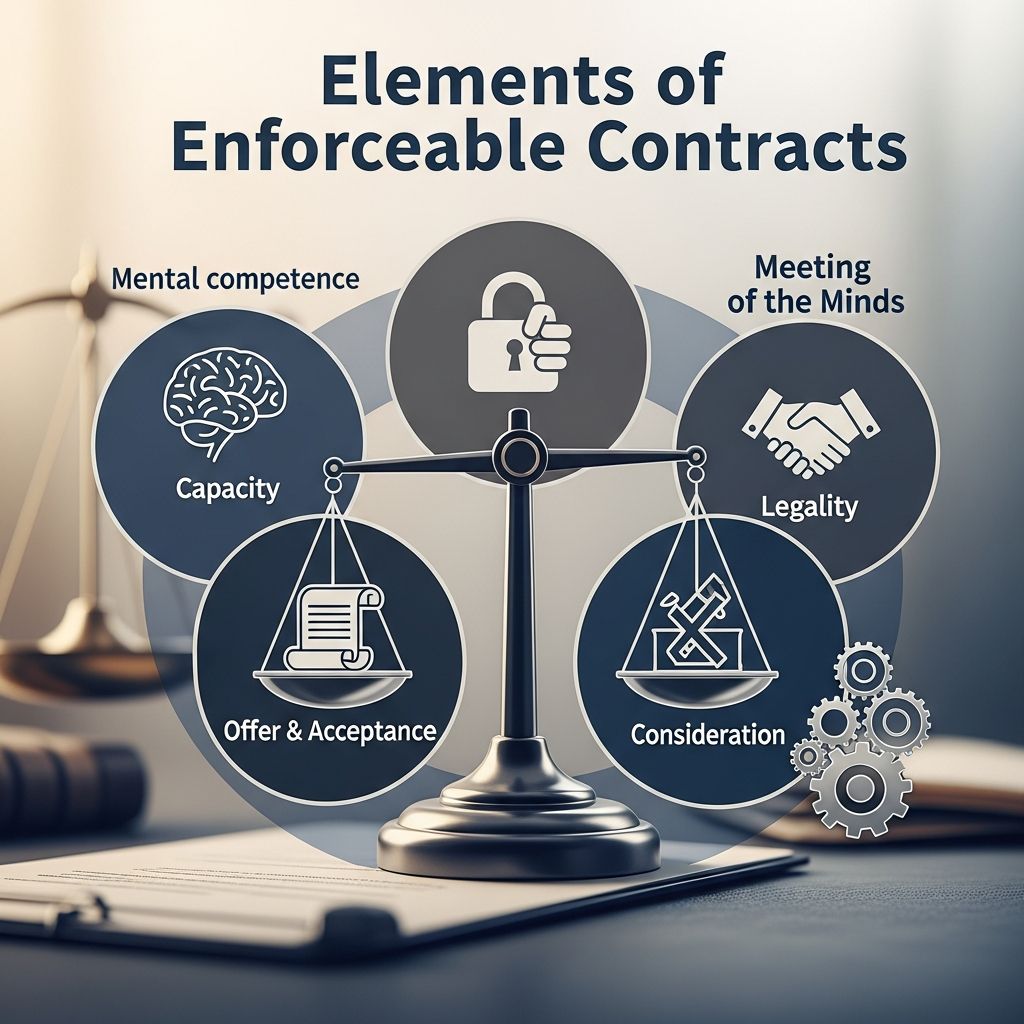
Contracts form the backbone of countless transactions, from simple purchases to complex corporate deals. Understanding what elevates an agreement from a casual handshake to a court-enforceable obligation is crucial for individuals and businesses alike. This article delves into the foundational principles that define a legally binding contract, drawing on established legal standards to provide clarity and practical guidance.
Understanding the Foundation of Contract Validity
At its core, a contract represents a promise backed by law. Courts across jurisdictions recognize specific criteria that must be met for an agreement to qualify as enforceable. These criteria ensure fairness, clarity, and mutual commitment, preventing disputes and promoting trust in commercial relationships. Without these elements, even the most detailed document may fail in legal proceedings.
Historically, contract law evolved from common law principles, emphasizing voluntary exchange. Today, statutes like the Uniform Commercial Code in the U.S. codify these rules for goods transactions, while general principles apply broadly. The goal remains consistent: protect parties while facilitating commerce.
The Initial Step: Crafting a Clear Offer
Every enforceable contract begins with a definitive offer. This is a proposal by one party to enter into an agreement on specific terms, demonstrating a willingness to be bound if accepted. An offer must be communicated clearly, leaving no room for ambiguity about the subject matter, price, quantity, or performance obligations.
For instance, stating “I will sell you my car for $15,000” constitutes a valid offer, as it specifies the item, price, and intent. In contrast, a vague statement like “Let’s discuss the car sometime” lacks the precision needed. Advertisements are typically invitations to treat rather than offers, unless they promise specific performance under clear conditions.
Offers can be revoked before acceptance, but once accepted, they form the basis of the contract. Time limits or expiration clauses further define an offer’s lifespan, adding predictability.
Sealing the Deal: Acceptance of the Offer
Acceptance is the unqualified agreement to the offer’s terms, mirroring them exactly—a concept known as the “mirror image rule.” Any deviation creates a counteroffer, restarting the process. Acceptance must be communicated to the offeror, either expressly or through conduct that implies agreement.
- Express acceptance: Verbal “yes” or signed document.
- Implied acceptance: Performing the requested action, like shipping goods after an order.
- Silence as acceptance: Generally not valid unless prior dealings establish it.
In digital eras, email confirmations or e-signatures under laws like ESIGN Act suffice, provided intent is clear. The “mailbox rule” deems acceptance effective upon dispatch in traditional mail scenarios.
Mutual Awareness and Intent to Contract
Parties must genuinely intend for the agreement to create legal relations—a “meeting of the minds.” This mutual understanding, or mutuality of assent, confirms both sides comprehend and accept the terms without deception.
Social arrangements, like dinner plans, rarely imply legal intent, but business contexts presume it unless stated otherwise (e.g., “non-binding letter of intent”). Courts examine language, context, and conduct to determine this element. Explicit clauses affirming binding nature strengthen enforceability.
| Scenario | Intent Present? | Reason |
|---|---|---|
| Formal sales contract | Yes | Clear business purpose and signatures |
| Family loan promise | No | Domestic context presumes non-legal |
| Memorandum of Understanding | Usually No | Often labeled preliminary |
| Service order email | Yes | Specific terms and confirmation |
Providing Value: The Role of Consideration
Consideration is the bargained-for exchange of value—something each party gives or promises in return. It can be money, services, goods, or forbearance (refraining from an action). Past consideration or illusory promises (e.g., “if I feel like it”) do not suffice.
Courts rarely inquire into adequacy, only existence. A peppercorn rent symbolizes nominal consideration. In modifications, new consideration is often required to avoid challenges.
Practical Tip: Document exchanges explicitly to prove mutuality, such as “payment of $X for Y services.” Promissory estoppel may enforce promises without consideration if reliance causes detriment, but it’s a narrow exception.
Ensuring Competency: Capacity of the Parties
Contracting parties must possess legal capacity—mental competence, majority age (typically 18), and authority to bind themselves or their entities. Minors’ contracts are voidable, allowing disaffirmance. Intoxicated or mentally incapacitated individuals lack capacity if they couldn’t understand terms.
Corporations require authorized agents; unauthorized signatures risk invalidation. Trustees or guardians handle cases of incapacity. Verifying identity and authority via IDs or corporate resolutions mitigates risks.
- Minors: Contracts for necessities (food, shelter) are enforceable.
- Mentally impaired: Void if proven lack of comprehension at signing.
- Corporations: Bylaws dictate signing authority.
Upholding Standards: Legality of Purpose
The contract’s objective must be lawful, not violating statutes, public policy, or morals. Agreements for illegal acts (e.g., drug sales) are void ab initio. Even legal subjects become unenforceable if methods contravene regulations, like unlicensed professional services.
Public policy voids contracts restraining trade excessively or promoting immorality. Compliance with antitrust, labor, and consumer laws is essential. Severability clauses preserve valid portions if illegal parts exist.
Form and Formalities: Written vs. Oral Contracts
Most contracts are valid orally, but the Statute of Frauds mandates writing for land sales, guarantees, one-year+ terms, and goods over $500 (UCC). Writings prevent fraud and clarify terms.
Electronic records qualify under UETA/ESIGN. Best practices include detailed descriptions, signatures, dates, and witnesses. Parol evidence rule limits external proof contradicting written terms.
Common Pitfalls That Invalidate Contracts
Mistakes, fraud, duress, or undue influence can void contracts. Mutual mistakes about facts render them unenforceable; unilateral ones may not. Coercion vitiates consent.
Unconscionable terms—grossly unfair and hidden—fail judicial scrutiny. Ambiguous language invites interpretation against the drafter (contra proferentem). Regular reviews by counsel avert these issues.
Strategies for Drafting Ironclad Agreements
To maximize enforceability:
- Define terms precisely with definitions section.
- Specify governing law and dispute resolution (arbitration/mediation).
- Include termination, force majeure, and indemnity clauses.
- Use boilerplate like entire agreement and severability.
- Employ digital tools for secure e-signing and storage.
AI contract review platforms aid but don’t replace legal expertise.
Frequently Asked Questions
Can a verbal agreement be legally binding?
Yes, verbal contracts are binding if they meet all elements, except those under Statute of Frauds requiring writing. Proof via witnesses or conduct is key, though harder than written proof.
What happens if a contract lacks one element?
It may be void, voidable, or unenforceable. Courts reform or rescind as equity demands, but prevention via thorough drafting is ideal.
Are emails considered binding contracts?
Yes, if they contain offer, acceptance, consideration, and intent. Courts treat threaded emails as integrated agreements.
Does consideration need to be monetary?
No, any value suffices—promises, acts, or waivers. Nominal amounts work if bargained.
How do I prove capacity in a dispute?
Evidence like medical records, age verification, or authority docs. Burden shifts to challenger post-signature.
Navigating Modern Contract Challenges
In global trade, cross-border elements invoke choice-of-law clauses. Blockchain smart contracts automate enforcement but must align with traditional elements. Sustainability clauses address ESG compliance, ensuring legality amid evolving regulations.
Post-pandemic, force majeure expanded for supply disruptions. Data privacy (GDPR/CCPA) mandates lawful processing in service contracts. Forward-thinking drafters anticipate these shifts.
Consulting attorneys tailors agreements to jurisdictions, minimizing litigation risks. Platforms streamline lifecycle management from drafting to renewal.
References
- The 6 Essential Elements of a Legally Binding Contract — Pocketlaw. 2024-09-23. https://pocketlaw.com/content-hub/essential-elements-of-a-contract
- Legally binding contract vs. non-binding agreement — Adobe Acrobat Business Hub. N/A. https://www.adobe.com/acrobat/business/hub/binding-vs-non-binding-contract.html
- Legally Binding Documents: What You Need to Know — Axiom Law. N/A. https://www.axiomlaw.com/guides/legally-binding-document
- What Makes a Contract Legally Binding — TermScout Blog. N/A. https://blog.termscout.com/what-makes-a-contract-legally-binding
- The 6 Essential Elements of a Contract — DocuSign Blog. N/A. https://www.docusign.com/blog/the-6-essential-elements-contract
- The essential elements of a contract — Thomson Reuters Legal Blog. N/A. https://legal.thomsonreuters.com/blog/the-essential-elements-of-a-contract/
- Requirements of a Legally Binding Contract — Nolo. N/A. https://www.nolo.com/legal-encyclopedia/contracts-basics-33367.html
- Contract — Legal Information Institute, Cornell Law School. N/A. https://www.law.cornell.edu/wex/contract
Similar Articles








Read full bio of medha deb


