
Handling E-Verify Tentative Nonconfirmations for Employers
Comprehensive guide for employers on managing E-Verify tentative nonconfirmations, ensuring compliance and protecting employee rights.
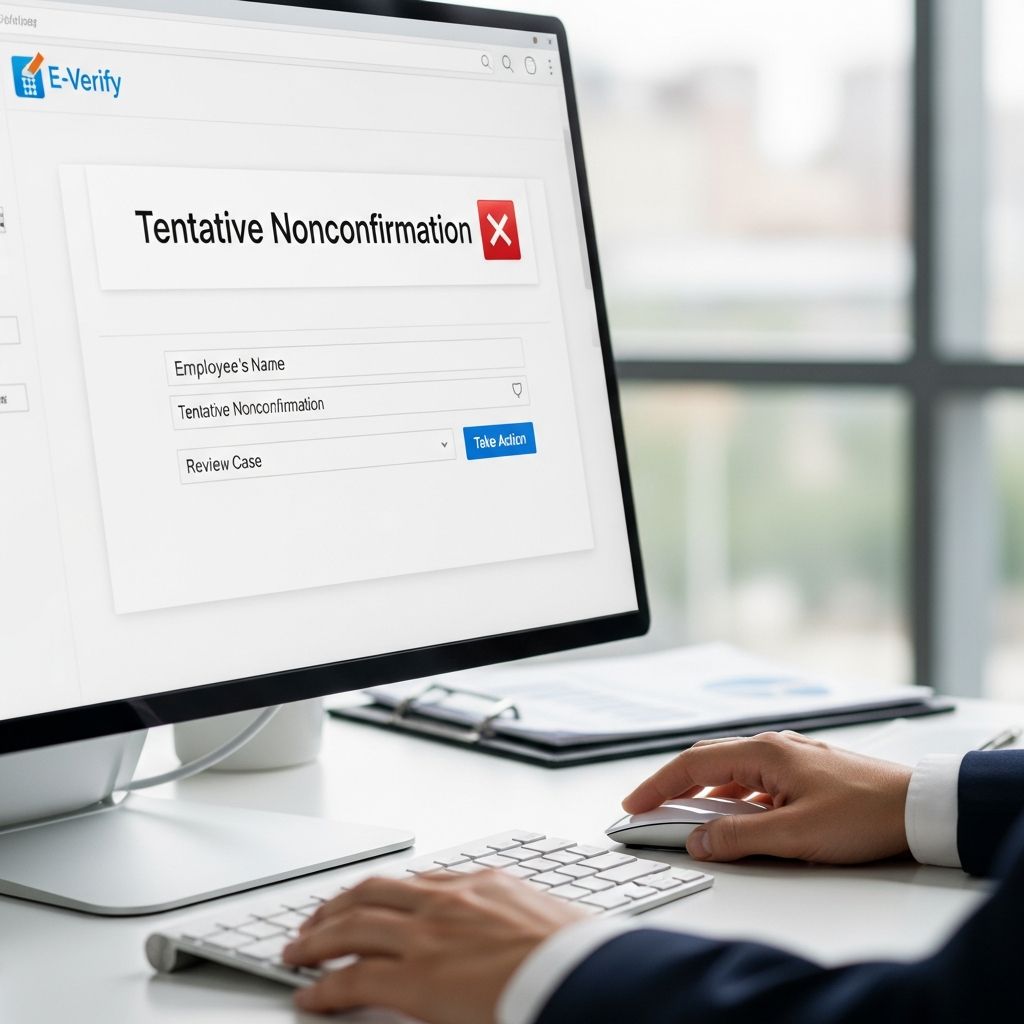
E-Verify serves as a key federal system for confirming employee work authorization in the United States. When it generates a
tentative nonconfirmation (TNC)
, employers face specific obligations to maintain compliance and fairness. This article outlines the process, timelines, employee rights, and best practices to guide businesses through these situations effectively.Understanding Tentative Nonconfirmations in E-Verify
A tentative nonconfirmation occurs when data entered into E-Verify from Form I-9 does not match records held by the Social Security Administration (SSA) or Department of Homeland Security (DHS). This mismatch, or TNC, does not prove ineligibility to work; it signals a need for further review. Common triggers include clerical errors, outdated records, or name changes not updated with agencies.
Employers must recognize that a TNC is preliminary. Acting prematurely, such as terminating employment based solely on it, violates federal rules and risks discrimination claims. Instead, the system provides structured steps to resolve discrepancies while allowing employees to continue working.
Immediate Employer Responsibilities Upon Receiving a TNC
Upon E-Verify issuing a TNC, employers must act swiftly and privately. Key actions include:
- Notify the employee promptly in a confidential setting, providing a copy of the Further Action Notice generated by E-Verify.
- Explain the TNC without implying wrongdoing, emphasizing it’s a mismatch needing resolution.
- Avoid any adverse actions like termination, suspension, or pay withholding during the contest period.
Timeliness is critical: employers have 10 federal government working days from the TNC issuance to update the case status in E-Verify. Federal working days exclude weekends, federal holidays, and closures.
Employee Options and the Contest Process
Employees facing a TNC decide whether to contest it. Employers facilitate this by:
- Presenting the Further Action Notice, which details how to challenge the mismatch.
- Having the employee sign to indicate their choice: contest or not.
- If contesting, issuing a Referral Date Confirmation Number with agency contact instructions.
Employees have 8 federal government working days to contact SSA or DHS. They can continue working during this time and beyond, provided they initiate the contest timely. If no decision by day 10, employers close the case, noting the employee’s inaction.
| Scenario | Employee Action Required | Employer Response | Timeline |
|---|---|---|---|
| Employee contests TNC | Contact agency within 8 days | Provide referral letter; allow work continuation | 8 days to start; case remains open |
| Employee declines to contest | Sign notice indicating no action | Close case; decide on continued employment | Within 10 days |
| No response from employee | None | Close as ‘no action’; note employment decision | By day 10 |
Common Reasons for Tentative Nonconfirmations
Mismatches arise from various sources. For SSA-related TNCs:
- Failure to update citizenship or immigration status.
- Unreported name changes.
- Incorrect name, SSN, or birth date in records.
- Employer data entry errors.
For DHS-related issues:
- Inaccurate A-Number, USCIS number, or I-94 details.
- Verification failures for passports or IDs.
- Outdated immigration records.
- Entry mistakes by employer.
Before closing a case, verify entered data. If incorrect, close and reopen with corrections.
Navigating Resolution and Final Outcomes
After employee referral, agencies review the case. Possible results:
- Employment Authorized: Case closes positively; employee cleared.
- Final Nonconfirmation (FNC): Employee ineligible; employer may terminate without liability if following rules.
- Case Remains Tentative: Extended review; no adverse action permitted.
Employers must not pressure employees for SSA printouts or specific proofs, as this breaches guidelines. Monitor E-Verify regularly for updates.
Legal Protections and Anti-Discrimination Rules
Federal law safeguards workers during TNCs. Employers cannot:
- Discriminate based on national origin or citizenship.
- Use E-Verify pre-hire, on current employees without cause, or for reverification.
- Treat TNC recipients differently in I-9 processes.
Violations invite remedies through the Department of Justice or USCIS. Proper handling shields employers from liability.
Best Practices for E-Verify Compliance
To minimize TNCs and issues:
- Train HR on accurate I-9 completion and E-Verify use.
- Communicate E-Verify usage upfront to all hires.
- Maintain records of notices, signatures, and case actions.
- Consult E-Verify resources for dual SSA/DHS TNCs, requiring contact with both.
- Implement policies for timely case closures, using options like ‘Administrative/Employee Unavailable’ if needed.
Regular audits ensure adherence to the E-Verify Memorandum of Understanding (MOU).
Special Scenarios in TNC Management
Dual Agency TNCs: Employee contacts both SSA and DHS within 8 days.
Extended Reviews: No termination allowed, even past 10 days, if contest initiated.
New Hire Delays: TNC does not justify delaying start dates or training.
Document all interactions to defend against potential claims.
Frequently Asked Questions (FAQs)
What is a tentative nonconfirmation in E-Verify?
A preliminary mismatch between employee data and agency records, requiring resolution before final determination.
Can I fire an employee immediately after a TNC?
No. Adverse actions are prohibited until a final nonconfirmation or employee choice not to contest.
How many days does an employee have to contest a TNC?
8 federal government working days to contact the agency.
What if the employee’s info was entered wrong?
Close the case, correct it, and create a new one.
Are there penalties for mishandling TNCs?
Yes, including discrimination charges and MOU violations.
Training and Policy Recommendations
Develop internal protocols mirroring federal requirements. Conduct annual training sessions covering TNC procedures, using official DHS materials. Integrate E-Verify into onboarding without pre-screening. For multi-state operations, note uniform federal timelines apply nationwide.
Proactive steps like verifying SSN formats pre-entry reduce TNC frequency. Partner with legal counsel for complex cases involving immigration status changes.
References
- You Should Know Your Rights and Responsibilities Under E-Verify — U.S. Department of Homeland Security. 2008-01-18. https://www.permiacare.org/wp-content/uploads/2022/06/e-ver-employee-rights.pdf
- E-Verify Tentative Nonconfirmation (TNC) — Hawaii Employers Council. Accessed 2026. https://www.hecouncil.org/resources/e-verify-tentative-nonconfirmation-tnc/
Similar Articles








Read full bio of medha deb




