
DUI Testing: Breath vs Blood Accuracy Guide
Uncover the key differences, accuracy issues, and legal challenges in breathalyzer and blood tests for DUI cases nationwide.
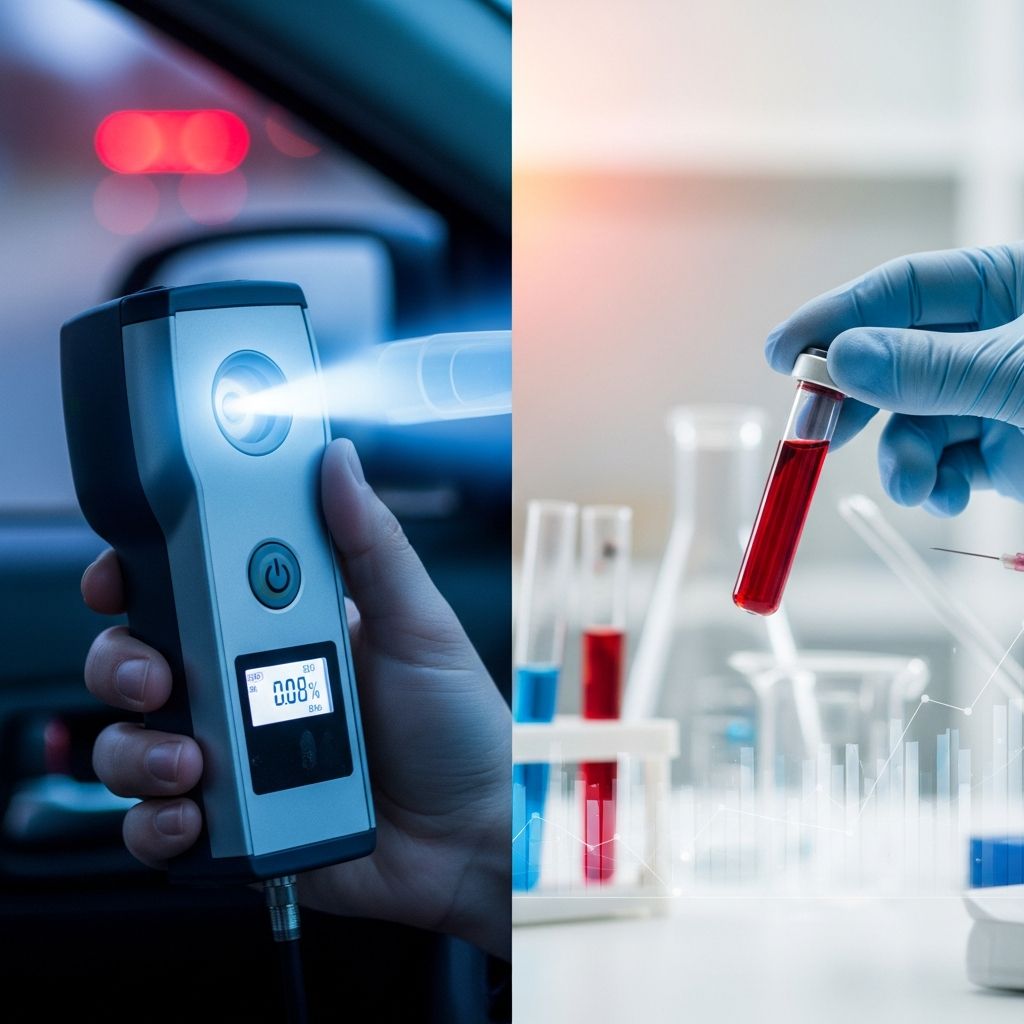
Driving under the influence (DUI) or driving while intoxicated (DWI) cases often hinge on chemical tests measuring blood alcohol concentration (BAC). Law enforcement primarily relies on breathalyzer devices for quick roadside assessments and blood draws for more precise lab analysis. Understanding the mechanics, reliability, and vulnerabilities of these tests empowers individuals facing charges to navigate legal proceedings effectively.
Understanding BAC and Its Legal Thresholds
Blood alcohol concentration (BAC) quantifies alcohol in the bloodstream, expressed as grams per 100 milliliters of blood. Most U.S. states set the legal driving limit at 0.08% for adults over 21, with stricter thresholds like 0.00% for commercial drivers and 0.02% for minors under zero-tolerance laws. These tests estimate impairment levels, but their indirect or direct measurement methods introduce variables that can skew outcomes.
Breathalyzer Tests: Quick but Questionable?
Breath tests, commonly called breathalyzers, dominate DUI enforcement due to portability. Officers use handheld preliminary breath test (PBT) devices at stops and stationary Intoxilyzer machines at stations. You exhale deeply into a tube, and the device analyzes alcohol vapor to infer BAC.
The science assumes breath alcohol correlates with blood levels at a 2,100:1 partition ratio—meaning 2,100 molecules of breath alcohol equal one in blood. Devices employ fuel cell technology, infrared spectroscopy, or chemical reactions to detect ethanol via electrical currents or light absorption.
- Fuel cell method: Alcohol triggers a reaction generating current proportional to concentration, ideal for portable units.
- Infrared analysis: Measures alcohol’s light absorption at specific wavelengths for stationary evidential tests.
- Chemical test strips: Change color based on alcohol interaction, used in some preliminary screens.
While convenient, breath tests require certified operators, proper calibration, and observation periods—typically 15-20 minutes without eating, drinking, or smoking to avoid residual mouth alcohol.
Blood Tests: The Gold Standard with Drawbacks
Blood tests directly measure alcohol in venous blood samples drawn by phlebotomists or medical staff using sterile needles. Samples go to accredited labs for gas chromatography analysis, which separates and quantifies ethanol precisely.
Unlike breath tests, blood analysis detects not just alcohol but potential drugs, offering comprehensive toxicology panels. Two vials are standard for duplicate testing and chain-of-custody verification. Procedures demand anticoagulants like sodium fluoride to prevent fermentation and refrigeration for stability.
| Test Type | Administration Time | invasiveness | Typical Location |
|---|---|---|---|
| Breathalyzer | Minutes | Non-invasive | Roadside or station |
| Blood | Hours to days | Invasive (needle) | Hospital or clinic |
Blood tests shine in unconscious suspects or refusals of breath samples but delay results, allowing BAC dissipation.
Accuracy Showdown: Breathalyzer vs Blood
Blood tests generally outperform breathalyzers in precision, as they analyze actual blood rather than estimating via breath partition. Studies and legal precedents note breath devices carry a ±0.01% margin of error, potentially overestimating BAC by 15-25% in some cases.
Raw blood yields direct ethanol quantification, minimally affected by breath-related confounders. However, both can err if protocols falter—breath more frequently due to environmental and physiological interferences.
Common Pitfalls in Breathalyzer Results
Breathalyzers falter under multiple influences, providing fertile ground for defense challenges.
- Residual mouth alcohol: Recent drinks, mouthwash, or burps elevate readings; a 15-minute wait mitigates but isn’t foolproof.
- Medical conditions: Diabetes (ketones mimic alcohol), acid reflux, or GERD release stomach alcohol into breath.
- Calibration and maintenance: Dirty sensors, outdated software, low batteries, or infrequent checks yield false highs.
- Operator errors: Insufficient breath sample, radio interference, or ambient temperature swings distort results.
- Partition ratio variability: Individual factors like body temperature alter the 2100:1 assumption.
These issues prompted courts to scrutinize breath evidence, often requiring expert testimony on device limitations.
Potential Errors in Blood Test Procedures
Blood tests aren’t infallible despite higher reliability.
- Sample contamination: Non-sterile needles or vials introduce errors.
- Fermentation: Improper preservation lets bacteria convert glucose to alcohol, inflating BAC post-draw.
- Chain-of-custody breaks: Mislabeled or mishandled vials risk mix-ups.
- Lab mistakes: Technician errors in dilution, calibration, or analysis.
- Delay effects: Time between stop and draw allows alcohol metabolism (0.015% per hour average).
Defenses often highlight warrant validity, phlebotomist qualifications, and storage logs.
Legal Rights and Test Refusal Implications
The Fourth Amendment guards against unreasonable searches; chemical tests need implied consent or warrants. Most states impose “implied consent” laws: driving equates to agreeing to tests, with refusal triggering license suspension (6-12 months first offense) and admissibility of refusal as evidence.
Post-Missouri v. McNeely (2013), warrants are routine for blood without exigency. You can consult counsel before deciding, but delays may prompt forced draws.
Challenging Test Results in Court
Effective DUI defense dissects test validity:
- Request calibration logs, maintenance records, and proficiency tests for breath devices.
- Cross-examine on observation periods and interfering substances.
- For blood, audit lab reports, preservatives, and timelines.
- Hire toxicologists to model rising/falling BAC curves.
Motions to suppress flawed evidence can dismiss charges or force pleas.
Field Sobriety Tests as Precursors
Pre-arrest, standardized field sobriety tests (SFSTs)—walk-and-turn, one-leg stand, horizontal gaze nystagmus—gauge impairment. Non-standard tests like alphabet recitation add subjectivity. Positive SFTs justify chemical tests but aren’t BAC proof.
Drug Recognition Experts and Beyond Alcohol
For suspected drugs, drug recognition experts (DREs) conduct 12-step evaluations. Blood tests confirm metabolites, as breathalyzer ignores non-alcohol impairants.
Frequently Asked Questions (FAQs)
Which is more accurate: breath or blood test for DUI?
Blood tests are typically more accurate, directly measuring BAC with fewer external interferences than breath estimates.
Can I refuse a breathalyzer without penalties?
Refusal often leads to automatic license suspension under implied consent laws, plus evidentiary use in trial.
How long after drinking can a blood test detect alcohol?
Up to 12-24 hours, depending on amount consumed and metabolism rate.
Do medical conditions affect breathalyzer results?
Yes, conditions like diabetes or GERD can produce false positives by mimicking alcohol signals.
Is a preliminary breath test admissible in court?
Usually not; PBTs are screening tools, with evidential station tests holding more weight.
Strategies for Post-Arrest Protection
Immediately request an independent blood test if breath results seem off—many states allow this at your expense. Document everything: officer demeanor, test timing, health issues. Retain a DUI specialist versed in local protocols and forensic science.
Advancements like smartphone breath apps or wearable BAC monitors emerge, but none supplant official tests legally yet.
References
- DUI Test Accuracy Between DWI Blood and Breathalyzer Tests — Browning & Long, PLLC. 2023. https://www.browninglonglaw.com/blog/dui-test-accuracy-between-dwi-blood-and-breathalyzer-tests.cfm
- The Science Behind DUI Testing – Breath and Blood Tests — Denver DUI. N/A. https://www.denverdui.com/the-science-behind-dui-testing-breath-and-blood-tests/
- Breath Test vs. Blood Test — Reynolds Defense Firm. N/A. https://www.reynoldsdefensefirm.com/dui-law-breath-test-vs-blood-test/
- Blood Test vs. Breathalyzer in DUI Stops! — Just Criminal Law (YouTube). 2023-07-21. https://www.youtube.com/watch?v=BjX4yS4JT6I
- Does a Breathalyzer Read Higher Than a Blood Test? — R. Eisenerg Law. N/A. https://www.rbisenberg.com/faqs/does-a-breathalyzer-read-higher-than-a-blood-test/
Similar Articles








Read full bio of medha deb




