
Understanding DUI Expungement Laws Across the United States
Learn how DUI expungement and record-sealing work, which states allow relief, and what steps might help clear or limit a DUI record.
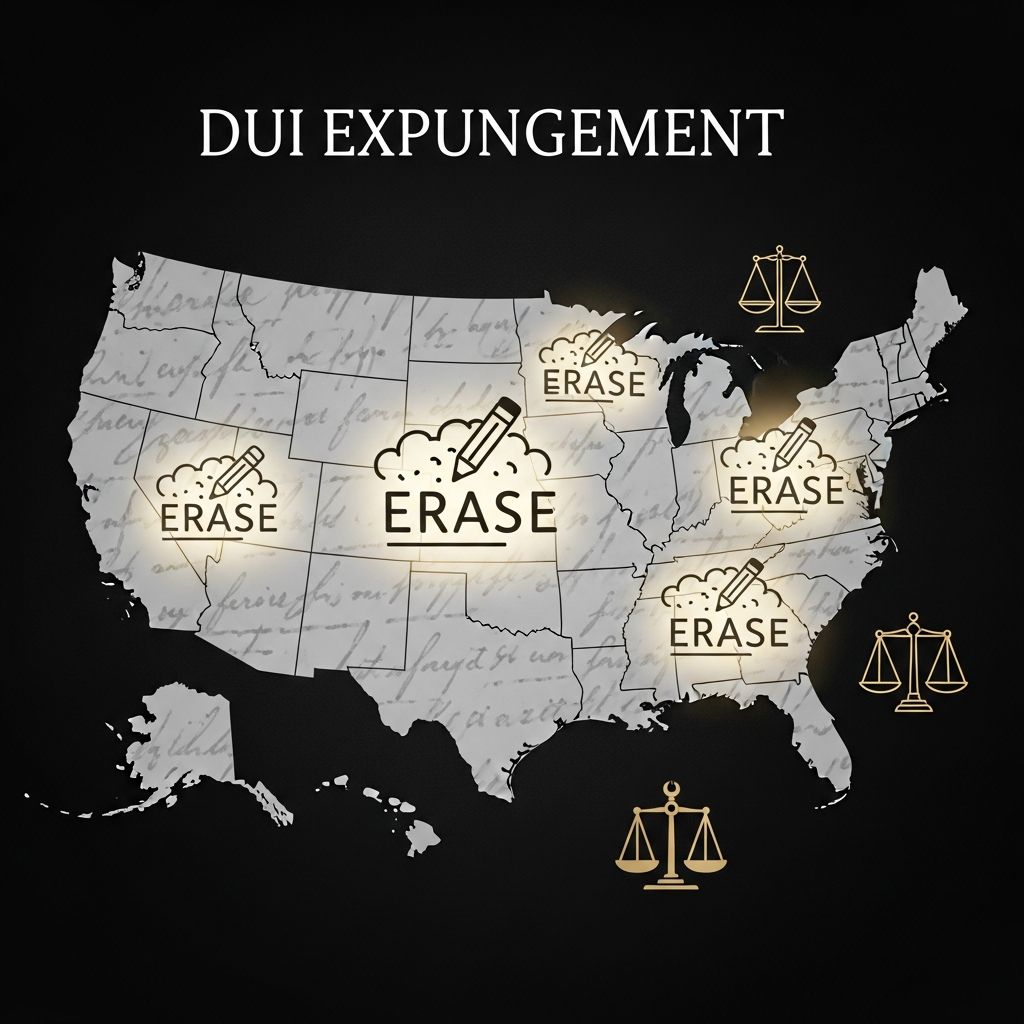
Driving under the influence (DUI) convictions can follow a person for years, affecting employment, housing, licensing, and even insurance rates. In some states, it is possible to reduce the long-term impact of a DUI through expungement, record sealing, or related forms of record relief. However, eligibility and procedures vary widely across the United States, and in several jurisdictions a DUI cannot be expunged at all.
This guide explains what DUI expungement means, outlines the main types of record relief used for DUI cases, and summarizes how states tend to differ. It is not legal advice and cannot replace speaking with a qualified attorney in your state.
What Is DUI Expungement?
Although each state defines the term differently, expungement generally refers to a court-ordered process that removes or substantially limits public access to a criminal record. In many jurisdictions, expungement either:
- Destroys or deletes the record from public files; or
- Converts it to a non-public record accessible only to courts, law enforcement, or certain licensing bodies.
When a DUI is expunged or an equivalent remedy is granted, a person may often be legally allowed to say that they have not been convicted of that offense in most private employment contexts, though there are exceptions for government or sensitive positions.
Expungement vs. Related Forms of Relief
Because some states do not use the word “expungement,” DUI relief may appear under different labels:
- Record sealing: The record still exists but is hidden from most public background checks; law enforcement and some agencies may still see it.
- Set-aside or vacatur: The conviction is set aside or vacated after successful completion of the sentence, sometimes converting it to a dismissal, though it may still count as a prior offense for future DUIs.
- Certificates of rehabilitation or similar documents: Some states cannot erase a DUI but allow court-issued certificates to show rehabilitation, which can assist with employment or licensing.
For DUI specifically, these distinctions matter because many statutes that broadly permit expungement of misdemeanors or lower-level felonies specifically exclude drunk or impaired driving.
Why DUI Expungement Matters
Even a single DUI conviction can have effects long after fines and probation have ended. Common consequences include:
- Employment barriers: Employers who run criminal background checks may reject applicants with DUI convictions, particularly for driving, security-sensitive, or professional roles.
- Professional licensing hurdles: Healthcare, teaching, commercial driving, and many licensed trades require disclosure of DUI convictions and may impose discipline or deny licenses.
- Housing challenges: Property managers frequently screen criminal records and may deny applicants with DUI-related entries.
- Insurance costs: Auto insurers often treat DUI as a high-risk factor, leading to higher premiums for years.
Where expungement or sealing is available, it can:
- Reduce what shows up on private background checks
- Improve chances of employment and housing approval
- Provide a legal mechanism to demonstrate rehabilitation
How States Classify and Treat DUI Records
States do not treat DUI records uniformly. Key differences include how DUI is classified, whether expungement is allowed, and how long records remain accessible.
Common DUI Classifications
- Traffic or motor vehicle offense: In a few states, DUI is handled as a serious traffic infraction rather than a standard criminal conviction, which can affect whether traditional expungement laws apply.
- Misdemeanor: First-time DUIs without injuries or aggravating factors are frequently misdemeanors.
- Felony: Repeat DUIs, crashes causing serious injury or death, or cases involving very high blood alcohol levels may be charged as felonies.
The more serious the classification, the less likely it is that the state will make expungement available.
General Patterns by State
Based on comparative surveys of record-relief laws, states tend to fall into broad categories:
| Category | Typical Approach to DUI Records |
|---|---|
| States allowing some DUI expungements | Permit expungement or sealing for certain DUI convictions, often first offenses, after a waiting period and completion of all sentence terms. |
| States allowing only non-conviction relief | Allow expungement or sealing when DUI charges were dismissed, not filed, or resulted in acquittal, but not when there is a conviction. |
| States barring expungement for DUI | Explicitly exclude DUI from expungement statutes, even if other misdemeanors or felonies can be cleared. |
| States using set-aside or similar remedies | Do not label relief as expungement but allow courts to set aside, vacate, or otherwise mark the conviction after successful completion of probation. |
Typical Eligibility Factors for DUI Expungement
Where states do permit DUI expungement or sealing, eligibility generally depends on several recurring criteria.
Completion of Sentence and Probation
- Courts usually require that all terms of the sentence be completed: jail or community custody, fines, restitution, classes, and probation.
- If a DUI sentence did not involve probation because it was serious enough to warrant immediate prison time, expungement is often unavailable.
Waiting Periods
Many states impose a mandatory waiting period starting after completion of the sentence or probation.
- Shorter waiting periods (for example, 1–3 years) are more common for lower-level misdemeanors.
- Longer waiting periods apply to more serious offenses or repeat DUIs; some states require 7–10 years or more.
- Separate waiting periods may apply to non-conviction records, such as arrests that did not lead to charges or cases that were dismissed.
Number and Type of Offenses
- Relief is frequently limited to first-time DUI convictions; additional DUIs may automatically disqualify a person.
- Some jurisdictions allow only a fixed number of expungements over a lifetime (for example, one felony and two misdemeanors), and DUI may be subject to even stricter rules or longer waits.
- States often exclude DUIs with aggravating factors such as serious bodily injury, high blood alcohol levels, or the presence of minors in the vehicle.
Clean Record During the Waiting Period
- Applicants typically must avoid new convictions during the waiting period.
- Some statutes expressly require that there be no intervening findings of guilt before a petition can be granted.
How the DUI Expungement Process Commonly Works
Although specific forms and court procedures differ by state and even by county, the overall process for seeking DUI expungement or sealing tends to follow a similar structure.
1. Research State Law and Local Court Rules
- Review your state’s expungement or record-sealing statute to verify whether DUI is eligible and under what conditions.
- Some state court systems publish self-help materials describing eligibility and forms for cleaning criminal records.
2. Determine Eligibility
Consider, with or without legal help:
- Type of DUI (misdemeanor vs. felony)
- Number of prior convictions
- Completion of probation, fines, programs, and other conditions
- How much time has passed since the conviction or completion of sentence
3. File a Petition for Relief
Where expungement or similar relief is available, the applicant typically must:
- Prepare a petition or motion requesting expungement, sealing, or set-aside of the DUI conviction
- Include an affidavit or sworn statement describing eligibility, rehabilitation, and reasons for relief
- Pay any required filing fees, which in many states range from roughly $100 to several hundred dollars
- Serve a copy of the petition on the prosecuting attorney or other designated party, who may oppose the request
4. Judicial Review and Possible Hearing
- A judge may review the petition on the written record or schedule a hearing.
- At a hearing, the court may consider:
- Compliance with all sentencing terms
- Evidence of rehabilitation (employment, education, treatment, community service)
- Public safety and the interests of justice
- Any objection from the prosecution or victims
If the judge grants the petition, the court issues an order directing relevant agencies—such as law enforcement, court clerks, and record repositories—to expunge, seal, or reclassify the DUI record.
States That Strictly Limit or Prohibit DUI Expungement
Even as many jurisdictions expand record relief for other offenses, some states specifically refuse to expunge DUI convictions. Comparative surveys have found that in several states, DUI is singled out as ineligible for expungement, even when many misdemeanors or low-level felonies can be cleared.
Common features of these states include:
- Statutes that list DUI among the categories that cannot be expunged or sealed
- Allowing expungement only for non-conviction DUI records, such as dismissed or acquitted cases
- Alternative remedies such as:
- Record sealing that stops short of full expungement
- Set-aside laws that mark the conviction as dismissed after completion of probation
- Administrative limits on how long DUI appears on a driving record, which may differ from the criminal record
Because these laws often change through legislative reforms, up-to-date state-specific research is essential.
Evolving Trends in Criminal Record Relief
Over the past decade, many states have broadened access to expungement, sealing, and automatic record clearance for certain offenses, largely to improve employment opportunities for people with criminal histories. Some key developments include:
- Automatic or “clean slate” laws: Several states have created systems that automatically seal or expunge some convictions after a defined period without new offenses, though DUI is often excluded or subject to more restrictive rules.
- Expanded eligibility lists: Legislatures have added more misdemeanors and certain non-violent felonies to the list of offenses eligible for expungement or sealing.
- Decoupling from unpaid fines: A number of jurisdictions no longer require full payment of court debt as a strict prerequisite for some forms of record relief, though this varies and may not apply to DUI.
In some large states that have significantly expanded record-clearing laws, DUI-related offenses are treated more cautiously, reflecting ongoing debates about road safety and repeat-offense risks.
Practical Considerations Before Seeking DUI Expungement
Anyone considering a DUI expungement, sealing, or similar remedy should carefully weigh several practical issues.
1. Impact on Future DUI Charges
Even when a DUI conviction is expunged or set aside, many statutes allow it to be used as a prior offense to enhance penalties if the person is convicted of a new DUI in the future.
- Expungement may improve employment prospects but not eliminate the consequences of a subsequent drunk driving arrest.
- Courts and prosecutors often retain access to expunged records for this limited purpose.
2. Disclosure Obligations
Expungement may allow a person to answer “no” to certain conviction questions on private employment applications, but exceptions commonly exist for:
- Government jobs
- Law enforcement or corrections positions
- Professional licenses (such as law, medicine, nursing, and teaching)
- Positions involving vulnerable populations
Applicants often must still disclose an expunged or set-aside DUI when asked by licensing boards or governmental entities, though the board may treat it more leniently than an un-cleared conviction.
3. Driving Record vs. Criminal Record
In many states, a DUI appears on both the criminal record and the motor vehicle driving record. Expungement may affect only the criminal record, leaving administrative driving history unchanged, or vice versa. Motor vehicle agencies may use different time frames for how long DUI remains visible for insurance or license-sanction purposes.
4. Role of Legal Counsel
Because eligibility rules and procedures for DUI expungement are highly technical and state-specific, many people choose to consult a lawyer experienced in criminal record relief or DUI defense. An attorney can:
- Analyze eligibility based on the exact statute and facts
- Identify whether expungement, sealing, set-aside, or another remedy is most realistic
- Prepare petitions and supporting documentation
- Represent the applicant at hearings
Frequently Asked Questions About DUI Expungement
Q: Is a DUI always eligible for expungement if I completed probation?
A: No. Many states exclude DUI from expungement statutes altogether or allow relief only in narrow circumstances, such as certain first-time misdemeanors or non-conviction outcomes. Completing probation is usually necessary but not sufficient by itself.
Q: Can an expunged DUI still be used against me in court?
A: In several states, an expunged or set-aside DUI can still be treated as a prior conviction to enhance penalties for a new DUI charge, even though it is hidden from most public background checks.
Q: How long do I have to wait before applying to expunge a DUI?
A: Waiting periods differ widely. Some jurisdictions require only one or a few years after completion of sentence for eligible misdemeanors, while others require far longer or completely bar DUI expungement. The gravity of the offense and your probation length can significantly affect timing.
Q: Does expungement erase my DUI from my driving record?
A: Not necessarily. Criminal record relief and motor vehicle record rules are often separate. A court order might clear or seal the criminal conviction while the Department of Motor Vehicles continues to show a history of license suspension or DUI-related action for a specified period.
Q: If my DUI case was dismissed, can I still seek expungement?
A: In many states, non-conviction records—such as dismissals, acquittals, or charges that were never filed—are easier to expunge or seal than actual convictions, and some jurisdictions even provide automatic relief after a waiting period.
References
- 50-State Comparison: Judicial Expungement, Sealing & Set-Aside — Collateral Consequences Resource Center. 2022-08-10. https://ccresourcecenter.org/state-restoration-profiles/50-state-comparisonjudicial-expungement-sealing-and-set-aside-2-2/
- How to Clear Your Record of a DUI (DUI Expungement) — Alcohol.org / American Addiction Centers. 2021-09-23. https://alcohol.org/dui/clear-your-record/
- DUI Expungement: How to Remove a DUI from Your Record — DUI.org. 2023-05-15. https://www.dui.org/resources-and-articles/dui-expungement-process/
- Clean Your Record — Judicial Council of California. 2024-01-01. https://selfhelp.courts.ca.gov/clean-your-record
- California is clearing criminal records — including violent crimes. Here’s what that means — CalMatters. 2024-03-28. https://calmatters.org/justice/2024/03/california-criminal-records-expungement-law/
- What States Can You Get a DUI Expunged? — Pardon Me LLC. 2023-07-11. https://www.pardonmellc.com/what-states-can-you-get-a-dui-expunged
Similar Articles








Read full bio of Sneha Tete




