
Driving With Due Care: Legal Duties and Everyday Practice
Learn what “due care” means behind the wheel, how it differs from reckless driving, and why it matters in traffic tickets, lawsuits, and safety.
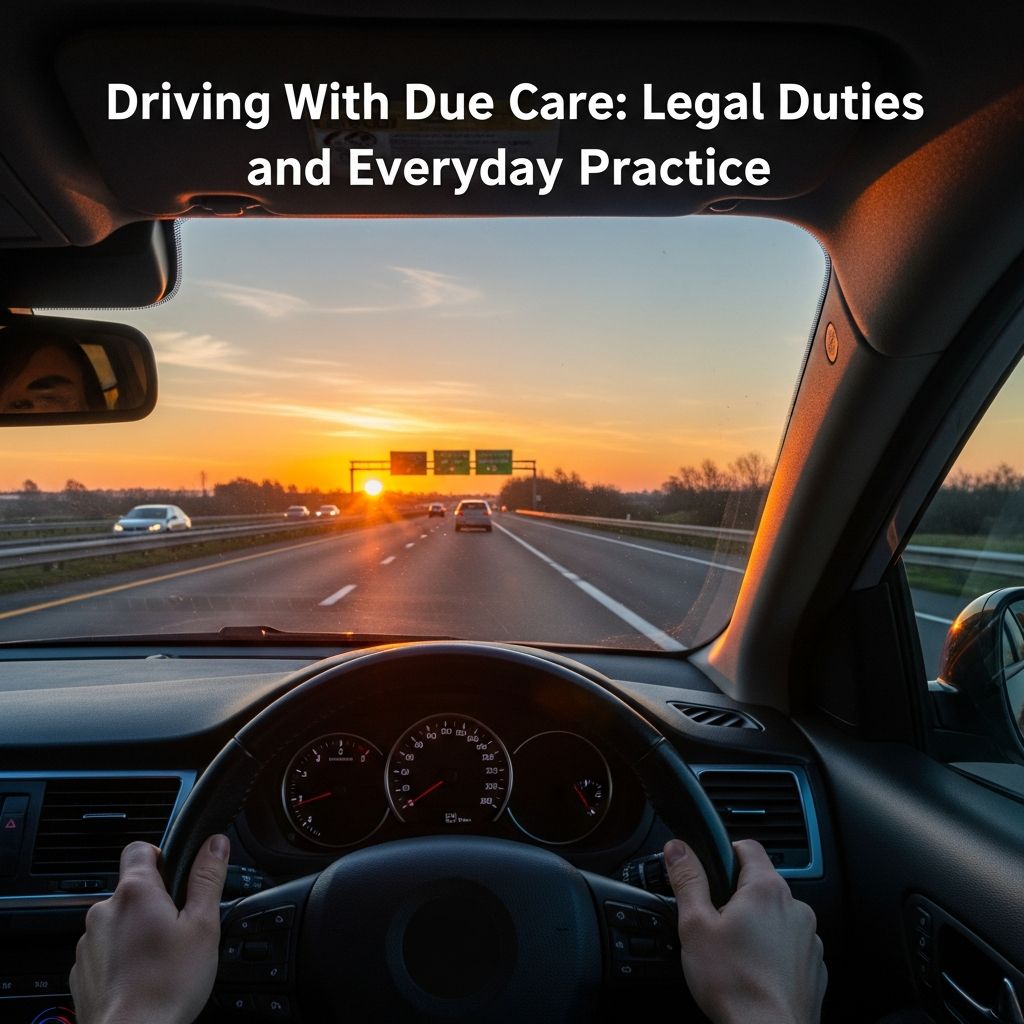
“Driving with due care” is a legal and safety standard that applies to every person who gets behind the wheel. It goes beyond simply obeying the posted speed limit or stopping at red lights. At its core, due care requires you to drive as a reasonably careful person would in the same situation, taking into account the real-world conditions around you.
This article explains what due care means, how it is enforced in traffic law, how it connects to negligence in civil lawsuits, and what you can do in everyday driving to meet this standard and avoid tickets, liability, and preventable crashes.
1. The Legal Meaning of “Due Care” on the Road
Across U.S. law, due care (often called ordinary care or reasonable care) is the level of caution and attention that a reasonably prudent person would use in similar circumstances.
- Reasonable person standard: Courts and officers compare your behavior to what an average, careful driver would have done facing the same conditions.
- Context-dependent: What counts as due care changes with weather, visibility, traffic density, time of day, and the presence of vulnerable road users such as pedestrians and bicyclists.
- Baseline duty: Every driver has a legal duty of care not to create unreasonable risks of harm to others on or near the roadway.
Failing to use due care can be a traffic offense on its own and can also serve as evidence of negligence if someone is injured and files a civil claim.
1.1 Due Care vs. Simple Compliance With Traffic Laws
Traffic codes set minimum rules for all drivers, such as speed limits and right-of-way requirements. Due care, however, can require more than strict compliance with written rules when circumstances demand it.
- You may be traveling at or below the speed limit but still be found careless if that speed is unsafe for fog, ice, or heavy pedestrian traffic.
- You may have the legal right-of-way and still be held responsible if you ignore obvious signs that another driver or pedestrian will enter your path.
Because of this, a driver can be cited for failure to use due care even when no other specific rule—like speeding or running a light—was broken.
2. Careless Driving and “Driving Without Due Care and Attention”
Many jurisdictions use phrases such as careless driving or driving without due care and attention for violations where the driver’s manner of driving falls below the standard of a reasonably careful driver but does not rise to the level of reckless or dangerous driving.
| Concept | Typical Legal Label | Core Idea | Relative Seriousness |
|---|---|---|---|
| Failure to use due care | Careless driving, driving without due care and attention | Driving falls below reasonable standard, often without deliberate risk-taking | Less serious than reckless or dangerous driving, but still an offense |
| Reckless or dangerous driving | Reckless driving, dangerous driving | Conscious or obvious disregard of a substantial risk to others | More serious, often with higher fines, license consequences, or jail |
2.1 Typical Behaviors That Suggest Lack of Due Care
Although each state or country defines offenses in its own statutes, the following behaviors commonly support a charge of driving without due care or careless driving:
- Failing to notice a pedestrian or cyclist who is plainly visible in the roadway.
- Driving at a speed that is reasonable in ideal conditions but unsafe on wet, icy, or dark roads.
- Becoming distracted by a phone, in-car screen, food, or conversations, leading to delayed reactions.
- Following another vehicle too closely for the prevailing speed and road conditions.
- Not adjusting driving around schools, crosswalks, or areas with children, seniors, or people with disabilities.
Any pattern that suggests inattention, poor judgment, or failure to adapt to risk can become evidence that you did not exercise due care.
3. Due Care as a Traffic Offense
Many traffic codes treat failure to use due care as a distinct violation. A typical example is a law requiring drivers to use due care to avoid colliding with pedestrians, bicyclists, or domestic animals and to use the horn when necessary as a warning.
3.1 How These Laws Work
Although wording varies, these provisions usually share several features:
- Duty toward vulnerable road users: Drivers must exercise special care around pedestrians, bicycle riders, and sometimes animals, recognizing that they are more exposed to injury.
- Injury-based enforcement: In some jurisdictions, the specific offense is triggered when a collision results in injury to a protected person or animal.
- Flexible definition: Statutes may not define “due care” precisely, relying instead on the general legal meaning of acting as a reasonable person would under similar circumstances.
3.2 Typical Penalties
Penalties for driving without due care or failure to use due care vary, but they can include:
- Monetary fines, which often increase if an injury is serious or if it is a repeat offense.
- Points or endorsements on your driving record, which can affect license status and insurance rates.
- Short-term license suspension in more serious or repeated cases.
- In severe outcomes (such as causing death by careless driving), potential jail or prison time in some jurisdictions.
Because these offenses are often considered less serious than reckless or dangerous driving, they may carry lower maximum penalties, but they still create a record and can be used against you in later proceedings.
4. Due Care and Negligence in Civil Lawsuits
Due care is not only a traffic concept; it is also central to negligence law, which governs many personal injury cases arising from vehicle collisions. To prove negligence, an injured person (the plaintiff) generally must show:
- Duty of care: The driver had a legal obligation to use reasonable care toward others on the road.
- Breach of duty: The driver’s behavior fell short of that standard—i.e., they did not exercise due care.
- Causation: The breach was a factual and legal cause of the crash (the harm would not have occurred without it and was a foreseeable consequence).
- Damages: The plaintiff suffered actual harm, such as medical bills, lost income, or pain and suffering.
Evidence of a traffic citation for careless driving or failure to use due care can be powerful in a negligence case, because it supports the argument that the driver breached their duty of care.
4.1 Duty of Care for Drivers
The baseline duty of care for drivers has several practical components:
- Operate the vehicle at a safe speed for the conditions, not just for the posted limit.
- Maintain a proper lookout for others on and near the road.
- Control the vehicle and be able to stop or maneuver within a reasonable distance.
- Follow applicable traffic laws designed to protect other road users.
When a driver habitually fails to perform these basic tasks, the law may consider it negligence, exposing them to liability for injuries and damages.
5. Everyday Situations Where Due Care Matters
Understanding your duty is easier when you see how it applies in common scenarios. These examples illustrate how due care should guide real-world decisions.
5.1 Poor Weather and Low Visibility
Rain, snow, fog, and darkness all increase risk. Due care in these conditions typically includes:
- Reducing speed below the posted limit when traction or visibility is compromised.
- Increasing following distance to allow for longer stopping times.
- Using headlights appropriately so you can see and be seen.
- Avoiding sudden lane changes or braking that could cause loss of control.
A driver who proceeds at normal speeds in heavy fog or on icy pavement may be considered careless, even if they never exceed the limit.
5.2 Pedestrians and Cyclists
Many traffic codes impose heightened expectations around vulnerable road users because a minor error can cause serious harm. Due care may require you to:
- Slow down and be prepared to stop near crosswalks, bus stops, and school zones.
- Give cyclists adequate lateral clearance when passing.
- Yield when pedestrians are in a crosswalk or obviously preparing to cross.
- Use your horn when necessary to warn a pedestrian or cyclist of your approach, especially when visibility is limited.
Ignoring these factors, even briefly, can lead to a collision and an allegation that you failed to use due care.
5.3 Distraction and Inattention
Modern vehicles and smartphones create numerous opportunities for distraction. Negligent driving law frequently recognizes distracted driving—such as texting, dialing, or interacting with screens—as a failure to exercise due care.
- Looking away for a few seconds can prevent you from noticing a stopped car or a person stepping into the road.
- Hands-free systems reduce, but do not eliminate, cognitive distraction.
- Eating, grooming, or handling objects while driving can all be used as evidence that you were not paying adequate attention.
5.4 Special Duty Around Schools and Residential Areas
School zones and residential neighborhoods present predictable risks: children running into the street, people backing out of driveways, or pets escaping yards. Due care in these areas often demands:
- Driving well below the posted speed limit when children are present.
- Scanning between parked cars where a child or pedestrian could appear suddenly.
- Being cautious at driveways and alleys where visibility is limited.
Because harm to children is particularly serious, courts and officers may be less forgiving when a driver fails to adapt to these risks.
6. How Lack of Due Care Is Proven
To show that a driver did not use due care, law enforcement officers, insurers, and courts look at multiple sources of information:
- Witness statements: Bystanders, passengers, or other drivers may describe erratic, inattentive, or unsafe behavior.
- Physical evidence: Skid marks, vehicle damage, and final resting positions can reveal speed, reaction time, or failure to brake.
- Video or data: Dashcams, surveillance footage, and event data recorders can show the driver’s actions immediately before impact.
- Environment: Weather reports, lighting conditions, and road design help establish what a reasonable driver should have anticipated.
From this evidence, investigators reconstruct whether the driver acted as a reasonably careful person would have in the same situation.
7. Practical Ways to Demonstrate Due Care
Because due care is a flexible standard, the safest approach is to err on the side of caution. The following habits help show that you are taking your duty seriously:
- Adjust to conditions: Slow down, lengthen following distance, and increase vigilance when conditions are poor or traffic is unpredictable.
- Minimize distractions: Put your phone out of reach, set navigation before moving, and keep in-car tasks to an absolute minimum.
- Scan continuously: Check mirrors regularly, look far ahead for hazards, and watch sidewalks and crosswalks as well as the lane ahead.
- Anticipate mistakes: Assume other road users may misjudge distance or fail to see you, and give yourself room to respond.
- Document responsible behavior: Using a dashcam and maintaining your vehicle (brakes, lights, tires) can help show that you take safety and due care seriously if an incident occurs.
8. Frequently Asked Questions About Driving With Due Care
Q1: Is failure to use due care the same as reckless driving?
No. Failure to use due care is generally treated as a less serious offense than reckless or dangerous driving. Reckless driving typically involves deliberate or obvious disregard of a substantial risk, while lack of due care usually reflects inattention, misjudgment, or insufficient caution without clear intentional risk-taking.
Q2: Can I get a ticket for failing to use due care even if I did not break any specific traffic rule?
Yes. Many statutes allow officers to issue a citation for failure to use due care based on how you drove in the circumstances, even if you did not speed or run a light. If a reasonable driver would have acted more cautiously—especially around pedestrians or cyclists—you may still be charged.
Q3: How does due care relate to negligence in a lawsuit after a crash?
Due care defines the standard you are expected to meet. In a negligence case, the injured person must show that you breached your duty of care, causing their injury and damages. Evidence that you failed to exercise due care—such as a careless driving ticket or proof of distraction—helps establish that breach.
Q4: Does due care always require me to slow down below the posted speed limit?
Not always, but when conditions are worse than normal—such as heavy rain, ice, darkness, or crowded pedestrian areas—the safe and reasonable speed may be lower than the posted limit. If you drive at the limit when a careful driver would slow down, a court may find that you did not use due care.
Q5: How can I show an officer or court that I did use due care?
You may rely on evidence such as dashcam footage, vehicle data, proof of proper vehicle maintenance, and witness testimony that you were attentive, within a safe speed, and made reasonable efforts to avoid a collision. Ultimately, the question is whether your overall behavior matched what a reasonably careful driver would have done.
References
- Driving without due care and attention — Wikipedia (summarizing statutory frameworks in multiple jurisdictions). 2024-03-10. https://en.wikipedia.org/wiki/Driving_without_due_care_and_attention
- Failure to Use Due Care – VTL § 1146 — Rosenblum Law. 2023-05-01. https://traffictickets.com/new-york/traffic-tickets/failure-to-use-due-care-vtl-1146/
- How Driving Negligence Leads to Legal Consequences — Visionary Law Group. 2023-02-20. https://visionarylawgroup.com/how-driving-negligence-leads-to-legal-consequences/
- due care Definition, Meaning & Usage — Justia Legal Dictionary. 2022-09-15. https://dictionary.justia.com/due-care
- Due Care — Cornell Law School, Legal Information Institute (LII). 2020-08-01. https://www.law.cornell.edu/wex/due_care
Similar Articles








Read full bio of Sneha Tete


