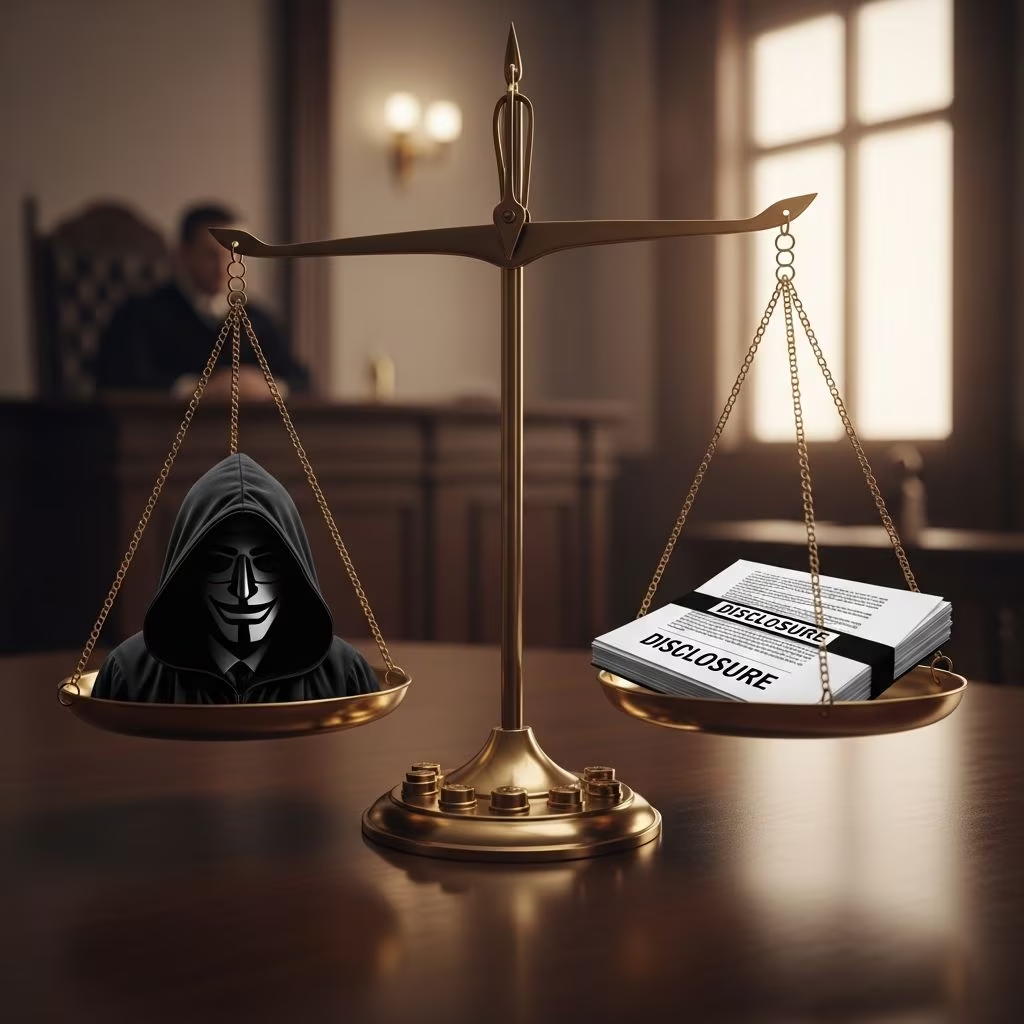
In the realm of democratic processes, the tension between governmental transparency and individual privacy rights often comes to a head. The case of Doe v. Reed exemplifies this conflict, centering on whether states can publicly disclose the identities of individuals who sign petitions for ballot referendums. Originating from Washington State’s Public Records Act (PRA), this legal battle traversed district courts, the Ninth Circuit, and ultimately the U.S. Supreme Court, reshaping discussions on electoral disclosure requirements.
Origins of the Dispute: Referendum 71 and the Push for Privacy
The controversy ignited in 2009 amid Washington’s Referendum 71 (R-71), a measure seeking voter approval for domestic partnership expansions—a politically charged issue that drew intense public scrutiny. Opponents gathered over 138,000 signatures to challenge the law via referendum, invoking the PRA which mandates public access to government records, including petition signers’ names and addresses.
Petitioners, identified as Does, filed suit in the U.S. District Court for the Western District of Washington, arguing that compelled disclosure infringed on their First Amendment rights to free speech, association, and anonymous political expression. They claimed harassment risks from opponents made public release unconstitutional, both facially and as applied to R-71. The district court agreed, applying strict scrutiny and granting a preliminary injunction against disclosure.
Ninth Circuit’s Initial Reversal: Shifting the Scrutiny Standard
The State of Washington, led by Secretary of State Sam Reed, appealed to the Ninth Circuit Court of Appeals. In a landmark reversal, the Ninth Circuit ruled that strict scrutiny was inappropriate; instead, intermediate scrutiny applied to this incidental burden on expressive conduct—signing a petition.
Under intermediate scrutiny, drawn from precedents like United States v. O’Brien, the court assessed whether the PRA: (1) fell within governmental authority, (2) advanced substantial interests unrelated to speech suppression, and (3) imposed no greater restriction than necessary. The Ninth Circuit found Washington’s interests in promoting accountability, preventing fraud, and fostering informed discourse sufficiently compelling to justify disclosure.
- Key Governmental Interests: Ensuring petition integrity, enabling public verification, and enhancing electoral transparency.
- Incidental Burden: Potential deterrence of signers due to privacy concerns, but not a direct suppression of speech.
This decision lifted the injunction, ordering release of the R-71 petition data, a move celebrated by transparency advocates but decried by privacy proponents.
Supreme Court Intervention: Exacting Scrutiny and Facial Validity
The case reached the Supreme Court as Doe #1 v. Reed (No. 09-559), with certiorari granted to resolve the scrutiny standard dispute. In a 8-1 decision authored by Chief Justice John Roberts on June 24, 2010, the Court affirmed the Ninth Circuit, holding that mandatory disclosure of referendum petition signers does not per se violate the First Amendment.
The Court adopted an “exacting scrutiny” standard tailored to electoral contexts, requiring a substantial relation between disclosure and sufficiently important state interests. Washington’s PRA met this bar by advancing goals like election integrity and public oversight without unduly burdening core speech.
| Justice | Position | Key Rationale |
|---|---|---|
| Roberts (Majority) | Affirm Ninth Circuit | Disclosure substantially relates to important interests like fraud prevention. |
| Alito (Concurrence) | Affirm, but allow as-applied challenges | As-applied exemptions possible if harassment risk proven. |
| Sotomayor (Concurrence, joined by Stevens, Ginsburg) | Affirm | Referendum process historically public; balance favors disclosure here. |
| Stevens (Concurrence in part) | Affirm judgment | Joined Breyer; emphasized contextual weighing. |
| Thomas (Dissent) | Reverse | Strict protection for anonymous political speech. |
Justice Alito’s concurrence proved crucial, noting that while facially valid, as-applied challenges could succeed upon showing a “reasonable probability” of threats or reprisals.
Post-Supreme Court Developments: Remand and Mootness
The Supreme Court vacated the Ninth Circuit’s judgment and remanded for as-applied claims under R-71, particularly harassment allegations. On remand, the district court rejected these claims in 2011, finding insufficient evidence of widespread threats two years post-election.
Plaintiffs appealed again to the Ninth Circuit, which dismissed the case as moot since the petitions had already been publicly released, rendering injunctive relief futile. This procedural end underscored the challenges of litigating time-sensitive electoral disputes.
Broader Implications for Electoral Law and Privacy
Doe v. Reed established precedents for disclosure in direct democracy mechanisms like initiatives and referendums. It reinforced that anonymity, while protected in some contexts (e.g., NAACP v. Alabama), yields to transparency when state interests are substantial.
States nationwide adopted similar frameworks, balancing open government with targeted exemptions. For instance:
- California and Oregon maintain public petition access with fraud-detection mechanisms.
- Harassment claims now require concrete evidence, raising the bar for anonymity.
Critics argue this chills minority viewpoints on divisive issues like same-sex rights or abortion, potentially deterring participation. Proponents counter that sunlight disinfects electoral processes, curbing signature-buying and forgery.
Legal Standards in Depth: From Strict to Exacting Scrutiny
Understanding the scrutiny evolution is key. Strict scrutiny demands narrow tailoring to a compelling interest, presumptively striking laws. Doe petitioners urged this, citing anonymous pamphleteering traditions from the Founding era.
Intermediate (O’Brien) scrutiny suffices for content-neutral regulations with incidental speech effects. The Ninth Circuit’s application highlighted disclosure’s viewpoint-neutral nature. Exacting scrutiny, per the Supreme Court, bridges these for elections—rigorous but deferential to state experimentation.
In practice:
- Facial Challenges: Rarely succeed post-Doe; must show disclosure inherently violates rights.
- As-Applied: Viable if plaintiffs prove specific harms, e.g., doxxing risks in polarized climates.
Contemporary Relevance in a Digital Age
Though decided in 2010, Doe v. Reed resonates amid rising online harassment and deepfakes in elections. Digital PRA equivalents amplify risks, as leaked data spreads virally. Courts reference it in challenges to voter roll disclosures or donor lists.
Recent Ninth Circuit reconsiderations, as hinted in ongoing dockets, revisit mootness doctrines for enduring precedential value. With ballot measures proliferating, the case guides states navigating privacy laws like CCPA against public records mandates.
Stakeholder Perspectives: Advocates and Critics
Equality advocates, including GLAD Law and Lambda Legal, hailed the ruling for exposing anti-LGBTQ+ organizers, countering narratives of victimhood. Campaign finance watchdogs praised enhanced accountability.
Conversely, conservative groups decried it as enabling boycotts and violence, echoing fears in Buckley v. Valeo dissents on compelled disclosure. Empirical studies post-Doe show minimal widespread harassment but notable isolated incidents.
Frequently Asked Questions (FAQs)
What was the main issue in Doe v. Reed?
The case questioned whether Washington’s Public Records Act unconstitutionally required public disclosure of referendum petition signers’ identities, burdening First Amendment rights.
Did the Supreme Court rule disclosure always constitutional?
No; it upheld facial validity but allowed as-applied challenges proving harassment risks.
What scrutiny standard applies to petition disclosures?
Exacting scrutiny: substantial relation to important governmental interests.
Why was the as-applied claim dismissed?
The Ninth Circuit deemed it moot after petitions were released.
How does Doe v. Reed impact modern elections?
It promotes transparency in ballot processes while permitting exemptions for credible threats.
Conclusion: Enduring Lessons on Democratic Transparency
Doe v. Reed endures as a cornerstone of electoral law, affirming that public access to petition data bolsters democracy without blanketly sacrificing privacy. As direct democracy evolves, its framework continues informing the delicate equilibrium between openness and protection (Word count: 1678).
References
- Doe #1 v. Reed | Supreme Court Bulletin — Legal Information Institute, Cornell Law School. 2009-10-20. https://www.law.cornell.edu/supct/cert/09-559
- Doe v. Reed — Campaign Legal Center. 2023-05-15. https://campaignlegal.org/cases-actions/doe-v-reed
- Doe v. Reed — GLAD Law. 2012-08-01. https://www.gladlaw.org/cases/doe-v-reed/
- Doe v. Reed — The Federalist Society. 2010-06-24. https://fedsoc.org/case/doe-v-reed
- Doe v. Reed | 561 U.S. 186 (2010) — Justia US Supreme Court Center. 2010-06-24. https://supreme.justia.com/cases/federal/us/561/186/
- Doe v. Reed – SCOTUSblog — SCOTUSblog. 2010-06-24. https://www.scotusblog.com/cases/case-files/doe-v-reed-2/