
DMV Visits, Warrants, and ID Cards: What You Need to Know
Understand how outstanding warrants can affect DMV visits, ID cards, and driver’s licenses—and how to reduce your legal risk.
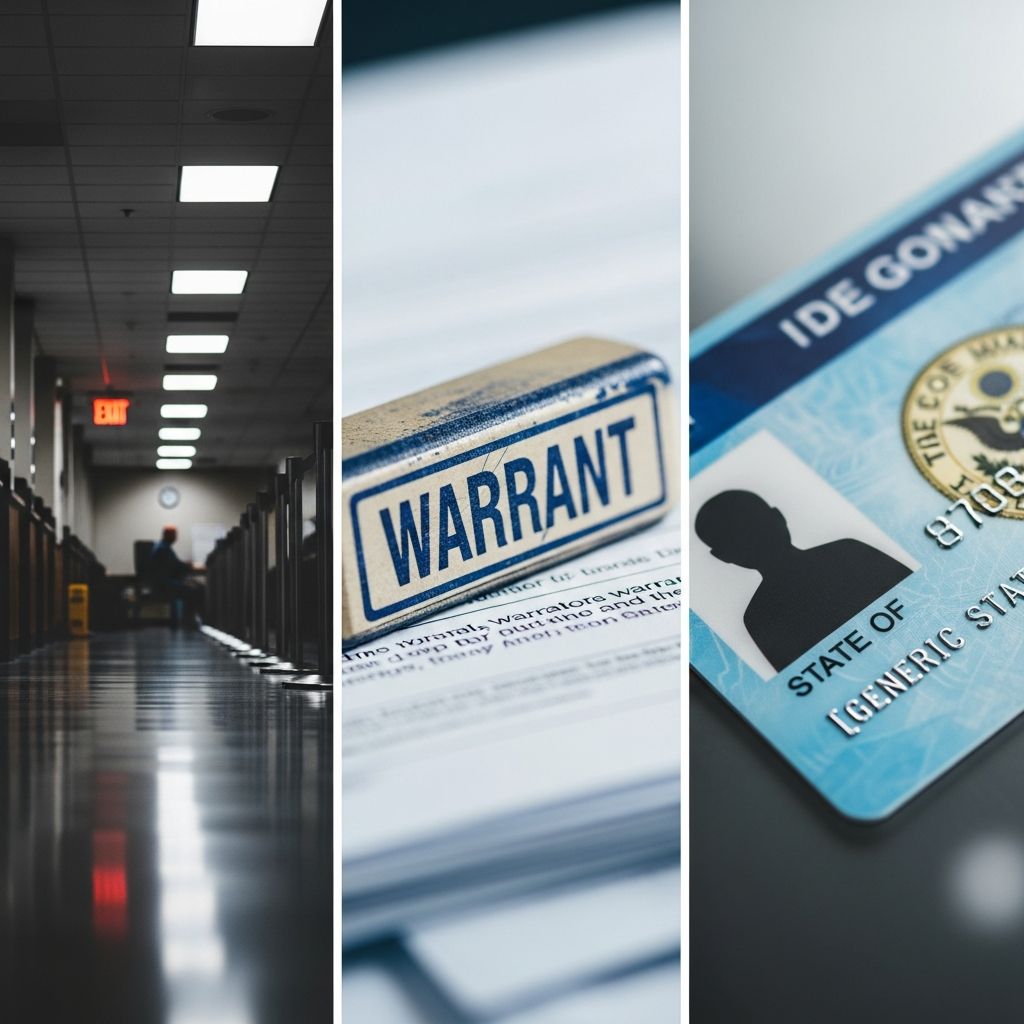
Many people need to visit the Department of Motor Vehicles (DMV) to obtain a state ID card, renew a driver’s license, or update vehicle registration—but worry about what might happen if they have an outstanding warrant. This guide explains how warrants and DMV records interact, what risks you may face, and how to approach the situation as safely and strategically as possible.
1. Understanding Warrants and DMV Records
To understand whether the DMV might detect a warrant, it helps to know the basic types of warrants and how they connect (or do not connect) to your driving record.
1.1 Common types of warrants
- Arrest warrants – Issued by a judge when there is probable cause to believe you committed a crime, often after a police investigation or formal charges are filed.
- Bench warrants – Issued by a judge when you disobey a court order, such as missing a required court appearance or violating probation.1
- Traffic-related warrants – Typically bench warrants that arise from unpaid traffic tickets or failure to appear in traffic court; these often affect your driving privileges directly.2
Warrants are usually entered into law-enforcement databases so police can identify you during traffic stops, arrests, or other encounters.1
1.2 What the DMV usually sees
The DMV manages records related to driving and vehicle ownership, not all aspects of your criminal history. In many states:
- DMV databases focus on license status, points, suspensions, and revocations.
- Court actions that affect driving privileges—such as a failure to pay traffic fines or appear in traffic court—are often transmitted to the DMV as a hold or suspension on the license, not as a full text of the warrant.2
- The clerk may see that there is an unresolved court matter tied to your license (with a case number and court name) but not necessarily the underlying arrest warrant itself.2
However, some DMVs and licensing agencies are electronically linked to broader state or national databases, especially when safety is at stake, and may be able to see or flag certain serious matters.
2. Do DMVs Check for Warrants?
There is no single nationwide policy. DMV procedures vary by state and sometimes by local office, but there are some general patterns.
2.1 When your record is likely to be checked
DMV staff commonly run your information when you:
- Apply for a first-time driver’s license or learner’s permit
- Renew a driver’s license or state ID card
- Reinstate a suspended or revoked license
- Update name, address, or other identifying details
- Register or title a vehicle in your name (in some jurisdictions)
During these transactions, your record is pulled from the state driver database, and in many states that record is cross-checked against information supplied by courts or other agencies regarding holds, suspensions, or eligibility to drive.2
2.2 How warrant-related information may appear
Depending on how your state links its systems, the DMV may see:
- A license hold or block caused by unpaid tickets or failure to appear in traffic court
- Notes that driving privileges are suspended due to a criminal conviction (for example, DUI) or court order
- An indication that you are not eligible for issuance or renewal until you contact a specific court
In some states, a clerk can see only the driving consequence (such as a suspension) and basic case information—not the existence of a non-traffic felony warrant.2 In others, deeper integration with police databases could provide more detailed flags related to active warrants, particularly for serious offenses.1
2.3 Out-of-state warrants and national databases
Many states participate in interstate information-sharing systems for drivers. For example:
- States share driver history through systems such as the National Driver Register (NDR), which helps identify drivers with suspended or revoked privileges in another state.3
- Law enforcement also uses national databases to locate people with extraditable warrants, especially for serious crimes.1
In practice, an out-of-state warrant may lead to a hold on your ability to obtain or renew a license, especially if that warrant is connected to prior driving offenses or revoked privileges in another state.3
Table: How DMV Records and Warrants Can Interact
| Situation | What DMV May See | Possible Result at DMV |
|---|---|---|
| Unpaid traffic ticket, failure to appear | License hold or suspension; court case reference | Denial of renewal or issuance until court clears hold |
| DUI conviction with court-ordered suspension | Suspension/revocation details and reinstatement requirements | Refusal to issue license until requirements met |
| Felony arrest warrant unrelated to driving | Varies; may not appear in DMV record in some states | Service may proceed or be denied depending on system links and policies |
| Out-of-state suspension or serious violation | NDR flag or interstate driver record note | Denial of license until issue resolved in other state |
3. Can You Be Arrested at the DMV?
People often fear that simply walking into the DMV will automatically lead to arrest if they have a warrant. The reality is more nuanced.
3.1 DMV employees versus law enforcement
- DMV clerks are not police officers. They typically do not have authority to arrest you.
- In many states, employees see only license-related information and may not see a full warrant entry at all.2
- However, some DMV offices have on-site law enforcement or security officers, and employees can contact local police if there is a reason to do so.
Regardless of what the DMV system shows, law enforcement officers can arrest you anywhere—including at a DMV—if they confirm that you have an active warrant.1
3.2 How police might become involved
Police could learn you are at the DMV if:
- The office has an on-site officer who runs your information and finds a warrant.
- DMV staff contact law enforcement after discovering a serious issue affecting public safety.
- You are already under investigation (for example, in a DMV fraud or identity case) and investigators coordinate with local police.2
Additionally, if you leave the DMV and encounter police later—for example, in a traffic stop—the officer will routinely run your information and can arrest you based on any active warrant, regardless of whether the DMV discussed it with you.1
4. How Warrants Can Affect Your Ability to Get ID or a License
Even if you are not arrested at the DMV, outstanding warrants and related court issues can interfere with DMV services.
4.1 Denial, suspension, or delay of services
You may experience one or more of the following outcomes:
- Refusal to issue or renew a driver’s license or state ID until you clear a court-ordered hold.
- Suspension of an existing license because a court reported non-payment, failure to appear, or a disqualifying conviction.2
- Requirements to obtain proof from a court (for example, a release of hold or clearance form) before the DMV can proceed.
These administrative actions are separate from the criminal warrant itself, but they can make daily life more difficult by limiting your ability to drive legally, register a car, or obtain government-issued identification.
4.2 Special issues for commercial drivers
Commercial drivers often face stricter standards. Under federal and state rules, certain convictions and serious traffic violations can disqualify a Commercial Driver’s License (CDL), and states must record and share disqualifications and serious offenses through national systems.3 As a result, CDL holders may be more directly impacted when warrants are connected to traffic, DUI, or other disqualifying offenses.
4.3 DMV investigations and fraud-related cases
Some DMVs employ their own investigative divisions that focus on vehicle-related crimes, such as title fraud, odometer tampering, identity theft to obtain licenses, or misuse of disabled parking placards.2 These investigators can:
- Conduct surveillance and gather evidence
- Serve search warrants or arrest warrants with law enforcement assistance
- Recommend criminal charges or administrative penalties, such as license suspension or revocation
If you are under active DMV-related investigation, any in-person visit may carry a heightened risk of enforcement action.
5. Safer Ways to Check for and Address Warrants
If you suspect you have a warrant, visiting the DMV first is rarely the safest strategy. It is usually better to confirm your status and plan your next steps beforehand.
5.1 How to find out whether you have a warrant
Depending on your jurisdiction, you may be able to:
- Contact the local police department or sheriff’s office and ask about active warrants (some agencies provide a public phone line or in-person counter for inquiries).1
- Search online court records or warrant databases provided by your state judiciary or county courts, where available.4
- Consult directly with the court clerk if you know which court handled your case; they can usually access docket information and upcoming hearings.4
- Ask a defense attorney to conduct a more thorough check in court systems and police databases, which can be especially useful if you have cases in multiple jurisdictions.
Some courts and police departments publish searchable online lists of outstanding warrants, although availability varies widely and may be limited to certain case types.4
5.2 Working with a lawyer
Warrants do not expire simply because time passes; in many states, they remain active until cleared by a court.1 An attorney can often:
- Verify the existence and type of warrant
- Advise you on whether you are likely to be taken into custody if you appear in court
- Request that the court recall or quash a bench warrant, possibly without you being arrested first, especially for lower-level offenses
- Negotiate surrender terms, such as turning yourself in at a specified time or appearing for an arranged hearing
In some situations, a lawyer may even appear on your behalf for certain procedural hearings, depending on state law and court rules.
5.3 Clearing court holds before going to the DMV
If a court has placed a hold on your license or driving privilege, you will typically need to:
- Resolve the underlying case (for example, by paying fines, completing a class, or appearing for a hearing).
- Obtain proof—such as a clearance letter or electronic release—from the court showing the hold has been lifted.
- Bring that proof to the DMV, if required, so the agency can update your record and allow renewal or reinstatement.
Courts and DMVs may take time to update their systems after an issue is resolved. Keeping copies of court documents and confirmation receipts can help if there is a delay or database mismatch.
6. Practical Tips if You Must Visit the DMV With a Possible Warrant
If you cannot postpone a DMV visit—even though you suspect a warrant exists—consider the following practical steps to lower your risk and avoid surprises.
- Try to confirm your status first. Make reasonable efforts to contact the court, check online records, or speak with an attorney before going in person.
- Bring accurate identification and documentation. Errors in your name, date of birth, or address can create confusion or make it harder to resolve your case later.
- Be prepared for service denial. Even if you are not arrested, be ready for the possibility that the DMV may refuse to issue an ID or license because of a court hold.
- Remain calm and avoid providing false information. Lying to officials or using fake documents can create new criminal charges, often far more serious than the original matter.
- Schedule follow-up with the court. If a clerk tells you that a court issue is blocking your transaction, ask for the court name, case number, and any reference numbers you might need.
These steps will not eliminate all risk, but they can help you stay better informed and avoid additional legal complications.
7. Frequently Asked Questions (FAQs)
Q1: Does every DMV automatically run a warrant check when I apply for an ID or license?
Not necessarily. Most DMVs routinely check your driving record and license status, which can reveal court holds or suspensions, but they may not directly access every type of warrant in criminal databases. The exact practice depends on how your state links DMV and law-enforcement systems.
Q2: If I have a bench warrant for missing traffic court, can I still renew my license?
Often you cannot. Courts frequently notify the DMV when you fail to appear or pay required fines in traffic cases, leading to a hold or suspension on your license. Until you resolve the case and the court lifts the hold, the DMV may refuse renewal or reinstatement.
Q3: Can I be arrested just for asking the police or court whether I have a warrant?
Police generally can arrest you if they confirm that you have an active warrant and you are physically present before them. Some people therefore contact a lawyer first, or ask an attorney to make inquiries on their behalf, especially when they suspect a serious warrant.
Q4: Will an out-of-state warrant always block me from getting a new license?
Not always, but it often can. If another state has suspended or revoked your driving privileges or reported a serious violation, that information may appear through national driver databases. Many states refuse to issue a new license until the out-of-state issue is cleared.
Q5: Is there any way to get a state ID while I still have a warrant?
In some situations, you might obtain an ID even with a warrant if the DMV system does not link the warrant to your eligibility. However, there is always some risk, and many states block identification documents when unresolved court orders or holds are present. Speaking with an attorney about resolving the warrant is usually the safest approach.
References
- Types of Warrants — United States Courts (Administrative Office of the U.S. Courts). 2023-03-01. https://www.uscourts.gov/services-forms/criminal-justice/types-warrants
- How Traffic Cases Work — Judicial Council of California. 2022-08-15. https://www.courts.ca.gov/1024.htm
- National Driver Register (NDR) — National Highway Traffic Safety Administration (NHTSA), U.S. Department of Transportation. 2022-05-10. https://www.nhtsa.gov/national-driver-register-ndr
- Online Case Search and Court Records — Michigan Courts. 2024-01-05. https://www.courts.michigan.gov/case-search/
Similar Articles








Read full bio of Sneha Tete


