
Dismantling Global Accountability and Human Rights
Systematic attacks destabilizing international justice and global human rights.
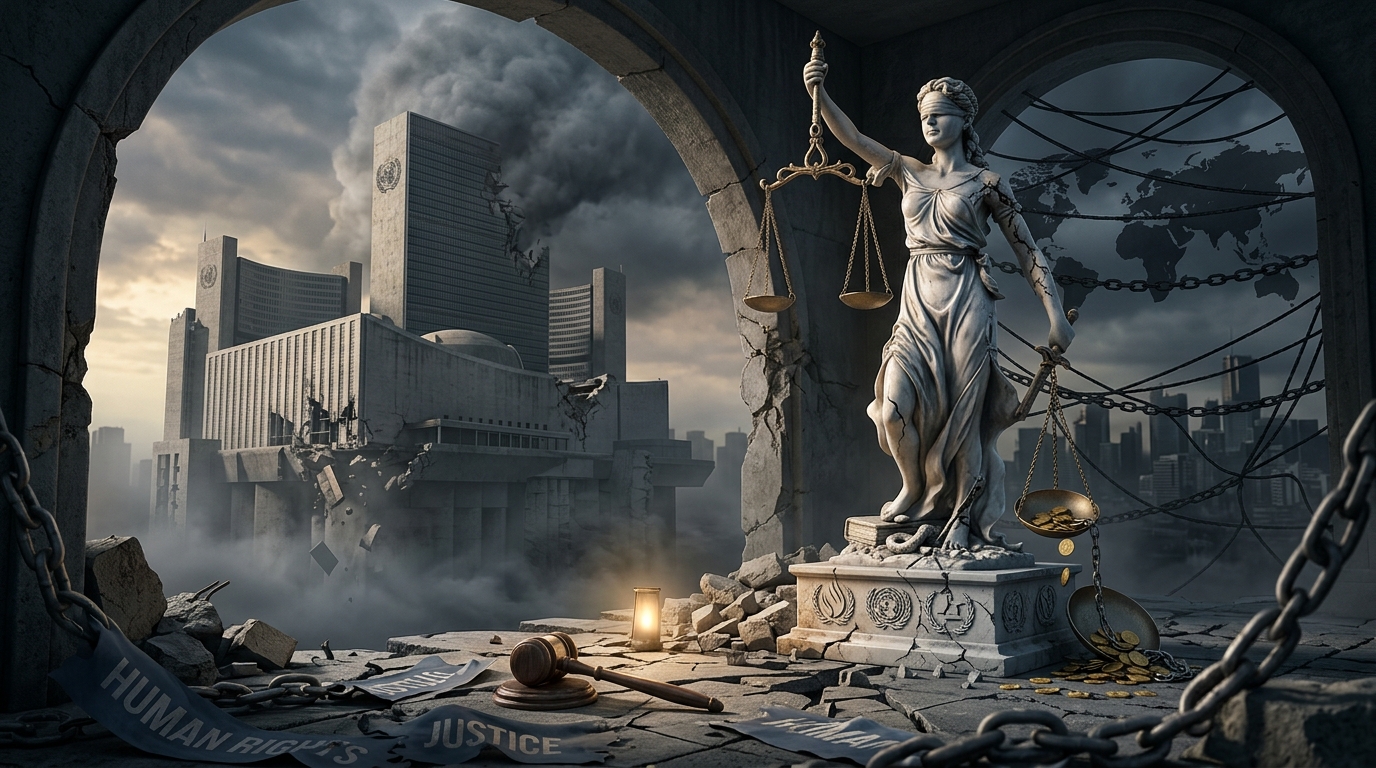
The architecture of international human rights law was not built overnight. Forged in the aftermath of the Second World War, the global consensus sought to create a comprehensive web of accountability. Through treaties, international tribunals, and diplomatic councils, the global community established mechanisms designed to ensure that state sovereignty could never again be used as a shield for mass atrocities or systemic oppression. For decades, the United States positioned itself as a chief architect, financier, and defender of this system. However, a stark paradigm shift occurred in recent years, moving beyond mere diplomatic isolationism into a phase of active, systematic destabilization. This era was characterized by a targeted dismantling of the very institutions designed to uphold international law.
Rather than isolated policy disagreements, the aggressive measures taken against global courts, health organizations, and diplomatic councils represented a cohesive strategy to insulate powerful actors from scrutiny. This systematic erosion of global accountability has profound implications, not just for international relations, but for the countless vulnerable populations who rely on these mechanisms as their last, and sometimes only, avenue for justice and protection.
Attacking the Guardians of Justice: The ICC Sanctions
The most glaring escalation in the assault on international justice was the unprecedented attack on the International Criminal Court (ICC). Established by the Rome Statute, the ICC serves as a permanent, independent judicial body designed to prosecute individuals for the gravest crimes known to humanity: genocide, war crimes, and crimes against humanity. While the United States has never been a state party to the Rome Statute, it historically engaged in a complex, albeit sometimes cooperative, relationship with the court. That dynamic shattered entirely with the issuance of Executive Order 13928 in June 2020. This sweeping executive action authorized the imposition of severe economic sanctions and travel bans against senior ICC officials, including its Chief Prosecutor at the time, Fatou Bensouda.
By invoking the International Emergency Economic Powers Act—a tool traditionally reserved for neutralizing terrorists, narcotics traffickers, and rogue regimes—the administration effectively equated international jurists with grave threats to national security. The rationale provided was to protect American personnel from potential investigations regarding actions in Afghanistan. However, the execution went far beyond defensive posturing; it was an offensive strike against the independence of international law itself.
The sanctions froze assets, threatened the families of court officials, and created a profound chilling effect across the global legal community. Human rights defenders, academic researchers, and non-governmental organizations found themselves terrified of violating financial sanctions simply by providing evidence or cooperating with the court. Although these sanctions were formally revoked in April 2021—with the subsequent administration recognizing them as inappropriate and ineffective—the structural damage was already done. The precedent was set that a powerful democracy was willing to economically cripple a judicial institution to evade accountability, leaving a lingering scar on the pursuit of global justice.
Retreat from Multilateral Diplomacy: Leaving the UN Human Rights Council
The retreat from global accountability extended far beyond judicial bodies, bleeding heavily into the realm of multilateral diplomacy. In June 2018, an abrupt announcement signaled the withdrawal from the United Nations Human Rights Council (UNHRC), the premier intergovernmental body tasked with promoting and protecting human rights across the globe. The official justification for the departure cited the Council’s disproportionate focus on specific nations and the inclusion of states with abysmal human rights records among its voting membership.
While criticisms of the UNHRC’s internal political dynamics and hypocrisies are well-documented and often valid, the decision to vacate the seat entirely proved to be a catastrophic strategic error for global human rights advocacy. Walking away from the negotiating table did not reform the institution; rather, it initiated a dangerous vacuum of democratic leadership. The practice of empty-chair diplomacy inevitably hands the microphone—and the agenda-setting power—to the very authoritarian regimes the withdrawal claimed to protest.
In the absence of robust democratic pushback, countries with severe records of domestic oppression maneuvered swiftly to shield themselves and their allies from international scrutiny. Furthermore, the withdrawal abandoned civil society activists, journalists, and persecuted minorities who rely on the Council as a vital forum to amplify their struggles on the world stage. For many dissidents living under repressive regimes, the UNHRC is one of the few places where their governments can be publicly confronted. By relinquishing its role, a key global power compromised its ability to steer critical resolutions, protect marginalized groups, and enforce diplomatic consequences for state-sponsored violence.
Jeopardizing Global Health: The WHO Defunding and Withdrawal
The concept of human rights is intrinsically linked to the fundamental right to health and life, a reality that became starkly evident during the outbreak of a once-in-a-century pandemic. During this unprecedented global health emergency, the World Health Organization (WHO) served as the central coordinating body for scientific research, resource distribution, and public health guidance. Yet, instead of bolstering this critical institution when it was needed most, a formal announcement was made in 2020 to halt funding and initiate withdrawal procedures from the WHO. This maneuver represented a profound escalation of the broader strategy to dismantle international cooperation, weaponizing public health funding for political expediency.
Defunding the primary international health mechanism amidst a devastating pandemic had immediate and severe humanitarian consequences. The WHO’s mandate extends far beyond singular crisis response; it is responsible for managing essential vaccination campaigns for polio, tuberculosis, and measles, as well as providing maternal health services in the Global South. By threatening to pull billions of dollars in critical funding, the political maneuvering jeopardized the fragile health infrastructure of some of the world’s poorest nations.
The attempt to dismantle international health cooperation underscored a dangerous disregard for the interconnectedness of human survival. Although the withdrawal was officially rescinded before taking full legal effect, the mere threat destabilized global health initiatives, eroded trust in international scientific cooperation, and demonstrated that even life-saving institutions were not immune to the chaotic dismantling of the international order.
Regional Repercussions: Undermining the Inter-American System
While the attacks on high-profile global institutions like the UN and WHO captured major international headlines, a quieter but equally destructive campaign was waged against regional accountability mechanisms. The Inter-American Commission on Human Rights (IACHR), an autonomous organ of the Organization of American States (OAS), has long served as a vital bulwark against authoritarianism and abuse in the Western Hemisphere. Historically, democratic nations championed the IACHR, utilizing it as an effective tool to demand accountability from military dictatorships and corrupt regimes across the Americas.
However, the broader strategy of destabilization eventually targeted this regional body as well. Efforts were made to manipulate funding mechanisms to restrict the IACHR’s ability to advocate for specific fundamental rights, most notably reproductive rights and the basic legal protections of LGBTQ+ individuals. By attempting to attach strict ideological conditions to diplomatic funding, there was a concerted effort to enforce domestic political agendas onto the landscape of international human rights law.
This financial coercion aimed to silence advocacy for some of the most vulnerable and marginalized populations in the hemisphere. The attempt to undermine the IACHR signaled a profound and troubling shift: it was no longer just a matter of withdrawing from international bodies, but actively attempting to rewrite the scope of universal human rights to explicitly exclude protections for specific minority groups.
Overview of Key Targeted Institutions
The systematic dismantling of international mechanisms targeted various pillars of global governance. Below is a summary of the key institutions affected and the implications of these disruptive actions.
| Institution | Core Mandate | Mechanism of Disruption | Global Consequence |
|---|---|---|---|
| International Criminal Court (ICC) | Prosecute war crimes, genocide, and crimes against humanity. | Economic sanctions and visa bans placed on leading jurists. | Chilling effect on legal investigations and enhanced impunity for state actors. |
| UN Human Rights Council (UNHRC) | Promote global human rights and investigate systemic abuses. | Total diplomatic withdrawal and halting of participation. | Created a massive power vacuum readily exploited by authoritarian regimes. |
| World Health Organization (WHO) | Coordinate global public health responses and disease eradication. | Threatened withdrawal and aggressive funding freezes. | Destabilized pandemic response and jeopardized critical health initiatives. |
| Inter-American Commission (IACHR) | Protect regional human rights in the Western Hemisphere. | Conditioning funds to censor specific rights advocacy. | Fragmented regional protections for marginalized communities. |
The Ripple Effect: Emboldening Authoritarianism
The most insidious consequence of this sustained assault on international human rights frameworks is the global ripple effect it generates. The architecture of international law relies heavily on the normative power, financial backing, and compliance of dominant global players. When a foundational architect of this system blatantly disregards its rules, imposes sanctions on its independent judges, and abruptly abandons its diplomatic councils, it issues a de facto permission slip to authoritarian regimes worldwide.
This phenomenon of political whataboutism empowers despots to justify their own systemic abuses. If leading democracies can financially penalize international prosecutors, autocrats in Eastern Europe, Asia, and the Middle East feel entirely emboldened to crush domestic judicial independence and silence civil society without fear of meaningful reprisal. The dismantling of global accountability does not just alter the text of treaties; it actively greenlights impunity, making the world demonstrably more dangerous for human rights defenders, journalists, and vulnerable minorities. Rebuilding this architecture requires far more than merely signing back onto treaties; it demands a fundamental restoration of global trust and an unwavering commitment to the universal application of justice without exception.
Frequently Asked Questions (FAQs)
- Why is international human rights law fundamentally important?
International human rights law establishes a universal baseline of fundamental freedoms and protections that supersede national borders. It provides vital mechanisms to hold governments accountable when domestic legal systems fail, collapse, or are actively weaponized against their own citizens. These frameworks are essential for preventing mass atrocities and ensuring justice for the vulnerable. - How did targeted sanctions impact the International Criminal Court’s operations?
The imposition of economic sanctions severely disrupted the ICC’s operations. By freezing assets and threatening visa restrictions, the sanctions created a profound chilling effect. Human rights organizations, academic researchers, and critical witnesses were deterred from cooperating with the court out of fear of facing devastating financial penalties, thereby obstructing active investigations into severe international crimes. - What happens when a major global power withdraws from human rights bodies?
When a major geopolitical power withdraws from forums like the UN Human Rights Council, it creates a significant power vacuum. This absence diminishes democratic influence and allows authoritarian states to dominate the agenda, shield themselves from international scrutiny, and systematically lower the global standards of accountability. - Can international frameworks function effectively without participation from major world powers?
While institutions like the ICC and the UNHRC possess the legal infrastructure to operate independently, the absence or active hostility of a global superpower severely limits their enforcement capabilities, financial resources, and political leverage. Complete effectiveness in international law requires the cooperative participation of major global actors.
Conclusion
The era characterized by the targeted chaos against international justice serves as a stark and urgent reminder of the extreme fragility of global accountability. The mechanisms designed to protect human dignity—courts, councils, and health organizations—are not self-sustaining; they require the constant, principled backing of the international community. The aggressive deployment of economic sanctions against jurists, the weaponization of health funding during a pandemic, and the retreat from diplomatic forums have collectively weakened the barriers that stand between civilization and impunity. Moving forward, the restoration of global justice cannot simply rely on reversing executive orders. It demands a renewed, structural commitment to multilateralism, an acceptance that true sovereignty does not mean immunity from accountability, and a profound recognition that a world where international law is respected is inherently safer and more just for everyone.
References
- Executive Order 13928: Blocking Property of Certain Persons Associated With the International Criminal Court — The White House / Federal Register. 2020-06-11. https://www.federalregister.gov/documents/2020/06/15/2020-12953/blocking-property-of-certain-persons-associated-with-the-international-criminal-court
- Termination of Emergency With Respect to the International Criminal Court — Office of Foreign Assets Control, U.S. Department of the Treasury. 2021-04-05. https://home.treasury.gov/policy-issues/financial-sanctions/recent-actions/20210405_33
- Ending Sanctions and Visa Restrictions against Personnel of the International Criminal Court — U.S. Department of State. 2021-04-02. https://www.state.gov/ending-sanctions-and-visa-restrictions-against-personnel-of-the-international-criminal-court
- UN chief hails ‘very important role’ of Human Rights Council, as US withdraws, citing alleged bias — UN News. 2018-06-19. https://news.un.org/en/story/2018/06/1012642
Similar Articles








Read full bio of Sneha Tete


