
Denied Bathroom Access: Legal Recourse for Discrimination
Understand your rights when businesses deny bathroom access and explore discrimination lawsuit options across public and work settings.
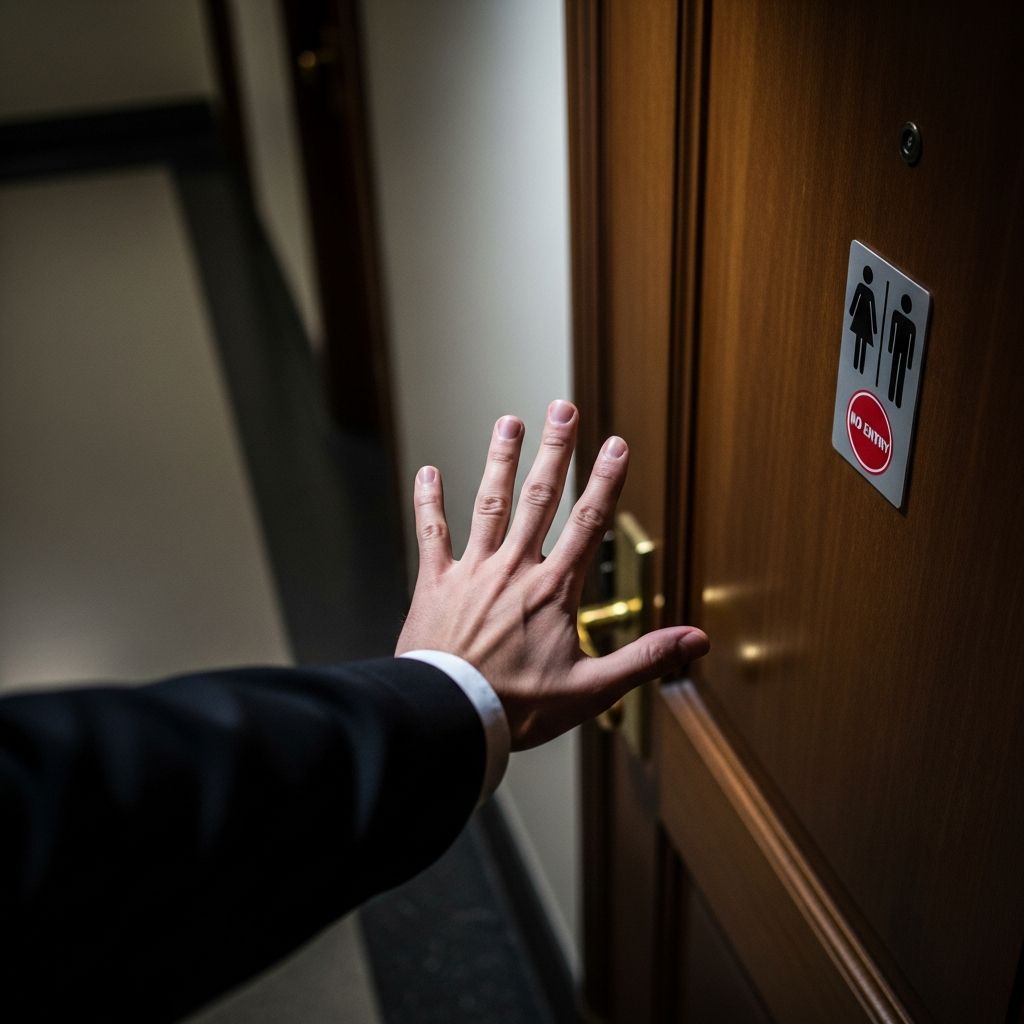
Refusal of bathroom access by businesses can trigger discrimination claims, particularly when based on gender identity, under federal laws like Title VII for employees and various state statutes for public visitors. Customers and workers alike may pursue legal action if denials violate anti-discrimination protections, though outcomes depend on jurisdiction and context.
Understanding Bathroom Access as a Discrimination Issue
Bathroom policies in commercial spaces often intersect with civil rights, especially for transgender individuals seeking facilities matching their gender identity. Federal agencies assert that such denials constitute sex discrimination, applicable in workplaces and potentially extending to public areas. This stems from interpretations of laws prohibiting bias based on sex, which courts have expanded to include gender identity.
Private businesses must navigate these rules carefully. For employees, restrictions on restroom use aligned with gender identity breach workplace standards, prompting enforcement actions. Public-facing establishments face similar scrutiny under local ordinances protecting patrons from exclusionary practices.
- Federal oversight bodies emphasize prompt, safe access without unreasonable barriers.
- State variations create a patchwork of protections, some mandating gender-neutral options.
- Incidents often arise from discomfort among staff or customers, but legal duty falls on the business to accommodate.
Federal Protections Shaping Business Obligations
The Equal Employment Opportunity Commission (EEOC) enforces Title VII of the Civil Rights Act of 1964, covering employers with 15 or more staff. This law bans sex discrimination, encompassing gender identity, meaning businesses cannot bar transgender workers from restrooms matching their identity.
In key rulings like Macy v. Holder, the EEOC established that transgender status falls under sex discrimination protections. Guidance documents clarify that denying common restrooms corresponding to an employee’s gender identity violates federal law, overriding contrary local policies.
The Occupational Safety and Health Administration (OSHA) complements this through its Sanitation Standard, requiring prompt access to sanitary facilities. OSHA directs employers to allow transgender employees to use facilities aligned with their gender identity, suggesting options like single-occupant gender-neutral restrooms to ensure safety and convenience.
| Agency | Key Guidance | Application |
|---|---|---|
| EEOC | Title VII covers gender identity | Workplace restrooms/lockers |
| OSHA | Prompt sanitary access | All facilities, prioritize safety |
| DOJ | Recognizes transgender claims | Employment discrimination |
State and Local Laws Expanding Rights
Beyond federal baselines, numerous states and cities impose stricter rules. California’s Equal Restroom Access Act mandates gender-neutral signage on single-occupancy bathrooms and allows use based on gender identity or expression.
Vermont’s Act 127 requires public buildings to label single-user facilities simply as ‘restroom,’ open to all genders. Illinois follows suit for new constructions. Cities like New York, Philadelphia, and Seattle prohibit discrimination in bathroom access since the early 2000s, treating denials as gender identity violations.
These laws apply to public accommodations, enabling customers—not just employees—to challenge exclusions. In contrast, states with restrictive ‘bathroom bills,’ like historical North Carolina efforts, faced legal pushback and were often deemed unenforceable against federal supremacy.
- California: Gender-neutral single-occupancy required.
- New York City: Bans denial since 2002.
- Washington State: Employers must solve access issues.
Workplace Scenarios and Employer Best Practices
Employers frequently encounter complaints from non-transgender staff uncomfortable sharing facilities. Courts rule that the burden of accommodation lies with the employer, not the transgender individual—offering alternatives like private restrooms to objectors.
Post-Bostock v. Clayton County (2020), the Supreme Court affirmed Title VII protects sexual orientation and gender identity, influencing facility policies. Businesses should permit use consistent with identity, regardless of birth-assigned sex or medical transitions.
Practical steps include:
- Installing lockable stalls or gender-neutral options.
- Training staff on non-discrimination.
- Documenting policy compliance to defend against claims.
OSHA warns that forcing mismatched use risks health issues and harassment by outing individuals.
Public Accommodations: Customer Rights Explored
For non-employees, protections vary. Title VII applies only to employment, but state public accommodation laws fill gaps. Transgender customers denied restrooms matching their identity may claim sex discrimination, filing with agencies like state human rights commissions.
Cases in schools and public venues set precedents extending to retail. Courts in Maine and Colorado recognized restroom rights aligning with gender identity, rejecting birth certificate mandates.
Businesses risk lawsuits if policies single out based on appearance or identity, even absent explicit rules. Privacy invasions, like invasive questioning, compound violations.
Steps to Take if Access is Denied
Document the incident: note date, staff involved, stated reasons, and witnesses. Politely request policy clarification in writing.
- Contact business management immediately.
- File complaint with EEOC (employees) or local agency (customers).
- Consult attorney for potential lawsuit.
EEOC charges must precede federal suits; time limits apply (180-300 days). State processes differ but often mirror this.
Potential Lawsuit Outcomes and Defenses
Successful claims yield back pay, damages, policy changes, and attorney fees. Defenses like undue hardship rarely succeed for simple accommodations.
Recent EEOC guidance links bathroom denial to harassment, broadening claims. Businesses citing state laws fail against Title VII preemption.
Frequently Asked Questions
Can I sue a business for denying me bathroom access as a customer?
Yes, under state public accommodation laws in protective jurisdictions; file with anti-discrimination agencies first.
Does Title VII protect transgender customers?
No, Title VII is employment-only, but analogous state laws often apply to public spaces.
What if a coworker complains about sharing with a transgender employee?
Employers accommodate the complainant, e.g., via private facilities; transgender rights take precedence under federal law.
Are single-occupancy restrooms required to be gender-neutral?
In places like California and Vermont, yes, with specific signage mandates.
Can businesses require proof of gender for bathroom use?
No; such invasive practices violate privacy and anti-discrimination rules.
Navigating Evolving Legal Landscapes
Lawsuits and guidance continue shaping policies. The 2024 EEOC harassment update reinforces bathroom access as non-negotiable, countering challenges to prior stances. Businesses adapting proactively avoid litigation.
Trends favor inclusivity: more gender-neutral facilities reduce conflicts. Retailers like Target proactively aligned policies with federal views amid debates.
For transgender individuals, asserting rights involves awareness of options. Allies and advocates push for uniform national standards.
Challenges persist in conservative states, but federal overrides prevail in employment. Public accommodation expansions signal broader change.
Business owners benefit from compliance audits, policy reviews. Legal counsel ensures alignment with multilayered regulations.
References
- What Do “Bathroom Bills” Mean for Employers? — Employment Law Business Guide. 2016-05. https://www.employmentlawbusinessguide.com/2016/05/what-do-bathroom-bills-mean-for-employers/
- Transgender Rights Toolkit — Lambda Legal (via CCCD.edu). N/A. https://documents.cccd.edu/Employees/Title9/Transgender%20Rights%20Toolkit_Lambda%20Legal.pdf
- Practical Questions for Employers Following the Bostock Decision — Ogletree Deakins. 2020-07 (post-Bostock). https://ogletree.com/insights-resources/blog-posts/practical-questions-for-employers-following-the-bostock-decision-part-1-sex-segregated-facilities/
- Bathroom Bills: What Employers Need To Know — Labor and Employment Law Counsel. 2016-04. https://www.laborandemploymentlawcounsel.com/2016/04/bathroom-bills-what-employers-need-to-know/
- Untangling the Legal Landscape on LGBTQ+ Workplace Rights — Fisher Phillips. Recent (Biden-era ref). https://www.fisherphillips.com/en/news-insights/untangling-the-legal-landscape-on-lgbtq-workplace-rights-under-title-vii.html
- Prohibited Employment Policies/Practices — EEOC.gov. Ongoing. https://www.eeoc.gov/prohibited-employment-policiespractices
- EEOC Issues Fact Sheet that Opens Bathrooms to All — Vorys. 2016 (EEOC fact sheet). https://www.vorys.com/publication-i-Labor-and-Employment-Alert-i-EEOC-Issues-Fact-Sheet-that-Opens-Bathrooms-to-All
Similar Articles








Read full bio of medha deb




