
Do Delivery Robots Deserve Pedestrian Status?
As sidewalk delivery bots gain legal traction, debates rage over safety, access, and urban equity in evolving robot regulations.
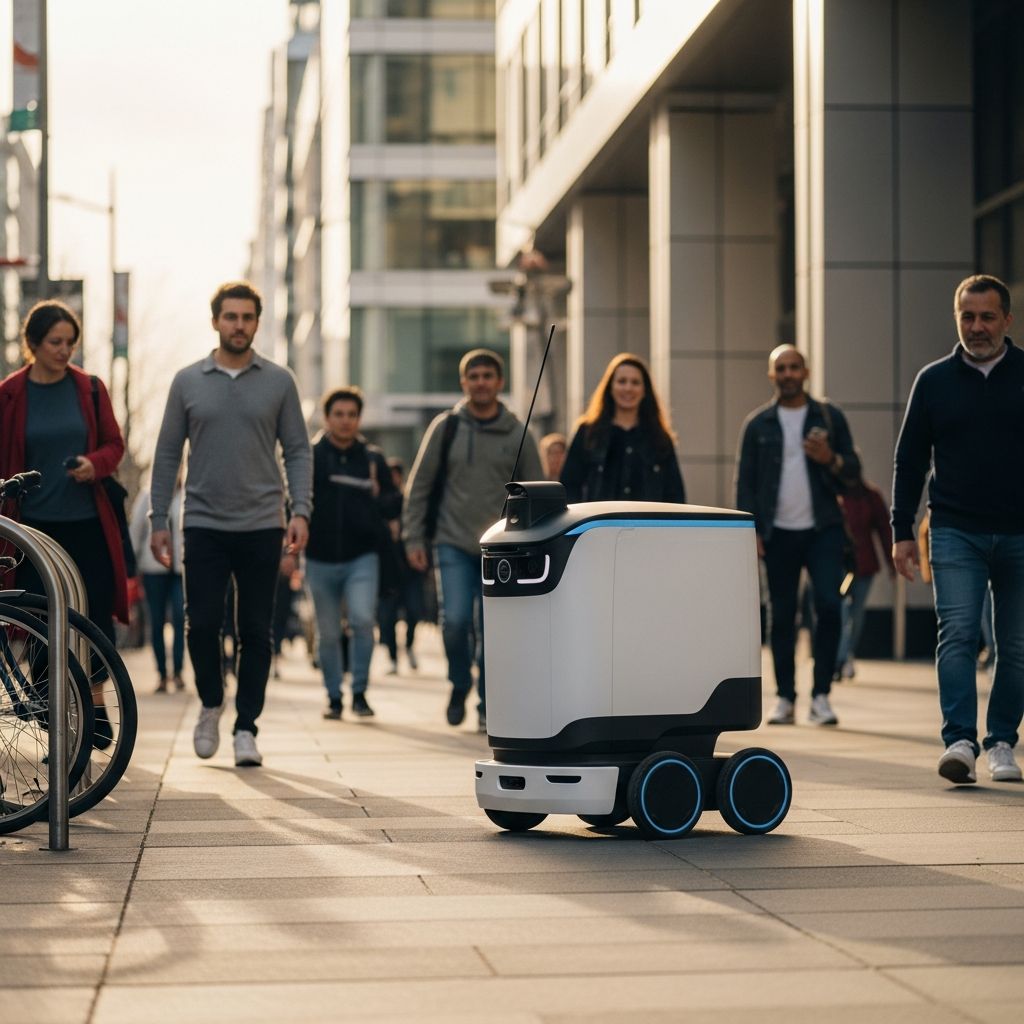
Autonomous delivery robots, those compact machines zipping along sidewalks with packages and groceries, are no longer science fiction. Multiple U.S. states have enacted laws treating these devices as pedestrians, allowing them to navigate public walkways alongside humans. This shift aims to enable efficient last-mile delivery but ignites fierce debates on public safety, accessibility for vulnerable groups, and the future of urban spaces.
The Surge of Sidewalk Delivery Technology
Companies like Amazon, FedEx, Starship Technologies, and others are deploying fleets of these robots in cities, suburbs, and campuses. Designed to carry groceries, pizzas, or small parcels—up to the equivalent of three grocery bags—these bots roll at speeds of 3.5 to 12 mph on sidewalks, crossing streets at designated points.
Starship Technologies leads with deployments on over 15 college campuses and partnerships like Save Mart for grocery delivery in California. Their robots, described as ‘coolers on wheels,’ integrate sensors to avoid obstacles and follow paths where pedestrians are permitted. Amazon’s Scout and FedEx’s Roxo are in testing phases, promising reduced traffic congestion and emissions from fewer delivery vans.
This technology promises ultra-fast delivery, potentially within hours, by minimizing human drivers and idling vehicles. Proponents argue it supports e-commerce growth while cutting urban pollution.
State Laws Redefining ‘Pedestrian’
At least 10 states, including Pennsylvania, Virginia, Idaho, Florida, Wisconsin, Colorado, and others—totaling up to 21 by some counts—have legalized sidewalk robot operations. Pennsylvania’s 2021 law classifies ‘personal delivery devices’ (PDDs) as pedestrians, permitting weights up to 550 pounds and speeds to 12 mph.
Common regulations include:
- Speed limits: 3.5-12 mph on sidewalks, up to 25 mph on road shoulders.
- Weight caps: 80-550 pounds unloaded, varying by state.
- Path restrictions: Sidewalks, crosswalks, and road edges; must yield to actual pedestrians.
- Supervision: Remote human oversight required in many cases.
- Insurance: Minimum $100,000 coverage typical.
- Prohibitions: No hazardous materials.
These rules create a legal framework equating robots to humans for navigation rights, provided they prioritize pedestrian right-of-way.
| State | Max Weight (lbs) | Max Sidewalk Speed (mph) | Key Requirement |
|---|---|---|---|
| Pennsylvania | 550 | 12 | Classified as pedestrians |
| Virginia | Varies | 10-12 | Yield to pedestrians |
| Florida | 100 | 10 | Human oversight |
| Colorado | 80-100 | 12 | No interference with peds |
Identification markers with owner contacts and unique IDs are mandated for accountability.
Safety Innovations and Real-World Challenges
Robots feature advanced sensors, cameras, and AI to detect obstacles, stop for pedestrians, and navigate complex environments. Developers claim they enhance safety by reducing human error in deliveries.
Yet incidents reveal gaps. Starship robots have gotten stuck, driven into canals, or blocked curb ramps, stranding wheelchair users. In one case, a robot in Texas lacked clear identification post-collision, complicating response; police debated if it qualified as a ‘vehicle.’
Emily Ackerman reported a robot impeding her wheelchair at an intersection, heightening risks in crowded areas. A Pittsburgh student highlighted accessibility issues, prompting temporary testing halts. These events underscore needs for better software tweaks, data sharing on crashes, and standardized interactions.
Opposition from Pedestrians and Advocates
Critics, including the National Association of City Transportation Officials (NACTO), urge restrictions or bans. They warn of sidewalks flooded with bots, hindering walking, especially for disabled individuals, parents with strollers, or elderly pedestrians.
Labor unions like the Teamsters oppose, fearing job losses for delivery workers. Accessibility advocates stress risks to curb ramps and narrow paths. San Francisco banned sidewalk robots in 2017, granting rare exceptions like Postmates’ Serve.
Experts like Nico Larco of Urbanism Next note early-stage uncertainties: liability for falls, breakdowns, insurance needs, and ramification foresight.
Liability, Insurance, and Enforcement Gaps
Current laws address accountability via insurance and markers but falter in practice. Who pays if a 250kg robot (over 550lbs) collides at 12mph? Is the operator, manufacturer, or city liable?
One proposal frames robots under ‘robot self-defense’ or property rights in game theory contexts, but practical enforcement lags. Cities seek authority to halt operations locally, demanding crash reports and testing transparency.
David Clamann advocates common standards, community testing, and clear victim recourse.
Environmental Gains vs. Urban Congestion Risks
Benefits include fewer emissions and traffic from van reductions. However, unchecked fleets could amplify noise, clutter paths, and demand infrastructure upgrades like wider sidewalks or dedicated lanes.
Data collection for safety raises privacy issues; infrastructural changes burden taxpayers.
Global Perspectives and Future Directions
While U.S.-focused, similar debates emerge elsewhere. Regulations must evolve with tech, balancing innovation and public good. Local governments should influence state laws for tailored rules.
Piaggio Fast Forward’s Greg Lynn likens sidewalks to past drone debates, predicting bike-lane expansions for faster bots.
Frequently Asked Questions
How many states allow delivery robots on sidewalks?
At least 10 to 21 states have passed such laws, with specifics varying.
Are delivery robots safer than human deliveries?
Proponents claim yes due to sensors, but incidents show ongoing risks needing refinement.
Can cities ban these robots?
Some like San Francisco have, but state preemption may limit; locals push for stop authority.
What happens in a robot accident?
Insurance covers damages, but identification and jurisdiction issues persist; clear liability rules are evolving.
Do robots block disabled access?
Yes, reports cite curb ramp blockages; better navigation is demanded.
References
- Sidewalk robots get legal rights as “pedestrians” — Axios. 2021-03-04. https://www.axios.com/2021/03/04/sidewalk-robots-legal-rights-pedestrians
- Sidewalk ontology: the dangerous equation of robots and pedestrians — Futuribile.org. 2021-03-31. https://futuribile.org/2021/03/31/sidewalk-ontology-the-dangerous-equation-of-robots-and-pedestrians/
- Are Robots Coming to a Sidewalk Near You? — Next City. N/A. https://nextcity.org/urbanist-news/are-sidewalk-robots-coming-to-a-sidewalk-near-you
- Sidewalk Robots — We Robot (University of Miami). 2021. https://robots.law.miami.edu/2021/wp-content/uploads/2021/08/GrimmThomasen_Sidewalk-Robots.pdf
- Sidewalk robots get legal rights as “pedestrians” — Urbanism Next. N/A. https://www.urbanismnext.org/news/sidewalk-robots-get-legal-rights-as-pedestrians
- Autonomous Robot Delivery Legislation — General Code. 2021. https://www.generalcode.com/blog/autonomous-robot-delivery-legislation/
- Autonomous delivery robots: a legal framework for infliction of game… — Taylor & Francis (peer-reviewed). 2024. https://www.tandfonline.com/doi/full/10.1080/17579961.2024.2392940
Similar Articles








Read full bio of medha deb


