
Establishing a Delaware Nonprofit Corporation: Complete Guide
Step-by-step roadmap for launching and legally establishing your nonprofit organization in Delaware.
Understanding Delaware Nonprofit Structures and Legal Framework
Establishing a nonprofit organization in Delaware represents a significant commitment to creating a mission-driven entity that serves the public good. Delaware offers a favorable legal environment for nonprofit incorporation, with streamlined processes and well-developed statutes governing nonprofit operations. Before initiating the formation process, prospective nonprofit founders must understand the fundamental distinctions between different organizational structures available within the state.
Delaware recognizes two primary nonprofit entity types: exempt corporations and non-stock corporations. An exempt corporation is specifically designed for organizations with charitable, religious, civic, educational, or similar nonprofit purposes. These entities benefit from state and local property tax exemptions, business fee waivers, and corporate tax relief. A non-stock corporation, while also nonprofit in nature, operates under a different legal framework and may not qualify for the same tax benefits. Most organizations seeking traditional nonprofit status should pursue exempt corporation formation.
The incorporation process in Delaware is governed by the Delaware General Corporation Law and represents the foundation upon which all subsequent organizational activities rest. Unlike some alternative structures, incorporating as a business entity provides significant legal protections, including liability separation between the organization and its board members, enhanced credibility with funding sources, and alignment with federal tax exemption requirements.
Preparing Your Organization for Incorporation
The groundwork for successful nonprofit incorporation begins well before filing any documents with state authorities. Strategic preparation during this initial phase establishes a strong foundation for sustainable operations and regulatory compliance.
Selecting Your Governance Leadership
Your initial board of directors and incorporator must meet specific Delaware requirements, though the state maintains relatively flexible qualification standards compared to other jurisdictions. Delaware requires a minimum of one director, though most organizations benefit from a larger board structure for diverse perspective and shared responsibility. Directors must be natural persons but face no residency requirements, meaning you can recruit qualified leaders from anywhere nationally or internationally. The IRS, however, prefers that organizations identify at least three unrelated individuals to serve as initial directors to demonstrate governance diversity and reduce conflicts of interest.
An incorporator is the individual who signs and submits the Certificate of Incorporation to the Delaware Division of Corporations. While this role can be performed by a founder, attorney, or business professional, the incorporator must be identified in your formation documents. You may designate one or multiple incorporators for this process.
Establishing Your Registered Agent
Delaware law requires every corporation to maintain a registered agent within the state. This designated representative serves as your organization’s official contact for legal documents and regulatory correspondence. The registered agent must maintain a physical office address in Delaware and be available during business hours to accept service of process and government communications. Many nonprofits engage professional registered agent services rather than designating an individual, ensuring reliable availability and professional management of legal correspondence.
Securing an Appropriate Business Name
Your nonprofit’s name must comply with Delaware naming requirements and clearly communicate your organization’s nonprofit character. The name must include a designation indicating corporate status, such as “Corporation,” “Corp.,” “Incorporated,” or “Inc.” Your chosen name must be distinguishable from existing Delaware corporations in the state’s records. Before investing significant branding effort, verify name availability through the Delaware Division of Corporations and consider whether the name aligns with your mission, communicates your purpose clearly, and remains relevant across anticipated organizational evolution.
Drafting Organizational Governance Documents
Comprehensive governance documentation establishes the operational framework that guides your nonprofit’s activities and ensures compliance with state and federal requirements.
Creating Effective Bylaws
Bylaws represent the internal operating rules governing your nonprofit corporation and address critical governance matters including board composition, member rights, meeting procedures, officer responsibilities, amendment processes, and conflict resolution. While Delaware does not require bylaws to be filed with state authorities, their creation remains mandatory under state law and essential for demonstrating organized operations to federal tax authorities. Bylaws must be drafted by individuals with expertise in both Delaware nonprofit law and federal tax-exempt organization regulations, as improper provisions can jeopardize your tax exemption application or create operational conflicts.
Effective bylaws should address board size and composition, director election and removal procedures, officer titles and responsibilities, meeting notice and quorum requirements, committee structures, conflict of interest policies, amendment procedures, and dissolution provisions. Your bylaws establish the governance structure that supports effective decision-making while protecting your nonprofit’s legal standing.
Developing Conflict of Interest Policies
A comprehensive conflict of interest policy protects your organization from self-dealing, financial misconduct, and regulatory violations. This governance document should require disclosure of conflicts, establish procedures for managing conflicts when they arise, and create accountability mechanisms ensuring adherence. Federal tax authorities examine conflict of interest policies closely when evaluating tax exemption applications, making this document critical to your compliance profile.
Filing Your Certificate of Incorporation
The Certificate of Incorporation (also called Articles of Incorporation in some contexts) represents your nonprofit’s birth certificate as a legal entity. This document must be submitted to the Delaware Division of Corporations to officially establish your organization’s corporate status.
Required Certificate Components
Your Certificate of Incorporation must include the following essential elements:
- Your nonprofit’s legal name as it will be recognized by the state
- A statement indicating that the corporation shall not have any capital stock, distinguishing it from for-profit entities
- A description of your organization’s purpose, including specific language addressing your charitable, religious, educational, civic, or other nonprofit mission
- The name and Delaware address of your registered agent
- The name and mailing address of your incorporator
- Provisions addressing membership requirements or conditions, or a statement that membership details are governed by bylaws
- For exempt corporations, specific language referencing the IRS subsection under which your organization qualifies for tax exemption
- Additional provisions your organization deems necessary to govern operations
Submission Process and Timelines
The Delaware Division of Corporations accepts Certificate of Incorporation filings through multiple submission methods including mail, facsimile, and online portals. Standard processing typically requires approximately three weeks for document review and approval. However, Delaware offers expedited processing options for organizations requiring faster incorporation:
- 24-hour expedited service for $50 state fee
- Same-day service for $100 state fee
- Two-hour service for $500 state fee
- One-hour service for $1,000 state fee
The standard incorporation filing fee is $89, plus $9 for each page exceeding the standard limit. Professional incorporation service providers often recommend including a cover letter with your filing, though this remains optional.
Obtaining Your Federal Employer Identification Number
An Employer Identification Number (EIN) is a unique nine-digit identifier assigned by the Internal Revenue Service to classify your organization for federal tax purposes. This number is essential for virtually every nonprofit operation, regardless of whether your organization maintains employees. You will need your EIN to establish corporate bank accounts, apply for federal tax exemption, file federal tax returns, and manage payroll and withholding obligations.
The IRS provides multiple methods for obtaining an EIN. Organizations can apply online through the IRS website for immediate assignment, apply by telephone, submit Form SS-4 by mail, or engage a tax professional to handle the application on your behalf. Online application provides the fastest results, typically providing your EIN immediately upon completion.
Conducting Your Initial Board Meeting
The organizational meeting of your board of directors represents a critical milestone in nonprofit formation, during which foundational governance decisions are made and formally documented.
Meeting Requirements and Preparation
Delaware law requires that board members receive written notice of the organizational meeting at least two days prior to the gathering. This meeting should be attended by your initial directors and incorporator, with all discussions and decisions documented in detailed minutes.
Key Decisions and Approvals
During your organizational meeting, your board should address the following essential items:
- Formal approval and adoption of your organization’s bylaws
- Adoption of conflict of interest policy and other governance documents
- Election of board officers (president, treasurer, secretary, and additional officers as your bylaws provide)
- Confirmation of your registered agent and registered office address
- Authorization to establish corporate bank accounts and designation of signatory authority
- Adoption of resolutions affirming the board’s commitment to pursuing incorporation and federal tax exemption
- Determination of your organization’s mission statement and purposes
- Establishment of board meeting schedules and decision-making procedures
Comprehensive meeting minutes create a formal record of these decisions, protect directors from liability through documentation of prudent governance, and demonstrate organized operations to federal tax authorities.
Pursuing Federal Tax-Exempt Status
While state incorporation creates your nonprofit corporation, federal tax exemption under Section 501(c)(3) represents a separate and equally critical achievement. This determination removes federal income tax obligations and potentially qualifies donors to claim charitable deductions for contributions to your organization.
Selecting the Appropriate IRS Application Form
The IRS offers two primary mechanisms for 501(c)(3) applications, each suited to organizations with different characteristics. Form 1023-EZ serves smaller organizations with limited annual revenue, simpler operations, and minimal startup complexity. Form 1023 accommodates more comprehensive applications for organizations with greater complexity, significant projected revenue, or specific operational considerations. Organizations should carefully evaluate which form aligns with their circumstances, as choosing incorrectly can delay approval or complicate the examination process.
Application Timeline and Processing
The federal tax exemption process typically requires two weeks to three months for complete determination. Organizations using expedited procedures or addressing examiner questions may experience extended timelines. The IRS filing fee is $275 for Form 1023-EZ and $600 for Form 1023.
State Registration and Compliance Requirements
Beyond incorporation and federal tax exemption, Delaware nonprofits must complete additional state registrations to ensure comprehensive compliance with all regulatory requirements.
Business License and Registration
Nonprofits must file the Combined Registration Application (Form CRA) with the Delaware Division of Revenue to register for applicable business licenses and establish withholding agent status if employing staff. This registration varies in fee based on your organization’s activities and employment structure.
Employment-Related Registrations
Organizations planning to employ staff must register with the Delaware Department of Labor by submitting Form UC-1 to establish unemployment insurance accounts and demonstrate compliance with employment regulations. While this registration carries no direct state fee, it establishes your organization’s legal employment status.
Charitable Registration
Some Delaware nonprofits must register with state charitable authorities depending on their fundraising activities and revenue sources. Organizations engaged in direct public fundraising may need to complete additional charitable registration requirements distinct from tax exemption.
Organizing Records and Financial Management Systems
Establishing robust recordkeeping systems from inception supports compliance, financial accountability, and effective governance.
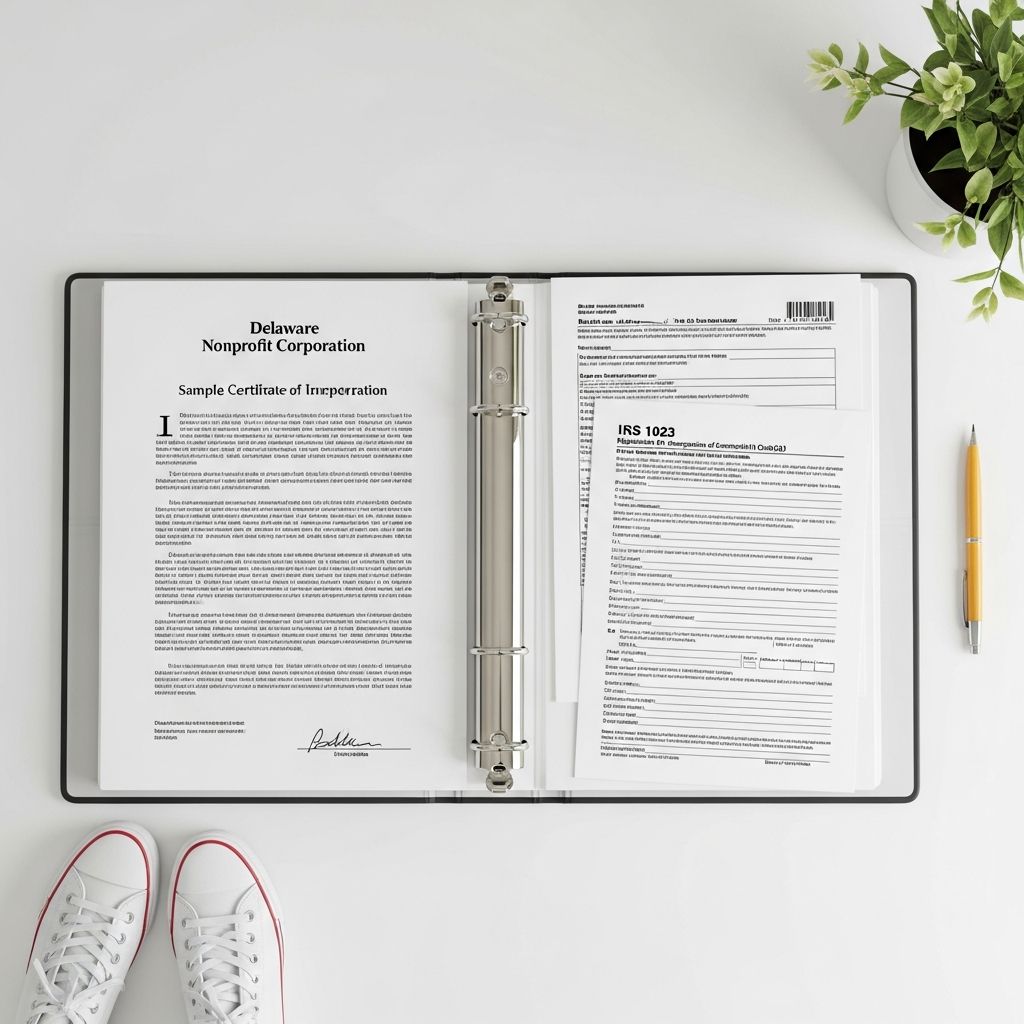
Organizations should establish corporate records files containing articles of incorporation, bylaws, board meeting minutes, conflict of interest policies, and governance documents. Many nonprofits maintain these records in organized binders or digital repositories, ensuring ready access for board review and external audits. Financial records should track all income and expenses with clear documentation supporting transactions, bank deposits, and expenditures. Organizations can maintain financial records through manual systems using spreadsheets and organized files or implement computerized solutions such as cloud-based accounting platforms providing real-time financial visibility and automated reporting.
Establishing Your Nonprofit Bank Account
Once you have obtained your EIN and established board authorization, establishing a dedicated nonprofit bank account separates organizational finances from personal funds and demonstrates financial integrity to donors and regulators. Banks typically require your Certificate of Incorporation, EIN assignment letter, board resolution authorizing account establishment, and identification documents for authorized signatories.
Timeline and Cost Overview
The complete nonprofit formation process in Delaware typically spans several months when pursuing federal tax exemption, though state incorporation can be accelerated significantly:
| Activity | Timeline | Cost Range |
|---|---|---|
| Certificate of Incorporation Filing | 3 weeks standard; 1-24 hours expedited | $89-$1,000+ |
| EIN Acquisition | Immediate to few days | No fee |
| 501(c)(3) Tax Exemption | 2 weeks to 3 months | $275-$600 |
| State Business Registration | Variable | Variable |
| Registered Agent Service (Annual) | Ongoing | $49+ |
Frequently Asked Questions About Delaware Nonprofit Formation
Q: Can I form a Delaware nonprofit if I don’t live in Delaware?
A: Yes, Delaware does not require incorporators or directors to be Delaware residents. Organizations nationwide and internationally can incorporate in Delaware and maintain registered agent services to satisfy residency requirements.
Q: What is the difference between an exempt corporation and a non-stock corporation?
A: Exempt corporations are specifically designed for charitable, religious, and similar nonprofit purposes and receive state tax benefits. Non-stock corporations are generic nonprofit structures that do not automatically qualify for tax exemptions. Most tax-exempt nonprofits use exempt corporation status.
Q: Do I need to file bylaws with the state?
A: Delaware does not require bylaws to be filed with state authorities. However, bylaws are mandatory under state law, must be drafted carefully to comply with both state and federal requirements, and must be submitted with your federal tax exemption application.
Q: How many board members do I need?
A: Delaware requires a minimum of one director, but the IRS recommends at least three unrelated individuals to demonstrate governance diversity and reduce conflict-of-interest concerns. Most effective nonprofits maintain boards of 5-15 members providing diverse expertise and perspective.
Q: What is a registered agent and why do I need one?
A: A registered agent is your organization’s official in-state representative authorized to receive legal documents and government correspondence. Delaware law requires every corporation to designate a registered agent with a physical Delaware office address. Many nonprofits use professional registered agent services ensuring reliable availability.
Q: Can I accelerate my incorporation timeline?
A: Yes, Delaware offers expedited processing options ranging from 24-hour service ($50) to same-day service ($100) and even one-hour service ($1,000). The federal tax exemption process cannot be significantly accelerated and typically requires 2-3 months.
Q: What happens after my tax exemption is approved?
A: Once you receive your determination letter confirming 501(c)(3) status, you should register with state charitable authorities if applicable, establish your bank account using your EIN and determination letter, begin implementing your programs and services, and maintain ongoing compliance through annual Form 990 filings and adherence to governance standards.
References
- Forming and Maintaining a Nonprofit Organization Delaware Edition — 501c3.org. 2012. https://www.501c3.org/forming-maintaining-nonprofit-delaware/
- How to Start a Nonprofit Organization in Delaware — Harbor Compliance. 2024. https://www.harborcompliance.com/how-to-start-a-non-profit-organization-in-delaware
- Starting a Nonprofit Organization in Delaware – Checklist — Delaware Nonprofit. 2017. https://delawarenonprofit.org/
- Corporate Forms and Certificates for an Exempt Corporation — Delaware Division of Corporations. State of Delaware. https://corp.delaware.gov/corpformsexemptcorp09/
- How to Form a New Business Entity – Division of Corporations — State of Delaware Department of State. https://corp.delaware.gov/howtoform/
- Learn How to Form a Delaware Nonprofit Corporation — ZenBusiness. 2024. https://www.zenbusiness.com/delaware-nonprofit-corporation/
Similar Articles








Read full bio of medha deb


