
Deferred Revenue Explained: Essential Guide For Businesses
Master deferred revenue: Learn how businesses handle advance payments, accounting entries, and real-world impacts on financial statements.
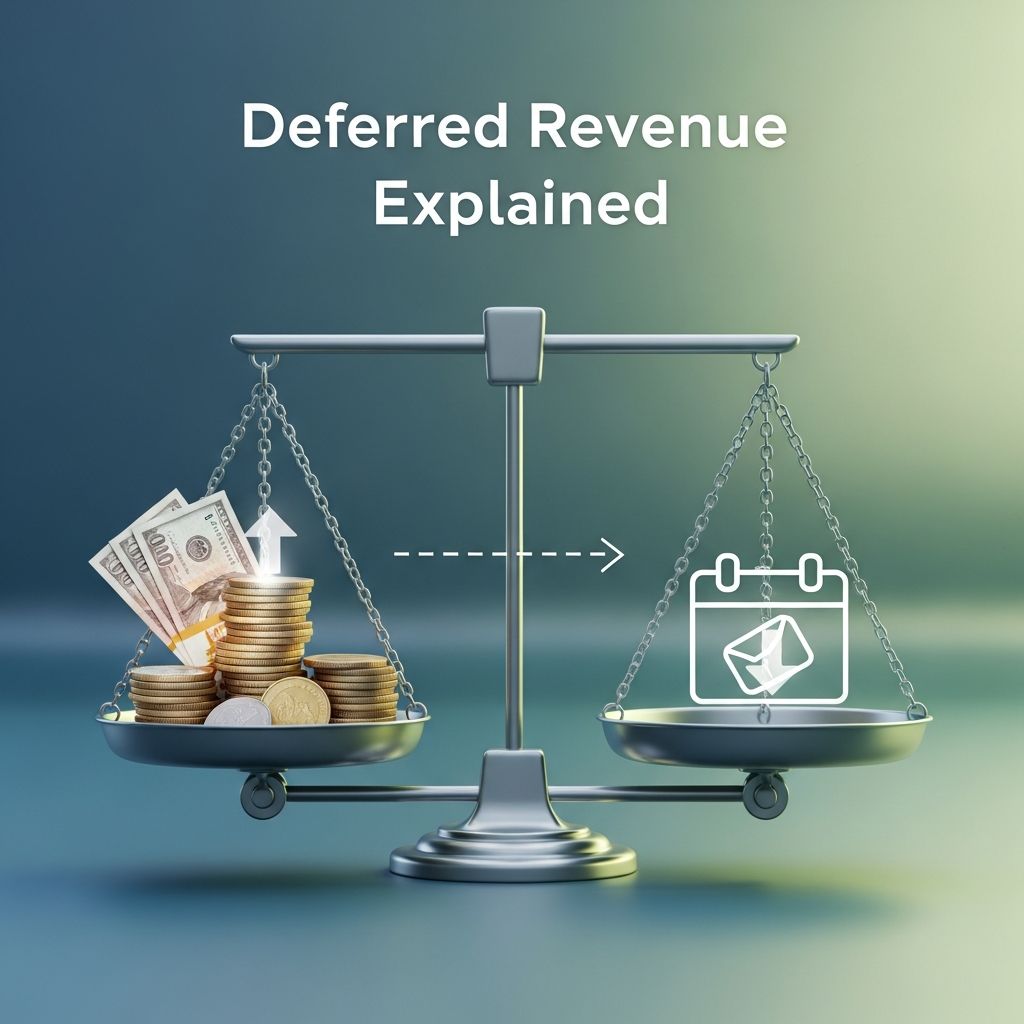
Deferred revenue represents funds a company receives before fulfilling its obligation to deliver goods or services, making it a key concept in accrual accounting. This liability ensures financial statements reflect true performance only when value is provided to customers.
Understanding the Fundamentals of Deferred Revenue
In accrual-based accounting, revenue qualifies as earned only upon delivery of promised benefits, not upon cash receipt. When payments arrive early, businesses classify them as deferred revenue—a balance sheet liability signaling an ongoing commitment.
This approach aligns with standards from bodies like the Financial Accounting Standards Board (FASB), preventing premature profit inflation. For instance, a software firm receiving annual fees upfront records the full amount as a liability, gradually converting portions to revenue as updates roll out.
Deferred revenue splits into current (due within a year) and non-current (longer-term) categories, influencing liquidity assessments and tax planning. Accurate tracking maintains compliance and investor trust.
How Deferred Revenue Appears on Financial Statements
Upon receipt, cash assets rise, but no income hits the profit and loss statement. Instead, the deferred revenue liability grows, reflecting the company’s duty.
As obligations fulfill, journal entries shift the liability to revenue: debit deferred revenue, credit revenue account. This reduces liabilities while boosting income proportionally.
| Financial Statement | Initial Receipt Effect | Recognition Effect |
|---|---|---|
| Balance Sheet | +Cash, +Deferred Revenue (Liability) | -Deferred Revenue, No Cash Change |
| Income Statement | No Revenue | +Revenue |
| Cash Flow Statement | +Operating Cash (Initial) | $0 (Offset by Liability Decrease) |
The table illustrates how initial inflows boost operating cash, but subsequent recognitions neutralize cash flow impacts, providing a clearer earnings picture.
Journal Entries: Step-by-Step Recording Process
Recording deferred revenue follows precise double-entry rules. Consider a $1,200 annual subscription paid August 1:
- Initial Entry: Debit Cash $1,200; Credit Deferred Revenue $1,200.
- Monthly Recognition (e.g., August 31): Debit Deferred Revenue $100; Credit Subscription Revenue $100.
For partial fulfillment, like 85% service delivery on a $1,000 contract, recognize $850 immediately, leaving $150 deferred until completion.
Initial Receipt:Dr. Cash $1,200 Cr. Deferred Revenue $1,200Recognition:Dr. Deferred Revenue $100 Cr. Revenue $100These entries ensure balance sheet integrity and proper income timing.
Real-World Examples Across Industries
Deferred revenue manifests in diverse scenarios:
- Subscriptions: A streaming service collects yearly fees upfront, recognizing monthly as content access continues.
- Gift Cards: Retailers treat unused balances as liabilities until redemption.
- Insurance Premiums: Carriers defer policies paid in advance, earning revenue over coverage periods.
- Rent: Landlords receiving advance payments record as unearned until occupancy.
- Software Maintenance: Vendors defer upgrade fees tied to future support.
In a baking school example, $1,200 for a six-month course (paid June) defers fully until July classes start, with straight-line recognition thereafter.
Deferred Revenue in the SaaS Ecosystem
SaaS companies thrive on subscriptions, amplifying deferred revenue’s role. A $12,000 annual contract paid upfront debits cash and credits deferred revenue; monthly $1,000 slices transfer to income as platforms deliver value.
This model highlights remaining performance obligations (RPOs), vital for forecasting. Negative deferred (unbilled receivables) arises if services outpace billing, flipping to an asset.
FASB’s ASC 606 standardizes recognition, often via straight-line or usage-based methods, ensuring transparency for public SaaS filers.
Differences: Deferred Revenue vs. Accrued Revenue
| Aspect | Deferred Revenue | Accrued Revenue |
|---|---|---|
| Cash Timing | Received First | Earned First |
| Balance Sheet | Liability | Asset |
| Example | Prepaid Subscriptions | Unbilled Services |
| Recognition | Upon Delivery | Upon Invoicing |
Deferred revenue is ‘unearned cash in hand,’ while accrued is ‘earned but unpaid,’ balancing sheets oppositely.
Why Accurate Deferred Revenue Management Matters
Precise handling avoids misstatement risks, supports cash flow analysis, and aids taxation—revenue taxes only post-recognition.
Investors scrutinize deferred balances for growth signals; rising figures indicate strong future revenue potential. Tools like revenue lifecycle software automate tracking, reducing errors.
Non-compliance invites audits; deposits differ as refundable, unlike obligatory deferred revenue.
Strategies for Effective Tracking and Recognition
- Implement robust billing systems integrating with accounting software.
- Apply ASC 606 for multi-element contracts, allocating transaction prices.
- Monitor RPOs quarterly for forecasting accuracy.
- Use straight-line for uniform delivery or milestone-based for discrete events.
- Reconcile monthly to catch variances early.
These practices enhance financial health visibility.
Frequently Asked Questions
What counts as deferred revenue?
Any advance payment for undelivered goods/services, like subscriptions or gift cards, recorded as a liability.
How does deferred revenue affect cash flow?
Boosts initial operating cash but shows neutral flow during recognition due to liability offsets.
Is deferred revenue always short-term?
No, split into current (under 1 year) and long-term based on fulfillment timeline.
What’s the journal entry to recognize deferred revenue?
Debit Deferred Revenue, Credit Revenue for the earned portion.
Why is it critical for SaaS firms?
Reflects subscription backlogs, key for valuing recurring revenue streams.
References
- Deferred Revenue – Accounting, Definition, Example — Corporate Finance Institute. 2023-01-15. https://corporatefinanceinstitute.com/resources/accounting/deferred-revenue/
- Deferred Revenue | Definition + Journal Entry Examples — Wall Street Prep. 2024-05-20. https://www.wallstreetprep.com/knowledge/deferred-revenue/
- What is Deferred Revenue? — Salesforce. 2024-11-10. https://www.salesforce.com/sales/revenue-lifecycle-management/deferred-revenue/
- Accounting 101: Deferred Revenue and Expenses — Anders CPA. 2023-07-12. https://anderscpa.com/learn/blog/accounting-101-deferred-revenue-expenses/
- What is Deferred Revenue in SaaS? — Maxio. 2024-09-05. https://www.maxio.com/saaspedia/deferred-revenue
- Deferred revenue explained — Stripe. 2024-03-18. https://stripe.com/resources/more/deferred-revenue-explained
- Accruals/Deferred Revenue — Cornell University Division of Financial Services. 2023-02-28. https://finance.cornell.edu/accounting/topics/revenueclass/accruals
Similar Articles








Read full bio of Sneha Tete


