
Defending the Marketplace of Ideas on College Campuses
Why protecting offensive speech is vital for American higher education.
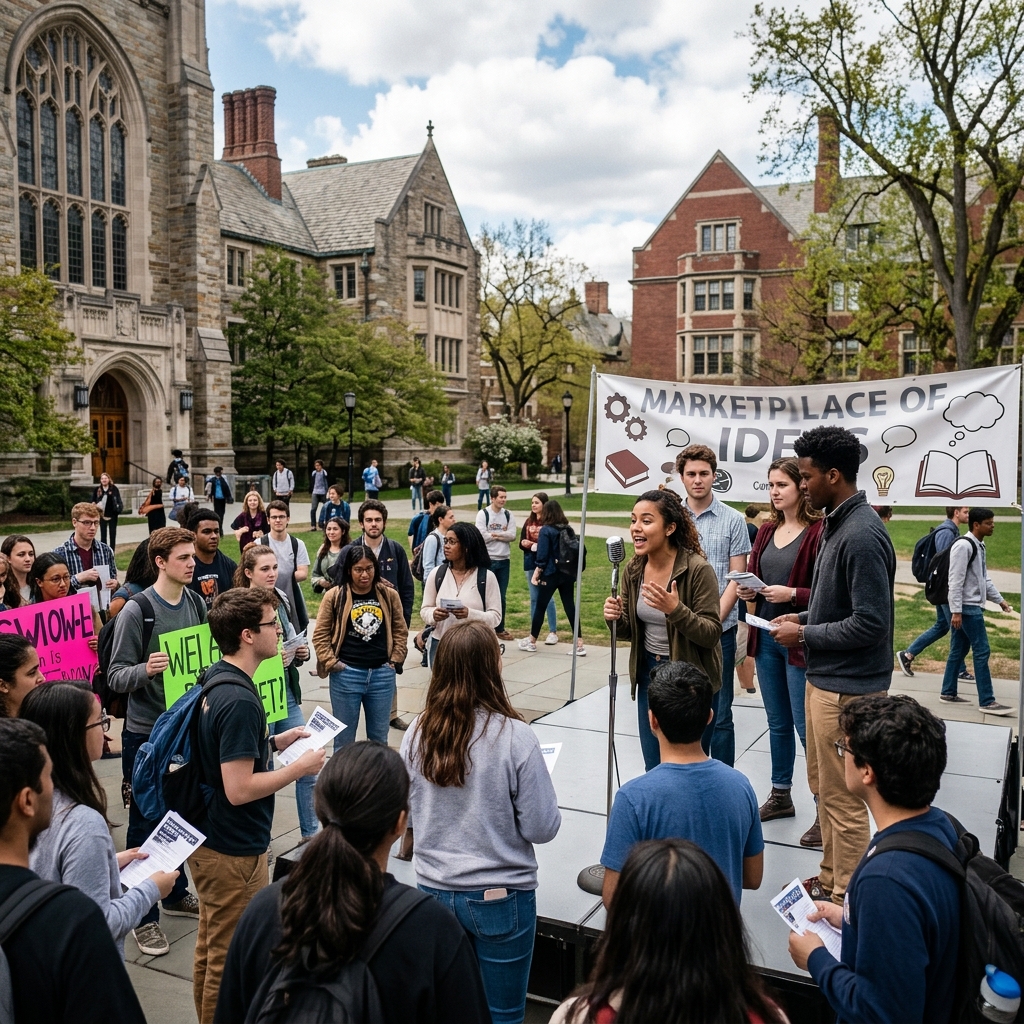
The Crucial Role of Unfettered Discourse in Higher Education
American higher education is currently navigating a profound ideological crisis. At the center of this storm is the fundamental right to free expression. Across the country, college campuses—long heralded as the ultimate marketplaces of ideas—are facing unprecedented pressure to censor, restrict, and punish constitutionally protected speech. From student-led protests concerning international conflicts to controversial guest speakers sparking widespread outrage, the tension between maintaining a welcoming campus climate and upholding the First Amendment has never been more palpable.
The modern university’s identity is inextricably linked to the Free Speech Movement of the 1960s, a watershed era where students vehemently fought against institutional censorship to assert their rights to political advocacy. Today, ironically, the call for censorship often originates from within the student body itself, creating a bizarre historical inversion. However, the foundational truth remains unchanged: an environment that shields individuals from controversial or deeply unpopular ideas ceases to function as a university. To restrict constitutionally protected speech under the guise of creating safe environments deeply undermines the core mission of higher education. To learn, students must be relentlessly challenged. To grow, they must frequently encounter perspectives that make them deeply uncomfortable.
The Constitutional Mandate for Public Universities
The United States Supreme Court has repeatedly affirmed that the First Amendment applies with full vigor to public universities. In the landmark 1972 case Healy v. James, the Court explicitly stated that the precedents of the Constitution leave no room for the view that First Amendment protections should apply with less force on college campuses than in the community at large . The classroom, and its surrounding environment, is uniquely designed to invite dispute and provoke critical thought.
While public institutions are legally bound by the United States Constitution, private universities operate under different legal frameworks. Private colleges possess the autonomy to establish their own codes of conduct and speech guidelines. However, the vast majority voluntarily promise robust free expression and academic freedom in their official charters and student handbooks. Abandoning these commitments in the face of public outcry or social media backlash constitutes a betrayal of the university’s foundational purpose. When administrators yield to demands to cancel controversial speakers or silence student organizations, they replace the rigorous debate necessary for intellectual development with an atmosphere of ideological conformity.
Furthermore, polling data reveals a highly complex campus climate regarding how students perceive their own liberties. According to a 2025 Gallup report, while many students still feel their institutions promote free speech generally, there remains a significant national debate over self-censorship, peer retaliation, and ideological intimidation . When the institutional response to this fear is to implement restrictive speech codes, universities validate the idea that words alone are a form of violence that must be legislated away. This fundamentally alters the pedagogical model from one of intellectual resilience to one of fragility.
Navigating Title VI: Harassment vs. Protected Speech
One of the most concerning trends in the modern censorship debate is the weaponization of civil rights statutes to silence political or ideological disagreements. Specifically, advocates for speech restrictions frequently cite Title VI of the Civil Rights Act of 1964—which prohibits discrimination on the basis of race, color, and national origin in programs receiving federal financial assistance—as a justification for punishing offensive speech.
However, conflating subjective offense with actionable harassment reflects a severe misunderstanding of civil rights law. According to guidelines provided by the U.S. Department of Education’s Office for Civil Rights (OCR), a hostile environment is only created when conduct is subjectively and objectively offensive and is so severe or pervasive that it limits or denies a person’s ability to participate in or benefit from the recipient’s education program or activity .
This is a rigorously high legal threshold. A student holding a sign with a provocative political slogan, a professor lecturing on a controversial historical theory, or a campus group chanting a polarizing phrase generally does not meet this standard. Such expression, while potentially deeply offensive or hurtful to some listeners, is heavily shielded by the First Amendment. Harassment, by contrast, involves targeted, discriminatory behavior that genuinely disrupts a student’s educational access.
| Characteristic | Protected Expression (First Amendment) | Actionable Harassment (Title VI / Title IX) |
|---|---|---|
| Nature of Conduct | General expression of political, ideological, or social views directed at a broad audience. | Targeted, discriminatory conduct based on protected classes directed at specific individuals. |
| Legal Threshold | Protected even if it causes subjective emotional distress or offense. | Must be severe, pervasive, and objectively offensive to a reasonable person. |
| Impact on Education | May cause discomfort, but does not systematically block access to university resources. | Effectively limits or denies a student’s ability to participate in or benefit from the educational program. |
| Examples | Controversial guest speakers, political demonstrations, op-eds, provocative signage. | Repeated racial slurs targeting a specific dorm resident, physical intimidation, persistent stalking based on nationality. |
The Boomerang Effect of Speech Codes
History provides a stark warning about the dangers of institutionalizing censorship: the very tools created to silence hateful or harmful speech are almost always eventually turned against marginalized communities and the politically powerless. When a university establishes a precedent that it can ban speech deemed offensive by the majority or by those in power, it places a loaded weapon on the administrator’s desk.
Consider the historical application of anti-obscenity laws or anti-communist loyalty oaths in the mid-20th century. In every instance, administrators and government officials claimed these measures were necessary for public safety and institutional integrity. Yet, they were disproportionately utilized to fire dissenting professors, silence LGBTQ+ advocacy, and suppress the civil rights movement. When a campus establishes a bureaucratic mechanism to police expression based on its content, the enforcement of that mechanism will inevitably be influenced by the political biases of whoever currently holds authority. The pendulum of political power swings continuously. A policy intended to protect a specific minority group today can, and historically will, be weaponized tomorrow to silence that same group’s activism.
Advocates for restricted speech often argue that the current political climate is uniquely dangerous, thereby justifying emergency exceptions to the First Amendment. Yet, exceptions to free speech principles are inherently subjective. Who decides what constitutes hateful rhetoric? Who gets to define which political ideologies are permissible? By demanding that university administrators act as ideological referees, students and faculty inadvertently surrender their own rights to dissent. The most effective defense for marginalized voices has historically been, and remains, an unwavering commitment to free expression for everyone.
Legislative Mandates and Donor Coercion
The threat to campus free speech does not solely emanate from within the student body or faculty; it is increasingly driven by powerful external forces. In recent years, state legislatures, federal politicians, and wealthy alumni donors have exerted immense pressure on universities to curate campus discourse. We are witnessing a surge in legislative attempts to ban divisive concepts from university curricula, alongside threats from politicians to withhold federal research grants or state funding from institutions that refuse to quell specific student protests .
Simultaneously, prominent donors have threatened to withdraw millions of dollars in endowments unless universities condemn specific viewpoints or expel students participating in controversial demonstrations. This financial and political coercion represents a grave threat to academic independence. Universities must remain autonomous entities, free from the whims of partisan politics and the financial leverage of affluent benefactors. If higher education institutions become beholden to the highest bidder or the loudest politician, they cease to be universities and become mere public relations arms for powerful special interests.
Administrators must demonstrate the courage to hold the line against these external pressures. Defending the right to express an unpopular opinion does not mean the university endorses that opinion; it simply affirms the institution’s commitment to the structural integrity of free debate. Conceding to donor demands to punish protected speech destroys the credibility of the academic enterprise.
Fostering Discourse Without Resorting to Censorship
Rejecting censorship does not mean universities must remain passive in the face of hateful or deeply offensive rhetoric. There are numerous constitutional and highly effective frameworks institutions can utilize to foster a healthy, respectful speech climate without violating First Amendment principles. The ultimate remedy for flawed, offensive, or hateful speech is not censorship, but rather, more speech.
Universities can implement the following proactive measures to balance safety and expression:
- Emphasizing Counter-Speech: University leaders can use their own platforms to condemn hateful ideologies and support affected communities, demonstrating moral leadership without resorting to disciplinary action against the original speakers.
- Establishing Viewpoint-Neutral Restrictions: Institutions can and should regulate the time, place, and manner of protests (e.g., prohibiting amplified sound during exam weeks, preventing the blocking of access to academic buildings) to ensure the educational mission continues, provided these rules are applied equally to all groups regardless of their message.
- Promoting Dialogue and De-escalation: Universities should invest in robust educational programming during student orientation that explicitly teaches the tenets of the First Amendment, the value of intellectual diversity, and techniques for constructive dialogue across profound ideological divides.
- Providing Structural Support: Instead of insulating students from difficult ideas, universities should offer comprehensive mental health and counseling services to help students build the psychological resilience needed to engage in a pluralistic, occasionally contentious society. Furthermore, funding debate societies and moderated forums can elevate the overall quality of campus discourse.
Conclusion
The push to sanitize college campuses from offensive or controversial ideas is a well-intentioned but profoundly misguided endeavor. Education is fundamentally not meant to be a comfortable process. It requires friction, debate, and the collision of opposing worldviews. As society grapples with complex moral, political, and social issues, the university must remain the ultimate arena for these debates to unfold safely and robustly. Rejecting efforts to restrict constitutionally protected speech is not a defense of bigotry or hatred; it is a defense of the only philosophical system capable of peacefully defeating those exact societal ills. By protecting the marketplace of ideas, higher education fulfills its highest duty to democracy.
Frequently Asked Questions (FAQs)
Are hate speech and harassment legally the same thing?
No. Hate speech, while highly offensive and controversial, is generally protected by the First Amendment unless it crosses into specific, narrowly defined unprotected categories like true threats, incitement to imminent lawless action, or targeted harassment. Harassment is a specific legal standard under Title VI and Title IX requiring severe, pervasive, and objectively offensive conduct that denies educational access.
What is the heckler’s veto?
The heckler’s veto occurs when a speaker’s right to express their views is curtailed by the government or university administration because of the anticipated or actual hostile reaction of the crowd. Under the First Amendment, universities are legally obligated to protect the speaker and manage the disruption, rather than silence the speaker to appease an angry mob.
Can a private university legally ban certain types of speech?
Legally, private universities are not state actors and are therefore not bound by the First Amendment. They have the legal right to create their own strict speech codes. However, most prestigious private institutions promise robust free expression in their student handbooks, and holding them to these explicit contractual and philosophical commitments is considered standard practice in higher education advocacy.
References
- Fact Sheet: Harassment based on Race, Color, or National Origin on School Campuses — U.S. Department of Education, Office for Civil Rights. 2024-07-02. https://www2.ed.gov/about/offices/list/ocr/docs/ocr-factsheet-harassment-202407.pdf
- Campus Free Speech Protection Laws — Vile, John R., The First Amendment Encyclopedia (Middle Tennessee State University). 2024-10-21. https://firstamendment.mtsu.edu/article/campus-free-speech-protection-laws/
- Most Students Say College Does Well Promoting Free Speech — Gallup News. 2025-04-08. https://news.gallup.com/poll/643354/students-say-college-promotes-free-speech.aspx
Similar Articles








Read full bio of Sneha Tete


