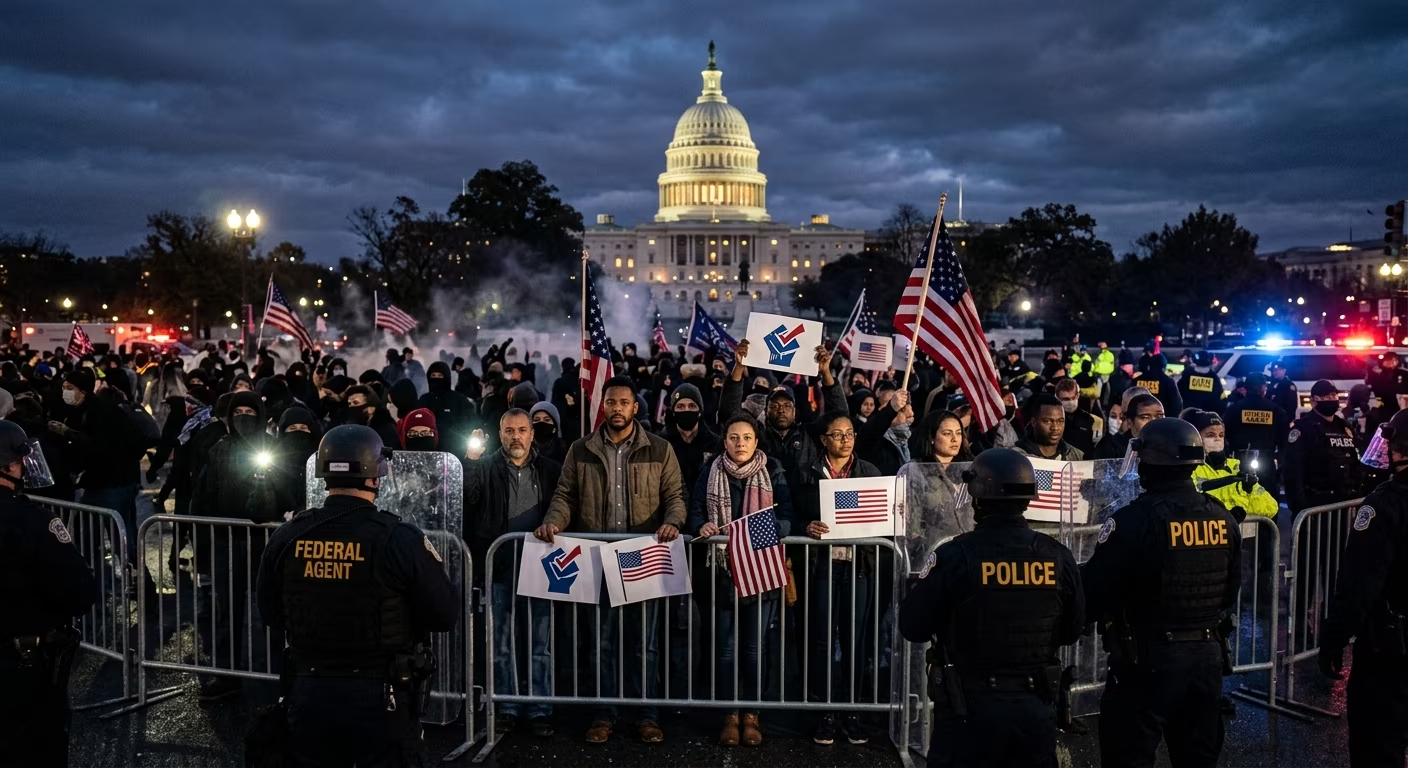
The foundation of any democratic society rests on the unhindered ability of its citizens to participate in the electoral process. For decades, the United States relied on robust federal oversight to ensure that state and local jurisdictions did not enact discriminatory election laws. However, recent years have witnessed a dramatic shift in this paradigm. With the dismantling of crucial federal safeguards, a wave of stringent state-level voting regulations has emerged, fundamentally altering the landscape of American elections. This legislative shift has sparked intense national debate, leading civil rights advocates to call for immediate congressional action to restore balance and protect marginalized communities from systemic disenfranchisement.
To understand the current crisis, one must examine the historical context of federal oversight and the profound consequences of its absence. By analyzing the mechanics of modern voter suppression, the aggressive tactics used in maintaining voter rolls, and the ongoing judicial battles, a clear picture emerges of why new federal legislation is not merely a political preference, but a democratic necessity.
The Collapse of Federal Oversight and the Rise of State Autonomy
For nearly half a century, the Voting Rights Act of 1965 stood as the most effective piece of civil rights legislation in American history. Its crown jewel was the “preclearance” requirement, which mandated that states and localities with documented histories of discriminatory voting practices obtain federal approval before altering their election laws. This proactive measure prevented countless disenfranchising policies from ever taking effect.
That era of robust protection effectively ended in 2013 with the Supreme Court’s landmark ruling in Shelby County v. Holder. The Court invalidated the coverage formula used to determine which jurisdictions were subject to preclearance, arguing that the formula was outdated and no longer reflected current realities. By stripping away this enforcement mechanism, the Court essentially handed a blank check to state legislatures, allowing them to rewrite election rules without prior federal scrutiny.
The consequences were immediate and profound. Freed from the constraints of preclearance, numerous states rapidly introduced and passed omnibus election bills that erected significant new barriers to the ballot box. These legislative packages were often framed as necessary measures to secure election integrity, but critics quickly pointed out that their practical effect was to disproportionately burden specific demographic groups.
The Mechanics of Modern Voting Restrictions
Modern voting restrictions rarely resemble the overt discrimination of the Jim Crow era. Instead, they operate through subtle, bureaucratic hurdles that make registering to vote and casting a ballot more difficult, time-consuming, and legally perilous. A prime example of this trend is the sweeping legislation passed in states like Texas, which has been at the epicenter of the voting rights debate.
These comprehensive election laws typically target the administrative processes of voting. Key components often include:
- Stringent Identification Requirements: Expanding mandatory ID rules not just for in-person voting, but also for mail-in ballot applications. Voters are frequently required to provide specific, matching identification numbers, leading to high rejection rates for minor clerical errors.
- Limitations on Mail-In Voting: Prohibiting election officials from proactively sending out absentee ballot applications, restricting the use of secure drop boxes, and shortening the window for requesting and returning mail-in ballots.
- Criminalizing Voter Assistance: Imposing severe criminal penalties on individuals or organizations that assist voters with disabilities or language barriers. This includes punishing volunteers who provide food or water to voters waiting in extraordinarily long lines.
- Empowering Partisan Poll Watchers: Granting partisan observers unprecedented access and authority within polling places, raising concerns about voter intimidation and disruptions to the electoral process.
Comparing Electoral Frameworks
| Electoral Aspect | Traditional/Accessible Framework | Recent Restrictive Frameworks |
|---|---|---|
| Mail-In Ballots | No-excuse absentee voting; proactive mailing of applications. | Strict excuse required; ban on proactive distribution; narrow application windows. |
| Voter Assistance | Broad community assistance permitted for the elderly and disabled. | Severe restrictions on who can assist; criminal penalties for technical violations. |
| Polling Locations | Abundant community locations and extended early voting hours. | Consolidated locations, reduced Sunday voting, and elimination of 24-hour options. |
| Voter Identification | Flexible verification methods (e.g., utility bills, affidavits). | Strict, matching state-issued ID requirements for all phases of voting. |
Aggressive Voter Roll Maintenance and List Purges
Another critical front in the battle over voting access involves the maintenance of state voter registration lists. Ensuring that voter rolls are accurate and up-to-date is a legitimate administrative function, necessary for the smooth operation of elections. However, the methods and scale of recent voter purges have alarmed civil rights organizations and federal authorities alike.
In recent years, several state executives have touted the massive removal of names from their voter rolls. For instance, in August 2024, Texas authorities announced the removal of over one million individuals from the state’s registration lists since 2021. While states claim these purges target deceased individuals, noncitizens, and those who have moved out of state, the aggressive nature of these list maintenance programs frequently catches eligible voters in the crossfire.
The reliance on matching algorithms across disparate and sometimes outdated government databases inevitably leads to false positives. Eligible citizens, particularly those with common names, naturalized citizens, and individuals who move frequently, often find themselves unexpectedly removed from the rolls. When these voters arrive at the polls on Election Day, they are forced to cast provisional ballots or are turned away entirely.
The friction over voter list maintenance has escalated into federal confrontation. In late 2025, the United States Department of Justice initiated federal lawsuits against multiple states for failing to produce their statewide voter registration lists upon request, signaling an intensified federal effort to ensure state list-maintenance practices comply with the National Voter Registration Act (NVRA).
Disproportionate Impact on Minority and Marginalized Voters
The core argument against these restrictive state laws and aggressive purges is that they do not impact the electorate equally. Empirical research and demographic analyses consistently show that these administrative burdens fall disproportionately on voters of color, younger voters, individuals with low incomes, and voters with disabilities.
Research published by academic institutions, such as the Brennan Center for Justice, indicates a strong correlation between the racial diversity of a jurisdiction and the likelihood of its representatives sponsoring anti-voter legislation. This suggests that shifting demographics and the perceived erosion of traditional power structures often catalyze the introduction of restrictive voting bills.
Consider the impact of strict ID requirements for mail-in ballots. Minority and low-income voters are statistically less likely to possess the specific forms of identification required by newer laws. Furthermore, restrictions on community voter assistance directly harm language-minority voters and elderly citizens who rely on trusted community members to navigate complex voting procedures. By dismantling these support structures, state legislatures effectively suppress the participation of these targeted demographics.
The Judicial Landscape: An Uphill Battle for Civil Rights
With preclearance eliminated, civil rights groups and the Department of Justice are left to challenge discriminatory voting laws after they have already been enacted. This reactive approach, primarily relying on Section 2 of the Voting Rights Act, is inherently difficult, expensive, and time-consuming.
Under Section 2, plaintiffs must endure lengthy trials to prove that a specific law dilutes the voting power of minority groups or was enacted with discriminatory intent. Cases like the prolonged LUPE v. Abbott trial demonstrate the immense resources required to contest complex state legislation piece by piece.
Furthermore, the federal judiciary has erected new barriers to these challenges. In the 2021 decision Brnovich v. Democratic National Committee, the Supreme Court established new guideposts that make it significantly harder for plaintiffs to win Section 2 lawsuits. The Court determined that the mere existence of a disparate impact on minority voters is not necessarily sufficient to strike down an election regulation, heavily weighting the state’s interest in preventing hypothetical voter fraud over the immediate burden placed on the electorate. This narrowing of judicial remedies underscores the urgent need for a legislative solution.
Reviving Preclearance: The Push for Federal Legislation
The convergence of state-level restrictions, aggressive voter purges, and a conservative federal judiciary has created a perfect storm that threatens the foundational principle of equal representation. In response, a coalition of lawmakers and civil rights advocates has continuously pushed for comprehensive federal intervention, most notably through the proposed John R. Lewis Voting Rights Advancement Act.
Named in honor of the late civil rights icon, this federal legislation aims to repair the damage caused by the Shelby County decision. Its primary objective is to establish a new, modernized, and geographically neutral coverage formula for preclearance. Under this proposed law, any state or local jurisdiction—regardless of its geographic location—that demonstrates a recent, documented pattern of voting rights violations would be subject to federal oversight.
Additionally, the Act seeks to restore the strength of Section 2 litigation, providing courts with clearer standards for evaluating discriminatory laws and addressing the judicial hurdles erected by recent Supreme Court decisions. It also mandates that specific types of voting changes—such as the reduction of polling places in diverse neighborhoods or the implementation of strict new ID laws—must be cleared by the federal government or a federal court before implementation, regardless of the jurisdiction’s prior record.
Passing this legislation has proven exceedingly difficult in a deeply polarized Congress, where procedural mechanisms like the Senate filibuster have repeatedly blocked its advancement. Nevertheless, the continuous reintroduction of the bill highlights an unwavering recognition that without federal baseline standards, the right to vote remains vulnerable to the partisan whims of state legislatures.
Conclusion
The health of a democracy is measured by the accessibility of its ballot box. The ongoing proliferation of restrictive state voting laws, coupled with aggressive voter roll purges and the weakening of judicial remedies, represents a coordinated retreat from the promise of equal participation. While states possess the constitutional authority to administer elections, that authority cannot be weaponized to exclude specific communities from the political process. Federal intervention, in the form of modernized civil rights legislation, is not an infringement on state sovereignty; it is a necessary defense of the American citizen’s most fundamental right. Until Congress acts to establish uniform protections, the struggle for equitable access to the ballot will continue to define the nation’s political landscape.
Frequently Asked Questions (FAQs)
What is federal preclearance?
Federal preclearance was a provision of the 1965 Voting Rights Act that required certain states and local governments with a history of discrimination to get approval from the U.S. Department of Justice or a federal court before changing their voting laws or practices. This ensured that new laws did not negatively impact minority voters before they went into effect.
Why do states purge their voter rolls?
States routinely maintain voter rolls to remove individuals who have died, moved out of the jurisdiction, or otherwise become ineligible. While accurate list maintenance is necessary for election integrity, critics argue that aggressive, poorly executed purges relying on flawed data matching often result in the accidental removal of thousands of eligible, properly registered citizens.
What would the John Lewis Voting Rights Advancement Act accomplish?
The proposed legislation aims to restore and strengthen the protections of the original Voting Rights Act. It would create a new, updated formula to determine which jurisdictions require federal oversight (preclearance) based on recent records of discrimination, and it would make it easier to challenge discriminatory voting practices in federal court.
References
- Texas voting case demonstrates the need for new preclearance system — Brookings Institution. 2023-09-27. https://www.brookings.edu/articles/texas-voting-case-demonstrates-the-need-for-new-preclearance-system/
- How Voter Suppression Legislation Is Tied to Race — Brennan Center for Justice. 2023-09-06. https://www.brennancenter.org/our-work/analysis-opinion/how-voter-suppression-legislation-tied-race
- Governor Abbott Announces Over 1 Million Ineligible Voters Removed From Voter Rolls — Office of the Texas Governor. 2024-08-26. https://gov.texas.gov/news/post/governor-abbott-announces-over-1-million-ineligible-voters-removed-from-voter-rolls
- Justice Department Sues Six Additional States for Failure to Provide Voter Registration Rolls — U.S. Department of Justice. 2025-12-02. https://www.justice.gov/opa/pr/justice-department-sues-six-additional-states-failure-provide-voter-registration-rolls