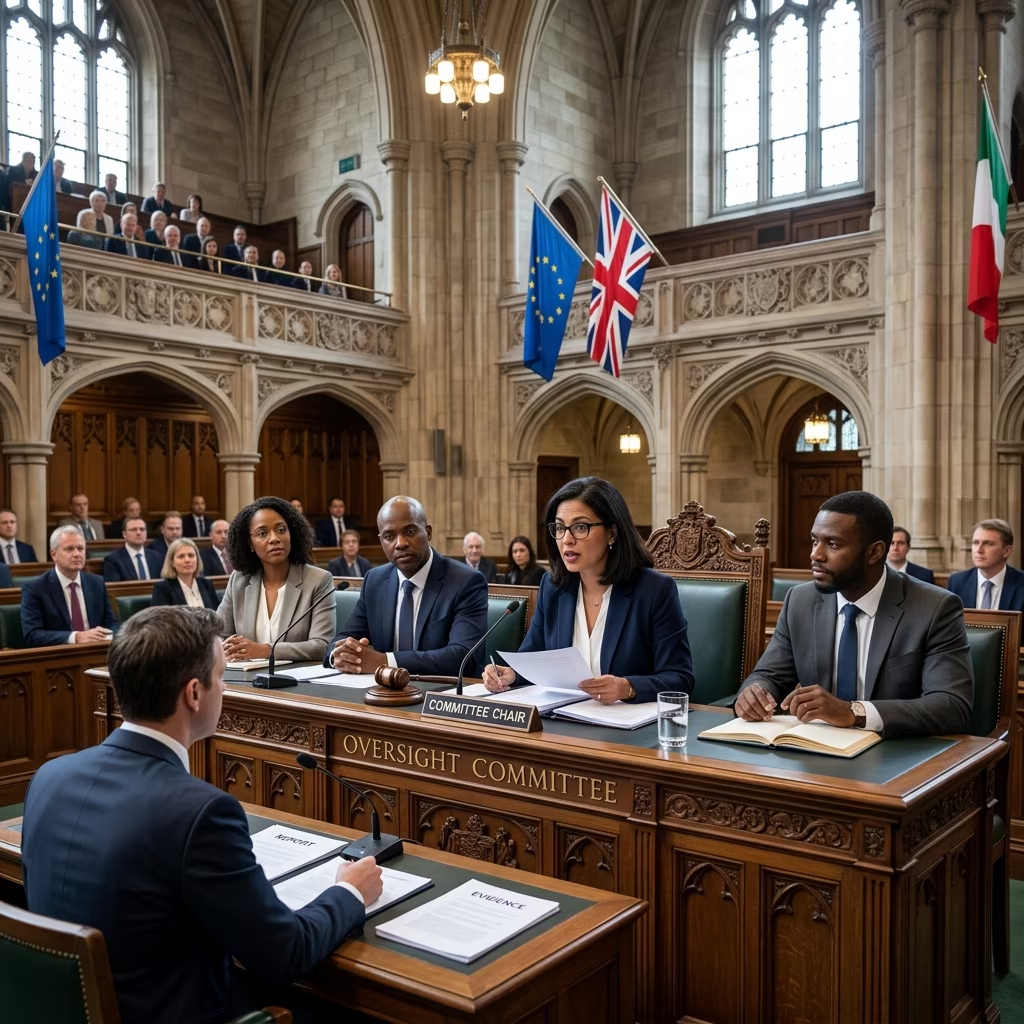
Introduction to Democratic Accountability
In the intricate machinery of a modern democratic state, maintaining the delicate equilibrium between preserving national security and protecting foundational civil liberties represents one of the most profound challenges of governance. A government entrusted with the formidable responsibility of defending its citizens must inherently possess significant and wide-reaching authority. Yet, history has repeatedly demonstrated that without robust, uncompromising mechanisms of accountability, this exact authority can easily metastasize into an instrument of systemic overreach. Democratic oversight is fundamentally not an impediment to a nation’s security; rather, it serves as the vital, non-negotiable guardrail that ensures state power remains tethered to the public interest without sacrificing the very freedoms it purports to defend. The persistent tension between the necessity for state secrecy—often required in intelligence gathering—and the democratic mandate for transparency demands constant and aggressive vigilance. True patriotism in a free society does not equate to blind trust in secretive institutions. Instead, it involves holding government entities accountable. When intelligence agencies, domestic law enforcement divisions, and executive bodies are permitted to operate deep within the shadows, effectively immune from public scrutiny and legislative checks, the core principles of a free society are placed in immediate, existential jeopardy.
The Bedrock of Democracy: Why Checks and Balances Matter
At the very heart of the American constitutional framework lies a deep-seated, historically informed suspicion of concentrated power. The architects of the Republic understood a fundamental, immutable truth about human nature and institutional behavior: power, when left unchecked and unmonitored, inevitably seeks to expand its own boundaries. This foundational philosophy birthed the system of checks and balances, a structural, architectural guarantee that no single branch of government could ever operate as a law unto itself. In the hyper-complex realm of modern national security, this constitutional principle becomes exponentially more critical. The executive branch today commands vast global intelligence networks, unparalleled military capabilities, and deeply resourced domestic enforcement agencies. If the legislative and judicial branches abdicate their constitutional duty to aggressively monitor these entities, the entire equilibrium of state power collapses.
Effective oversight requires substantially more than passive observation or rubber-stamp approvals; it demands active, adversarial, and persistent inquiry. It involves lawmakers asking profoundly uncomfortable questions, demanding unfettered access to highly classified executive directives, and steadfastly refusing to accept generalized invocations of “national security” as a blanket justification for bypassing constitutional norms. When oversight is relegated to a mere bureaucratic formality, the state rapidly gains the unconstrained capacity to target its own citizens, suppress lawful dissent, and manipulate domestic political outcomes without facing any tangible consequences. Therefore, the ongoing preservation of a democratic system is inextricably, permanently linked to maintaining aggressive accountability over the state’s most insulated and secretive apparatuses.
Echoes from the Past: Historical Abuses of Secret Powers
To truly comprehend the indispensable nature of rigorous legislative and public oversight, one must closely examine the historical precedents where its blatant absence led to catastrophic abuses of public trust. During the height of the Cold War era, the United States intelligence community operated with minimal, if any, legislative constraint. Agencies operated under the dangerous assumption that the existential, global threat of communism justified virtually any covert countermeasure, regardless of its legality. This completely unchecked environment predictably bred deeply unconstitutional domestic surveillance and disruption programs, most notably the FBI’s COINTELPRO, which actively sought to dismantle domestic civil rights organizations.
The critical turning point in modern American oversight occurred in the mid-1970s with the formation of the Senate Select Committee to Study Governmental Operations with Respect to Intelligence Activities, widely known as the Church Committee. This bipartisan investigative body unearthed deeply disturbing realities about the sheer extent of unchecked domestic spying. They revealed to a shocked public that federal agencies had unlawfully infiltrated peaceful civil rights organizations, illegally wiretapped the private communications of political activists, and engaged in vicious, covert campaigns to discredit prominent figures. The Church Committee’s exhaustive investigation formally concluded that intelligence agencies had fundamentally undermined the constitutional rights of citizens precisely because the checks and balances designed by the framers to assure accountability had been entirely bypassed .
The resulting legacy of the Church Committee was nothing short of transformative. It led directly to the establishment of permanent intelligence oversight committees in both chambers of Congress and paved the way for the passage of the Foreign Intelligence Surveillance Act (FISA) of 1978. These sweeping legislative reforms were explicitly designed to forcefully bring the intelligence community back within the bounds of constitutional law, proving that aggressive, historical transparency is the only viable, long-term remedy for covert institutional corruption.
The Modern Surveillance State and Section 702
While the monumental reforms of the 1970s successfully established critical structural guardrails, the rapid, explosive advancement of digital technology has created an entirely new paradigm of intelligence gathering. This modern landscape demands modernized, technically sophisticated, and significantly more rigorous oversight mechanisms. In the twenty-first century, the primary scope of state surveillance has dramatically shifted from targeted, analog wiretaps to sweeping, algorithmic bulk data collection. The sheer, incomprehensible volume of digital information generated daily by ordinary citizens—encompassing emails, text messages, geolocation data, and intimate search histories—has provided intelligence agencies with an unprecedented, deeply intrusive window into the private lives of the global populace.
At the absolute center of contemporary debates over surveillance oversight is Section 702 of the Foreign Intelligence Surveillance Act. Originally enacted to address perceived collection gaps resulting from modern digital communication technology, Section 702 theoretically allows the government to conduct targeted surveillance solely of foreign persons located outside the United States to acquire crucial foreign intelligence information . However, the practical reality of its implementation has sparked severe, widespread civil liberties concerns. Because global digital communications cross international networks seamlessly, the surveillance of foreign targets routinely, predictably, and incidentally sweeps up the private communications of entirely innocent American citizens.
Once this massive trove of data is captured and stored in government databases, federal agencies, most notably the FBI, have routinely utilized what privacy advocates term the “backdoor search loophole.” This allows agents to query the collected international information for domestic investigations without ever obtaining a traditional, particularized warrant. In highly critical recent speeches on the Senate floor, lawmakers have heavily emphasized that the FBI conducted thousands of warrantless searches on Americans in a single year, stating clearly that these persistent abuses represent a fundamental, glaring flaw that violently bypasses the Fourth Amendment’s bedrock protection against unreasonable searches and seizures . Without uncompromising oversight and immediate, structural legislative reform, surveillance programs like Section 702 threaten to permanently normalize the warrantless surveillance of the domestic population under the protective guise of international counterterrorism.
The Anatomy of Accountability: Independent Watchdogs in Action
Effective, functional oversight does not rely on a single entity; rather, it depends on an intricate, interlocking ecosystem of institutional watchdogs, each serving a distinct, specialized role in peeling back the heavy layers of executive secrecy. Congressional intelligence and judiciary committees hold the primary, constitutional legislative authority, utilizing their awesome subpoena power and the power of the purse via budget authorizations to mandate transparency from executive agencies. However, Congress, as a political body, cannot effectively or granularly monitor these vast bureaucracies alone; they depend heavily on continuous internal mechanisms of accountability.
- Inspectors General (IGs): Prominent among these internal mechanisms are the independent Offices of the Inspector General. Under the landmark Inspector General Act of 1978, the explicit role of federal IGs is to independently prevent and detect waste, fraud, and abuse relating to their respective agency’s programs, and to continuously promote overall operational efficiency . Crucially, while IGs are technically housed within the massive agencies they monitor, they are structurally and legally designed to operate with fierce independence, reporting their unvarnished findings not just to agency heads but directly to Congress. They serve as the indispensable, legally protected eyes and ears of the public deep inside the bureaucratic machinery.
- Whistleblower Protections: Furthermore, individual whistleblowers remain a uniquely vital component of the modern accountability architecture. When formal, structured channels of oversight are deliberately obstructed, underfunded, or politically co-opted, individuals of profound conscience within the national security apparatus are frequently the very last line of defense against illegal, unconstitutional, or highly unethical conduct. Protecting these courageous individuals from targeted professional retaliation is not merely an internal employment issue; it is a fundamental, absolute requirement for a transparent, functional democratic system.
The High Cost of Operating in the Shadows
When established oversight mechanisms fail, the resulting consequences extend far beyond abstract, theoretical legal violations; they inflict deep, tangible harm on the very fabric of civil society. A government operating aggressively in the shadows inevitably generates a pervasive, toxic chilling effect on free expression and lawful association. If citizens reasonably suspect that their private digital communications are being actively monitored without proper judicial authorization, they predictably self-censor. Investigative journalists hesitate to contact crucial confidential sources, civil rights activists are severely deterred from organizing lawful, peaceful protests, and political dissidents are silenced out of a justified fear of unwarranted state retribution.
Moreover, the long history of unchecked state surveillance demonstrates a consistent, undeniable pattern of disproportionate impact on politically and socially marginalized communities. Historically, intelligence and law enforcement agencies have overwhelmingly targeted religious minorities, communities of color, and vulnerable immigrant populations under the excessively broad, ill-defined umbrella of national security. Without aggressive, mathematically sophisticated oversight to audit targeting algorithms and demand rigorous, documented justifications for surveillance protocols, these systemic human biases are allowed to operate and scale undisturbed, effectively weaponizing the state’s security apparatus against its most vulnerable demographics.
A Blueprint for Future Reform
Safeguarding the future of democracy requires a highly forward-looking, technically literate approach to oversight that rapidly adapts to the continuously evolving landscape of digital technology and expanding executive power. Future, critical reforms must inherently focus on forcefully hardening the legal independence of internal watchdogs. Congress must ensure that Inspectors General can freely conduct their complex investigations without facing political interference or the looming threat of retaliatory, summary termination by the executive branch they are tasked with monitoring.
Legislatively, Congress must aggressively reassert its constitutional authority by significantly reforming outdated intelligence-gathering statutes. For highly controversial laws like FISA Section 702, this fundamentally means instituting mandatory, strict probable-cause warrant requirements for any queries involving the private communications of United States persons. The glaring legal loophole that currently allows vast international intelligence databases to be utilized for routine domestic law enforcement purposes must be unequivocally, permanently closed.
Finally, oversight committees must be rapidly equipped with the advanced technical expertise necessary to properly evaluate modern, AI-driven surveillance tools. As artificial intelligence, machine learning, and predictive behavioral algorithms increasingly drive covert intelligence operations, traditional, paper-based legal audits are woefully insufficient. Legislative oversight must radically evolve to mandate strict algorithmic transparency, ensuring absolutely that AI-driven targeting does not violate constitutional privacy rights or endlessly perpetuate historical demographic discrimination. The defense of democracy is an ongoing, exhausting endeavor, demanding relentless, uncompromising scrutiny to ensure the tools of security are never weaponized against the citizens they are meant to protect.
Frequently Asked Questions (FAQs)
What exactly is government oversight?
Government oversight refers to the continuous, structured monitoring, reviewing, and supervision of executive branch agencies, highly classified programs, and internal policies by independent bodies. This is typically conducted by the legislative branch (Congress) or independent internal watchdogs like Inspectors General. Its primary purpose is to ensure strict legal accountability, aggressively prevent abuses of power, and guarantee that government entities operate strictly within the bounds of the Constitution.
Why is oversight necessary in national security?
While national security operations inherently require some level of operational secrecy to protect fragile intelligence sources and tactical methods, extreme, unchecked secrecy can easily shield illegal activities, constitutional violations, and gross bureaucratic incompetence. Oversight securely ensures that even highly classified programs are scrutinized by authorized, legally cleared representatives of the public, maintaining a crucial, delicate balance between public safety and foundational civil liberties.
What was the historical impact of the Church Committee?
The Church Committee was a highly pivotal, bipartisan 1975 Senate investigation that dramatically exposed decades of illegal domestic surveillance, wiretapping, and disruption campaigns conducted by U.S. intelligence agencies against American citizens. Its shocking public revelations directly resulted in the creation of permanent congressional intelligence oversight committees and spurred the establishment of the Foreign Intelligence Surveillance Act (FISA) to regulate government spying.
How does FISA Section 702 affect ordinary citizens?
Although FISA Section 702 is legally designed to target only non-U.S. persons located abroad, the highly interconnected nature of modern digital networks means the government routinely and incidentally intercepts the private communications of American citizens who are in contact with those foreign targets. Critics and lawmakers strongly argue that the FBI’s ability to search this massive collected data pool for routine domestic investigations without obtaining a warrant violates the fundamental Fourth Amendment rights of ordinary Americans.
References
- A History of Notable Senate Investigations: The Church Committee — United States Senate. 1976. https://www.senate.gov/about/powers-procedures/investigations/church-committee.htm
- Section 702: Basics — Office of the Director of National Intelligence. https://www.dni.gov/files/icotr/Section702-Basics.pdf
- In Senate Floor Speech, Durbin Calls For Opposition To FISA Section 702 Reauthorization Without Serious Reforms — United States Senate Committee on the Judiciary. 2026-06-03. https://www.judiciary.senate.gov/
- Inspectors General — Council of the Inspectors General on Integrity and Efficiency (CIGIE) / Oversight.gov. https://www.oversight.gov/inspectors-general