
Defamation vs. False Light: Key Legal Differences
Understanding how defamation and false light differ in privacy, reputation, and legal standards.
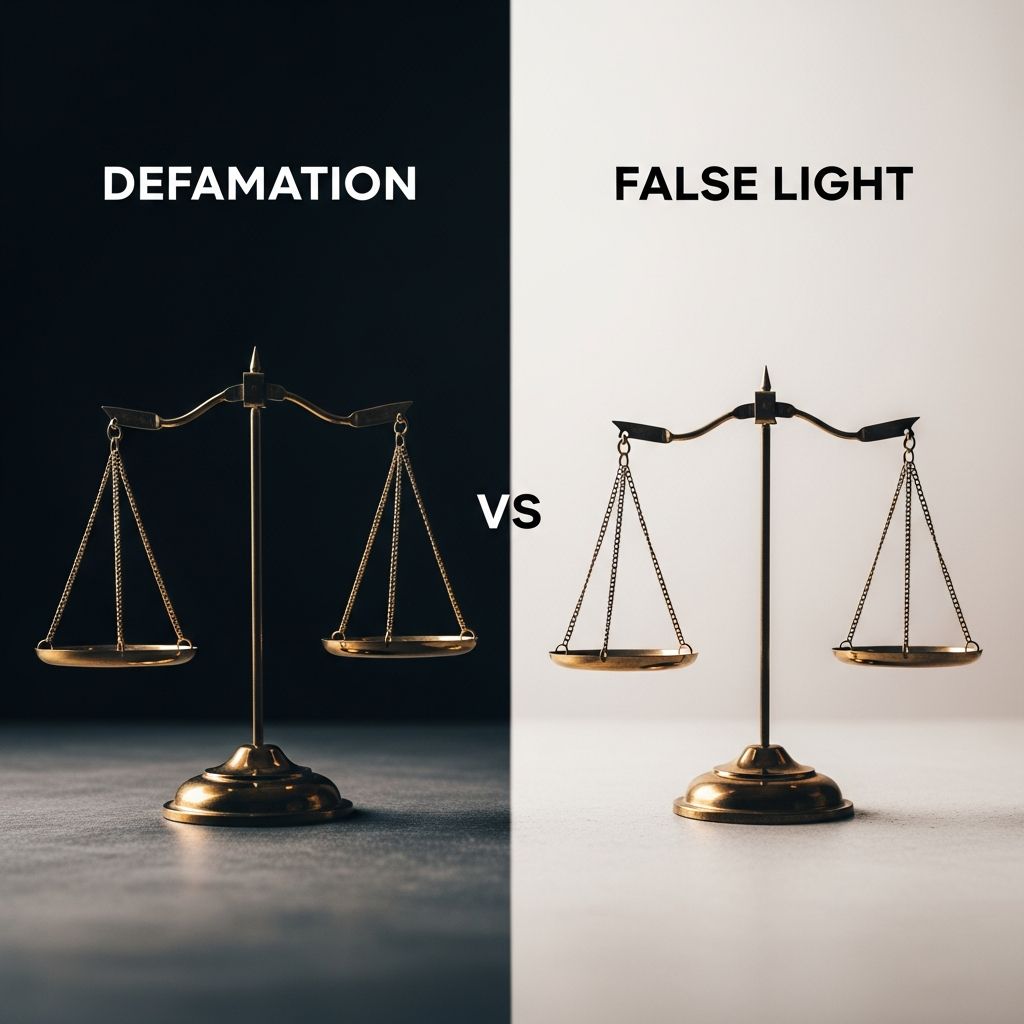
Defamation vs. False Light: Understanding the Core Legal Distinction
When someone spreads false information about another person, the law offers several remedies. Two of the most commonly confused are defamation and false light. While both involve false statements about a person, they protect different interests and operate under distinct legal rules. Defamation is fundamentally about protecting a person’s reputation in the eyes of others. False light, by contrast, is a privacy tort focused on shielding individuals from being portrayed in a misleading or offensive way, even if that portrayal does not directly damage their reputation in a traditional sense.
What Defamation Actually Protects
Defamation is a well-established tort that arises when a false statement of fact is communicated to a third party and causes harm to the subject’s reputation. The core concern is how others perceive the person, not how the person feels about themselves. For a statement to be defamatory, it must be:
- A false assertion of fact (not mere opinion)
- Published to at least one other person
- Capable of harming the person’s standing in the community
- Connected to actual or presumed damages
Because defamation targets reputation, the law is especially sensitive to the context in which the statement appears. A false claim that someone is a thief, for example, can damage their ability to find work or maintain relationships. A false claim that someone has a certain political view may be defamatory if it is presented as a fact and is damaging in that community.
What False Light Is Designed to Prevent
False light is a privacy-based tort that protects individuals from being publicly portrayed in a way that is highly misleading or offensive, even if the specific facts are technically true. The focus is not on whether the statement lowers the person’s reputation, but on whether the overall impression created is false and deeply objectionable.
For example, a news story that accurately reports that a person attended a protest but implies they were a violent agitator when they were not may not be defamatory in the traditional sense, but it could place them in a false light. The harm here is more personal: humiliation, embarrassment, and emotional distress from being misrepresented to the public.
Reputation vs. Privacy: The Fundamental Divide
The most important conceptual difference between defamation and false light is the interest each tort protects:
- Defamation protects against harm to a person’s reputation in the community.
- False light protects against an invasion of privacy through misleading or offensive public portrayal.
This distinction shapes how courts analyze each claim. In defamation, the question is: “Does this statement make others think less of the person?” In false light, the question is: “Does this portrayal create a false and highly offensive impression about the person, regardless of whether it directly harms their reputation?”
Who Can Bring Each Type of Claim?
Both defamation and false light can be brought by private individuals, but the rules differ significantly when it comes to public figures.
Defamation and Public Figures
Under U.S. constitutional law, public figures (such as politicians, celebrities, and high-profile business leaders) must meet a higher burden in defamation cases. They must prove that the defendant made the false statement with actual malice—that is, with knowledge that it was false or with reckless disregard for the truth.
This high standard exists to protect robust public debate and free speech on matters of public concern. Private individuals, by contrast, typically only need to show that the defendant was negligent in verifying the truth of the statement.
False Light and Public Status
False light claims are treated differently. In many jurisdictions, the distinction between public and private figures is less important or does not apply at all. Courts often require plaintiffs in false light cases to show that the defendant knew the portrayal would create a false impression or acted with reckless disregard for the truth, regardless of whether the plaintiff is a public or private figure.
This means that even a private individual may face a relatively high bar in a false light case, while a public figure may not get the same constitutional protections that apply in defamation.
What Makes a Statement Actionable?
The threshold for what counts as a legally actionable statement also differs between the two torts.
Defamation: Focus on Harm to Reputation
In defamation, the statement must be capable of causing reputational harm. It does not need to be insulting or offensive in tone; it only needs to be the kind of statement that would tend to lower the person’s standing in the community or deter others from associating with them.
Examples include false claims about:
- Professional competence or ethics
- Criminal behavior
- Financial dishonesty
- Sexual misconduct
The statement can be written (libel) or spoken (slander), and in many cases, the plaintiff must show actual financial or professional harm, though some types of statements are considered so damaging that harm is presumed.
False Light: Focus on Offensiveness and Misleading Impression
False light claims require that the portrayal be highly offensive to a reasonable person. The emphasis is on how the information is presented and the overall impression it creates, not just on whether specific facts are false.
A true fact can still support a false light claim if it is arranged or framed in a way that strongly implies something false and offensive. For example:
- Using a photo of a person in a way that suggests they endorse a controversial product or cause
- Editing a quote or interview to make it appear that the person holds an extreme or unpopular view
- Presenting a series of true but selectively chosen facts that create a misleading narrative
The key is that the overall impression is both false and deeply objectionable to an ordinary person in the plaintiff’s position.
How Truth Functions as a Defense
Truth is a powerful defense in both torts, but its scope and application differ.
Truth in Defamation
In defamation, truth is an absolute defense. If the defendant can prove that the statement was substantially true, the claim fails, no matter how damaging or unpleasant the statement may be.
This rule reflects the policy that people should not be punished for speaking the truth, even if it harms someone’s reputation. Minor inaccuracies that do not change the essential meaning of the statement are generally not enough to defeat a truth defense.
Truth in False Light
In false light, truth is a more limited defense. Even if the individual facts are true, the defendant may still be liable if the way those facts are presented creates a false and highly offensive impression.
For example, a magazine article that accurately reports that a person once struggled with addiction but presents the information in a sensationalized way that implies they are currently unstable or dangerous may still support a false light claim, even if every quoted fact is technically correct.
Required Level of Fault and Intent
The mental state the plaintiff must prove also varies between the two torts.
Defamation: Negligence vs. Actual Malice
In defamation:
- Private figures generally must show that the defendant was negligent in failing to verify the truth of the statement.
- Public figures must show actual malice: that the defendant knew the statement was false or acted with reckless disregard for the truth.
This distinction is rooted in First Amendment protections for speech on matters of public concern.
False Light: Often Requires Actual Malice
False light claims frequently require a higher standard of fault, often equivalent to actual malice, even for private individuals. Courts impose this standard to avoid chilling protected speech, especially in news reporting and commentary.
To succeed, the plaintiff usually must show that the defendant:
- Knew the portrayal would create a false impression, or
- Acted with reckless disregard for whether the portrayal was misleading or offensive.
This makes false light claims harder to win than many defamation claims brought by private individuals, but potentially easier than defamation claims brought by public figures.
Types of Harm and Damages
The nature of the harm each tort addresses also differs, which affects the types of damages available.
Defamation: Reputational and Economic Harm
Defamation is primarily concerned with:
- Damage to professional or business reputation
- Loss of employment or business opportunities
- Loss of standing in the community
Compensatory damages in defamation often include lost income, lost business, and sometimes emotional distress, especially when tied to reputational harm. In some cases, punitive damages may be awarded if the defendant’s conduct was particularly egregious.
False Light: Emotional and Personal Harm
False light is more focused on personal and emotional injury. The typical harms include:
- Humiliation and embarrassment
- Personal shame and distress
- Damage to dignity and sense of self
Because the tort is rooted in privacy, damages often emphasize the plaintiff’s subjective experience of being misrepresented. Courts may award compensation for mental anguish, emotional suffering, and the invasion of personal dignity, even if there is no clear financial loss.
Where Each Tort Applies: Jurisdictional Variations
Not all states recognize both defamation and false light as separate causes of action. The legal landscape varies significantly across the country.
States That Recognize Both
In many states, plaintiffs can bring both defamation and false light claims, sometimes in the same lawsuit. However, courts often scrutinize whether the claims are truly distinct or whether they are based on the same publication. In some cases, a plaintiff may be required to choose one theory or the other, or may be barred from recovering on both for the same incident.
States That Limit or Reject False Light
Several states, including Colorado, Florida, North Carolina, Texas, and Virginia, do not recognize false light as a separate tort. In these jurisdictions, courts either treat such claims as defamation or reject them altogether, often out of concern that false light could unduly restrict free speech and press freedoms.
States That Require Retractions
In about one-third of states, plaintiffs in defamation cases must first request a retraction from the publisher before they can seek certain types of damages. These retraction statutes generally do not apply to false light claims, which are treated as privacy torts rather than defamation.
Comparing the Two: A Practical Overview
The following table summarizes the key differences between defamation and false light in most jurisdictions that recognize both torts.
| Aspect | Defamation | False Light |
|---|---|---|
| Core Interest Protected | Reputation | Privacy / Dignity |
| Public vs. Private Figure | Crucial: higher burden for public figures | Less important or not applied |
| Required Fault | Negligence (private) / Actual malice (public) | Often actual malice, regardless of status |
| Truth as Defense | Absolute defense if statement is true | May not fully protect if impression is false |
| Offensiveness Requirement | Not required; only reputational harm matters | Must be highly offensive to a reasonable person |
| Primary Type of Harm | Reputational and economic | Emotional and personal |
| Retraction Requirements | Often required in many states | Generally not required |
Frequently Asked Questions
Can I sue for both defamation and false light?
In some states, yes, but courts often require that the claims be based on different aspects of the publication or that they not duplicate each other. In other states, you may have to choose one theory or the other, especially if both claims arise from the same statement.
Is false light easier to prove than defamation?
Not necessarily. While false light may not require proof of specific financial harm, it often demands a higher standard of fault (actual malice) and a showing that the portrayal was highly offensive. In practice, this can make false light claims just as difficult, if not more so, than many defamation claims.
Can a true statement still lead to a false light claim?
Yes. If true facts are presented in a way that creates a false and highly offensive impression, that can support a false light claim, even if no individual fact is technically false.
Do corporations have false light claims?
Generally, no. False light is considered a personal privacy tort, so it is typically only available to individuals, not businesses or organizations. Corporations may have defamation claims, but they usually cannot bring false light claims.
Why do some states not recognize false light?
Some states have rejected false light because of its overlap with defamation and concerns that it could be used to punish protected speech. Courts in those states often prefer to handle such cases under defamation or other privacy doctrines to avoid chilling free expression.
References
- Restatement (Second) of Torts § 652E — American Law Institute. 1977. https://www.ali.org/publications/restatement-second-of-torts/
- Time, Inc. v. Hill, 385 U.S. 374 (1967) — Supreme Court of the United States. 1967. https://supreme.justia.com/cases/federal/us/385/374/
- False Light Invasion of Privacy — Legal Information Institute, Cornell Law School. https://www.law.cornell.edu/wex/false_light
Similar Articles








Read full bio of medha deb


