
The Gatekeepers of Congress: Decoding the House Rules Committee
Understanding how a small, powerful committee controls the fate of American legislation.
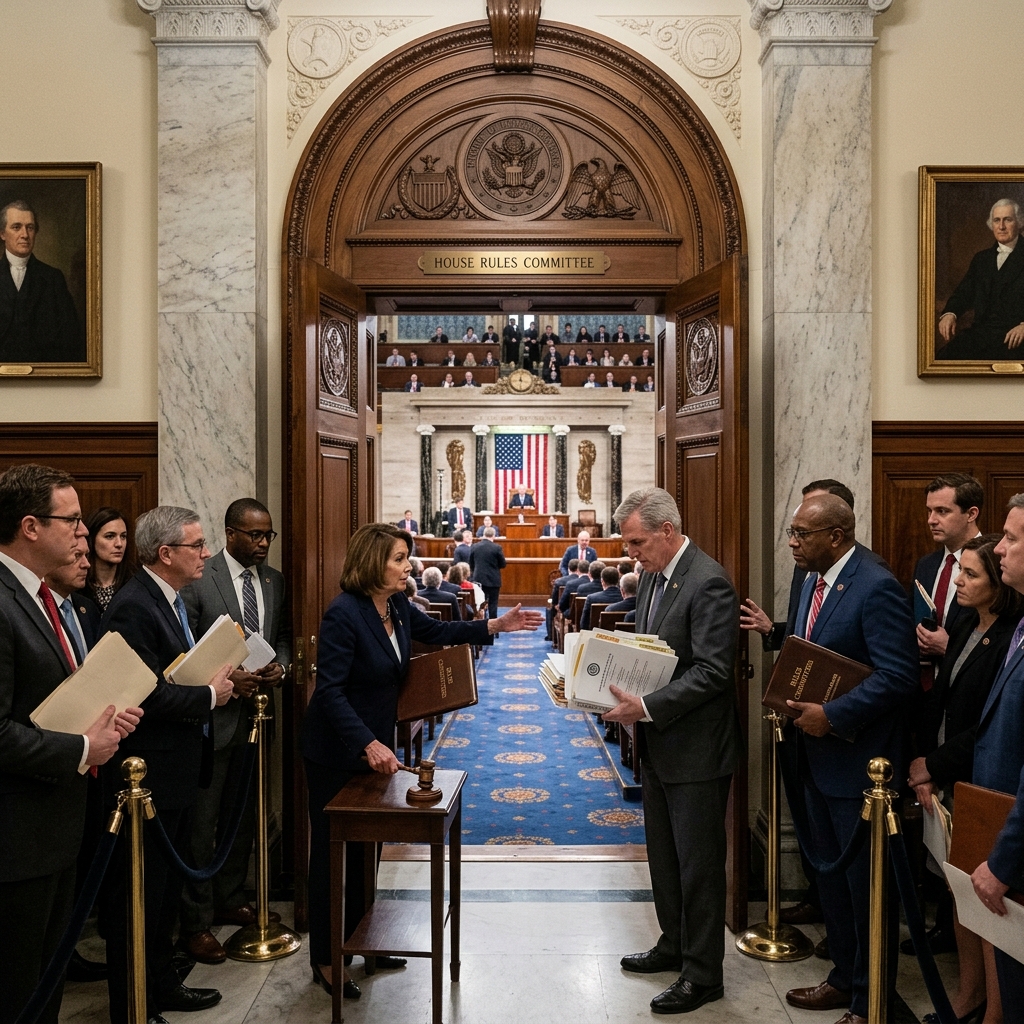
The Unseen Machinery of American Lawmaking
When most Americans learn about the legislative process, the narrative is often highly streamlined. A member of Congress writes a bill, a committee marks it up, the full chamber debates it, the Senate agrees, and the President signs it into law. However, this simplified model completely bypasses one of the most critical chokepoints in modern American democracy: the House Rules Committee. Often referred to by political insiders as the “traffic cop of Congress,” this small but immensely powerful panel wields disproportionate influence over the fate of almost every major piece of legislation.
Its members do not debate the substantive merits of agricultural subsidies, foreign policy, or healthcare reform. Instead, they dictate the precise terms of how those topics will be debated by everyone else in the chamber. For organizations focused on civil liberties, constitutional advocacy, and government transparency, understanding the inner workings of this committee is an absolute necessity. Civil liberties advocates carefully monitor the Rules Committee because procedure often dictates policy outcomes. A minor procedural tweak to an amendment rule can spell the difference between protecting digital privacy and allowing unchecked surveillance. If you want to know why a widely supported amendment was never voted on, or how a controversial measure was rushed to the floor without public scrutiny, the answer almost always lies with the House Rules Committee.
The Historical Evolution of the Speaker’s Committee
The House Rules Committee is not a modern procedural invention; its origins stretch back to the very foundation of the United States government. Formally constituted on April 2, 1789, during the First Congress, it began as a temporary select committee tasked with drafting the initial parliamentary rules for the newly formed legislative body. For nearly a century, it existed merely as a temporary panel, convened only at the beginning of each Congress to establish basic procedural guidelines for the upcoming term.
It was not until March 2, 1880, that the Rules Committee was officially elevated to the status of a permanent standing committee. Because of its pivotal role in determining the flow of legislation, it quickly became known around Washington as “The Speaker’s Committee.” For decades, the Speaker of the House personally chaired the panel, using it as a blunt instrument to maintain absolute, unilateral control over the legislative agenda. Although major parliamentary reforms in 1910 ultimately stripped the Speaker of the chairmanship, the committee remains the primary procedural tool of the majority party to this day.
Today, its membership ratio is heavily and intentionally skewed to ensure the majority leadership never loses a critical vote. Since the late 1970s, the committee has been locked into a “2 to 1” ratio, typically consisting of nine members from the majority party and four from the minority. This deliberately stacked deck guarantees that the party in power can consistently structure floor debates to its tactical and political advantage.
The Mechanics of “Special Rules”
To fully grasp the immense power of the Rules Committee, one must understand the legislative mechanism known as “special rules.” The United States House of Representatives is composed of 435 voting members. If every single member were permitted to speak for as long as they wanted and offer an infinite number of amendments to every bill, the legislative process would immediately grind to an absolute halt. The chamber relies on general standing rules to function, but major, controversial legislation requires a tailored approach to prevent endless obstruction and delay.
This is precisely where special rules come into play. A special rule is a specific House resolution that temporarily bypasses or modifies the general standing rules of the House to expedite the consideration of a particular bill. It essentially creates a custom-built procedural framework for one specific piece of legislation. The Rules Committee is the sole entity within the House with the jurisdiction to draft and report these resolutions.
Before a major bill reaches the House floor, the Rules Committee must issue a special rule outlining exactly how much time will be allocated for general debate and which majority and minority members will control that time. More importantly, the rule dictates exactly which amendments, if any, will be allowed a vote on the floor. Once the Rules Committee approves the special rule, it is sent to the full House. The entire chamber must vote to adopt the rule by a simple majority before they can even begin debating the underlying legislation. If the rule is defeated—a rare embarrassment for the majority party leadership—the bill is effectively stalled in its tracks.
The Spectrum of Legislative Control: Types of Rules
The Rules Committee utilizes various types of special rules, each offering a different level of democratic participation and minority party input. These rules generally fall into four distinct categories along a spectrum of restrictiveness. The table below outlines how these different procedural frameworks operate and impact the legislative process.
| Rule Type | Description | Impact on Legislative Process |
|---|---|---|
| Open Rule | Allows any germane (relevant) amendment that complies with general House rules to be offered on the floor. | Promotes maximum debate and minority input. Increasingly rare today, as they leave the majority vulnerable to difficult votes. |
| Modified-Open Rule | Functions like an open rule but imposes minor restrictions, such as requiring all amendments to be pre-printed in the Congressional Record by a specific deadline. | Prevents surprise amendments and gives party leadership adequate time to review proposals and whip votes accordingly. |
| Structured Rule | Explicitly lists the exact amendments authorized for floor consideration. If an amendment is not on the list, it cannot be offered. | The most common framework for major bills. It allows the majority to carefully curate the debate and block politically sensitive issues. |
| Closed Rule | Completely prohibits any amendments from being offered on the floor by rank-and-file members. | Forces the House to vote on the bill exactly as reported. Used for highly partisan or fragile emergency legislation to prevent unravelling. |
The Traffic Cop in Action: Navigating the Process
The procedural journey of a bill through the Rules Committee is distinctively different from the path it takes through traditional policy committees. When a substantive committee, such as the Judiciary or Armed Services Committee, finishes drafting and marking up a bill, the chairman sends a formal letter to the Rules Committee requesting a procedural hearing.
Unlike other committees that invite outside legal experts, civil rights advocates, or executive branch officials to testify, the Rules Committee only hears from other elected members of Congress. During a Rules Committee hearing, the chairman and ranking member of the originating committee present their case for the bill. Subsequently, rank-and-file members approach the panel to pitch their proposed amendments, essentially asking the Rules Committee to make their amendments “in order” under the forthcoming structured rule.
Behind closed doors, the Rules Committee members—working in tight coordination with the Speaker of the House and majority leadership—draft the special rule. They decide which amendments will survive to see the floor and which will perish in obscurity. The committee then holds a markup, votes to approve the special rule, and files it with the House. Following a mandatory layout period, usually one legislative day, the rule is debated on the House floor for a maximum of one hour before the final vote to adopt it takes place.
Implications for Policy and Civil Liberties
For citizens and organizations deeply invested in civil liberties, environmental protection, or economic justice, the Rules Committee is a critical battleground. The procedural decisions made in this small room often have profound substantive impacts on the fabric of American law.
Consider a massive intelligence reauthorization bill. Suppose a bipartisan coalition of lawmakers wishes to introduce an amendment that bolsters privacy protections and restricts warrantless surveillance. If the Rules Committee issues a closed rule, or a structured rule that intentionally excludes the privacy amendment, the coalition’s legislative efforts are instantaneously neutralized. The full House will never get the opportunity to debate or vote on the surveillance restrictions. This effectively silences the will of the minority and prevents a potentially popular civil liberties measure from becoming law, all without forcing representatives to take a controversial vote on the record.
Conversely, special rules can also be used defensively to protect vulnerable legislation. By issuing a structured rule, leadership can prevent opponents from attaching “poison pill” amendments—hostile additions deliberately designed to make the underlying bill so controversial that its original supporters are forced to abandon it. The Rules Committee must constantly balance the democratic desire for open debate with the pragmatic need to govern effectively in a deeply divided chamber.
Frequently Asked Questions
- Can a bill bypass the House Rules Committee?
Yes, but it is procedurally challenging. The most common alternative method is through a procedure called “Suspension of the Rules.” This track is generally reserved for non-controversial legislation, such as naming post offices or passing bipartisan resolutions. However, bills considered under suspension require a two-thirds supermajority to pass, rather than a simple majority. Another extremely rare and difficult method is a “discharge petition,” which forces a bill out of committee and onto the floor if a majority of the entire House (218 members) signs a formal petition.
- Why is the committee’s partisan ratio always 9 to 4?
Because the Rules Committee acts as the primary procedural arm of the majority leadership, it is designed to ensure the majority never loses a vote. The 2-to-1 ratio (plus one extra seat for the majority) provides a structural buffer. It ensures that even if a few majority members defect or are absent, leadership maintains absolute control over the floor agenda.
- What happens if the House votes down a special rule?
When a special rule is defeated on the House floor, it is a significant political setback for the majority party’s leadership. If a rule fails, the underlying bill cannot be brought up for debate under that resolution. The majority leadership must then retreat, renegotiate with holdout members, and draft a completely new special rule that can secure enough votes to pass. Such an event highlights deep fractures within the majority coalition and can temporarily paralyze the legislative agenda.
- What is a Motion to Recommit?
The motion to recommit is traditionally the final opportunity for the minority party to impact a bill before final passage. Depending on the rules adopted for the specific Congress, this procedural motion can either send the bill back to its originating committee for further study or immediately amend the bill on the floor.
Conclusion
The legislative process in the United States House of Representatives is a complex, high-stakes dance of policy, procedure, and partisan strategy. While high-profile floor speeches and dramatic final votes capture the public’s attention on cable news, the true parameters of legislative possibility are drawn long before the cameras start rolling. The House Rules Committee, acting as the undisputed traffic cop of Congress, exercises unparalleled authority over the nation’s legislative agenda. By controlling the clock and strictly managing the amendment process, this small group of lawmakers dictates the scope of national debate. Whether safeguarding fundamental civil liberties, managing the federal budget, or reforming healthcare, any path to legislative success must first navigate the formidable procedural gates of the Rules Committee.
References
- About — House of Representatives Committee on Rules. 2026-06-03. https://rules.house.gov/about
- The Legislative Process: From Bill to Law — Congress.gov. 2026-06-03. https://www.congress.gov/legislative-process
- Special Rules in the House of Representatives: Purpose and Content — Congressional Research Service. 2024-12-13. https://crsreports.congress.gov/product/pdf/R/R48308
- Making the rules of the House — Niskanen Center. 2025-01-28. https://www.niskanencenter.org/making-the-rules-of-the-house/
Similar Articles








Read full bio of Sneha Tete


