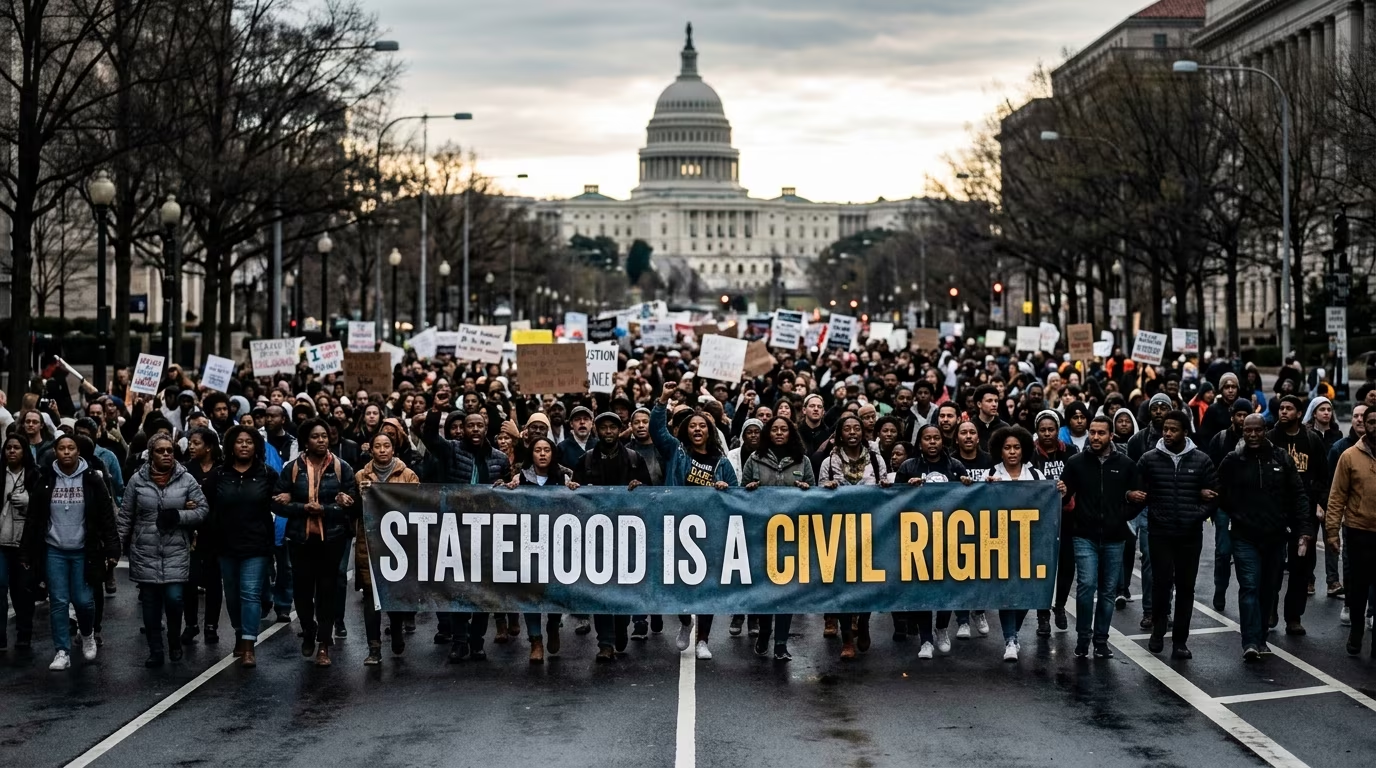
The Democratic Deficit at the Heart of America
The United States of America was fundamentally built upon a revolutionary grievance: that taxation without representation is an intolerable offense to liberty. Centuries after the Founding Fathers fought a war to establish a government based on the consent of the governed, a glaring paradox remains at the very center of the nation’s political life. Over 700,000 American citizens residing in Washington, D.C., fulfill all the obligations of citizenship yet are systematically denied a voting voice in the federal legislature that governs them. They pay federal income taxes, serve on juries, and fight in the armed forces, yet they have no representation in the United States Senate and only a non-voting delegate in the House of Representatives.
This democratic deficit is not merely a geographic anomaly or a constitutional quirk; it is a profound crisis of civil rights. The population of the District of Columbia is larger than that of several states, including Wyoming and Vermont. Furthermore, District residents historically pay more per capita in federal income taxes than the residents of any state in the union. Despite these contributions, the systemic denial of equal voting rights represents a continuing legacy of disenfranchisement. Modern civil rights advocates and legal scholars increasingly emphasize that the push to grant statehood to Washington, D.C., cannot be separated from the broader struggle for racial justice in America.
The Historical Roots of Disenfranchisement
To understand the modern debate over D.C. statehood, one must examine the historical origins of the District’s unique status. The United States Constitution, under Article I, Section 8, Clause 17, established a federal district to serve as the seat of the national government. The intention was to ensure that the federal government would not be beholden to any single state for its security or operations. Initially, citizens living in the territory ceded by Maryland and Virginia continued to vote in those states. However, the passage of the Organic Act of 1801 placed the District under the exclusive jurisdiction of Congress, abruptly stripping residents of their voting representation.
Following the Civil War, there was a brief period of progressive change. During Reconstruction, Black men in Washington, D.C., were granted the right to vote in local elections, and the city experienced a surge in biracial political participation. Black citizens began securing seats on the local city council and playing a vital role in municipal governance. However, this progress was perceived as a threat by conservative lawmakers of the era. In the 1870s, Congress swiftly moved to dismantle the locally elected territorial government. It was replaced with a presidentially appointed board of commissioners. This maneuver effectively silenced the political voice of the city’s rapidly growing Black population, locking the District into a state of political subordination that would last for a century.
A Deeply Intertwined Racial Justice Crisis
The historical timeline reveals that the disenfranchisement of the District is inextricably linked to race. For generations, Washington, D.C., has been celebrated as a center of Black culture, intellectualism, and political activism, earning the moniker “Chocolate City.” It was the first major American city to feature a majority-Black population, and today, Black residents still constitute nearly half of the city’s demographic makeup. When evaluating the impact of the District’s lack of statehood, the racial dimensions become impossible to ignore.
The structure of the United States Senate inherently favors states with smaller, predominantly white, and rural populations. By denying statehood to a densely populated, highly diverse jurisdiction like Washington, D.C., the federal government perpetuates a system that severely dilutes the voting power of Black Americans on a national scale. If admitted to the Union, the District would be the only state with a plurality Black population. Therefore, voting rights organizations and civil liberties advocates argue that D.C. statehood is not just a partisan objective, but one of the most pressing civil rights issues of the 21st century. Refusing to grant these citizens a voice in the Senate effectively silences a massive constituency of minority voters, preserving a demographic imbalance in the upper chamber of Congress.
The Burden of Congressional Interference
Beyond the lack of federal representation, the absence of statehood strips D.C. residents of fundamental local autonomy. The District of Columbia Home Rule Act of 1973 was a hard-fought compromise that allowed citizens to elect their own mayor and city council. However, this legislation did not grant true sovereignty. Under the Home Rule Act, the United States Congress retains the ultimate authority over the District. All locally passed legislation is subject to a congressional review period, during which federal lawmakers can step in and veto the will of D.C. voters.
This dynamic creates a form of colonial oversight that has tangible, often detrimental, effects on the daily lives of residents. Federal lawmakers who are entirely unaccountable to the people of Washington, D.C., frequently use the city’s budget and local laws as pawns in national political disputes. The practical consequences of this interference are vast and troubling:
- Criminal Justice System: Congress has historically intervened to block or alter local criminal justice reforms enacted by the D.C. Council, undermining the community’s ability to govern its own public safety protocols.
- Public Health Restrictions: Federal riders have routinely been attached to D.C.’s budget to restrict how local tax dollars can be spent on critical public health initiatives, such as reproductive healthcare access and harm reduction programs.
- Judicial Appointments: Unlike states where local judges are appointed or elected locally, D.C.’s local judges are appointed by the President of the United States and confirmed by the Senate, further removing the justice system from the community’s control.
This structural paternalism dictates that the people of the District are treated as second-class citizens, incapable of the same self-governance afforded to residents of the fifty states.
The Legislative Pathway: The Washington, D.C. Admission Act
To rectify this centuries-old injustice, advocates have rallied behind comprehensive legislation known as the Washington, D.C. Admission Act, commonly designated as H.R. 51 in the House of Representatives. This bill offers a practical and constitutionally sound pathway to statehood. It addresses the requirements of the Constitution by shrinking the federal district to a two-square-mile enclave that encompasses the White House, the U.S. Capitol, the Supreme Court, and the principal federal monuments. This preserves the Founders’ vision of an independent seat of government.
The remainder of the territory, comprising the residential and commercial neighborhoods where the citizens actually live, would be admitted to the Union as the 51st state, appropriately named the State of Washington, Douglass Commonwealth. This name pays homage to both the first U.S. president and the iconic abolitionist Frederick Douglass, a long-time resident of the city. The passage of H.R. 51 would finally grant these residents two voting Senators and proportional representation in the House of Representatives, instantly transforming the civil rights landscape of the nation.
Overcoming the Partisan Divide and Constitutional Counterarguments
Despite the moral and democratic imperatives driving the statehood movement, the effort faces intense partisan resistance. Opponents frequently deploy constitutional arguments to block statehood, suggesting that the District Clause of the Constitution or the 23rd Amendment (which granted D.C. electoral votes for president) makes statehood impossible without a constitutional amendment. However, prominent legal scholars and constitutional experts have thoroughly debunked these claims. The Constitution grants Congress the broad and explicit power to admit new states into the Union through simple legislative majorities, a process that has been utilized to admit 37 of the current 50 states.
Beneath the surface of constitutional debates lies the reality of raw partisan politics. Because Washington, D.C., is a heavily urban and diverse jurisdiction that predominantly votes for progressive candidates, admitting it as a state would likely result in the election of two Democratic senators. Consequently, political actors who fear losing their proportional advantage in the Senate have vehemently opposed the measure. Civil rights advocates counter that constitutional rights and equal citizenship should never be subjected to a political litmus test. Denying full enfranchisement to a demographic group simply because of how they might vote is antithetical to the principles of a functioning democracy and closely mirrors the voter suppression tactics of the Jim Crow era.
Conclusion: A Test of American Democracy
The continuing disenfranchisement of Washington, D.C. is an enduring stain on the fabric of American democracy. It is a situation where historical inertia, partisan maneuvering, and racial disparities have combined to deny over 700,000 citizens their fundamental right to self-determination and equal representation. Recognizing D.C. statehood as a vital racial justice issue shifts the conversation from a localized bureaucratic grievance to a national moral imperative. Until the residents of the Douglass Commonwealth are granted full and equal status within the Union, the United States cannot truly claim to be a nation where every citizen’s voice is heard and valued equally. The battle for H.R. 51 is not merely about adjusting the stars on the flag; it is about fulfilling the unkept promises of the American civil rights movement.
Frequently Asked Questions (FAQ)
Do residents of Washington, D.C. pay federal taxes?
Yes. Residents of the District of Columbia pay all federal taxes, including income, payroll, and corporate taxes. In fact, D.C. residents pay more per capita in federal taxes than the residents of any of the 50 states, underscoring the severity of their “taxation without representation” status.
Does Washington, D.C. have any representation in Congress?
D.C. residents elect one non-voting delegate to the U.S. House of Representatives. This delegate can draft legislation, sit on committees, and speak on the House floor, but is strictly prohibited from voting on the final passage of any legislation. The District has zero representation in the United States Senate.
Would making D.C. a state require a Constitutional Amendment?
No. Legal scholars overwhelmingly agree that Congress has the authority to admit new states through standard legislation, as it has done 37 times in the past. H.R. 51 fulfills constitutional obligations by preserving a smaller, exclusive federal district for core government operations while converting the residential areas into a new state.
Why can’t D.C. residents simply vote in Maryland or Virginia?
The concept of returning the residential portions of D.C. to Maryland (retrocession) ignores the distinct cultural, economic, and political identity the District has developed over two centuries. Furthermore, neither the residents of Washington, D.C., nor the state government of Maryland widely support retrocession. Residents of the District are advocating for their own statehood, autonomy, and equal footing within the Union.
References
- DISTRICT OF COLUMBIA: 2020 Census — U.S. Census Bureau. 2021-08-25. https://www.census.gov/library/stories/state-by-state/district-of-columbia-population-change-between-census-decade.html
- D.C. Home Rule — Council of the District of Columbia. 2023-12-22. https://dccouncil.gov/dc-home-rule/
- H. RES. 333 / H.R. 51 – Washington, D.C. Admission Act — U.S. Government Publishing Office (GovInfo). 2025-04-14. https://www.govinfo.gov/
- Federalism and Equal Citizenship: The Constitutional Case for D.C. Statehood — Georgetown Law. 2021. https://www.law.georgetown.edu/