
The Danger of Weaponizing Impeachment Over Policy Disputes
Exploring the constitutional risks of using impeachment for ideological clashes.
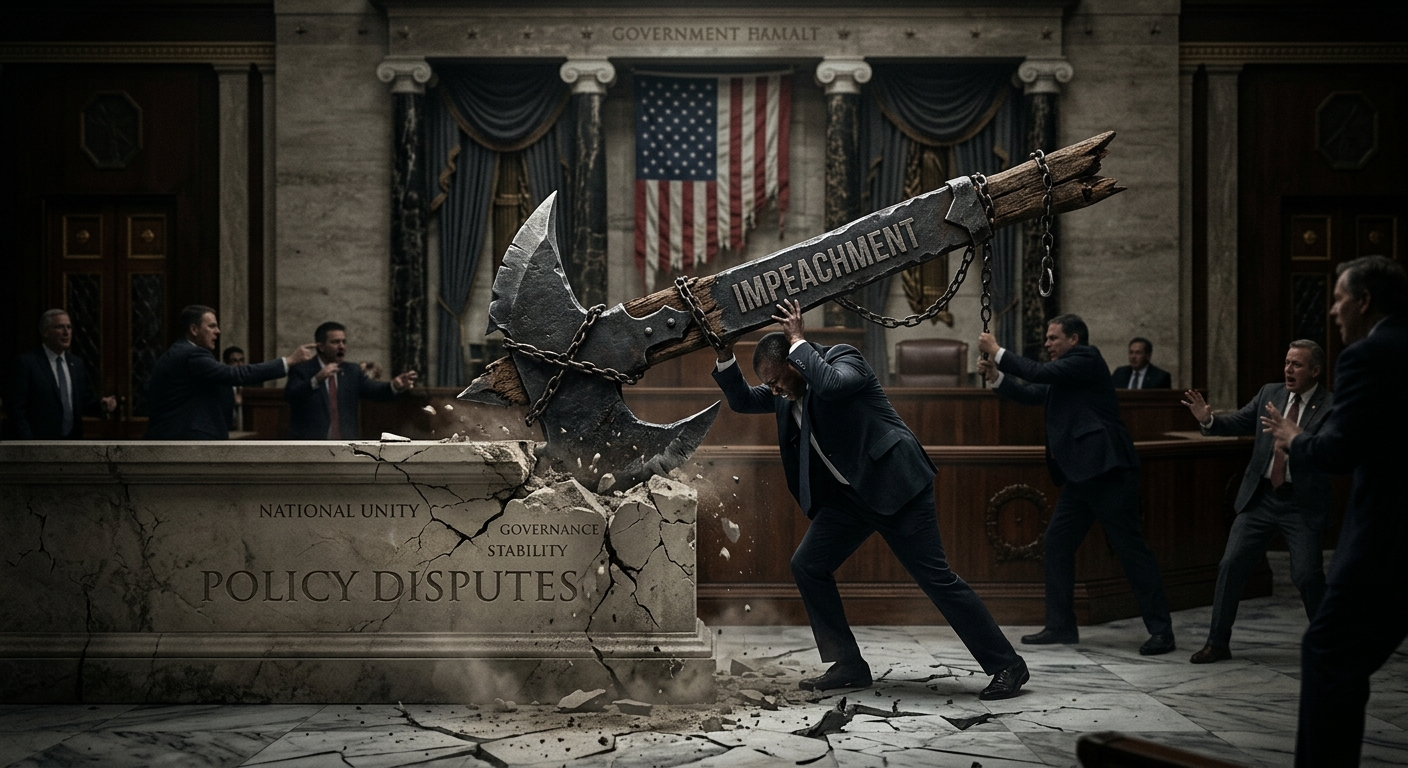
The constitutional framework of the United States was meticulously engineered to balance power among three distinct and co-equal branches of government. At the heart of this intricate system lies a series of checks and balances, designed to prevent any single branch from accumulating tyrannical authority. Among these checks, the power of impeachment stands as the ultimate constitutional fail-safe. It is the proverbial “break glass in case of emergency” mechanism, entrusted to the legislative branch to remove executive or judicial officers who pose an existential threat to the republic through profound misconduct.
However, in an era defined by hyper-partisanship and deep ideological polarization, this solemn mechanism is increasingly at risk of being degraded into a routine political weapon. When lawmakers attempt to wield the threat of impeachment not to address severe corruption or abuses of power, but merely to punish an executive official for executing policies with which they disagree, they cross a dangerous constitutional threshold. Using the impeachment clause to settle policy disputes undermines the electoral process, destabilizes the separation of powers, and subverts the foundational intent of the Constitution.
Understanding the gravity of this trend requires an examination of historical precedents, the explicit intentions of the Framers, and the crucial distinction between criminal malfeasance and political maladministration. Only by rigorously defending these constitutional boundaries can the integrity of American democratic institutions be preserved against retaliatory partisan warfare.
The Framers’ Intent: Drafting the Impeachment Clause
To grasp the intended scope of impeachment, one must look to the debates of the Constitutional Convention in 1787. The Framers were intensely focused on creating an executive branch that was strong enough to govern but accountable enough to prevent autocracy. As they drafted the impeachment clause, a critical debate unfolded regarding the specific grounds that would justify removing a sitting official from office .
Initially, George Mason suggested that “maladministration” should be included alongside treason and bribery as an impeachable offense. He argued that officials who were simply incompetent or enacted destructive policies should be subject to removal. However, James Madison vehemently objected to this proposal. Madison warned that allowing impeachment for mere “maladministration” would effectively destroy the separation of powers, rendering the executive branch subservient to the whims of the legislative majority. In Madison’s view, an official should not serve at the pleasure of the Senate .
Recognizing the danger of Madison’s warning, the Framers struck a deliberate compromise. They rejected “maladministration” and instead settled on the phrase “Treason, Bribery, or other high Crimes and Misdemeanors.” This language was intentionally chosen to raise the bar for removal, ensuring that impeachment would only be triggered by profound abuses of public trust, severe corruption, or acts that subverted the constitutional order itself, rather than mere policy failures or unpopular administrative decisions.
The Historical Precedent of Cabinet Removals
Throughout American history, the impeachment of executive branch officials—particularly at the cabinet level—has been exceedingly rare, reflecting the high constitutional bar set by the Framers. By examining the historical record, it becomes evident that Congress has traditionally understood impeachment as a tool reserved for literal corruption rather than ideological clashes.
The historical benchmark for cabinet impeachment occurred in 1876 when the House of Representatives impeached Secretary of War William Belknap. Belknap was not impeached because Congress disagreed with his military strategies or administrative policies. Rather, he was impeached for accepting illicit kickbacks in exchange for appointing an individual to a lucrative trading post at Fort Sill . This was a clear-cut case of bribery and self-dealing—a direct betrayal of public trust that neatly fit the definition of “high Crimes and Misdemeanors.”
The Belknap precedent solidifies the historical understanding that an impeachable offense must involve a fundamental abuse of power or corrupt intent. Attempting to apply this ultimate constitutional sanction to modern cabinet secretaries simply because a legislative majority vehemently opposes the administration’s policy execution represents a radical and ahistorical departure from centuries of congressional restraint.
Distinguishing Maladministration from Malfeasance
The core of the current debate surrounding the weaponization of impeachment lies in the failure—often intentional—to distinguish between maladministration and malfeasance. Conflating these two concepts poses a severe threat to the stability of executive governance.
Maladministration refers to poor management, inefficiency, incompetence, or the execution of policies that a segment of the population or legislature finds disastrous or objectionable. While maladministration can have severe consequences for the nation, the Constitution provides remedies for it through the electoral process, congressional oversight, and the power of the purse. Malfeasance, on the other hand, involves intentional, unlawful actions, corruption, or a deliberate subversion of the Constitution.
| Characteristic | Maladministration (Policy Disputes) | Malfeasance (High Crimes) |
|---|---|---|
| Definition | Inefficiency, unpopular policy decisions, or ideological differences in executing the law. | Intentional corruption, bribery, treason, or subversion of the constitutional framework. |
| Constitutional Status | Not an impeachable offense; explicitly rejected by the Framers. | Explicitly defined as grounds for impeachment and removal. |
| Appropriate Remedy | Elections, legislation, funding restrictions, public pressure. | Congressional investigation, articles of impeachment, Senate trial. |
| Historical Example | Disagreements over resource allocation or enforcement priorities. | William Belknap accepting financial kickbacks for appointments (1876). |
When lawmakers threaten to impeach an official because they believe a department is poorly managed or is executing laws in a manner contrary to the legislature’s preference, they are attempting to criminalize maladministration. This blur of constitutional lines dangerously lowers the threshold for removal, transforming a mechanism of accountability into a weapon of political intimidation.
The Modern Test: Ideological Clashes Over Executive Action
Contemporary political battles vividly illustrate the dangers of this constitutional mission creep. Modern executive departments, tasked with navigating complex, legally ambiguous, and highly polarized policy areas, frequently face intense scrutiny and fierce opposition. When a cabinet official exercises the prosecutorial discretion or resource allocation strategies inherent in their role, they often infuriate the opposing political faction.
However, ideological disagreements regarding how laws should be enforced or how resources should be distributed are fundamental components of the political process; they are not crimes. Executive officials operate under the directives of the President, who was elected to implement a specific policy agenda. If the legislative branch can impeach a cabinet secretary simply for carrying out the President’s lawful policy objectives—even if those objectives are deeply unpopular with the opposing party—it effectively nullifies the results of the presidential election.
Using the impeachment process to litigate these policy disputes degrades the solemnity of the procedure. It forces the legislature to spend countless hours on partisan theater rather than genuine oversight or productive legislating, ultimately misleading the public about the true nature and purpose of constitutional checks and balances.
The Danger of Normalizing Retaliatory Impeachments
The long-term institutional ramifications of abusing the impeachment power cannot be overstated. Normalizing the use of impeachment for policy disputes threatens to initiate an endless cycle of retaliatory political warfare. If one political party successfully lowers the bar to impeach an official over ideological differences, the opposing party will inevitably utilize the exact same precedent the moment they regain a legislative majority.
This cyclical weaponization erodes the separation of powers. As James Madison warned, it creates an environment where executive officials become subservient to the legislature, terrified to execute the President’s agenda out of fear of personal and professional destruction. Such a chilling effect paralyzes the executive branch, discouraging qualified individuals from seeking public service and ensuring that departments are governed by fear of congressional retaliation rather than lawful administrative strategy.
Furthermore, treating impeachment as a standard tool of political opposition cheapens its value when actual crises arise. If the public becomes accustomed to viewing impeachment merely as a partisan messaging tactic, they will be less likely to recognize or care when a genuine, severe abuse of constitutional power requires extraordinary legislative intervention.
Preserving the Balance: Alternatives to Impeachment
The argument against using impeachment for policy disputes does not imply that Congress is powerless to check the executive branch. On the contrary, the Constitution equips the legislative branch with a robust arsenal of tools designed precisely for resolving ideological clashes and correcting maladministration without resorting to the nuclear option of impeachment.
- The Power of the Purse: Congress possesses the absolute authority to fund or defund government programs. If lawmakers believe a department is mismanaging its duties, they can restrict funding, attach policy riders to appropriations bills, or explicitly defund specific executive initiatives.
- Legislative Action: If Congress disagrees with how an executive agency is interpreting a law, lawmakers can draft new, highly specific legislation that removes ambiguity and legally binds the agency to a different course of action.
- Vigorous Oversight: Committees hold the power to issue subpoenas, demand documents, and compel public testimony. High-profile hearings force transparency and allow Congress to hold officials accountable in the court of public opinion.
- Judicial Review: Disputes over the legality of executive actions can be—and frequently are—litigated in the federal courts. States, organizations, and individuals can sue the federal government to halt policies they believe exceed statutory authority.
These mechanisms respect the separation of powers while providing legitimate, effective avenues for challenging and changing executive branch behavior. Relying on these tools preserves the integrity of the republic, whereas defaulting to impeachment subverts it.
Conclusion: Safeguarding Democratic Institutions
Impeachment is the ultimate constitutional safeguard, a mechanism entrusted to the legislature to protect the republic from officials who fundamentally betray the public trust through high crimes and misdemeanors. It was explicitly designed by the Framers to be difficult to execute and reserved only for the most egregious offenses. Weaponizing this power to resolve policy disputes or punish political opponents represents a dangerous distortion of constitutional intent.
To protect the separation of powers and maintain the stability of the executive branch, lawmakers must resist the temptation to conflate maladministration with malfeasance. By relying on elections, robust legislation, the power of the purse, and judicial review, Congress can vigorously debate and shape policy without undermining the foundational pillars of American democracy. Preserving the integrity of impeachment is not merely a matter of historical pedantry; it is essential to ensuring that the republic can survive the intense partisan passions of the modern era.
Frequently Asked Questions
What does “high Crimes and Misdemeanors” actually mean?
While the Constitution does not provide an exhaustive list of offenses, historical context and the Framers’ debates indicate that “high Crimes and Misdemeanors” refers to severe abuses of power, significant corruption (like bribery or treason), and actions that fundamentally subvert the constitutional order. It does not include incompetence, unpopular decisions, or policy disagreements.
Why did the Framers reject “maladministration” as an impeachable offense?
James Madison successfully argued against including “maladministration” because he believed it would make the executive branch entirely dependent on the legislative branch. If an official could be removed simply for poor management or unpopular policies, it would destroy the constitutional separation of powers.
Has a U.S. Cabinet Secretary ever been impeached?
Yes, but it is extremely rare. The most notable historical precedent is Secretary of War William Belknap in 1876. Crucially, Belknap was not impeached over a policy dispute; he was impeached for criminal corruption, specifically accepting financial kickbacks in exchange for official appointments.
If Congress cannot impeach over policy, how can it stop executive actions it dislikes?
Congress has multiple robust tools to counter executive branch policies, primarily the “power of the purse” (defunding specific initiatives), drafting stricter legislation to eliminate executive loopholes, utilizing committee oversight and subpoenas to enforce transparency, and relying on the judicial system to strike down unlawful executive overreach.
References
- Impeachment and the Constitution — Congressional Research Service. 2024. https://crsreports.congress.gov/product/pdf/R/R46013
- The Evidentiary Record Pursuant to S. Res. 16 – Background and History of Impeachment — U.S. Government Publishing Office. 1998. https://www.govinfo.gov/app/details/GPO-CDOC-106sdoc3
- Chapter 27 Impeachment — U.S. Government Publishing Office (GovInfo). https://www.govinfo.gov/content/pkg/GPO-HPRACTICE-112/html/GPO-HPRACTICE-112-28.htm
Similar Articles








Read full bio of medha deb


